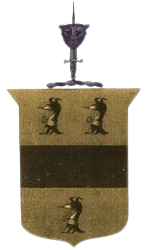
** All Text on these chapter pages has been copied verbatim – with permission – from this book: “Shurtleff Family Genealogy & History – Second Edition 2005” by William Roy Shurtleff & his dad, Lawton Lothrop Shurtleff ** Text in pdf convert to word doc – any spelling errors from the book may or may not have been fixed. **
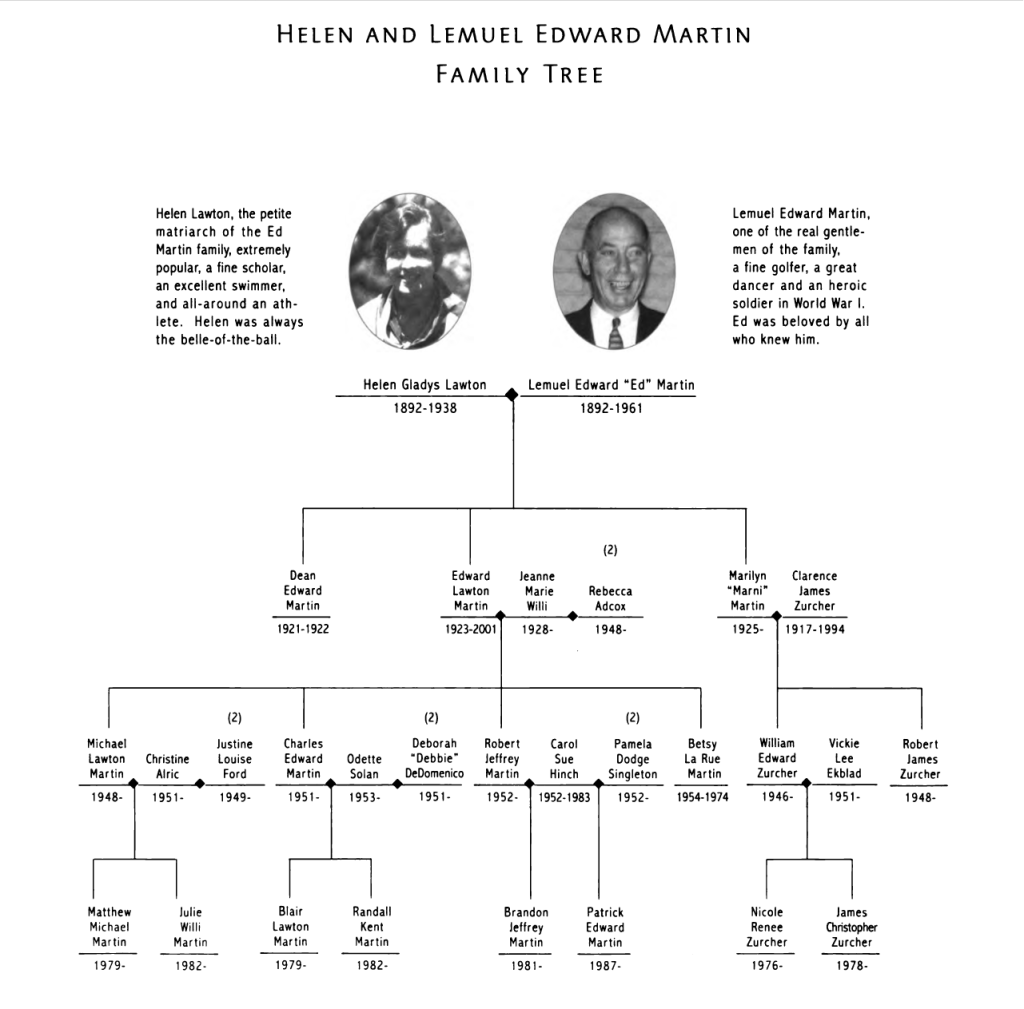
Helen Gladys Martin was born on 25 September 1892, in Berkeley, California, the fifth child (the fourth to survive) of Frank and Fannie Lawton. She had one older brother (Harry) and two older sisters (Winnie and Hazle). She and Hazle shared the same birthday (September 25), though Hazle had been born two years earlier. Like her brothers and sisters, Helen went to grammar school at the Dwight Way School in Berkeley.

Helen’s Diary and Berkeley High School. In February 1909, at age 16, Helen began to keep a diary. She wrote in pencil, starting on page 296 of a large (8-by-13-inch) leather-bound ledger called the CASH-BOOK, which her mother, Fannie, had used as a combination scrapbook and journal since the mid-1870s. The diary, which continues on page 184 and is 66 pages long, ended on 2 June 1911, when she was 18. Thus it covers a period of two years and four months, during which time Helen was living with her family and attending Berkeley High School.
This diary is a rich source of information about the early days of the Lawton family and their friends, and about the life of young people in Berkeley in those days. Perhaps the most conspicuous feature of the diary is the sheer number of people who are mentioned. Helen had a remarkably large number of friends. Her life revolved around people, and she clearly enjoyed being with them. As her brother, Don Lawton, later noted: “Helen was unusually popular. Everybody loved her. She had more friends than anyone I knew.”
A second characteristic of the diary is that it described only what Helen did, never what she thought.
When Helen was at Berkeley High School, men’s fraternities and women’s sororities were very popular. Students were invited to join during their first year of high school. Helen was a member of the Alpha Sigma sorority, as were many of her closest friends. In fact, throughout the pages of Helen’s diary there are many Greek letters, often in parentheses after the name of a person mentioned. The Alpha Sigs (as they were called) were an active group. They met frequently off campus in the members’ homes, had regular Sewing Club meetings (which Helen attended), put on social events (dances, tug rides on the Bay, and showers for lady friends), pledged new members and initiated them, held conventions with chapters from other California high schools, and produced pennants and pins to give to members and friends. Staying over night at the homes of various girl friends was very popular.
Of the many young women whose names appear in Helen’s diary, the following were her closest friends, as judged by the number of times they were mentioned. They are listed here in order of frequency of mention, so that her closest friends are listed first. Those whose names are followed by an asterisk are Alpha Sigs: Dorothy “Dot” Hundley* (mentioned twice as many times as any other person; her sister was Harriet Hundley), Lucille Stitt*, Grace Partridge, Lorene Wilcox*, Elizabeth Witter, Louise Burch, Gladys Partridge, Florence Woolsey*, Matie Waterbury*, Hertha Todd, and Phoebe Bunker.
Other close friends who were Alpha Sigs included Margaret Witter, Elizabeth Stitt, Beryl Burch, Helen Burnett, Ruth Hamblin, Helen Haven, Margurite Hendy, Beth Johnson, Lucy Pray, Ruth Smith, Constance Van Brundt, and Amy and Bessie Walden.
In about 1910 all fraternities and sororities at Berkeley High School were abolished by the principal, Mr. Biedenbach. He felt that the system was unfair to and unduly hard on students who were not invited to join, and thus were left out of a major portion of the school’s social life. So he required the fraternities and sororities to change their names, to stop using Greek letters, and to become social clubs. Helen’s Alpha Sigma became the Ivy Club in April 1911. Each club was required to have a faculty member as an observer at all meetings, which led to less privacy. But the system of membership by invitation was allowed to continue, so that no fundamental change took place. It was only a change of name, and even the old names tended to persist in everyday speech—and in Helen’s diary.
In addition to her many women friends, Helen also had many young men who were her friends. But her favorite during these years was Guy Witter, a serious but widely liked member of the Theta Chi fraternity (later Eunoia Club) at Berkeley High. The Lawton family and the Witter family had long been extremely close. Guy first appeared in the diary on Sunday, 13 March 1910, when he walked Helen home from the Witter house, where she had gone to see the baby. His only apparent rivals were Bob Sinclair and Bradley Crow, who had his own “machine,” i.e., automobile.
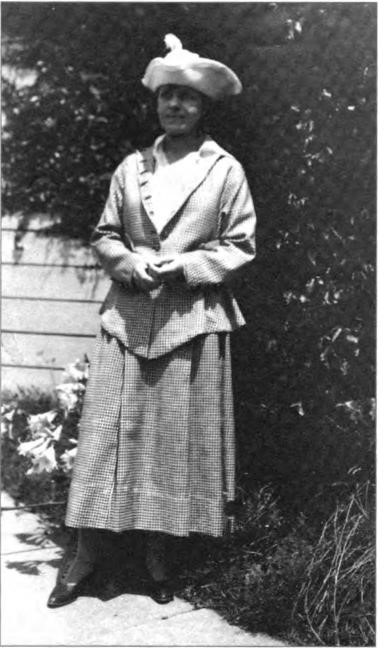
What sort of things did high school sweethearts aged 16-18 do in those days? Helen and Guy went to many dances and evening parties (sponsored by Guy’s fraternity / club or Berkeley High or various families in Berkeley), went on three tug rides on the Bay, spent the summer together in Monte Rio and rode back (at least part way) on the train, went to the Lurline baths (huge San Francisco swimming pools), went canoeing on Lake Merritt, took many rides on “the electric” (the fast Key Route electric train in Berkeley that replaced the steam trains), went to the Orpheum Theater (a vaudeville and moving picture show theater in Oakland) followed by ice cream at Lenhardt’s, had dinner together frequently at the Lawton home, went to church, walked home from school and around to visit friends in the neighborhood, went on a picnic, went ice skating, attended dancing classes and an occasional play at the theater or Cal’s Greek Theater, and hiked up to Grizzly Peak. On one interesting date they “went for a ride around Lake Merritt until most of the electricity had given out.” They barely made it home. On 15 May 1911 a friend, Ducky Short, was being initiated into the Cannibal Club at Berkeley High. “He had to lie in the gutter on Dwight and Grove, so we walked down with him (Hazle, Guy and I).”
By 1909 the automobile was starting to make its impact in Berkeley. Helen’s father, Frank Lawton, had purchased his first car, a big high-wheeled Oldsmobile, in about 1904-05. But it was a company car used mostly for business and kept in a garage away from home. By 1910 some of Helen’s friends and their friends’ parents had their own cars. Howard McCreary, a close friend of the family, often took Helen and her brothers and sisters out for rides in his auto. Helen’s friends Ward Sorrick, Lorene Wilcox, and Marjorie Nickerson also each had an auto by 1910. Helen’s brother, Don, got his first auto in about 1911-12. He was the first of the Lawton children to own a car.
Also by 1909 Helen was involved with Christian Science. Between May 13 and December 31 she mentions going to church eight times; six to Sunday morning services and two to Wednesday night testimonials. About half the time she went with members of her family and half with friends. Her interest in Christian Science would grow in the years to come.
Two other strong interests of Helen’s during this period were music and clothes. She took piano lessons twice a week after school from Miss Alice Johnson, and practiced regularly. She sewed a lot, especially with the Alpha Sig Sewing Club, and often described in her diary what outfits she had worn on various occasions.
In her diary, Helen tells us almost nothing about her studies in high school, except that she studied Latin and Greek. She does, however, indicate a love of sports and outdoor activities. The entry for 1 June 1909, for example, reads:
Hazle, Harry, Winnie, Uncle Charlie, Dot, & myself were in the back yard trying to chin ourselves. Harry & Dot & Uncle C. were the only ones who could do it. Then we all boxed for a while. Then Don and Uncle Charlie and I played ball. Uncle Charlie batted it over the fence.
The diary shows very vividly the strong family ties within the Lawton family. Helen did all sorts of things with her brothers and sisters and parents. Birthdays were a time of generous gift giving, and perhaps doubly so since she and Hazle shared the same birthday. On her 17th, Helen got “3 neck lengths of rushing (1 from Winnie), a red sweater and a pair of mocha gloves (from Win), a grand big black watered hair ribbon (7 ins., from Win), a parasol with big roses, a red hair ribbon, a beauty, embroidered collar and cuffs, a rhinestone ornament set in platinum, a new comb, a box of candy from Dot Hundley, a slipper bag.” Further indication of how much Helen liked clothes and trappings.
Overall, the diary gives the impression that young people in those days spent much more time than they do today having fun, visiting one another, socializing, going to dances and parties, and much less time studying and working.
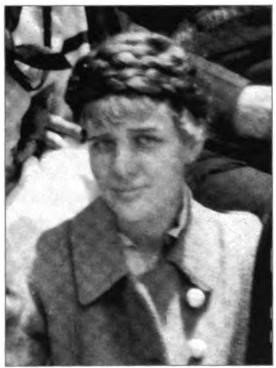
When this diary was written, Helen was a student at Berkeley High School. She graduated in June 1912. The school yearbook for that year shows that she was active in student affairs and sports. During her junior and senior years she was president of the Girls’ Rowing Club and rowed bow in the first string boat; Elizabeth Witter was stroke and Ramona Marks was coxswain. She was in the Ivy Club, and on the Judicial Board. In her junior year she was secretary of the Associated Students of Berkeley High School and on the Arrangement Committee for the Senior Ball. In her senior year, she was vice-president of the Associated Students and chairman of the Class Party Committee.
Helen’s photo in the June 1912 011a Podrida shows her to have very long hair. Her daughter Marilyn later recalled: “Aunt Win once told me that when Helen was young her hair was so long that she could comb it down and cover herself so completely that you couldn’t tell whether or not she had clothes on. It came down to her ankles and she sometimes wore it wound up on top of her head.”
Helen the Swimmer. Starting in 1906 the Lawton family began to spend each summer at Monte Rio, on the Russian River. The children all became excellent swimmers, but Helen and her older brother, Harry, are remembered as the best of all. From about 1908 on, their favorite place to swim was Sandy Beach. The water was deeper there and the sand went way up on the bank.
Swimming has come a long way since 1906. Both the swimsuits and the strokes have changed dramatically. In those days (and until the 1930s) men and boys wore swimsuits with straps over the shoulders. Women wore bloomers, basically a dress consisting of a sort of blouse with puff sleeves and pantaloons—not exactly designed for aquatic speed or grace. But the beautiful and famous American swimmer and diver, Annette Kellerman, began to change all that. Born in 1888, she parlayed her aquatic skills first into a career in the Aquacades, and then into a movie career, starring such films as The Art of Diving, Diving Displays, Neptune’s Daughter, and Queen of the Sea. Almost single-handedly Annette revolutionized women’s swimsuits styles. She wore a sleek and relatively scanty suit almost exactly like that worn by the men.
An entry in Helen’s dairy dated Monday, August 8, 1910, reads: “Saw Annette Kellerman. She is grand.” Soon Helen, now age 18, began to show her independent mind and her fine swimming stroke. As Don Lawton recalls:
Helen would swim out to the raft, a 12-foot high-dive platform that was mounted on big oil drums, swim in under it, and take off her bloomers. Underneath she had on this one-piece, tight-fitting little suit, her Annette Kellerman suit. It was very light weight, just enough to cover her. Then she’d come out and go swimming up and down the river. She was so graceful and fast without that cumbersome big heavy blouse and bloomers. She was known all over as the swimmer on the river. When she was done swimming, she’d duck back under the raft, put her bloomers back on top, and swim back over to Sandy Beach. She couldn’t come up on the beach with just her Annette Kellerman suit on. That would have been considered outrageous.
The 011a Podrida (Berkeley High School yearbook) of June 1912 called Helen “the second Annette Kellerman.”
The stroke that Helen was swimming in 1910 was the “overarm side stroke” with a scissors kick. That’s how virtually everyone in the United States and Europe swam in those days. The transition to the smooth and powerful six-beat kick of today was pioneered by the great Hawaiian sprint swimmer, Duke P. Kahanamoku. This was apparently the swimming style used by most Pacific Islanders since ancient times. He used this stroke in 1912, breathing only once every four strokes, to set a new Olympic record of 1:03.4 for the 100 meter event, chopping 2.2 seconds off C. M. Daniels’ old record. He won the Olympic event again in 1916, slicing 2.0 seconds more off his former record and becoming the first man in Olympic history to win any freestyle event at two Olympics in a row. In 1920 Kahanamoku set another new Olympic record of 1:01.4. John Weissmuller used the stroke that Kahanamoku had developed to win the 100 meter freestyle in the next two Olympic games, in 1924 and 1928, with times of 59.0 and 58.6. Note: In 1988 Matt Biondi of the United States set a new Olympic record with a time of 48.63 seconds-23.7% faster than Kahanamoku’s first Olympic record.
After his stunning victory with a new stroke in the 1912 Olympics, Kahanamoku became world famous, a legend in his time. In a chapter on the “History of Swimming,” the great Australian swimmer, Frank Beaurepaire, wrote of him in 1932:
Duke Kahanamoku is the most colorful personality who ever entered the swimming arena. Over six feet tall and a modest but thorough gentleman, he was immensely popular everywhere, for he was most playful and charming. When the moment demanded it, however, he was a stern opponent.
In the summer of 1912, shortly after his Olympic victory, Duke Kahanamoku took a vacation to Monte Rio to visit his old friend, Pop Dean. A jovial Tahitian, who weighed about 250 pounds and was friends with everyone in Monte Rio, Pop Dean had been well known as a swimmer in the Hawaiian Islands, and was now the swimming instructor and lifeguard at Sandy Beach in Monte Rio. Helen Lawton was Pop Dean’s prize pupil and Duke watched her swim her swift and graceful sidestroke up and down the river for hours. Pop Dean introduced his pupil to his Olympic champion friend, and before returning to Honolulu, Duke taught Helen his new six-beat crawl stroke. Since Kahanamoku’s method was so different from anything that Helen had ever seen before, she essentially had to learn how to swim all over again. Once she had mastered the double-overarm six-beat stroke, she taught her brothers and sisters. As Don Lawton recalls:
It was the darndest thing. Instead of the scissors kick that we were used to, Helen taught us how to swim the up and down kick, the flutter kick like they all use today. She had you lie flat on your face and swing both arms, paddling like a paddle wheel in front of you all the time. Then you’d just bring your head up occasionally to the side too get air and go right back down again, holding your breath until it was time to breath again.
Helen’s new crawl stroke, combined with her jazzy Annette Kellerman suit, was a two-punch knockout. Don Lawton remembers:
After Helen would swim past, duck back under the raft to “re-dress,” then emerge from the water up onto Sandy Beach, everyone on the beach would just stand up and applaud! No woman up there could swim like she could. She was a good sport and an outstanding athlete, especially a fine swimmer.
College at Cal and Years Before Marriage. In September 1912, Helen entered the University of California at Berkeley as a freshman in the class of 1916. That month she was 20 years old.
Her freshman year she was invited to join the Pi Beta Phi sorority, to which her older sister, Hazle, already belonged. She continued to lead an active social life. Her brother, Don, recalls: “Helen was unusually popular. Everybody loved her—all the football players and track men. She had more friends than anyone in the world, really.” She dated a number of very popular young men, primarily class presidents. These included classmate Norman Stern (who had been president of the Associated Students of Berkeley High School his senior year there, and whom she dated at both Berkeley High and Cal) and Matt Hazletine, Cal’s famous left end, who was the most outstanding football player on campus at the time, and was also president of the senior class. Helen and Matt dated for several years and he often visited the Lawton home, which was a thrill for Helen’s brothers. At one time the Lawton family thought that she and Matt were going to be married. He later became a famous doctor in Marin County. His son, Matt Jr., was also a great football player at Cal, and later with the San Francisco 49ers.
During her years at Cal, Helen was again active and again distinguished herself. She was in the Dyslyt literary honor society and Pi Beta Phi sorority throughout. She was in the Women’s Mandolin and Guitar Club (she played mandolin) her sophomore, junior, and senior years, and was its treasurer her junior year. She was on the Associated Women Students’ Finance Committee her sophomore and junior years, and on the Senior Advisory Committee her junior and senior years. Her junior year she was also on the Parthenia Executive Committee. In her senior year she especially distinguished herself as president of the Senior Women, which made her vice president of the senior class. Continuing her swimming, she was captain of the Women’s Interclass Swimming Team. She also continued her interest in Christian Science, taking a Bible study course at Cal.
Helen graduated from Cal in May 1916. As each class graduated from Cal, they participated in the events of Senior Week or Commencement Week, held in mid-May. In 1916 the week began with an extravaganza on Saturday night and the baccalaureate sermon in the Greek Theater on Sunday to 8,000 listeners. Monday, May 15 was the Senior Pilgrimage. The 800 men and women to receive undergraduate degrees and the 200 getting the higher degrees of master and doctor, divided themselves by sex. Gathering at Senior Women’s Hall on this sunny spring day, the women, in white dresses and carrying white parasols, marched in a body to Hearst Hall, where they were joined by the Cal Band and the men, dressed in white trousers and dark coats. The group then wended its way slowly across campus, bidding farewell to its favorite places, such as South Hall and the Sather campanile. At each of the 18 stopping places a short farewell speech was given. At Senior Women’s Hall, Helen Lawton, as vice president of her class, gave the first of the senior women’s adieus. The colorful and nostalgic procession came to a close under the “Senior Oak” with an address by Mat Hazletine, class president, and the singing of the university hymn, “All Hail.” A reception was then given for the class by President and Mrs. Benjamin Ide Wheeler in the president’s home. In all three Berkeley papers that covered the pageant, there was a large photograph of Helen, holding her parasol and looking lovely. Senior Week was wrapped up by the Phi Beta Kappa address, commencement exercises, and the Senior Ball at the Hotel Oakland.
It is not clear what Helen did during the year after she graduated from Cal. At some point she traveled to Wyoming to visit her elder sister, Winnie, who was married and living near Sheridan. There she met Lemuel Edward Martin, probably sometime in 1916, over a Coke at the Economy Drug Store, which Ed owned, in Sheridan. At the time Edward was a “druggist” (registered pharmacist). Helen and Ed were soon in love. By May 1917, Helen had returned to Berkeley. From there she wrote an important letter to Ed’s mother, Minnie. Postmarked 12 May 1917, Berkeley, California, and addressed to Mrs. L. E. Martin, R.D. 1, Sheridan, Wyoming, it read:
Friday
Dear Mrs. Martin,
I know you will be quite surprised when I tell you I have decided to announce my engagement next Saturday Ito Ed]. I have been just crazy to announce it and wear my ring openly. Hazle, my next older sister, said she would give me a party if I would do it now. She has planned a rather large bridge party at her home in Burlingame. I do wish you and Lona [Ed’s sister] were going to be there, for I would be very proud to have them all know you both. I’ll write and tell you all about it any way…
Since being home I have already made another dress, so now feel like a full fledged sewer. It takes just about three times as long to make one out here as it did back there. There are so many more interruptions.
Mother joins me in sending my best to you both.
Hope everything is going along fine on the ranch.
Lovingly,
Helen

In a charming love letter that Helen wrote to Ed at about the same time, she described her dear friend Etta, saying “If you knew Et, you wouldn’t be satisfied with me. She is absolutely a world beater.” She added that she had just seen her old boyfriend Norman Steam: “He is mother’s choice, pure and simple. She is always talking about him and asking of him, etc. But I know dear that she will forget him for good and all when she sees you. I am confidant of that, lover.” She closed with plans to visit him next summer.
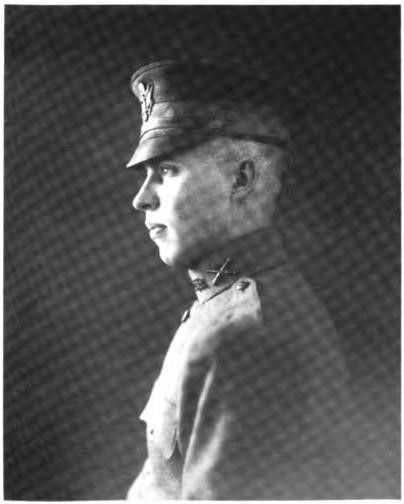
But these plans and the marriage would have to wait. A month earlier, in April 1917, the United States had declared war on Germany, and in June the first U.S. troops arrived in Europe. Edward, who liked horseback riding, signed up with the infantry (Bob and Marilyn think Wyoming First Cavalry) and by August 1917 he was a sergeant training in Cheyenne, Wyoming. That month his unit was sent to Camp Greene in Charlotte, North Carolina, and transferred from infantry to artillery. By December he was an officer (first lieutenant) in “D” Battery, 148th Field Artillery (the “big guns” that shot long distances), 41st Division, Camp Merritt, Cresskill, New Jersey. From New Jersey, the 148th Field Artillery was shipped to France, arriving at the end of January 1918 at which time he weighed 168.5 pounds. The story has come down that for some reason he had to travel across France alone. The only French word he knew was the word for “potatoes, so that’s all he ate for several days. During the war Ed was a faithful correspondent. A four-inch stack of letters that he wrote to his parents still survives. In May 1918 he was a radio officer, far from the front lines and enjoying his extensive traveling in France. But by the fall of 1918 his 148th Field Artillery was on the front lines in the thick of the battle. During one period, his group was under constant shell fire for three or four weeks. He had to sleep in his clothes and never had a chance to bathe. He had a helmet on over his overseas hat, and he did not bare his head once during this dangerous and terribly stressful period. Shortly thereafter, most of Ed’s hair fell out; his father was also bald. That same year his mother Minnie’s hair turned from beautiful dark brown to pure white, probably from worrying about her son at war.
Back in the U. S., Helen had arranged for her mother, Fannie, and Ed’s mother, Minnie, to meet. Everyone enjoyed the visit and Helen and Fannie planned to visit Minnie in Montana in early 1919.
When Ed returned home from the war in late June 1919, after a brief scarlet fever quarantine in St. Nazine, France, and after visiting his parents, he went straight to Berkeley to see his fiancee, Helen, at her family home. As she introduced her husband-to-be for the first time to everyone in her family, she noticed to her chagrin that he didn’t even have the good manners to take his hat off! Finally, alone with Helen for the first time in more than two years, he sheepishly unveiled his shining dome. Though Helen was surprised, she loved him too much to be the least bit deterred by such superficial things. But it took Ed’s mother years to get used to her son being bald.
On 27 August 1919, more than two years after the letter announcing their engagement was written, Helen and Ed were finally married. The wedding took place in Berkeley, and was conducted by A. M. Elston, “Minister of the Chapel,” Christian Science.
Before we follow Helen and Ed’s life any further, let us take a step backward and look at the very interesting family from which L. Edward Martin was descended.
L. Edward Martin and His Ancestors. The Martin family is especially fortunate in two ways.
First, they have a long and colorful history, and second they have a number of people who are interested in the genealogy and history of the family, and who have taken considerable time and effort to record it carefully. Credit goes, above all, to Lona Martin Helvey, Ed Martin’s sister, who spent 20-30 years working on the family genealogy and history. She recorded stories from old-timers who were still alive and organized the letters and other documents left by ancestors, especially Lemuel Emery Martin (18541926, Ed’s father) and Robert Allen Martin (182495, Ed’s paternal grandfather). She also encouraged others (such as Minnie Martin) to write their life stories, though not much came of this.
John Martin and Rebekah McMurrie, The Martin family can trace its ancestry back to John Martin, who was born in Ireland in 1760. There he married Rebekah McMurrie Crawford. She had previously been married to a Mr. Crawford and had a daughter, Margaret, by him. John and Rebekah had one child, William, in Ireland, and then they moved to Northumberland Co., Pennsylvania. There they had four more children: Alexander, Sarah, Thomas, and John, Jr.. John, the father, fought in the Revolutionary War, first as a private in Captain James Murray’s company, then as a lieutenant under Captain James McMahan. He died in 1810 in Platt Township, Lycoming Co., Pennsylvania. Many of his descendants stayed in this county in following generations.
Thomas Martin and Elizabeth Allen, Thomas Martin was born in 1793 in Northumberland Co., Pennsylvania. In September 1820 he married Elizabeth Allen, who was born in 1803 in Pennsylvania. They had six children between about 1820 and 1846, all born in Lycoming County: Margaret Crawford, Robert Allen, Rebecca, John, Sarah, and Percelia Ann. Elizabeth, the mother, died on 7 March 1864 in Lycoming Co., and was buried in Jersey Shore, Pennsylvania. Thomas, the father, died on 31 March 1875 in Lycoming Co., and was also buried in Jersey Shore.
Robert Allen Martin and Catherine Emery. These were L. Edward Martin’s grandparents. Robert Allen Martin was born on 12 March 1824 in Lycoming Co., Pennsylvania. On 11 December 1845 he married Catherine Emery. Born on 22 July 1822 in Linden, Lycoming Co., she was the daughter of Henry Emery and Sarah Horn. This couple had eight children between 1846 and 1864, all born at Larry’s Creek, Lycoming Co.: Sarah Elizabeth, Margaret Elm, a daughter (name unknown) who died in infancy, Lemuel Emery, Thomas Nelson, James Curns, Henry McClellan, and Robert Allen Jr. Lona Martin Helvey remembered Thomas, the father, as a “tall, slender, very kindly man with hosts of friends. He was known as Uncle Rob to many in the community.” Thomas died at Larry’s Creek on 19 April 1895 and was buried at Jersey Shore, Pennsylvania. His wife, Catherine, died on 20 May 1902 in Jersey Shore and was buried there three days later.
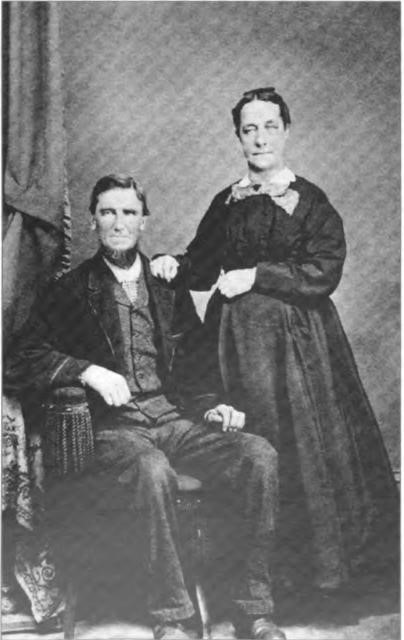
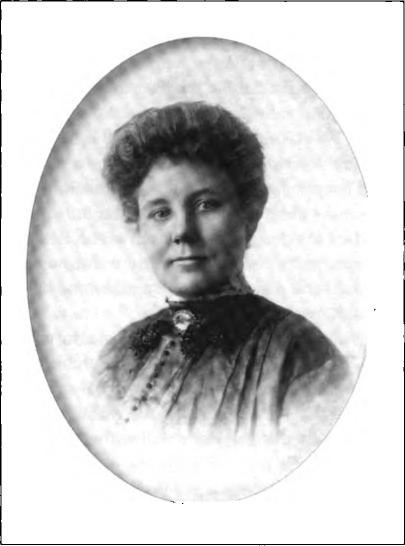
Lemuel Emery Martin and Minnetta Hester “Minnie” Jackson. These were L. Edward Martin’s parents. Mr. Martin was born on 17 June 1854 at Larry’s Creek, Lycoming Co., Pennsylvania, and christened (on an unknown date) at Jersey Shore, Pennsylvania. His church affiliation was Methodist.
Minnie and her children had often thought that they might be direct descendants of Andrew Jackson. Ed Martin, Helen’s son, recalls her telling him that she thought he was related to two generals, Andrew Jackson (1767-1845) and Robert E. Lee (1807-1870), who had fought on opposite sides in the Civil War. In fact, they never fought against each other. Jackson died almost 20 years before the Civil War. Lona Martin Helvey spent many years of genealogical research trying to trace her ancestry back to Andrew Jackson but was never able to.
Minnetta Hester “Minnie” Jackson was born on 11 January 1871 at Hawleyville, Page Co., Iowa, the daughter of William Edward Jackson and Amanda Davis. W. E. Jackson was born on 7 March 1843 in Shelby Co., Indiana, the son of William Joseph Jackson (1818-90) and Hester Copeland (1816-84). He married Amanda Davis on 15 September 1867 in Hawleyville, Iowa, at Amanda’s father’s home. He was 23 years old and she was 16. Amanda was born on 12 December 1850 in Hopkins, Nodaway Co., Missouri, the daughter of Matthew Lenord Davis (1814-87) and Mary “Polly” Wilfley (1815-1907). Amanda and her parents moved to near Clarinda, Page Co., Iowa in about 1852 and she received her common school education at Hawleyville. He had previously been in the fourth Iowa Cavalry and the Sears Rangers (1861-65). Their first child, Charles Francis “Frank” Jackson, born on 17 June 1869 in Hawleyville.
At the time of Minnetta’s birth in early 1871, her father, William Jackson, a pharmacist, owned a drugstore in Hebron, Iowa, in partnership with his brother, Dr. D. W. Jackson, a physician. William Jackson, a pioneer at heart, was not content to stay put in a drugstore. In the fall of 1871 the family moved to Lincoln Co., Kansas. There, on 12 April 1874, William and Amanda had their third and last child, Edna Mary Jackson, born in Lincoln Center. In 1878 the family moved back to Iowa, living at Hawleyville and Hepburn (Hebron). In 1880 William sold his drug store, bought two covered wagons pulled by four mules each, loaded everything he could into the wagons, and headed West in early May. Frank was 11, Minnie was 9, and Edna was 5 years old.
After crossing the Missouri River on flatboats, pulled across by hand pulleys and a cable, they fell in with immigrants headed for the Gallatin Valley of Montana. All went well on the long journey until they reached the Platte River in southern Nebraska. It was swollen and full of quicksand. The scary crossing was accomplished safely, though it took two days afterward for all the bedding to dry out. When they reached Cheyenne, Wyoming, Amanda Davis became ill. So they rented a house there and Mrs. Bradley, a friend made en route, stayed to care for Amanda.
Amanda’s brother, Will Davis (often called “Bear Davis” because he had killed a bear), had come to Wyoming and in 1879 and settled on Little Goose Creek in the Little Goose Canyon, near Big Horn, Sheridan County, at the eastern foot of the Bighorn Mountains in north central Wyoming. There were quite a few other settlers in the frontier community. When William Jackson, his wife Amanda, and their three children arrived there from Cheyenne, they fell in love with the place. Their long journey had come to its end. William Jackson laid the foundation for a cabin on Trabing Creek (on what later became the Goelet Gallatin Ranch), thus laying claim to 160 acres of land. He planted some wheat then went back to Cheyenne, the nearest trading post, and brought the women hack to the new home on 8 June 1880. Living in tents, they cut logs and tried to build a cabin on the foundation.
But in September the worst snowstorm in recorded history stopped all progress. They were desperate at the prospect of facing a severe winter in only a tent. Fortunately, the rounders Frank and Jesse James were just leaving their cabin, which was on Jackson Creek, so the Jackson family was able to move into the 14 by 16 foot dirt floor room. There they spent their first winter comfortably thanks to the famous outlaws. Fish and game (even a bear) provided abundant food. Trappers, prospectors, and cowboys came from miles around for the women’s cooking and to have their ailments treated and teeth fixed or pulled by a doctor. Mr. Jackson had brought a good supply of medicine and was soon skilled in the use of native herbs.
The next spring, 1881, the Jacksons gave up their foundation on Trabing Creek and decided to build a new house on Jackson Creek, in the same valley. They hauled logs out of the mountains, cut them into boards using a sawmill rigged from equipment secured from Old Fort McKinney, and built a two-room home with a board floor and roof, and a front and back door. Minnie later said she thought it was the first house with a board floor in the area. In 1987 this cabin was still standing, though it had become the back porch of a larger house. Minnie Martin’s grandson, R. E. “Bobbie” Helvey, and his family lived there.
In 1881 a cabin was built on the Jackson’s first dirt-floor foundation and used as a school. There Minnie Jackson began her education. The first school in Sheridan or Johnson counties, it was dark inside and the children sat on hewn log benches; in the winter, the only window was covered with oiled deerskin and the only light and heat came from a fireplace.
That fall, when Mr. Jackson was returning from Cheyenne with winter supplies, his wagons were suddenly surrounded at Brown Springs by a swarm of Sioux Indians, who were on the war path with the Paegans for stealing their horses. The Sioux stole most of the Jackson’s food (except for a little flour) as well as Minnie’s father’s and brother’s watches. In the unforgettable evening that followed, the Jackson family saw a big medicine dance around the bonfire. Mr. Jackson, a drummer in the Civil War, persuaded the Indians to let him play their tom-tom, and he did so well they kept him playing for hours. Then after midnight he and Sitting Bull (1831-90) smoked a peace pipe. The Jacksons felt extremely lucky to escape with their scalps. They were even allowed to buy back their mules, but no food. A hard winter followed, made softer only by the generosity of their friend, the great scout Frank Grouard, who had lived for many years with the Sioux Indians, including six years in Sitting Bull’s own lodge. Frank was a scout for the U.S. Army, stationed at Fort MacKenzie.
Just to the south of Sheridan County (formed in 1888) lay Johnson County (1875). The Jackson family was in Buffalo, Wyoming, when the famous Johnson County cattle wars broke out. The cattlemen wanted to drive the sheep men out and fence the open land. They experienced the sheep killings, the killing of sheep men by the cattlemen, and the continuing efforts to tame this untamed country.
During 1882 and 1883 Chief White Horse of the Crow Tribe brought his daughter, Princess Ottawalla, to visit Minnie. The princess would wear her white buckskin dress with beadwork and fringes, and buckskin moccasins. Minnie recalled that she would wash her hair only once a year, then put bee’s wax on it and braid it. Minnie gave the princess English language lessons and in return received lessons in the Crow language. She eventually learned to speak Crow well enough to communicate with the Indians, who lived right outside Sheridan.
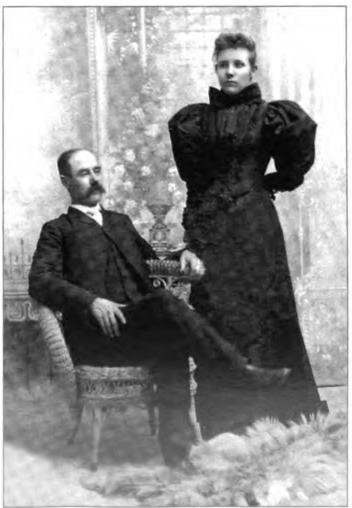
Turning now to the Martin family, Lemuel Emery Martin came into Sheridan County and the Big Horn area on 4 July 1883, working for the Colorado Colony & Ditch Company, a construction company. In 1870, when he was 16 years of age, he and his cousin, Judson Stout, had left his home near Jersey Shore, Pennsylvania, and gone to Ottawa County, Kansas. There they worked in the wheat fields for $12 a month. From Kansas, they went to Cripple Creek, Colorado, then to Longmount and Boulder. Captain Tyler of Boulder became interested in Lemuel and outfitted him with five prairie schooners, several four-mule teams, plows and scrapers, men, and supplies to go to Wyoming to build the Big Horn Reservoir and Canal, known as Colorado Ditch, to water 2,700 acres of land north of Big Horn. At that time there was no Sheridan. After completing the irrigation project, he surveyed the land and later imported farmers from Pennsylvania to farm it. It was then known as the Colorado Colony Ditch Co. Later he built the Carney Lake Reservoir and the Martin Reservoir. He and Minnie met, and not long thereafter, on 16 February 1888, they were married at the Jackson’s cabin on Jackson Creek, Big Horn, Sheridan County, Wyoming. He was 33 years old and she was only 17.
The couple established their home on the Colorado Colony & Ditch Company’s home ranch, 21/2 miles south of Sheridan. The Creighton Road Ranch soon became known as the Martin Ranch. Their two children were both born in Big Horn. Lona Emery Martin was born at home on 9 September 1889. She later married Robert Thomas Helvey on 22 August 1909 in Los Angeles, California. Lemuel Edward Martin was born in town on 31 December 1892. He later married Helen Lawton in 1919 in Berkeley.
In 1903-04 the Carney brothers, B. J. and W. J. from Iowa, purchased the Long Ranch on the Tongue River, and Mr. James Stout, John’s father and grandfather, opened the Carney Mine and built Carneyville, later known as Kleeburn. After getting this project started, they moved back to Big Horn on the Martin Ranch when Lemuel Emery Martin again managed the “Home Ranch,” built farm houses, barns, etc.
In the early 1900s, the Martin family moved off of their ranch and into the nearby large town of Sheridan. There they lived on Tschirgi Street. Lemuel Emery Martin managed the ranch as long as he was able, leasing it out to a sharecropper. Then in 1908 the Martins bought Judge Stott’s property at 240 Coffeen Avenue in Sheridan. They kept this house into the 1970s, and the ranch until at least the 1950s. A letterhead dated 20 October 1909 shows that they were also somehow involved with the Sheridan Land and Irrigation Company.
Minnie’s father, William E. Jackson, served as supervisor of the Bighorn National Forest. The many lakes he constructed in the Bighorn Mountains continue to provide abundant water to ranches in the area. He died on 4 March 1912 in Big Horn and was buried there. His wife, Amanda, went to Nebraska. Fortunately, she wrote a one-page history of her life in the mid-1920s. She died on 30 May 1932 in Milford, Nebraska, at the age of 82. She was taken back to Sheridan, Wyoming, and buried on 4 June 1932 in at Sheridan Municipal Cemetery.
In 1925 Minnie Martin (also called “Mother Martin”) persuaded the state of Wyoming to establish the Wyoming Girls School near Sheridan on a huge estate, which had been the summer home of the Verner Z. Reed family of Denver. Minnie was named superintendent. Known as the Wyoming Girls Industrial Institute for most of its early years, it was a sort of reform school. As young Ed Martin recalls:
The girls school was in a big gorgeous mansion on 380 acres about five miles south of Sheridan. The three-story, 30,000 square foot affair was built by Englishmen who raised cattle and lived in the grand style. It housed 30 girls in rooms and had a huge kitchen. The place was for girls who were homeless or in trouble or wards of the state. People came from all over the world to watch this model school perform, because it was one of the few self-supporting state schools. They raised all their own vegetables and cattle, milked the cows and made butter, gathered eggs, slaughtered the cattle and froze the meat. They also made their own dresses. She trained the girls to be self-sufficient at this school and ranch. It didn’t cost the state a dime. Mother Martin’s appointment was a political one; she used to feed the governor of Wyoming Sunday breakfast once a month as part of her political stability program.
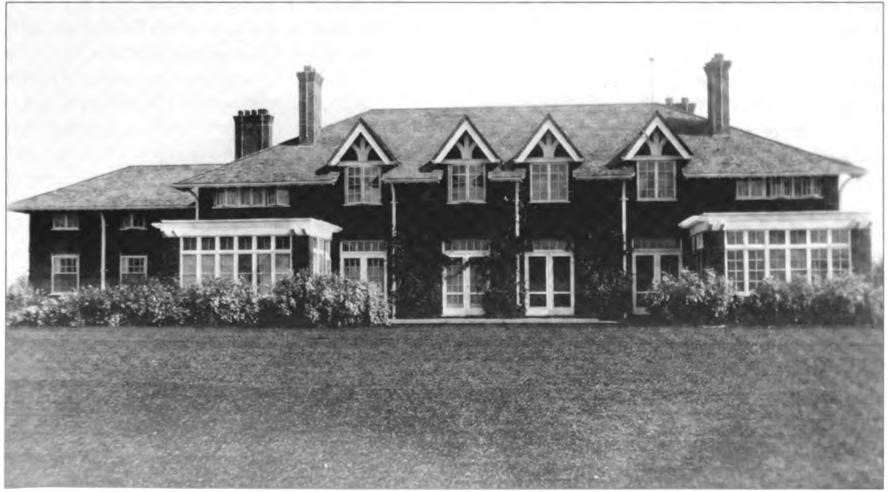
Minnie and her husband, Lemuel E. Martin, moved into the school’s central building. Lona and Bob Helvey now lived downstairs at 240 Coffeen Avenue and Minnie rented out the upstairs. A year later, on 10 June 1926, Lemuel Emery Martin died at the school in Sheridan, Sheridan County, Wyoming. He was buried at the Sheridan Municipal Cemetery three days later. A pioneer and a great storyteller was gone. He was age 71 at the time and Minnie was 55. Minnie Martin now had to make a new life for herself at the school. But she was well prepared. A very dynamic and charismatic woman, she had white hair piled atop her head and stood five feet, seven inches, tall but looked big because she was heavy. She definitely had a way with people, including the girls in her school.
Under her guidance, girls at the home, many of whom it was hoped would marry farmers or ranchers, were taught housekeeping plus all the skills a farm wife would need. They ironed, canned, gardened, harvested crops, and learned all the household skills that would make them good citizens of their future communities and good mothers to their families.
That the girls appreciated and loved Mrs. Martin for her untiring efforts is seen in the literally hundreds of letters she has from them, enough to fill a couple of large scrapbooks. Their success in later life they attributed to her. Many of the girls, after leaving school, would return to Sheridan to have their weddings or to be near Mrs. Martin when their babies came.
An influential and powerful woman, Minnie Martin made an enviable reputation, nationally and even internationally as attested to by the many letters and testimonials accorded her by governors of the different states, newspapers, and awards. Among these was the Casper Kiwanis Club’s Distinguished Service award of the year in 1941. Her methods of organization and operation were sought by many other counties.
Marilyn Martin Zurcher remembers that Minnie was very frugal in the use of the funds she was given to run the school. She often saved half the money budgeted to her each year. On two occasions she asked the state to build large school buildings, and each time she paid for half of the construction costs from funds she had saved.
Through the years, Mother Martin also took an active part in community life in Sheridan. She was president of the American League Auxiliary, member of the Sheridan Woman’s Club, and member of the Business and Professional Woman’s Club.
She was active in the Congregational church, and served as a member of the governor’s planning board for the White House child welfare conference. Mother Martin remained as head of her girls’ school for 24 years, during many political ups and downs, until her retirement in 1950. At that time she moved back into her house at Coffeen Avenue, upstairs. Lona and Bob still lived downstairs and her granddaughter Marny (Marjorie) lived in a house out in back. In November 1955 she started to write her life story, titled “Pioneering in Wyoming.” It was 10 typewritten pages long and stopped before the time of her marriage. At about this time her daughter, Lona Martin Helvey (and Lona’s husband, Bob Helvey), both of whom lived in Sheridan, recorded some of her many superb stories on tape. They also did extensive genealogical research, including in Salt Lake City. Bob interviewed Indians and people involved in the range wars. He gave his tapes to the University of Wyoming in the early 1960s. On 12 March 1960, the Sheridan Press wrote a laudatory story of Minnetta Jackson’s life and work. It concluded, “she is remembered by all who knew her as one of Sheridan county’s most outstanding women.”
Minnie “Mother” Martin died of cancer in December 1972, at the age of 101, in Sheridan, Sheridan County, Wyoming. A great woman, she was known by her descendants as “Nan.” She lived from the time of covered wagons and Indian raids to the space age with a man on the moon.
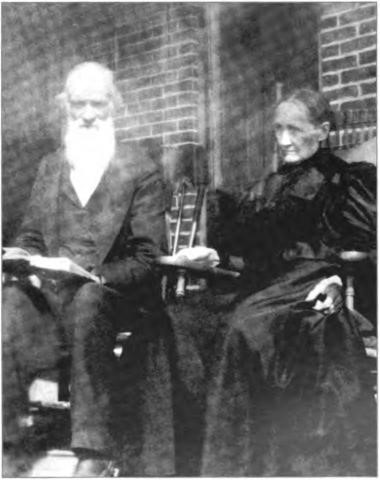
Lemuel Edward Martin, Helen Lawton’s husband, was born on 31 December 1892 in Big Horn near Sheridan, Wyoming, and grew up on the family ranch in Big Horn, just south of Sheridan. By October 1909 Ed was studying pharmacy, probably a two-year course in Philadelphia. A letter from 1911 shows Ed to be in Philadelphia, probably studying pharmacy, but also taking music lessons on the side. Upon graduation, he apparently received a PhG degree.
Ed then attended the University of Michigan at Ann Arbor, from which he graduated in June 1914. He (along with 17 others in his class) received the degree of Pharmaceutical Chemist from the Department of Pharmacy there, although he did not have a BS degree. The commencement brochure listed him as Lemuel E. Martin, Ph.G., Sheridan, Wyoming.
After graduation he was thinking of starting a drugstore in Port Angeles, Washington, with a friend named Jud, from Montana. After that fell through in August 1914, he worked briefly as a pharmacist for someone else in Sheridan, then purchased the Economy Drug Store, where he served as pharmacist until after he married Helen Lawton.
Helen and Ed Martin Raise a Family. After their marriage on 27 August 1919 in Berkeley, Ed and Helen returned to Sheridan, Wyoming, where they lived for several years in a house located one block behind Minnie Martin’s house on Coffeen Avenue. Their first child, Dean Edward Martin was born on 1 April 1921 in Sheridan. At about this time Roy and Hazle Shurtleff (Hazle was Helen Lawton’s elder sister) took a trip to Wyoming to visit Helen and Ed, and Winnie and Bimey Seymour. Roy persuaded Ed to switch careers and go to work for Blyth, Witter & Co. as a salesman in the investment banking business in California. Helen probably liked the idea, since all of her family was in the Bay Area. So Ed sold his drugstore in Sheridan and moved the family to California. In 1921 Ed started to work in San Francisco in the sales department for Blyth, Witter & Company, of which Roy Shurtleff was one of the founding partners.
For the first year or so, the Martin family stayed in Frank and Fannie Lawton’s big home at 2211 Durant Avenue. Fannie wanted very much for them to stay as long as possible.
Ed had always disliked his first name, Lemuel, so he stopped using it once he got to California. Marilyn Zurcher recalls that the first summer in Berkeley, Helen was in shorts and a halter and Ed was in a heavy winter suit with an overcoat, until he became acclimated to the higher humidity and coastal morning fogs in the Bay Area.
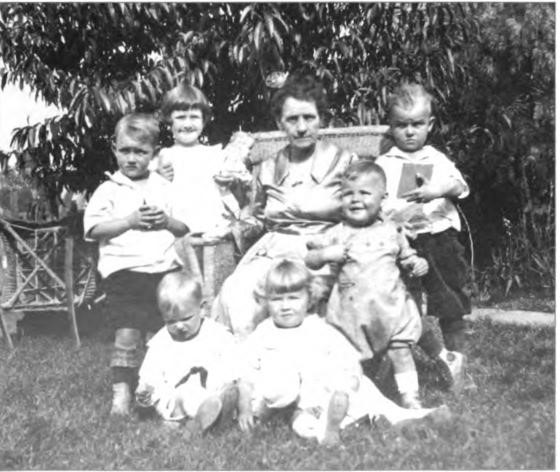
Then tragedy struck. On 16 September 1922, their child, Dean, less than 18 months old, died of “labor pneumonia” in Berkeley. His ashes were interred in the Lawton plot at Mountain View Cemetery on October 4. Helen never spoke of Dean again. At the time of his death, she was pregnant with their second child.
In 1923 Helen and Ed rented a home on Regent Street in Oakland, just two doors toward Oakland from the Harry and Dorothy Peet’s house and five houses from the cow pasture that served as the dividing line between Oakland and Berkeley.
Shortly thereafter, on 21 April 1923, Edward Lawton Martin was born at this home in Oakland with a Christian Science doctor. Then Marilyn Martin was born on 27 January 1925, also at home in Oakland. To keep names straight, since Ed’s business associates and friends all called him “Ed,” his son was generally called “young Ed” for many years, never “Ed Junior.” Having lost her first son, Helen spoiled her second, young Ed, thoroughly—as she later admitted to various close friends.
In about July 1925, shortly after Marilyn was born, the Martin family purchased a house at 3023 Benevenue Avenue, in the Claremont district of Berkeley, only a few blocks away from Winnie and Birney Seymour. Harry and Dorothy Peet would move into the same area in 1927, followed by Don and Billie Lawton in 1932. There were blackberry bushes and a large apricot tree in the yard; Helen enjoyed canning and stewing the fruit. Ed was a superb gardener. He loved to garden and he could grow anything. He was famous in the neighborhood for the row after and row of white stocks, an old-fashioned flower, that he grew in front of the Benevenue house. He liked to cut large bouquets for friends and passersby. Helen wrote Minnie just after they moved to the new house: “Ed is arranging the flowers for the house and he does it beautifully, making the most artistic groups and arrangements. Edward [young Ed] just adores Marilyn. He must kiss her every time he goes near her. He wants to hold her but I haven’t even let him try. For then there would be no peace at all.” By this time the Martins had begun to spend their summers in Monte Rio on the Russian River. They never owned a house there, but usually stayed with the Seymour family.
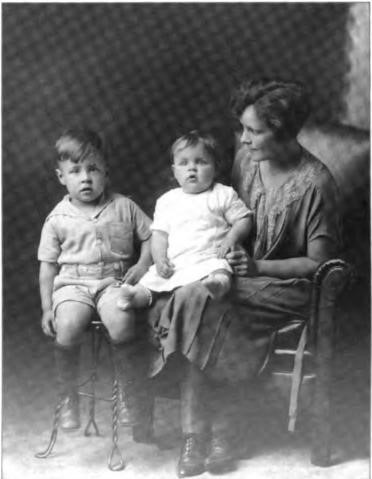
Helen. with her second son, Ed, and daughter. Marilyn, circa June 1925.
Helen kept up her interest in sports, especially golf and swimming. In the mid-1920s she and Ed apparently joined the Orinda Country Club, which was founded in 1924. Several photos from the late 1920s or early 1930s show her playing golf there. A December 1927 letter read: “Edna Cuttle and I are still playing golf 2 mornings a week and Ed and I play Saturday afternoons.” In addition, she and her husband loved to play bridge. Both were reputed to be very good players, and they played “all the time.” By 1926 Ed was doing some horseback riding with Roy Shurtleff and Cal Chapman.
In 1929 Blyth & Co. asked Ed Martin to open a new office for the company in Atlanta, Georgia. So he and Helen rented out the family home on Benevenue for one year, dropped their membership in the Orinda Country Club, packed up both kids, and left. By September 1929 they had rented a white house at 3907 Brookhaven Drive in Atlanta. On 29 October 1929 the stock market crashed, ushering in the Great Depression. Ed advised Blyth & Co. either to close the Atlanta office or to hire a southerner to run it. People in the area disliked dealing with northerners. Shortly thereafter Charlie Blyth called Ed in Atlanta and said, “We’re closing some of our offices, and Atlanta is one of them. Do you want to go to New York or San Francisco?” Ed said, “San Francisco.” Charlie replied, “Okay,” and hung up. Ed later liked to describe this as “the shortest telephone conversation on record,” especially for a major change in one’s life. In November 1929 Roy Shurtleff wrote Ed in Atlanta saying: “Your future in Blyth is more assured than it ever was… You have had a chance to show your executive ability. You poked your head from amongst the crowd as far as Blyth is concerned and you have made good at your job.”
After only about six months in Atlanta, the family returned to Berkeley. They rented a house on Regent Street across from Dorothy and Harry Peet and waited for six months until they could move back into their Benevenue home. The family rejoined the Orinda Country Club, where young Ed and Marilyn now also began to swim while their parents played golf and tennis. Marilyn recalls that when she was age six or seven her grandmother, Minnie, taught her how to speak and count in the Crow language. And at dinner time the children would often ask their father, Ed, to tell stories about Wyoming. Marilyn recalls: “He was a good storyteller, just like his parents and grandparents. He didn’t talk much about himself, but mostly about Nan [Minnie Martin] and Pa [William] Jackson. It was part of the family tradition to pass on the good old stories, just like the Indians did.”
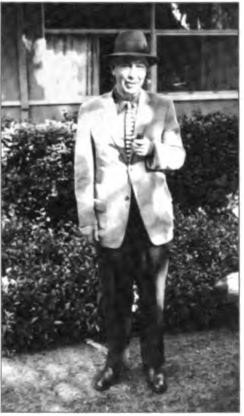
Image: Ed Martin, with hat and pipe, as many will remember him, circa 1938.
Marilyn also remembers that “Christmas was a fun time. On Christmas Eve we always drove out to see the Christmas lights decorating the big houses in Piedmont. On Christmas day we opened our presents, then one family came over and we exchanged gifts. Finally we all went to Roy and Hazel Shurtleffs home for Christmas dinner. One highlight was to shuffle our shoes on the thick carpet. Then we would line up by the Christmas tree and Uncle Roy would lift us up, one by one, to touch the tinsel at the top of the tree, causing a spark from the static electricity. All the cousins would play outside—Red Light Green Light,’ Stop and Go,’ and other active games.” The Depression meant added work and stress for Ed at Blyth & Co. As Helen wrote Minnie in December 1933, “Ed loves his work, but believe me, he works. He stays over about once a week and works till 8 or 9 right thru without any dinner & gets a bite on the boat on the way home.”
Over the years, Helen kept up a strong interest in Christian Science. Jeanne Willi Martin remembers hearing of one time when “Young Ed cut his hand and she wouldn’t let him go to a doctor. He walked home from kindergarten with it bleeding. When he got home, he lay down and Helen called a Christian Science practitioner. She read over him and he was well.” Birnelyn Seymour Piper recalls that “Helen did wonderful healing work herself. Young Ed Martin had a dog that was run over by a car. Helen’s work was so clear that she healed that dog completely.” Helen’s son, Ed, recalls: “Helen was a very strong Christian Scientist, a heavy believer. She sent us to Christian Science Sunday School, and put as much influence as you can on kids, which is not a helluva lot.” Her daughter, Marilyn, who was not interested in Christian Science, notes that “Mother remained a Christian Scientist to the end.”
In June 1935 the Martin family traveled to Wyoming for the wedding of Marny (Marjorie) Helvey, Lona’s daughter. Billie Lawton made Marilyn four dresses to take with her and those were the only ones she wore.
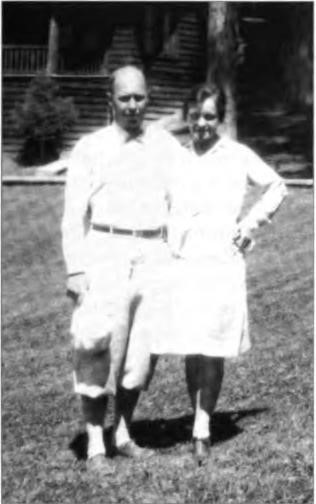
Image: Helen at the Orinda Country Club after a round of golf with Ed, circa 1927-28.
Both young Ed and Marilyn loved to swim in the Russian river each summer, and by the mid-1930s they had developed into excellent young swimmers, with Pop Dean as their teacher. Their father, Ed, would come up on weekends, but he never liked the water much, probably because he had never learned to swim. Jerry Reyes Martin (Ed Martin’s second wife) later recalled: “Ed was basically a cowboy from Wyoming. Nobody ever goes swimming there. Water is considered to be only good to wash in.”
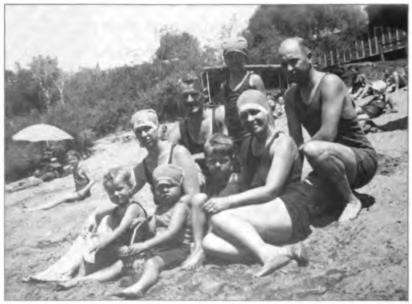
Image: The Peets and their cousins, the Martins, on the Russian River, early 1920s.
In early 1936 Blyth & Co. made some major organizational changes. Roy Shurtleff went to New York to become national sales manager. Dick Ponting, who had been sales manager of the San Francisco office, took over Roy’s job as head of the San Francisco office, and Ed Martin took over Ponting’s job as sales manager. This meant a major increase in salary. The Martins hired a Danish housekeeper. Things were looking good.
Then in about March 1936 a second tragedy hit the family. Helen found out that she had cancer. She may have learned this from her pharmacist husband, Ed. Her mother, Fannie Lawton, had died of stomach cancer six years earlier. On March 28 Helen wrote Minnie:
At last I’m home again. I went back to the hospital a week ago last Thursday, March 19 & didn’t get out for 8 days from then. Besides other things I had a blood transfusion and who do you think was my donor? My own sweet husband gave a pint and a half of blood. Now I am a real true Martin. Anyway I am all well, just waiting around now to gather some strength and more red blood. I’ll be taking it easy for quite some time.
Two days later she added: “Taking excellent care of myself at Ed’s command. I have begun to call him Mussolini or Hitler now… I’m going to my reading club now, so must run.” Two months later she went with her sister, Winnie Lawton Seymour, to the Christian Science Benevolent Association in San Francisco to rest and study. After thanking Minnie Martin for her kind offer of a blood donation, she noted that she had gained 12 pounds since she was in the hospital, a positive sign.
Over the years, Helen and her husband’s mother, Minnie, had become extremely close. On Mother’s Day, 6 May 1936, Helen wrote: “I wish every married woman had just such a mother-in-law as you are. There would he many more happy marriages and a great many fewer divorces.”
By June Helen could write, “I feel grand, tho’ weak from doing absolutely nothing but resting… my red corpuscle count is way up I think…” The next month she and Ed spent a weekend at Lake Tahoe. And in October, with Helen’s health apparently still improving, she and Ed took a trip to Mexico, sailing from San Francisco and visiting Acapulco, Taxco, and Mexico City. Photographs show Helen looking healthy and happy.
Soon thereafter Helen went to bed to rest. She was sick and bedridden until the end. Her children were both still quite young, ages 13 and 11. Marilyn recalls that in the years that followed, many of Helen’s multitude of friends called or visited, and each contact gave Helen a lift and brought her happiness. During this time the family had two German housekeepers, one to take care of Helen and one to take care of the house and cooking. Helen had her own thoughts as to why she had been stricken with cancer. According to Bimelyn Seymour Piper, Helen once told her sister Winnie, also a devout Christian Scientist, “I have never been able to overcome my fear of cancer. The problem is not the cancer itself, but my fear, my erroneous thinking. Fear is the most destructive thing there is.” Hazle visited her often and was disturbed that Helen refused medical assistance. Marilyn recalls:
While she was ill, Helen read each day from the Bible and Science and Health by Mary Baker Eddy. During her last days she was carried down each morning to lie in the sun on the back patio for most of the day. She was as brown as a berry but thin as a skeleton. Our father, Ed, begged mother to go to a doctor, but she would not. I never saw a Christian Science practitioner in the house, though she may have come while I was at school. I often heard mother talking with her on the phone and she would pray. Finally father persuaded mother to go to a doctor, but I think it was too late, about 6 months before she died. She was beginning to hurt. They took X-rays and when they showed the films to Ed, he passed out cold on the spot. I don’t know if she ever took any medication or not.
Helen died on 17 May 1938 in Berkeley, of cancer of the uterus, cervix, bladder, and rectum. She was only 45 years old. Her ashes were interred in the Lawton family plot at Mountain View Cemetery in Oakland three days later.
Only two months previously, Bob Seymour, Helen’s nephew, who was also a strong Christian Scientist and had refused medical aid, had died of a brain tumor at the tender age of 18. These two sad deaths, so close together, sent shock waves through the Lawton family and caused some people close to the family to question the basic tenets of Christian Science. Yet the incidents did not lead to a debate or controversy within the family. Don Lawton recalls that “it was handled very quietly, with no push and pull. Everyone tried to understand.” Nancy Shurtleff Miller remembers: “My mother, Hazle, was really upset when she heard that Helen had died. She came to Finch Junior College and took me out of school for the day, she was so distraught. She thought that Helen had refused medical assistance.”
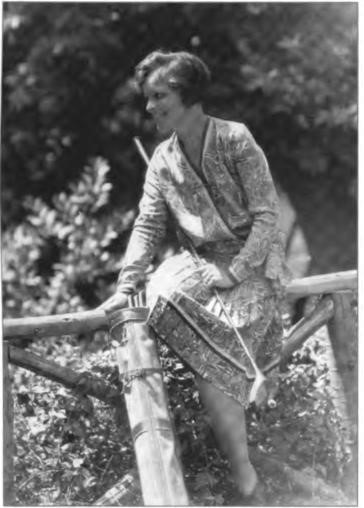
Image: The lovely, spirited Helen Lawton Martin died on 17 May 1938 when she was only 45. The entire family lost a beloved member, circa 1927.
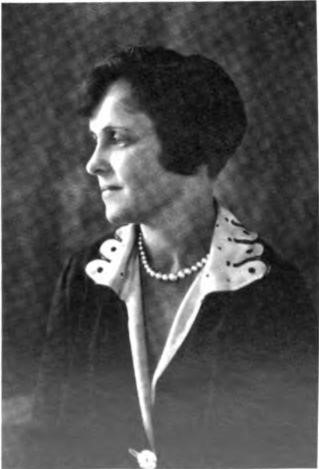
It is difficult to convey the traumatic and confusing effect that Helen’s death had on her children. For Marilyn it came as a shock out of the blue:
As the 13 year old child of a Christian Science mother, I was not aware of what illness or death were. Christian Scientists do not accept or even mention illness or death. I had no idea that my mother was ill or dying. I only knew that she was in bed. On that fateful day, a neighbor picked me up at Willard Junior High School, parked with nu’ alone on a side street, and told me that not mother had just died. I said, “What does that mean?” When I finally understood, I teas just devastated. I knew that grandpa Lawton had died, but of course we didn’t go to his funeral and nothing was ever said about it so it never really sank in. Aunt Win Minnie Seymour] didn’t go to Helen’s funeral. Christian Scientists don’t go to funerals. In the months that followed I cried myself to sleep every night until the Lord told me that mother was with him and he needed her. Only later did I learn from my grandmother [Minnie Martin] that mother had died of cancer. I had never heard of cancer. All I knew were Mercurochrome and iodine.
Several days after Helen’s funeral, Marilyn went to Wyoming to stay for the summer with her grandmother, Mother Martin. She ended up staying for three years.
Young Ed is remembered by some as a difficult child during his early years—especially after his mother’s death. No doubt the sense that there was something terribly wrong at home had its effect. Even though he was aware that his mother had cancer and that she was critically ill, her death came as a terrible shock. During the next school year he was sent to a private boarding school away from home.
About a year after Helen’s death, Ed met Gladys Evelyn “Jerry” Reyes. It is an unusual coincidence that her first name, Gladys, was the same as Helen Lawton’s middle name. However, Helen rarely used her middle name. When asked in 1994 what their mother’s middle name was, both Ed Martin and Marilyn Martin Zurcher said they had never heard that she had a middle name. Nor did Don Lawton, Birnelyn Seymour Piper, or Randy Martin know her middle name. It does not appear on her marriage or death certificates. In the Lawton family Bible, in the “Births” section, her name is written as “Helen G. Martin,” but only in the “Deaths” section have we been able to find her full maiden name: “Helen Gladys Lawton (Martin).”
Jerry Reyes and Billie Lawton (Don’s wife) went to the same hair dressing parlor in the Rockridge district of Berkeley. As Don Lawton remembers it:
One day Billie saw a very stylish, lovely person there. When she inquired and learned that Jerry was single, she took an active interest, for she knew that her brother-in-law, Ed Martin, was also single. Now Ed was going out with some gal in San Francisco who was a little on the expensive side. For example, she’d buy flowers at Podesta’s and bill them to Ed. We felt she just overdid it. One day Billie got up her nerve as matchmaker and invited Jerry to our home for an afternoon tea. At tea she said, “We’re having a benefit party and dance for Children’s Hospital out at the Orinda Country Club. I have a brother-in-law who is a divine dancer, and we’d like you to come along and be his partner.” Billie and Jerry became acquainted. Jerry realized what a lovely home and family this was, and decided to take a chance and go on a date with Ed Martin. Billie always did everything with such style.
Jerry, who had previously been married to DeRoy Austin and divorced, with no kids, decided to go. “As long as he was a great dancer, that was enough for me.” Billie and Jerry soon became close friends. The night of the dance, everyone (including Charlie Meek) met at Don and Billie’s for cocktails first. Don continues:
Ed brought two big beautiful corsages to the party. When Jerry arrived, we were all aghast. She was a knockout! Such a beautiful person, and so well dressed. Well, as we sat around, Billie said to Jerry, “I can play a few notes on the piano and I understand you can sing.” Jerry said, “1 can sing a little.” Well, she sang and honest to God, you’d think she was a regular opera singer. The rafters rang. She was just wonderful. She sang “Pale Hands I Love” and Ed was just ga-ga over her!
We all drove over to the dance together, then we didn’t see them all evening. They were at the bar getting acquainted. And boy they really got acquainted. Ed showed Jerry pictures of his kids. He proved to be not only a superb dancer but a charming escort.
Only after Ed began showing pictures of his children did Jerry start to suspect that he might be thinking about marriage. She thought, “If any guy with two children and a bald head thinks I’m going to get tied up with him, he’s got another think coming.”
But she had a lovely time and Ed was irresistible. He and Jerry were married shortly thereafter, on 19 July 1939 in Reno, Nevada. She was 32 years old at the time and Ed was 46. Young Ed was age 16 and Marilyn was 14. Ed and Jerry went to Hawaii on their honeymoon, and Roy and Hazle Shurtleff went with them!
Image: Ed and the attractive and talented Jerry Reyes, Circa 1941.
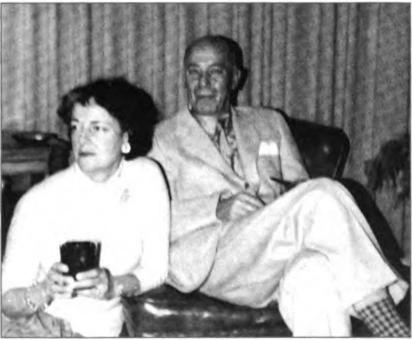
Born on 2 June 1907 at Fabiola Hospital in Oakland, California, Jerry was the daughter of John A. Reyes and Elizabeth Juliette Sprague. Jerry grew up in Oakland until she was about 6, then her family moved to Arlington, Massachusetts, where she lived until she was 14. Then they returned to Oakland. She went to college for one year at College of the Pacific, then she went east to the Leland Powers School of Drama in Boston, Massachusetts, for three years, graduating in 1929. Intelligent, charming, and blessed with a melodious voice, she had learned diction in Boston. After graduation, she returned to Oakland and began to teach drama, public speaking, and diction at the 20th Century Club on Derby Street above College in Berkeley. She also did readings like reviews of New York plays for hospital groups, plus some work with the Berkeley Little Theater. While working with a group of ladies in the 20th Century Club’s drama group, coaching one-act plays, she met Winnie Lawton. Jerry recalls: It was mostly fun acting, one act plays presented at the Club’s theater. It was a fun group to coach and they were all really lovely women.” The next year she married DeRoy “Pete” Austin. They lived in Berkeley for about a year, then moved to Hollywood in about 1932—not for her acting but because his family had a chain of shoe stores. The Depression was in full swing so times were hard. After her divorce, she returned to Berkeley and was studying singing with William Chamberlain when Billie Lawton called.
Memories of Helen and Ed. Both Helen and Ed were loved and admired by all who knew them. They were a rare couple. First, some memories of Helen. Jerry Martin: “I remember Billie Lawton telling me that Helen was really good at most everything she did. She was a lovely person, very athletic, capable, pretty, and popular.” Lawton Shurtleff: “She was an extremely beautiful young lady, the most beautiful in the family.” Don Lawton: “Helen was really a gal on her own. If anything had to be done, she’d do it. She was very independent.” Winnie Lawton: “She was really brilliant.” Nonie Peet Kelly: “She was a fun loving person and, before she became ill, our favorite sitter. I remember her warm, wonderful laugh.” Mardy Peet Love: “I remember Helen as being a very open, gung-ho type person.” Bimelyn Seymour Piper: “Helen was very bright and outgoing, very attractive, extremely enterprising, and lots of fun.” Memories of Helen’s husband, Ed, starting with Jerry Martin, his second wife:
Ed was one of the kindest men, the kind of perfect gentleman you don’t see any more these days. He was a very even-tempered guy: a wonderful man with a wonderful disposition. So kind and punctilious about his manners, he got along with everybody and had lots of friends. He was the greatest dancer, and he loved to play golf and bridge, and to garden. He also loved his business work, and could hardly leave it behind on vacations. Ed was close to both of his children.
Gene Shurtleff graduated from Cal in December 1939 and went to work full-time for Blyth & Co. in early 1940. At that time Ed Martin was Blyth’s sales manager and Gene’s boss:
Ed hired me at Blyth & Co. I worked for him for about 10 years and Hiked him very much. I knew him well. He was a sweet, lovable guy, very easy to get along with, easy going, gentle, and attractive. He smoked a pipe incessantly, and was pensive and low key, not brilliant, but very knowledgeable. A good man with people, he had lots of friends and they were devoted to him. I never knew anybody that didn’t like him. He was a good family man, and he and Helen were very devoted to one another.
Mardy Peet Love: “Ed Martin Sr. was an absolutely lovely, warm, sweet man and he doted on his wife, Helen. He loved her to the extent that during her long, long illness it was difficult for his children. I was at their home a lot because I was close to Marilyn.” Ed Martin: “My father, Ed, was very well liked. The most repeated comment I heard was ‘Ed never has anything bad to say about anybody.’ I got along well with him.”
Ed and Jerry’s Life Together. Stepping into a family with two teenage children, ages 14 and 16, was not an easy task for Jerry. She and Marilyn soon became very close and remained so over the years, but young Ed had a difficult time accepting a stepmother. He was never fully able to. The next summer (1939) he was sent to Wyoming to stay with his grandmother, Minnie Martin.
Image: Ed and Jerry with their two sons, Randy and Bob, celebrating at sea on the steamship Conine, 1956.
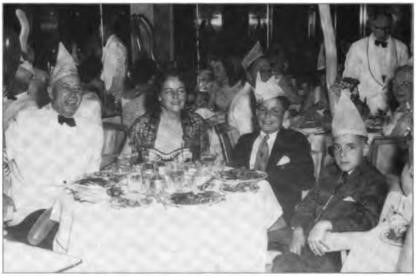
Marilyn recalls her first meeting with Jerry:
About a month before Ed and Jerry were to be married, my grandmother (Minnie Martin] and I got a letter. Ed wanted us to come out and meet his bride
to be and spend the month of June. Grandmother was furious because she loved Helen so much. Although I was only 14 years old, I sat her down in her office at the girl’s school and I said, “We’re going to go out there to meet Jerry, and we’re going to love her. And if you don’t behave yourself and do what you’re supposed to, I will embarrass you in front of your son.” Now we were the best of buddies and I loved her dearly. But she took one look at me and knew I meant business.
We met Ed and Jerry at the train station in Berkeley. Jerry had long black hair and she was just gorgeous. Ed was so fortunate to have two beautiful wives who loved him dearly. Jerry invited me to go to the World’s Fair with her the next day in her Model-A. We went and we had a ball. All those guys who ran the different rides couldn’t take their eyes off of her; they just let us ride and ride. Jerry was very nice to my grandmother, who in later years grew very fond of her.
The next summer I went back to California. I had a severe pain in my side. Ed told Jerry to take me to a doctor. I had never been touched by a doctor before. He said my appendix was about to rupture, so he operated and caught it just in the nick of time. Jerry was so warm and wonderful when she visited me in the hospital. I asked her at that time if 1 could call her “mother.” She said, “Fine,” and that’s what I still call her.
When he had lived in Wyoming, Ed had enjoyed horseback riding. After his brother-in-law and co-worker, Roy Shurtleff, bought a ranch in the Alhambra Valley, Martinez, Ed would often ride and exercise Roy’s horses there. He had dreamed of owning a place in Contra Costa County with a couple of horses, and he had started to look even before he met Jerry. Shortly after his second marriage, he sold the Benevenue house in Berkeley and that December (1939) the family moved into a home in Orinda at 8 El Sereno Road, near the country club. But they never had any horses there.
Jerry lived near and became very close to Rose and Gene Shurtleff in Orinda. She was at their wedding and was asked to be one of Kathy Shurtleff s two godmothers when one-year-old Kathy was christened in 1943.
Then Ed and Jerry had their own children. John Randall Martin was born on 30 September 1944 in Oakland, California, and Robert James Martin was born on 8 March 1947 also in Oakland.
Ed’s two children by his first marriage both married in 1945. Marilyn Martin married Clarence James Zurcher in Berkeley, and Ed Martin married Jeanne Marie Willi in Sacramento. Her father, Charlie Willi, worked for Ed’s father as a securities salesman.
Ed partially retired from Blyth & Co. in about 1959-60, following a very bad heart attack with serious fibrillations. He now had angina pectoris. He devoted his time to managing the affairs of a few of his old clients. He only went to work a few days each week; Jerry drove him over and picked him up. Then he had a second heart attack, which was fatal. He died on 15 April 1961 at Alta Bates Hospital in Berkeley, California, at age 68. His body was placed in a sealed casket in the Mausoleum at Mountain View Cemetery in Oakland. It was not cremated because Randy and Bob Martin objected to cremation, and he was not placed in the Lawton family plot, perhaps because he was not a Lawton.
Jerry continued to live in the Orinda home. She was kept busy raising two boys. Her favorite pastime was gardening. She belonged to a garden club and a book club (she read the classics), and worked as the jewelry buyer at Alta Bates hospital for 10-12 years. Jerry died on 28 December 1997 in Orinda, California. Ed and Jerry had two children, Randy and Bob. (See p. 397.)
Let’s go back and take a brief look at Ed and Helen’s two surviving children:
Edward Lawton Martin was born on 21 April 1923 in Oakland, California. He grew up in Berkeley, attending John Muir grammar school and Willard Junior High. His close friends like Bob and Dick Seymour, and Silver McFall, considered him a great guy. Family members and friends used to say that when he turned on the charm, he was so irresistible that “he could sell refrigerators to the Eskimos.”
In the days when Ed was at Willard Junior High, a kid could get a daytime drivers license at age 12, and a full-time license at age 14. Those were the days when many farm kids drove tractors. Ed recalls: “When I was 12, though I was pretty broke, we bought the People’s Bakery truck for $10. All tires were flat, so to get it running we rolled up the Saturday Earning Post and had those tires stuffed so solid they spit out confetti as we drove. We heard they used naphtha in the race car gasoline, so we dropped moth balls [made from naphtha] into our gas tank to hop up the gas.”
As noted above, following the death of her first son, Helen had spoiled Ed, showering him with her love and affection. The years from about 1935 on, while Helen was in bed with cancer, were trying ones for young Ed.
In the fall of 1937 Ed entered Berkeley High School as a sophomore, as was the practice in those days. He was a splendid athlete with a magnificent physique. He played end on the Berkeley High football team and got very poor grades. Near the end of his sophomore year, in May 1938, his mother finally died of cancer. It was a terrible blow. Jeanne Willi, Ed’s first wife, recalls: “Ed was very close to his mother and he absolutely adored her. He didn’t understand her dying so young. It was a great trauma for him. He had a hard time afterwards talking about her.” Marilyn Martin, Ed’s sister, adds: “Ed loved his mother and she adored him, but he was difficult and hard to get along with. Personally, I thought he was about the greatest thing on earth, but I don’t think he liked me or ever has.” Mardy Peet Love recalls: “For all his coolness and distance, he was terribly physically attractive, very athletic, and standing very tall. He was always great to me. But he was difficult and unkind as a boy, especially during the time [from age 12 on] when his mother was dying. Part of it must have been frustration and anger.”
Ed is remembered by all as an extremely bright young man, but also as somewhat of a loner. “He had his own mind and he went his own way. He didn’t talk or fraternize much.”
Ed spent the first half of the summer after his mother died at Monte Rio on the Russian River. Then getting bored, with nothing to do, he and a friend, Ed Nelson, took off with no particular destination in mind, except that both had relatives in Seattle. Ed recalls, “We didn’t exactly run away from home, we just never asked anyone for permission to go, and we didn’t tell anyone where we were going. We made no contact all summer. We did it on a lark.” They started out first in Nelson’s Model-T Ford, then when it broke down, they went back and got Martin’s Model-A. They ended up visiting Ed’s uncle, Harry Lawton, in Seattle. Ed hitchhiked back alone.
In the fall of 1938, with his wife Helen gone, Ed Sr. felt he would not be able to take care of his two children while working full-time. So he sent his son, young Ed, away to a private boarding school for his junior year in high school, the Catalina Island School for Boys in Southern California. Marilyn was with her grandmother,
Minnie Martin, in Wyoming. Ed disliked this school. The discipline was strict and the kids were allowed off the school grounds only twice a year, and it was three miles to town—by boat. “It was pretty damn boring, but they taught me how to study and my grades were average.”
Right after Ed’s father remarried to Jerry Reyes in mid-July 1939, he sent young Ed to spend that summer with his grandmother, Minnie Martin, in Wyoming working on the ranch at her girl’s school. He was the only boy around, surrounded by women and girls. Ed recalls: “They worked my tail off out there from dawn to dusk shocking wheat in those goddamned blazing hot Wyoming fields without any water. I guess they were just trying to keep me out of trouble and build me up by keeping me busy with hard work. They paid me $12 for the whole summer. I was glad to get out of there.” Marilyn, who was also there, remembers that Ed participated in a big Rotary Club swim meet that summer at the one large pool in Sheridan. He entered most events and won every one of them—to the astonishment and chagrin of the Sheridanites.
Jerry recalls receiving a letter from Mother Martin at the end of the summer saying in effect, “I can’t do anything with this child. Some people are just ornery. If he is to be disciplined, you’re going to have to do it. But it won’t be easy.” Ed couldn’t discipline a pet dove.” Jerry adds, “He was so tender hearted and he just adored young Ed, of course. But if Mother Martin, who was so marvelous with young people, couldn’t do anything, how could I, a stepmother? I did what I could but it was a loosing battle all the way. I shed a lot of tears over that.”
Young Ed had disliked it when his father married Jerry. He made things rough for both of them. For the rest of their lives, he and Jerry never got along well at all, though they both ended up living in Orinda.
For his senior year in high school, young Ed would have preferred to go to public high school at Berkeley High, but his father was too busy to take care of the kids at home. So instead young Ed talked his father in switching him from Catalina up to the San Rafael Military Academy starting in the fall of 1939. There his grades were straight A’s, and he made the Honor Roll. He also developed into a fine athlete. He was captain of both the swim team and the water polo team (and won numerous medals), played right tackle on the football team, and was also on the boxing team.
In 1940 Ed was accepted to Stanford University, where his father had always hoped he would go. Roy Shurtleff was instrumental in getting him admitted. Since Ed’s early high school grades had been marginal, he had to start with the summer session before his freshman year. After one year at Stanford he got tired of it, so he went to work, starting in the summer of 1941, for Standard Oil Co. on a tanker. After six months, when the United States entered World War H in December of 1941, the crew was sent home. For Ed there were two choices: get off the ship and be drafted right into the army or go back to school to complete the two years of college education required for acceptance into the air corps pilot training program. He took the latter approach and went to the University of California in Berkeley. He chose Cal in part because it was more affordable (he was now paying his own way) and in part because he had friends there.
After one year at Cal, Ed enlisted in the U.S. Army Air Corps. He was given about a year of basic pilot’s training at Santa Ana, California; various places in Arizona; Santa Rosa, California, and Nevada for gunnery school; and then back to Sacramento for final training. Finally he was sent to England for the real thing. As a fighter pilot with the 392nd Fighter Squadron of the Ninth Air Force in England, he flew P-38 fighter planes. These were high-speed, strafing, and low-level bombing craft, beautiful with their twin fuselages side by side and two propellors. Before the invasion, he flew mostly over France, disrupting the supply lines that would be reinforcing the beachhead at the time of the invasion. He was in the air over the beaches of Normandy providing air cover while the waves of Allied troops invaded at dawn on D-Day, the 6 June 1944. As he wrote his father later that day, “If the date was not June 6th, I would have sworn it was the 4th of July. It was really beautiful; rockets, parachute flares, naval gun fire, flak bursts, shore fire, huge fires and explosions on the coast itself.”
Image: Young Ed Martin, one of the many cousins to fly and fight for their country in World War II, circa 1942.
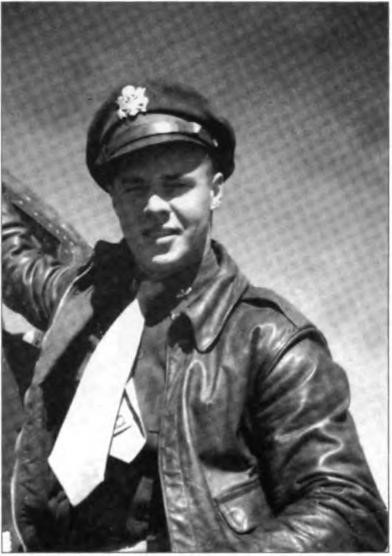
After D-Day he was transferred to France. From temporary airstrips there he flew raids over Germany, providing ground support. On one occasion, his engine blew up on takeoff and he had to crash land. His eye was so badly cut that he didn’t know if he would ever see again. He was sent to an English hospital for several weeks to recover. There he happened to see Dick, Jack, and Birnelyn Seymour. Returning to France, he was later transferred to San Quentin air base in Belgium. In total he flew 68 missions over Europe. It was extremely dangerous work and he was one of the few fighter pilots from his original group of 27 to come back alive. For his skill and bravery, Ed won the Distinguished Flying Cross and the Air Medal (two times). With the exception of the Medal of Honor, these are the two highest medals awarded by the Air Corps. Ed wrote many letters to his father during the war; they still exist as a leather-bound book.
After he got back from Europe but before VJ Day, Ed was selected to go into the First Fighter Group, the reincarnation of Eddie Rickenbacker’s World War I “Hat in the Ring” group. The air corps planned to send these pilots to Japan to fly America’s first jet fighter planes. Ed flew and tested the planes, taking combat training in Palmdale, California, but production of the planes was slow and the war was over before the group could get to Japan.
Shortly after the war ended, Ed returned to the University of California at Berkeley for about 30 days, decided it was not for him, and went into business. On 15 October 1945 (Marilyn says 1946) he married Jeanne Marie Willi (pronounced WILL-ai) in Sacramento, California. He had met her in Sacramento during his pilot’s training there. Born on 25 July 1928 and called “Willi” (pronounced Willie) by her friends, she was the daughter of Charles Willi and Virginia La Rue. Her father managed the Blyth & Co. office in Sacramento. Willi was popular, attractive and very active. Between 1948 and 1954 Ed and Willi had four children, three boys and a girl.
The role of the fighter pilot fit perfectly with Ed’s love of being the hair raising, rebellious daredevil. After the war, he continued to drive his car like a jet pilot. Jerry Martin recalls: “He used to scare me green when he’d drive me through the Orinda-Berkeley tunnel. One day his wife’s mother drove with him across the Bay Bridge and told me later that she’d vowed she would never set foot in another car with him again.”
Image: Ed Martin and his young and beautiful bride, Jeanne Willi Circa 1946.
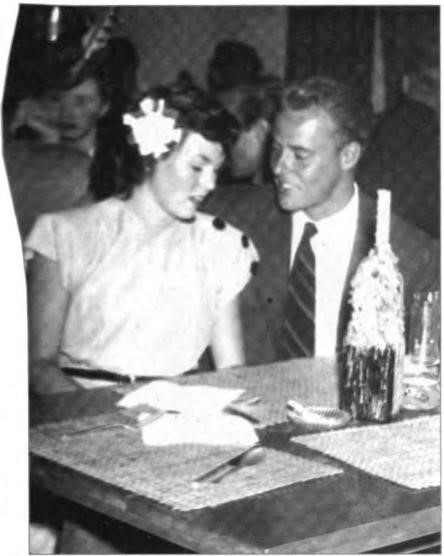
Right after the war, Ed saw an ad in the paper and got his first job selling Quonset huts. They were in the category of “army surplus” and the only construction material that was not controlled by the Civilian Production Authority. He was employed by Kraft Tile Co. in Niles, California, on a commission basis, and did very well selling these low-cost buildings. After a couple of years, Ed developed a low-cost building of his own, which he called the “Martin Building.” Consisting of a steel frame and a corrugated asbestos shell and sold in standard sizes, it was targeted at the same low-cost market as the Quonset hut. Peerless Iron Works in Alameda helped with the design and built the frame, then Ed lined up a contractor to have the buildings erected. These also sold well. During this same time Ed also sold Butler Buildings.
Then in about 1947 Ed went into the cement finishing business. He met some men who were good with concrete. They were doing “flat work,” which involved pouring concrete slabs and troweling them smooth.
In 1949, at age 26, Ed founded Bayshore Construction Co. Acquiring a general contractor’s license and operating out of his home in Oakland, he now started building whole buildings. Beginning with assets of only $2,000, he spent $1,500 on a pickup truck, leaving him $500 in working capital. The bank turned down his application for a $3,000 loan, but he soon found a job he could handle without help—a $744 contract to install concrete slabs for an auto wrecking company. “From then on we made it the hard way,” Martin recalled. “We bid low and we worked seven days a week.”
In 1951 Ed took in a partner, Herbert H. Hastings, two years his junior. Hastings had worked his way through engineering school at the University of California, Berkeley, graduating in 1946. Martin retained 51 percent of the company ownership, giving Hastings 49 percent. This generous gift resulted because Ed was in the reserves and feared he might be drafted for the Korean War; he needed someone to carry on the growing business while he was away. The fear never materialized. So in 1951 Martin and Hastings set up offices for Bayshore Construction Co. at 744 Folger Street in Berkeley.
In about 1953 Ed and his family moved from Oakland to Atherton, and Ed started driving a Cadillac.
Lawton Shurtleff recalls an incident from about this time. “Ed needed an introduction to ‘Flat Top’ Smith who was building a large tract of several hundred houses for blacks and whites in Richmond—one of the first such racially integrated housing developments. John Mackay and I gave him the introduction. Instead of responding as most ‘broke’ young men would have with a bottle of wine, etc., he gave both John and me a
full case of fine and expensive Scotch whiskey. Ed always thought big and was unexpectedly generous. He became an extremely successful businessman.”
With their profits, increased capital, and a better credit rating, Martin and Hastings won bigger contracting jobs: $7 million in army warehouses at Goose Bay, Labrador (eastern Canada), a $2 million hangar in Sacramento, National Guard armories in Walnut Creek and Santa Cruz, and various industrial buildings.
In about 1954 Bayshore Construction, which now had offices in Berkeley and Palo Alto, finished the first unit of the $5 million Town and Country shopping center in Palo Alto. The company had already completed more than 100 industrial and commercial projects in Northern California.
In 1955 the company completed the $1 million Tioga Building, a four-story office building at Milvia and Addison streets in Berkeley and their most significant achievement to date. The company was now doing the first tilt-up construction in Northern California. (The tilt-up technique had been invented by William T. Neal, a Ready-Mix expert in southern California a few years earlier.) The Tioga Building was cited in Construction Illustrated magazine as pioneering “ingenious advanced design and erection techniques for tilt-up concrete construction.” Vertical reinforced concrete columns are poured in forms laid flat on the ground, then raised by a crane and aligned swiftly by the adjustment of four big bolts. Similarly precast wall panels and floors were then erected between the vertical columns. By use of the faster bolt method of aligning the vertical columns, Bayshore eliminated much of the expensive bracing and “squaring up” operations formerly required in “tilt up” concrete work, as well as expensive finishing operations. The Tioga building was soon yielding a net income of $85,000 a year. On 5 September 1955 the Berkeley Gazette ran a lengthy story on Martin, Hastings, and Bayshore Construction, starting with the observation, “Horatio Alger would have liked this Berkeley success story.” Martin estimated that the company had already built 2 million square feet of office buildings, costing about $889 million.
On 1 May 1956, they started work on the seven story El Dorado Building at 22nd and Franklin streets in Oakland. Within one month the first tenants had moved in. The $3 million steel- faced structure was finished by the year’s end.
Also in 1956 they started the $6 million Bermuda Building, a 15-story office building at 22nd and Franklin streets in Oakland, across the street from the El Dorado Building. On 30 September 1956 the San Francisco Chronicle ran a story titled “Story of 2 Builders: $2000 Start Makes Millionaires in 7 Years.” The company’s assets were estimated at $2.2 million or more.
By the mid-1950s the company was in high gear and growing rapidly, with a host of highly bold, innovative, and profitable building projects. Ed had made a tremendous success of his construction business.
Ed’s father was extremely proud of his son: “He never came to me for help. It’s a remarkable job and I’m proud that he did it on his own.” Jerry Martin added: “I’ve always said that Ed would either die a pauper or become many times a millionaire. He’s a brilliant guy, a gambler and a big risk taker. He dares to do things. It’s the fighter pilot in him. You’ve got to take big risks to climb as rapidly as he did.”
But things were not well on the home front, and in 1960 Willie obtained a divorce. She received custody of their four children.
As a fighter pilot, Ed had grown used to drawing heavy enemy flack. But he drew even more from all those most closely related to him—in part since Willi was so very well liked by everyone: “He is a very closed person.” “He does exactly what he wants to and doesn’t seem to care what others think.” “He doesn’t seem to have any interest in his children or grandchildren. We almost never see one another. We’ve all tried very hard to pierce his shell, but we’ve finally given up.” (Jeff adds, “Not yet!”) “Quite gruff, curt, touchy, and abrupt.” “He isn’t very communicative.” “He has been loved his whole life but he doesn’t know how to handle that or how to return it.” “He was always very critical of his kids, but has never been able to take criticism himself.” Over the years he was essentially not on speaking terms with his sister, Marilyn, and his stepmother, Jerry.
But Jerry notes: “There’s no one who can be more charming than Ed. He can be ornery as hell, then he can turn around the next minute and be so charming you wouldn’t believe it.” Lawton Shurtleff adds: “I’ve always found Ed to be a super guy, warm, generous, witty, very well educated, a student of finance, extremely successful in his business, and a very good and caring friend. For example, when Jack Seymour was terminally ill in the Veterans Hospital in San Francisco, Ed was the only one to take the time to visit him. And when he died, Ed had Jack’s ashes interred in the Lawton family plot and his name engraved on the headstone. Ed paid all the expenses and, as far as I know, told no one but me. On another occasion Ed sent his sister, Marilyn, a plane ticket to fly to a family party at the Orinda Country Club.”
Ed had been especially fond of his only daughter and youngest child, Betsy. She was “the apple of his eye.” Thus it was a great loss for him, as well as for all the family, when, in August 1974, she died tragically at age 20 in Palo Alto.
In the mid-1970s Martin and Hastings, still together after 25 years, gradually phased out Bayshore Construction Co. as they moved into real estate projects and discontinued construction projects. They created new companies, Associated Investment Co. and Martin Investment Co.
On 24 August 1975 Ed remarried, this time to Rebecca Adcox Sherbourne in Carmel, Monterey County, California. Born in Alabama on 15 July 1948, she was age 27, the daughter of Davis Clint Adcox and Nellie Lucille Hayes, both born in Alabama. Marilyn Martin recalls that she was very attractive, with long reddish blonde hair. She was small (five feet, one inch), much younger than Ed, had been married once before, and had a darling young daughter. They were divorced after three to four years.
On 5 September 1982 Willi remarried in Healdsburg, California; her second husband was Harry Talbott “Toby” Hilliard. Born on 14 March 1923 in Pittsburgh, Pennsylvania, he was the son of Thomas J. Hilliard and Marianna Lowe Talbott. As of 1980 they owned a vineyard on Chalk Hill Road in Healdsburg, California, adjoining Lawton and Anneke Shurtleffs ranch.
Ed Martin died on 11 Aug. 2001 in Concord, California.
Let us now take a brief look at Ed and Willie’s four children:
1. Michael Lawton Martin was born on 31 May 1948 in Berkeley. He graduated from the University of Denver in 1972 with a BA degree in finance, and went on to become a real estate broker. He married Christine Alric on 15 Feb. 1975 in Paris, France. Born on 8 Nov. 1951 in Paris, she was the daughter of Jean Alric of France and Fernanda “Nanda” Trujillo of Morocco. They had two children:
Matthew Michael Martin was born on 15 Nov. 1979 in Bellevue, Washington. He graduated from Half Moon Bay High School and now works as an assistant chef in the Grand Hotel International on the outskirts of Paris, France.
Julie Willi was born on 6 March 1982 in Bellevue, Washington. She graduated from Cabrillo Community College in Santa Cruz, and is planning to enroll at San Francisco State University.
Michael and Christine were divorced. On 18 May 2002 Michael married Justine Louisa Ford of Sacramento, California. Born 19 Oct 1949, Justine is the daughter of Herbert Lewis Bowden and Billye Gene Witworth. She has four children by her previous marriage, Rachel, Jessica, Zachary, and Daniel.
2. Charles Edward Martin was born on 3 May 1951 in Oakland. Though he attended seven colleges, he never graduated. The last of these was Stanford University, which he left while still 15 credits short of a degree. He became a developer and general contractor. On 7 Oct. 1978 he married Odette Solan in Ross, California. Born on 31 May 1953 in Ross, California, she was the daughter of Greg Solan and Anne Marie Flayell. They were divorced on 7 Oct. 1982, four years to the day after they were married. They had two boys:
Blair Lawton Martin was born on 22 Oct. 1979 in San Francisco, California. He is currently a stock broker with Smith Barney in San Rafael.
Randall Kent Martin was born on 12 Jan. 1982 in San Francisco, California.
On 15 Sept. 2001, Charlie married Debrah “Debbie’ DeDomenico at his mother’s ranch in Healdsburg, Sonoma Co., California. Debbie was born 21 May 1951 in San Francisco, the daughter of Thomas D. DeDomenico and Lois Marion Bruce.
3. Robert Jeffrey “Jeff’ Martin was born on 6 Nov. 1952 in Oakland. After attending the University of Colorado at Boulder, he graduated from Antioch University in 1976. He then went into the commercial real estate business. Jeff married Carol Sue Hinch on 21 May 1981 in Woodside, California. Born on 2 April 1952, she was the daughter of Harold Hinch and Kathrine Teschner. But tragically, only two years later, on 27 Oct. 1983, she died of leukemia in palo Alto, California. Bob and Carol, had one son:
Brandon Jeffrey Martin was born on 25 Nov. 1981 in Redwood City, California. He lives in San Diego, California, works as a waiter, surfs, and does mountain biking. He hopes to start his own adventure travel business called the “California Experience.”
Robert “Jeff” Martin married Pamela Dodge Singleton, on 1 March 1986 in Belmont, California. The daughter of Richard Collom Singleton and Marion Liza White, she was born on 7 Aug. 1952 in Palo Alto, California. They have one child:
Patrick Edward Martin was born 22 Dec. 1987 in San Jose, California. He is presently a student at Robert Louis Stevenson, a fine private school in Pebble Beach, California from which Gene Shurtleff’s son, Bob, had graduated back in the late 1950s.
4. Betsy La Rue Martin was born on 21 July 1954 in Palo Alto, California. She died on 26 Aug. 1974. She was only 20 years old.
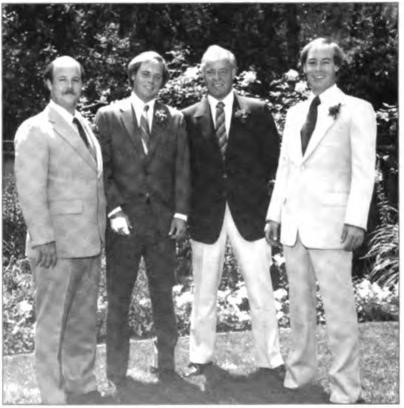
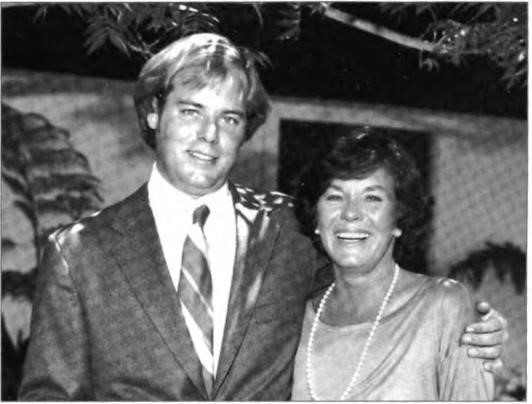
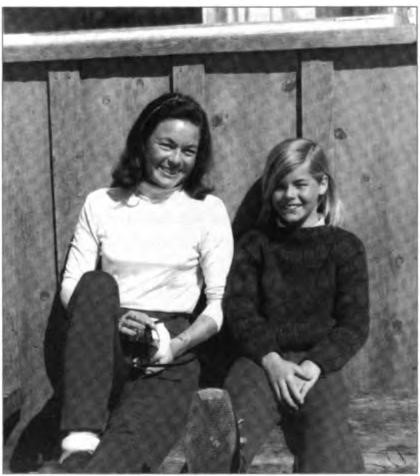
Marilyn Martin was born on 25 Jan. 1927. She grew up in Berkeley, attending John Muir grammar school and Willard Junior High. In 1938, when she was age 13 and in eighth grade, two or three days after her mother’s funeral, she went to Wyoming to stay with her grandmother, Minnie Martin. She attended high school there for three years.
While in Wyoming in 1939, at her grandmother’s initiative, she was christened “Helen Marilyn Martin” at the Congregational church in Sheridan. Marilyn recalls: “I was not christened when I was an infant because Christian Scientists don’t christen. I was born without a middle name. My mother felt that if I ever had a monogram, I could have an M on each side and my married name in the middle. But because my grandmother loved my mother, Helen, so much she wanted me to carry on her name.”
After three years she came back to live in Orinda and finished high school at Acalanes, which had opened in 1940. She graduated in 1942 with 8-10 other students, in one of the first classes. After attending Stephens College in Columbia, Missouri, for a year (many of the girls she knew in Wyoming had gone there), she got homesick, dropped out, and returned to Berkeley. She got a job at I. Magnin’s in Oakland and worked there for the next two years.
Billie Lawton described Marilyn in her 1936 diary as a “really lively gal.” Billie’s husband, Don, recalls: “Marilyn has always been a darling, so outgoing and so lovable. A sweetheart of sweethearts. She seemed very strong, courageous, and determined: Driving her own car, getting a job by herself at Magnin’s.”
In March 1945 Marilyn met Clarence James Zurcher (pronounced ZUR-kur) at the San Francisco Officers’ Club that Birnelyn Seymour had helped to start. They were married on 28 July 1945 in Berkeley, California. The son of Walter John Zurcher and Helen Saucy, he was born on 15 May 1917 in Laurel, Washington County, Oregon. His grandparents had come from Switzerland in search of religious freedom. The family was Baptist and had helped start the Bethany Baptist Church near Beaverton, Oregon. Jim grew up in Beaverton and graduated from the University of Oregon in December 1940 with a BS degree in business administration.
Jim joined the U.S. Navy in July 1940 then went to officer’s training at Northwestern University. During World War II he was commissioned in the navy and served on the USS Stack, a destroyer, until February 1943. Following three months of submarine school in New London, Connecticut, he became executive officer and navigator of the submarine Gunnell, based in Australia, until the end of the war. He was awarded the Silver Star medal for sinking and damaging over 25,000 tons of merchant and war ships during one single patrol at the end of 1944 in the region around Borneo.
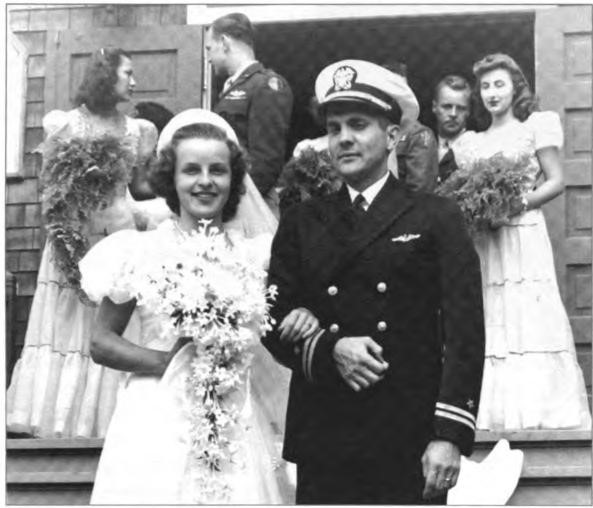
After the war, Jim stayed in the navy as a career officer. He went to post graduate school for a year at the U.S. Naval Academy at Annapolis, then in 1946 he became the executive officer of a new submarine, the USS Corsair out of New London, Connecticut. In 1946 when their first son was due, Marilyn returned briefly to her parents’ home in Orinda: William Zurcher was born at Peralta hospital in Oakland, California in 1946. Their second son, Robert James Zurcher, was born in Bethesda, Maryland, in 1948. During 1948-50 Jim was at Falls Church, Virginia in the Bureau of Naval Personnel. He went to San Diego, California, in command of the USS Catfish, operating mostly in East Asia during the Korean War. During 1952-54 he was with the CINCPAC fleet staff in Honolulu, then in 1954-56 in New London, chief staff officer and Commander of Submarine Development Group II. In 1957 he was there in command of submarine Division 82.
During 1957-58 he attended the National War College in Washington, DC, then in 1958-59 he worked with the Bureau of Naval Personnel as submarine detail officer. For 1960-62 he went back to take command of submarine development group II in New London. During 1962-64 he took command of the USS Truckee, one of the biggest navy tankers that fueled ships at sea. His family stayed at Norfolk, Virginia, the home port. In 1964-65 he took command of a squadron of 14 submarines, some of which were nuclear. In 196567 he was at the Office of Secretary of Defense (Robert McNamara’s outfit) in Washington, DC. During 1967-68 he worked with the Chief of Naval Operations office at the Pentagon as Deputy Director of the Strike Warfare Division for the Vietnam War.
In October 1968 Jim retired, after an enjoyable career of almost 30 years in the navy. He stayed in Washington, DC, for a year working for the Systems Research Corporation, doing contract work for the military. In 1969 he and his family moved to Mercer Island, just east of Seattle. They had moved 25 times before settling down there. During these years, Marilyn’s main activity was raising two boys. She was also active in some garden clubs, Cub Scouts, and navy clubs. In 1970 Jim started a business career with a Chinese partner exporting civilian housing materials to Iran. This continued until the shah fell in 1978, when he sold his portion of the export business to his partner and began doing personal investing.
In September 1983 Marilyn had a profound Christian rebirth experience. As she recalled in 1987:
On September 5,1 watched Pat Robertson’s “700 Club.” People asked Jesus to come into their hearts. That is all that’s required to become a Christian. At 10:00 Jim had gone to bed. I was sitting there having a cigarette and I thought, “I’d like Jesus to come into my heart.” But I had nothing to give to the Lord, so I said “Lord, if you will come into my heart, I will give up cigarettes.” I took one last puff, put out the cigarette, and went to bed. The next day I got up, had my coffee, watched the “700 Club” for an hour, had a second cup of coffee, then at about 11:00 as I was cleaning out a dirty ash tray, all of a sudden it hit me. I started to laugh and I said “Lord, you did it!” For 43 years I’ve been smoking (I enjoyed every puff) and I have always had a cigarette and a cup of coffee every morning, automatically. I was so excited. The peace and joy that flooded into my life was absolutely unbelievable. And I still have it. I have the Lord with me.
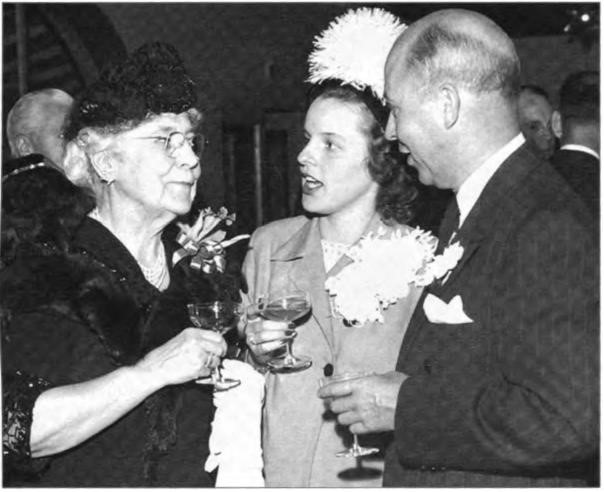
Zurcher and Ed Martin at young
Ed Martin’s wedding to Jeanne
Willi, Sacramento, 1945.
Marilyn joined a Bible study group in January 1984 and also began to read the Bible on her own. Jim died after a bad fall while on a fishing trip in Canada with his son, Bill, on 4 Aug. 1994, and is buried in the military cemetery in Portland, Oregon. Marilyn is now living in Sun City West, Arizona. Marilyn and Jim had two children:
1. William Edward Zurcher was born on 30 Nov. 1946 in Oakland, California. He graduated from Williston Prep School in East Hampton, Massachusetts, and then from Tulane University in New Orleans, Louisiana in 1969 with a BSc degree in mathematics. He then earned an MBA (Masters in Business Administration) from the Portland State University. Finally he graduated from the Pacific Banking School at the University of Washington in Seattle. He saw three years of active duty in the Vietnam War (1969-72) and then became a commander in the U.S. Naval Reserve.
He married Vickie Lee Ekblad on 12 May 1973 in Honolulu, Hawaii. The daughter of Charles Luther Del Mar Ekblad and Phyllis Jean Hibbert, she was born on 9 Sep. 1951 at Mt. Clemens, Macomb Co., Michigan, and christened there in Dec. 1951. Her church affiliation was Lutheran.
By 1981 he had become the vice president, and by September 1984 the credit administrator at the Oregon Bank in Portland. After two years in this high-stress job, he decided to leave and start his own business. So in Aug. 1986 he purchased Portland Import Auto Parts. In 1998 he made his second acquisition, Battle Ground Auto Wrecking—also in Portland. He seems very happy with both companies. Bill and his wife, Vickie, live in Gresham, Oregon. They had two children:
Nicole Renee Zurcher was born on 11 March 1976 at Hood River, Hood River Co., Oregon. She graduated from the University of Oregon in 1990 and is now an account executive with Tectronics Industries in Portland.
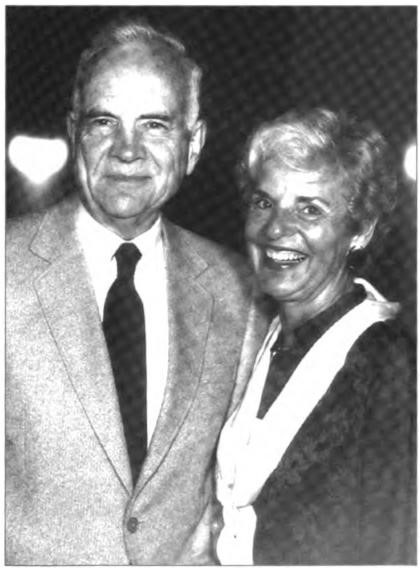
James Christopher Zurcher was born on 4 April 1978 in Eugene, Lane Co., Oregon. He graduated from Lewis and Clarke University in 2002. He is multi-lingual and taught English in Ecuador for a year and now is a lumber trader with Buckeye Pacific Lumber Company in Portland.
2. Robert James Zurcher was born on 4 Sept. 1948 in Bethesda, Maryland. After attending Williston preparatory school in East Hampton, Massachusetts, he graduated from Tulane University in 1970 with a BSc degree in mathematics and a minor in physics. He then received an MBA degree from the University of Washington. He worked for the Department of Defense (from 1975) on computer projects and was a commander in the U.S. Naval Reserve. He presently has a top position in the U.S. Internal Revenue Service. He lives in Falls Church, Virginia. His first love was computers.
Ed Martin, Sr. and Jerry Reyes’s two children were:
John Randall “Randy” Martin was born on 30 Sept. 1944 at Peralta Hospital in Oakland, California. He graduated from Stanford University with a BA degree in history in 1966. In 1969 he was ordained a minister in the United Church of Christ and from 1969-71 he was Assistant Minister at the First Congregational Church in Santa Cruz, California. From 1971-76 he was Pastor at the Glendale Church of the Bretheren in Glendale, California. During this time, on 26 July 1974 he married Polly Gail Williams Bishop in Glendale, California. Born on 4 March 1942, she was the daughter of William and Jane Williams. She had previously been married, to Steven Bishop. Randy and Polly were divorced on 16 Aug. 1977 in Palo Alto. There were no children by this marriage.
From 1976-80 Randy was acting assistant dean and adjunct minister at the Stanford Chapel. In 1979 he graduated again from Stanford with an MA in religious studies. Since Dec. 1980 he has been minister of the United Church of Christ in Arvin (near Bakersfield), California. During his ministry there he presented a number of extremely well done sermons on “Uncle Don,” describing Don Lawton and his interesting and courageous life.
Randy remarried on 21 August 1981 to Robin Elizabeth Riley at the Stanford University Chapel, Stanford, Santa Clara Co., California. Born on 1 Sept. 1946 in Los Angeles, California, she was the daughter of Sheldon Powell Riley and Dorothy Dodge. They had two children:
Robert Sheldon Martin was born on 25 April 1983 in Bakersfield, Kern Co., California. He is presently attending Santa Barbara City College.
William Riley Martin was born on 16 May 1985, also in Bakersfield, California. He is presently at Northern Arizona University in Flagstaff, Arizona.
In August 1990 Randy was called to be senior minister at the Church of the Foothills (United Church of Christ) in Ventura, California. This church is the descendant of one of the four oldest Congregational churches in southern California. Founded in 1867, this church called and ordained Ernest Warburton Shurtleff to be its pastor in 1889. Ernest was a prominent hymn writer and poet in the Congregational denomination (See Appendix C: Three Famous Shurtleffs).
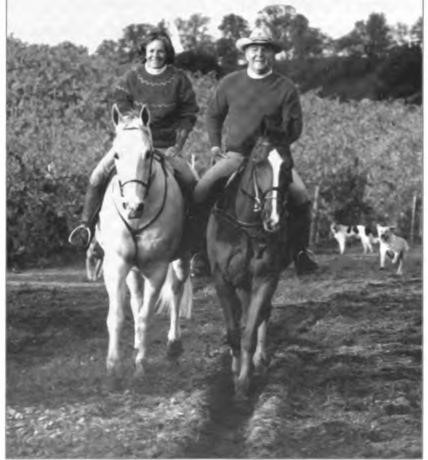
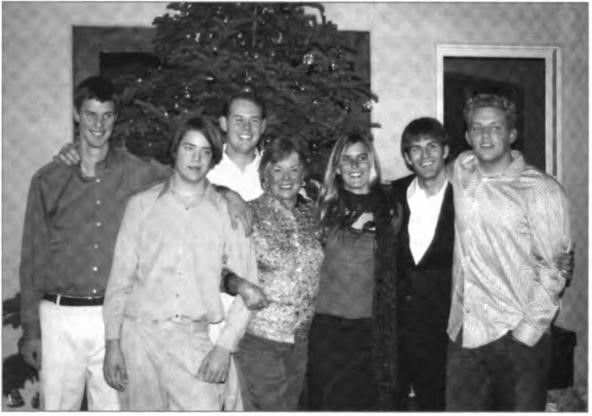
Robert James Martin was born on 8 March 1947 in Oakland, California. He grew up in Orinda, California. After one year of college at the University of California at Santa Barbara, he went to UCLA, graduating in 1968 with a BA degree in political science. Then he married Terry Ann Palmquist, his high-school sweetheart, on 15 Dec. 1968 in Orinda. The daughter of Gordon William Palmquist and Martha Jane Caldwell, she was born on 28 Oct. 1946 in Alameda, California. Bob entered Fuller Theological Seminary in southern California, graduating in 1972. His first work was as a youth minister with Young Life in Chico, California. There, between 1976 and 1983, he and Terry had two girls and a boy. Then the family moved to Moraga, California. As of mid-1987 he was Young Life’s area director for the Diablo Valley and the Associate Regional Director for the East Bay Area. He worked with young people of junior high and high school age, teaching them basic Christian values. Bob died 23 Sept. 2002 and is buried in the Mountain View Cemetary in Oakland. Their children were:
Kristin Martin was born on 2 Oct. 1976. She graduated from Campolindo High School in 1994, University of California Santa Barbara in 1998, and Johns Hopkins, with a Masters in international relations, in Dec. 2004.
Lindsay Martin was born on 14 Feb. 1979. She graduated from Campolindo in 1997, University of California Los Angeles in 2001, and received her teaching credential from St. Mary’s College in 2003. She now teaches at Piedmont High School.
David Robert Martin was born 9 Feb. 1983. He graduated from Campolindo in 2001, and now he is a senior at University of Texas-Austin.
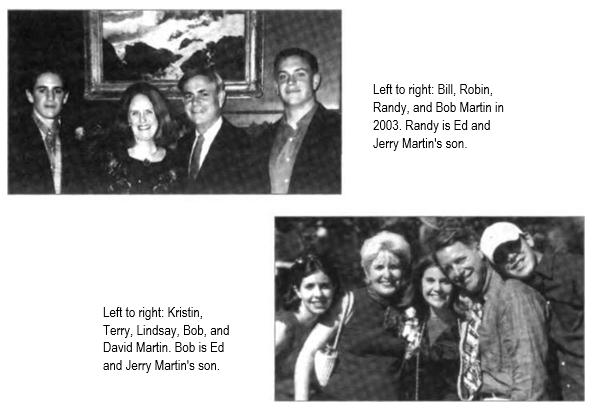
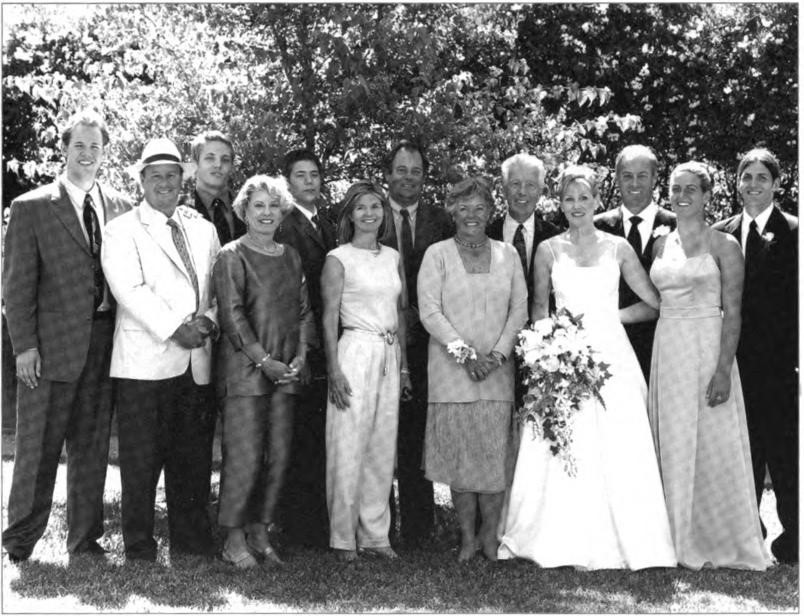
Michael is the eldest son of Edward and Willi Martin.
Everyone in the photo (except the “friend”) has the surname Martin.
Front row (left to right): Blair, Charlie, Debbie, Pam, Willi, Justine, and Julie.
Back row: Brandon, Patrick, Jeff, a friend, Michael, and Matthew.
 Shurtleff & Lawton Families Genealogy & History - Second Edition (2005)