** All Text on these chapter pages has been copied verbatim – with permission – from this book: “Shurtleff Family Genealogy & History – Second Edition 2005” by William Roy Shurtleff & his dad, Lawton Lothrop Shurtleff ** Text in pdf convert to word doc – any spelling errors from the book may or may not have been fixed. **
Growing up in Berkeley (1885-1902). Winnie (also called “Win”) was born on 19 March 1885 in San Francisco, Frank and Fannie Lawton’s first child. Her middle name was the same as her mother’s. Shortly after she was born, the family moved to Berkeley.
In Berkeley she attended the Maloney Grammar School. A photograph labeled “Class of 1894-1895, Grade Fourth and Fifth” shows her in the front row, second from the left. She was in the fifth grade.
By the time she was 11 years old, Winnie had begun to cultivate two of her hallmarks: talking a lot and writing short, humorous poems. Consider the following:
Then, there’s tantalizing Winnie
She’s a regular little devil
Makes more rumpus by herself
Than a lunatic eleven.
She’s the latest type improvement
Of the rapid fire gun
And when at last you think she’s through
She’s only just begun.
Winnie attended Berkeley High School. In 1898, when she was 13, during her “sub-junior” year, she dipped her pen in ink, opened to page 364 of the “Cash-Book” that her mother had kept as a scrapbook and diary since the mid-1870s, and began to write short poems, both silly and serious. Her beautiful script looked remarkably mature for a girl her age.
With pen in hand and book on lap
I will begin to scribble.
And so on the life of poetry
I think I will proceed to nibble.
My pen is poor, my ink is pale
My hand shakes like a puppy dog’s tail.
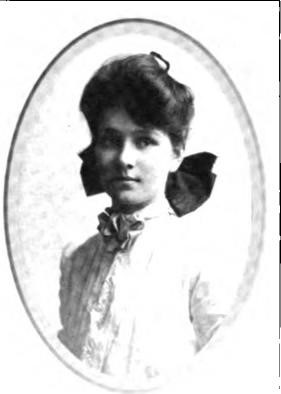
Winnie was a senior at Berkeley High in 1902. Her report card for the term ending in June, signed by principal M. C. James and her father, Frank Lawton, shows her with good grades in all her subjects: Latin, Greek, U.S. history, and physics. Winnie is mentioned numerous times and has a nice photo in the Berkeley High School yearbook, 011a Podrida, for 1902. Her appearance is described as “unassuming,” her chief accomplishment as “talking and talking,” and her quotation “Eager interest in doing good.” A two-line ditty reads: “And WINNIE LAWTON keeps a dancing school, Where grace and beauties rare are all the rule.” At “What I came to B.H.S. for,” Winnie’s entry says “To talk, talk, talk.” And The Onlooker notes: “Winnie Lawton—Her wit was more than man, her innocence a child.”
Image: Winnie at Beverly High School, circa 1902. She was a wise young lady.
Winnie was a very mature young lady for her age. She was extremely close to her parents, and they gave her considerable responsibility at an early age. Bimelyn Seymour Piper recalls:
“Winnie and her mother were very much alike in character, interests, and appearance—almost like twins. And they were very close as friends. Winnie was also very dose to her younger brothers and sisters. Don Lawton, the second to youngest, remembers that “She was just like a mother to us kids. She could persuade us to do anything in her nice way.”
College, Teaching, and Travel (1902-15). Winnie went to college at the nearby University of California at Berkeley, starting in mid-1902. She was just 17 years old, very young at the time. At Cal she continued her study of languages, especially French and English. Birnelyn recalls, “She was very good in languages, being able to read and write Greek, Latin, French, and Spanish. She was an excellent student, very broad minded, forward and modern thinking.” During college she went out with a young man named Hans Lisser. He was a piano player, composer, and artist, and he later became a famous ophthalmologist in San Francisco. Winnie graduated at age 21 with the Class of 1906. Unfortunately, because of the great San Francisco earthquake that year, no Blue and Gold yearbook was published for 1906, nor was there a commencement service. Thus we know little of her activities during college. Her photo appeared in the previous yearbook (vol. 32, 1905).
Upon graduation, Winnie began to look for work. She decided to become a school teacher. Birnelyn notes that this was not an occupation she particularly wanted, but there was not much that a woman in those days could do. So she went back to Cal for a fifth year and earned a teaching credential. Her first job was in a small rural public grammar school outside of Petaluma. Frank drove her up there the first day in his horse and buggy. She loved working with the children. The Journal of Helen Lawton, 1909-1911 describes how Winnie returned home to Berkeley to visit the family from time to time, usually bringing generous presents.
In the fall of 1910, Winnie went to Riverside, California, to teach school there for one year. In 1911 she returned to Berkeley and began to teach at Emerson School, a public grammar school on Forest and Piedmont streets. She was there until 1915.
Winnie’s mother, Fannie, had started to take a serious interest in Christian Science while Winnie was a junior or senior in college. As Birnelyn Seymour Piper recalls:
When Fannie spoke seriously of the healings she had heard described at Wednesday night testimonials, Winnie retorted, “Oh mother, how can you believe stuff like that. Its ridiculous.” She felt she was so smart. When Winnie was a junior or senior at Cal, Fannie told Winnie that there was to be a lecture on Christian Science by a famous professor, Herman S. Herring, from Johns Hopkins University. Winnie condescended to go. The professor, an eminent scientist in several fields, explained how he had been converted by Mary Baker Eddy, who he felt was teaching the highest Science of all. Winnie came out of the lecture humbled. Her whole attitude toward Christian Science turned completely around. She soon became a staunch Scientist, the most devout in the Lawton family, and remained so throughout the rest of her life.
Winnie began to see the practical power of Christian Science when she was teaching in Petaluma. During the 1970s she made a four-page list titled “Testimonies,” brief reminders of what she had presented at Wednesday night Christian Science testimonials. She cited 29 examples of God’s intervention that she had witnessed. Two of the earliest read: “Fainting prevented while teaching school at Petaluma and while I was reading in Monte Rio.” “Helped while driving from Monte Rio to Berkeley. Stopped at Petaluma [Christian Science] Reading Room. Used Hymnal before start.” The drive was a long and difficult one.
While teaching in Berkeley, Winnie developed a longing to travel. Though generous, she had also saved some money. Her first trip was to Hawaii. Then in the summer of 1914, at age 29, she got bolder, in fact remarkably bold for a single woman of this era. She decided to take a summer trip by ship alone to Asia, including China, Japan, Hong Kong, the Philippines, and Honolulu. On board the ship (the Pacific Mail Steamship Company’s 27,000-ton steamer Manchuria), Winnie met a man named Charles Birney Seymour, who was 48 years old, 18 years older than she. He was taking a vacation tour with his mother (Anna Lemond Seymour) and his daughter (Frances Birney). He had previously been married twice—according to his marriage certificate to Winnie. Now he was single. Winnie, who was very mature for her age, was quite taken with this older man. In fact, it was mutual love at first sight. Following the trip, Birney (as he was called) returned to California from his home in Wyoming. He and Winnie were married on 19 June 1915 in Berkeley.
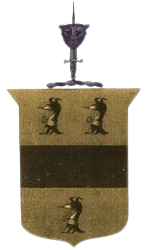
Charles Birney Seymour and His Ancestors. Winnie’s new husband, C. Birney Seymour, was descended on his mother’s side from the Bimey family, which had a long and interesting history. According to O’Hart’s Irish Pedigrees of the Birney Family, the family was of pure Protestant Scotch-Irish descent. The family motto on the coat of arms was “Arcus, Artes, Astra,” which referred to the bow, the arts, and the stars (religion). They lived mostly in the nine counties of northeastern Ireland, which are known as the province of Ulster. The old family homestead was near Cootehill, County Cavan. The first Birney to leave Ireland for America was James.
James Birney (1767-1839). Born in 1767 in the north of Ireland, James Birney, secretly left his father’s affluent home in County Cavan and embarked at Dublin in September 1783 to seek his fortune in America. He was 16 years old at the time, and had no money and little baggage. On the day of his arrival, he obtained employment in a wholesale and retail dry goods house, where he remained for the next five years. He then obtained a stock of goods on credit and in the fall of 1788 opened a store in Danville, Kentucky. In 1790 he married Martha Reed, a beautiful, intellectual woman from a wealthy family. The marriage proved a very happy one. James organized and became president of the local bank of Danville, where he served for many years.
James and Martha had two children in Danville: James Gillespie Bimey and Anna Bimey. The children’s mother, Martha, died in 1795, when her firstborn was only three years old. Thus the father, James Bimey, was left to raise two children by himself.
In an article titled “James Bimey and His Home,” the Kentucky Advocate (14 July 1968, p. 8), reported that James’s ‘business enterprises were uniformly successful. For many years he was reputed to be the richest man in Kentucky and one of the most cordial in his hospitality.” This occasioned the founding of Woodlawn. In 1799 he purchased 120 acres for the estate, and the two-story brick mansion was finished in 1800, probably not in 1792 as is sometimes alleged. “Doubtless James envisioned a home that would descend in his family just as the ancestral one in Ireland had come down through many years.”
In religion, James was a zealous Episcopalian. Support of the church was, for him, a matter of family pride. He was genial and hospitable, and had great moral and physical courage. Though he owned 20 slaves on his Kentucky estate, he avoided treating them harshly, to the reported despair of his overseers.
His active life was checked in 1828, when he fell while mounting his horse and fractured his thigh. He had to use crutches for the rest of his life. He eventually died in 1839 on his estate in Danville, well after his children were grown and married. At his death Woodlawn passed out of Bimey hands, for his daughter had already married and moved away, and his only son, James G., had left Kentucky, never to return. In 1968 the estate was still a Kentucky historical landmark.
James Gillespie Birney (1792-1857). The oldest son became a famous man. He was C. Birney Seymour’s maternal great-grandfather. James G. was born on 4 February 1792 in Danville, Kentucky. Upon the death of his mother in 1795, he and his sister were placed in the care of Mrs. Doyle, his father’s oldest sister. A widow without children, she had come from Ireland to care for the home. At age 11 James G. was sent to Transylvania University at Lexington. There he remained for several years. He returned home to enter a “Seminary” that had been opened at Danville by Dr. Priestly.
A southerner and a member of a wealthy slave-holding family, James G. learned from his father of the difficult moral issues raised by the keeping of slaves. According to Nelson’s Encyclopedia, he graduated from Princeton (actually Yale) in September 1810, then studied law with Alex J. Dallas in Philadelphia, where he was admitted to the bar after three and a half years. In May 1814 he returned to Danville, Kentucky, and began the practice of law. On 1 February 1816 he married Agatha McDowell, who was born in 1798. Between 1817 and 1838, they had 11 children. In August 1816 he was elected a member of the Lower House of the General Assembly of Kentucky (the Legislature). Wanting a wider sphere for his political ambitions, he bought a plantation within two hours ride of Huntsville, in Madison County, Alabama. He moved there with his family in February 1817, and stayed until 1833.
In Alabama, James managed a plantation, practiced law with great success, and from October 1819 served in Alabama’s First General Assembly. There he showed his interest in fair treatment for slaves, when he introduced a law
that was passed, allowing slaves on trial before a jury to have counsel. Opposing a resolution endorsing Andrew Jackson for the presidency, however, cost him his political career at the next election. During all this time he was himself a slaveholder, but he gradually became more and more convinced of the evils of slavery. In about 1827 he began to advocate gradual emancipation of slaves.
In 1833 he returned to Kentucky, established his home one and a half miles from Danville, and continued to urge the emancipation cause. In 1834 he freed his own slaves. The next year he was converted from gradualism to an immediatism, and joined the American Anti-Slavery Society, of which he was made a vice president. In 1835 he attempted to establish an antislavery journal in Danville, but for this he was ostracized socially, and not being able to secure a printer, he moved out of the South to Cincinnati, Ohio. There, on 1 January 1836, he published the first issue of The Philanthropist. Surprisingly, even here he met with fierce opposition, but his paper exerted considerable influence in the Midwest. James G. Birney, however, soon turned over active control of the paper to Gamaliel Bailey, moved to New York City in 1837, and devoted himself to the service chiefly as a lecturer and as secretary of the Anti-Slavery Society. Bimey opposed the radical extremist faction of the abolitionists headed by William Lloyd Garrison, who execrated the U.S. Constitution and advocated “no government” views.

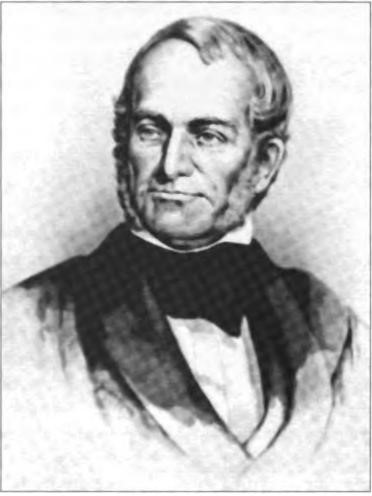
Birney thought this group would inevitably alienate many friends of emancipation and injure the cause. He favored working for emancipation through the political machinery furnished by the Constitution. He was, therefore, one of the leaders of those abolitionists who in 1840 broke away from the American Anti-Slavery Society and founded the Liberty Party, the first political party in the United States to give most of its attention to the slavery issue. In both 1840 and 1844 James Gillespie Birney was the Liberty Party candidate for president of the United States of America. He polled 7,100 votes and 62,300 votes in the two elections, respectively. In the 1844 election he ran on his antislavery ticket against Democrat James K. Polk and Whig nominee Henry Clay. Birney’s votes caused Clay’s defeat.
Between 1834 and 1840, James G. Birney wrote and lectured extensively on emancipation of slaves. Among his publications are “On the Sin of Holding Slaves” (1834), “Letter on Colonization” (1834), “Addresses and Speeches” (1835), “Political Obligations of the Abolitionist” (1839), “American Churches, the Bulwarks of American Slavery” (1840), and “Speeches in England” (1840). In 1890 his second son, William Birney (1819-1907), wrote his father’s story, Life and Times of lames G. Birney.
His wife, Agatha, died on 8 October 1838. On 25 March 1841 he remarried to Elizabeth Poth Fitzhugh, who was born in 1802. They had two children: Fitzhugh Birney (9 January 1842 to 17 June 1864) and Anna H. Birney (27 November 1843 to 8 March 1846), making James the father of 13 children in all. In 1845, James like his father before him, was disabled for life when he fell from his horse. He lived in retirement, first at Bay City, Michigan, and after 1853 at Eagleswood, near Perth Amboy, New Jersey. He never returned to the South. He died at Eagleswood on 25 November 1857 and was buried there. Afterward, however, his body was moved and now rests beside that of his second wife in the Fitzhugh burial plot in the Williamsburg Cemetery at Graveland, Livingston County, New York. A large marble monument marks his grave.
One of James Gillespie Birney’s sons was governor of Michigan (1861-63) and Minister to the Hague. Two were major generals and two were colonels.
Nelson’s Encyclopedia concluded its account of his life by saying, “James Gillespie Birney is one of the most attractive personalities in the great Anti-Slavery struggle in the United States. In no sense an extremist, he was himself tolerant and fair, but courageous and unflinching in his advocacy of what he believed to be the right.”
Dion Birney (1823-63). James Gillespie Bimey’s fourth child, Dion was born on 8 February 1823 near Huntsville, Alabama. He was C. Birney Seymour’s maternal grandfather. In 1845 he married Sarah I. Crawford in Cincinnati, Ohio. They had two children: Anna Lemond Birney and Robert Birney. Dion was a doctor during the Civil War. He died in August 1863 at age 40. His wife, Sarah, died at Saginaw, Michigan, in 1888.
Anna Lemond Bimey was C. Birney Seymour’s mother. She was born in Saginaw, Michigan, and was a descendant (granddaughter) of Colonel Lemond of the American Revolution. She was married to Charles Seymour, but for some reason they were divorced at a very early date. Anna had some wealth, perhaps because the Crawfords of Ohio, who owned a significant part of Cincinnati, were part of the family. C. Birney Seymour was their only child.
C. Birney Seymour was born on 22 August 1866 in Connecticut. As his second daughter, Frances Seymour Holmes, recalls:
Birney was raised in a large colonial-style house in Saginaw, Michigan by his mother and his maternal grandmother (his mother’s mother), Sarah I. Crawford (Birney?), both of whom were very domineering, strict, almost severe, divorced ladies. They were not very pleasant, in fact they were hard to get along with. There were no adult men in the family. Birney was not allowed to play with the other children in the neighborhood, considering outsiders as unfit companions. Thus Birney was not particularly close to his mother. At a young age, he was taught to knit. It was a very unusual upbringing.
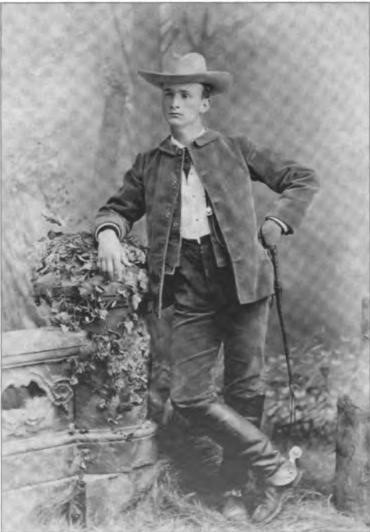
Birney ran away from home at age 14 and went to Texas and the West. He wanted to be a cowboy and traveled a lot. A photograph taken in Texas shows him in his late teens or early 20s in cowboy garb. Out of money, he returned to Saginaw, and to school. He went to a private college (probably in Michigan) but never finished.
Birney’s first wife was named Winifred. Her last name is unknown and the date and place of their inarriage is also unknown. She was an Irish beauty. The couple had one child, named Clinton Kirby Sormour, born in about 1894 in Saginaw, Michigan. Shortly thereafter, Winifred died of a fez,er. Clinton was an extremely handsome man. He graduated from Cornell Law School, and held a degree in corporate law from Harvard.
Birney Seymour remarried in about 1901, this time to Caro Spears. Caro is an Irish name and she was probably born in New York. They lived for several years in Duluth, Minnesota, where Birney worked for a lumber company. Their first child was a son, who died in his infancy. Their second child was a girl, Frances Birney Seymour, born on 27 October 1903. The family always spoke of itself as being Scotch Irish Presbyterian, though Birney was not a church goer. The term “Presbyterian” was necessary to assert that it was not Catholic. In 1905 Birney moved his family from Duluth to Wyoming, where he, together with three men from Chicago, started an open-pit coal mining operation. Just outside Sheridan, Wyoming, they built a coal mining town, which they named Carneyville, after the partner and president, Mr. Carney, who had put up most of the funds but stayed in Chicago. The miners lived on one side of the tracks and the non-miners and owners on the other. The town is no longer in existence.

Winnie’s Marriage to C. Birney Seymour. Raising a Family (1915-31). As noted above, Winifred Lawton and C. Birney Seymour were married in Berkeley on 19 June 1915. Berkeley was chosen as the site since Winnie wanted her family to be able to attend the wedding. It was Winnie’s first marriage and Bimey’s third. She was 30 years old, and he was 48. Don Lawton recalls his reaction: “I’ll never forget when I overheard Win tell mother that Birney had asked her to marry him. I thought, ‘Oh no! I hope she doesn’t marry an old man like that.’ To me, a young kid, he seemed like an old man.” Immediately after the wedding, Winnie and Birney moved back to his home in Cameyville, Wyoming. Life in this coal mining camp was not easy. The only real town nearby was Sheridan, which was nine miles away. It was icy cold in the winter but there were some amenities. As Frances Seymour Holmes recalls of the years when Bimey and his second wife (Frances’ mother) lived in Cameyville:
The two-storied house in Carneyville was well built—as houses were at the turn of the century. The coal furnace heated the entire house 24 hours a day in winter. There was also a furnace in the chauffeur’s quarters and the garage. The summer temperatures were moderate.
There was a company-owned store, a meat market, and an apartment above the company office for visiting business friends. There was even a movie house. Foods—such as fresh crab and live lobster, plus out-of-season fruits—were imported. There was a wine cellar, a root cellar, and an entire room for canned food, imported goods, and nuts.
We traveled to New York once a year and to Chicago at least twice. We also went abroad. Frankly, as much as I enjoyed and appreciated my four years in Berkeley, I never really got warm as we were in Wyoming.
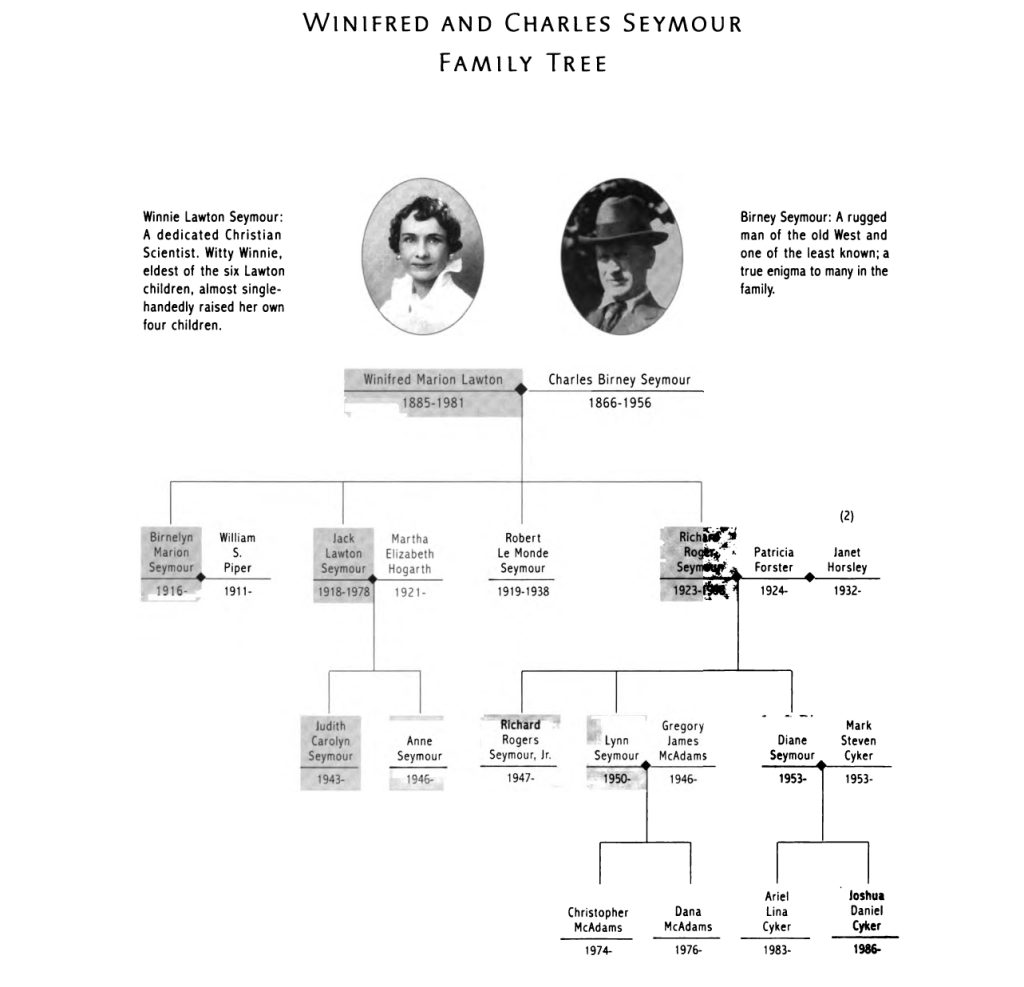
Winnie lived in this same house in Cameyville. On 14 November 1916 Winnie and Bimey’s first child, Bimelyn Marion Seymour, was born in Cameyville, Wyoming. Winnie made up the name “Bimelyn,” and the child’s middle name was the same as that of Winnie’s mother (Frances) and her mother’s mother. Shortly after or before Birnelyn’s birth, Frances Seymour (Birney’s daughter by his earlier marriage), now 13 years old, was sent to California to stay with Winnie’s parents, Frank and Fannie Lawton. There she went to school for four years.
Birnelyn was a sickly child at birth. She recalls the story heard numerous times from her mother:
I was diagnosed as having a serious disease. Later it was diagnosed as spinal meningitis. Doctors, unable to cure me, said I would either die or be a semi-invalid for the rest of my life. When father realized that doctors could not do anything to help, he told Winnie, “Go ahead and call a Christian Science practitioner.” I was healed.
A little later, when I was about two or three years old, I had asthma so badly that I was totally incapacitated. Again I was healed. My condition turned around from being fragile and sickly to one of fantastic health, with great energy and strength.
Still later, when I was about seven or eight years old my finger was slammed in the hinge side of the door of our big seven-passenger Lincoln limousine. It was smashed flat. I cried all the way home, and mother called a Christian Science practitioner. The finger was completely healed. I didn’t even lose the fingernail.
Thus, from her early years, Christian Science healings became an important part of Winnie’s life and of the lives of her children.
Charles Birney Seymour was very proud of his Birney ancestry. He used his middle name in preference to his first, included the name in the names of his second and third children, and often told his children about the Bimeys as they grew up.
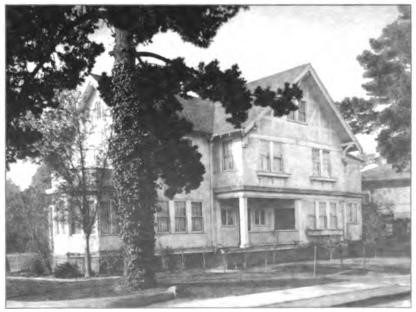
During the summer of 1918, Winnie left Wyoming briefly to visit her family in Berkeley and Monte Rio. A photograph taken that June shows her and Frances Seymour in bathing suits on the beach at Monte Rio. Then in 1919 the Seymour family moved from Wyoming back to Berkeley, and Birney, now 51, decided to retire. The family bought a big three-story house in the Claremont district of Berkeley at 2844 Woolsey Street on the corner of Claremont, just a half block from Don and Billie Lawton. Frances Seymour went East to Bradford Academy, a girls’ school in Massachusetts, then returned to Berkeley and graduated from the University of California at Berkeley. After graduating she taught school in Modesto. On 8 August 1930 she married Mr. Halliday B. Holmes in Berkeley. He died on 17 September 1967 in Bakersfield, leaving her a widow. She lived in Bakersfield for the rest of her life.
Birney and Winnie’s second child, Jack Lawton Seymour, was born in Berkeley on 24 May 1918. During this time Bimey had to go back to Cameyville from time to time on business. Each time he went, the whole family, including the children, nurses, and maids, went with him. Thus their third child, Robert Le Monde Seymour, was born in Cameyville, Wyoming, on 16 November 1919. After Robert, Winnie had a miscarriage. Then their fourth child, Richard Roger Seymour, was born in Berkeley on 9 March 1923. Each child was born in an alternate house.
The early years of Winnie and Birney’s marriage were apparently happy ones for everyone. The family lived well, almost affluently. They owned a chauffeur-driven Lincoln, partitioned between the driver and the passengers. During the summers they spent a week or two staying at the Lawton cabin in Monte Rio. Finally, in their heyday, they needed more room for the family of six, plus a chauffeur and nurse. So in 1928 they bought their own summer home in Monte Rio, just above Frank and Fannie’s home, where Winnie had spent so many happy years in her childhood. This Lawton house would stay in the family for the next 58 years. After the Depression hit in 1929, Bimey lost a large amount of money. By 1930 Winnie and Birney’s marriage was in trouble.
Before going on, let us take a closer look at Wirmie and Bimey as individuals.
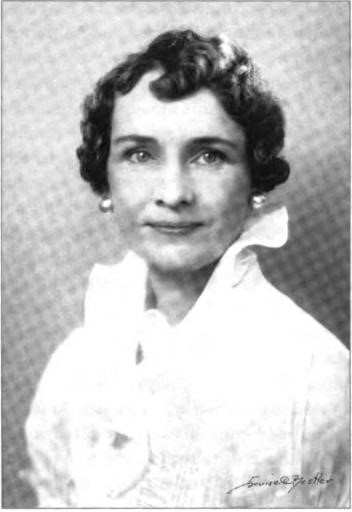
Winnie as a Person. Winnie was loved by everyone who knew her. She had a rare combination of maturity and inner strength, fun and humor. The center of her life was a deep religious faith in Christian Science that filled her heart with love and was indispensable in carrying her through hard times. Like her mother, Fannie, Winnie liked spiritual sayings or poems. She copied a number of her favorites (including –The Power of Love the World Can Sway”) from a devotional book of Fannie’s. Here are two more that she liked to repeat:

Charity
Don’t look for the flaws as you go thru life
Or even when you find them.
It’s wise and kind to be somewhat blind
And search for the light behind them.
A bell’s not a bell ’til you ring it.
A song’s not a song ’til you sing it.
And love in your heart was not put there to stay.
Love is not love ’til you give it away.
Birnelyn, Winnie’s oldest child, who lived with her for many years and probably knew her best, recalls:
She was the most wonderful mother. I felt that she was everything she could be as a person. All her kids were totally devoted to her. We would do anything for her. I still can’t believe that she was my mother. We were so lucky to have her.
She was always very fair and discreet with us. She never discussed anything of our personal lives with others, not our shortcomings, our dates or boyfriends, nothing. She never would inquire into my personal affairs, and never asked personal questions, such as where I was going or where I had been. And she never lectured us. Even when we were small children, she never opened or read our mail. Whenever I would get a phone call from a friend, mother would always leave the room, so I could talk in privacy. This teaching came from her mother. They both felt that privacy was very important. And both emphasized the importance of family loyalty.
Also like Grandmother, mother was always doing things to help other people, especially those in need. I remember going to visit needy families with her in west Berkeley. She would buy clothes for the poor kids in her school. She was so kind.
Mother had tremendous inner strength. We could always turn to her. She told me many times that she could never have survived and raised us four children if she hadn’t had Christian Science to lean on. It is so important to have something that you can turn to that you know works. She studied and practiced wholeheartedly throughout her life.
Winnie was very close to all her brothers and sisters. Don Lawton remembers: “Win was so doggone sweet. She was just a sweetheart all her life. Nobody could take her place.” She was perhaps closest to Harry and Helen.
Winnie was always ready with a joke or a pun, a limerick, or a cute little poem, which she would sign with some funny name like Win Tm Tm—Queen of the Redwoods (from Monte Rio). Lawton Shurtleff remembers her as “one of the most humorous ladies you’ll ever meet.” Mardy Peet Love reminisces:
Winnie was the motherly hen and had a very mature disposition. I remember her as being fun. She had a new outfit every year. It was specially made and all one color. It always had the same color hat, coat and dress, for example all red one year and all green the next.
When I was down with polio, she constantly sent me little jokes out of the Christian Science Monitor. She was very dear in attempting to help me through Christian Science, but she always did it in a very low-key way. She did not try to convince me to try it, but just suggested that it was a proven alternative. For example, she would write me and say, “1 want you to come and visit me in Monte Rio. I know you can go up and down those stairs. We know that Divine Mind realizes your wholeness and wellness and your being God’s perfect child.” She was sharing what she knew to be the Truth, without ever being pushy. She kept good, loving thoughts and gave me every opportunity to get any help I could from Christian Science.
Over the years, she never failed to write my mother, Dorothy, at least once a week for as long as mother lived.
Birney as a Person. Birney was a big man, with tremendous energy and vitality, a successful, self-made businessman, and a hard-driving coal mine owner and operator from Wyoming.
His first daughter by a previous marriage, Frances, remembers:
I had considerable rapport with Birney. I think I understood him better than anybody else. I could get along with him, and we had a pretty good time together; but I didn’t have to live under the same roof with him. I don’t think anyone was close to him. He was difficult, a very difficult man to live with, I think in part because of his unusual upbringing. He had a difficult personality. And when he drank, he became extremely difficult. He was a macho male, an opinionated, ultra-conservative Republican, somewhat arrogant, with no hobbies.
Father did get along with some people; with outsiders and a few old friends. He was not shy. He conversed easily with strangers and others outside the family. But he could not communicate on intimate terms.
Would you believe that he loved babies and very small children? But when they were old enough to have minds of their own, he lost touch; he couldn’t cope. Winnie was not strong enough to handle him.
Birnelyn Seymour Piper, his second daughter (Winnie’s first daughter), generally agrees with Frances’s description, but adds:
Father came from a good old family. Oh what a powerhouse he was, very strong physically and mentally, very intelligent and very strong willed. In his 60s, he had more strength and endurance than most men age 30. He was big and very healthy, a dynamic man and a hard worker in his coal mines and lumber companies. He looked strikingly like his grandfather, James Gillespie Birney, who ran for president of the United States. As a young man my father was very handsome and a marvelous dresser.
Father should never have retired. He needed action and challenges. He was not a man to be tamed, to live within the confines of a city. He loved the out of doors. It was hard for him to have to stay around our house, to be so confined. He read a great deal.
He was not a heavy drinker and did not drink that often. But if he had three drinks or more, he was feeling no pain and then he sometimes got mean, harsh, and abusive. On several occasions he hit Mother. Yet I don’t think alcohol was a major contributing cause to his problems with her. Though Winnie never drank herself, her son Jack did. Yet I don’t recall that she ever harassed either of them for it.
Though Father had no religion, that was not a cause of his and Winnie’s separation. Christian Science saved him tens of thousands of dollars in doctor bills. The problem was his severity, his harshness.
Father didn’t understand his children, so mother was the buffer. I think he was too old to know us kids. None of us children had a close relationship with him. It wasn’t that we had bad relationships, we didn’t have any. Yet I never thought of him as old when we were growing up. He could keep up with us. He was a dominating man, and quite severe. He had a short temper and had disposition. I think he got that from his mother, who was overly strict with him.
Don Lawton, who lived near the Seymours for years, remembers Bimey as “a big rough and tumble guy, one of those great big moguls that saw things his own way and pushed right on through. But he wasn’t inherently a bad guy.”
But Dick Seymour has different memories:
I spent much time with my father on weekends in San Jose while I was in grade school. Also, he lived with me in Berkeley and Orinda for many months after World War II. The only time I ever saw him take a drink was after my discharge when he and I visited Carmel for a day and he had one martini with me. I never saw my father be “mean, harsh, or abusive.” He was extremely honest in dealing with people and had pleasant relations in dealing with people anywhere he went with me. In my association with father, he was far from “severe, rough and tumble” but just the opposite. I have never seen him loose his temper.
Mardy Peet Love was a little girl when she knew Birney:
Winnie and Birney’s relationship was always for me a frightening one. He was a spooky person for me. He was not loving in any way. He never made us feel that he was glad to have us around. I could not relate to him. Yet it was very exciting because we always went in the chauffeur-driven car with the lovely fur lap robes down to their yacht. It was that kind of thing, a very different world in my early days.
Ed Martin spent a lot of time around the Seymour home while he was growing up:
I thought Birney was a very interesting and nice guy, though he kind of stayed out of the family swim. He was a very gruff sounding guy and a little curt with everybody. I never saw Birney drink and was not aware that his drinking was a problem.
Divorce and Years Alone (1931-59). Winrtie and Bimey separated in about 1931, after 16 years of marriage. The basic causes of the parting have been described above. Finally the last straw came. As Don Lawton recalls: “I remember clearly one day, Win called me at my office. She was sobbing and Bimey was drunk. She told me she couldn’t stand it any longer. So I went over and told him to pack his suitcase and get out. He did, and they were later divorced.” Birnelyn, who was there during the incident, recalls: “I was going to Piedmont High School at the time. Birney was fed up after years of being cooped up, and he’d had a few drinks too many. He was being exceptionally difficult and unpleasant. We were all relieved when he left. It took the pressure off all of us, and off him too. I don’t think he came back after that.” The actual divorce was a year or two later.
But Dick Seymour asks: “How could I be relieved when my father left home? I had a good and close relationship with him.”
Bimey moved out, to another house in Berkeley. Winnie and her children lived in the big house on Woolsey Street for the next nine years. Bimey continued to help support his kids financially, and he visited with them a little from time to time. Birnelyn recalls him telling her stories about the Bimey family.
During the years of trials and tribulations that followed, Winnie and her four children received great support and help from her brothers and sisters. Hazle Lawton Shurtleff, Winnie’s younger sister, invited Birnelyn (age 15) to live with her and Roy for six to eight months at their home on Crocker Avenue in Piedmont. Hazle and Winnie had decided that it would be easier for Winnie if there was one less child at home at the time. Harry Lawton had told his dear older sister, “Anytime you are in deep water, whenever you need me, no matter where in the world I am, just call and I’ll be at your side.” During the next few years he visited several times from Seattle. Birnelyn notes that “Jack was the most sensitive of the four, and it was hardest on him.”
In the years that followed, Winnie had Bimey over for dinner occasionally. She made every effort to maintain a friendly atmosphere. With the help of Christian Science, she worked to heal the situation for herself, her resentment and bitterness and all. On one occasion, several years after the separation, Birnelyn came home and found Bimey there. He had dropped in and was waiting to see his boys. Winnie was away. She remembers:
Something had happened that was very upsetting to me. I burst out and told him everything. Then I really started crying. And, you know, he starting crying with me and for me. He came over and put his arms around me, the one and only time in his whole life. He was usually so tough, harsh and unreasonable, and he buried his soft side under all this protective coating.
A year or two after the divorce, in order to better support herself, Winnie went into the real estate business in Berkeley, in partnership with Mrs. Officer. The two women never signed any papers. It was a “handshake partnership agreement,” based only on each other’s word and mutual trust. They bought and sold homes successfully for four or five years.
In 1938 a crisis occurred. Winnie’s third child, Bob, started to act strange. He was hearing bells and sirens, having dizzy spells, and not seeing clearly. Bob had a deep belief in Christian Science (though Dick Seymour says that Bob never mentioned Christian Science to him) and wanted to deal with his problem through his religion, as did Winnie. But it got steadily worse. Finally Bimey insisted that they take Bob to a hospital. They did, diagnosed a tumor, and upon operating found him to have a brain tumor about the size of a tennis ball. He died in Merritt Hospital in Oakland on 14 March 1938 at age 18. This, of course, was a major, tragic blow to Winnie.
In about 1940 Winnie sold the big house on Woolsey Street and bought a smaller 10-room house at 2721 Webster Street in Berkeley, just two blocks away. She and Bimelyn (who was working for the summer in the office at Montezuma Mountain School) moved in there together. During World War II, she took in young military couples, on a semicommercial basis, so that the couples could be together. The naval personnel went to the Christian Science center in Alameda asking for help to find rooms for their wives. Winnie decided to help, as she had three extra empty bedrooms. One of the people she took in, in 1942, was Betty Lawton Parker, her brother Harry Lawton’s daughter.
The war years were difficult ones for Winnie; they tested her faith. All three of her living children were in dangerous combat zones. But she knew she could trust in God’s will. So during the war she wrote this poem:
Security
God sails the seas, He flies the skies
He travels o’er the land.
So how could man be there alone
Or separate from his hand.
I am so grateful that I can know
This fact for all mankind.
God’s power and love is here for all
Each one is safe in mind.
IN. L. Seumour
One other sample of her poetry from these years remains. It is written to little Bill Shurtleff, Hazle Lawton’s first grandchild and (had they been living) Frank and Fannie Lawton’s first great-grandchild. He was born on 28 April 1941 to Lawton and Bobbie Shurtleff:
Hello Bill and greetings to you
From your great-aunt far away.
We will welcome you in person
At a not so distant day.
Let me ever whisper to you
And admire your wisdom rare
For your wise choice of a family
A family very much beyond compare.
It’s a family who’ll stand behind you
Sustain you when things go wrong
Cheer you when everything’s sailing
And give you a boost with a song.
Your mom and your pop are one hundred percent
Your grandmas and pas all true blue
Here’s a great big welcome and a bunch of
love, A lucky little rascal are you.
W.L.S.
In 1949, after her oldest child Bimelyn went to Japan, Winnie sold the home on Webster Street and moved into her home at Monte Rio. In September 1958 Bimelyn was married to William Piper. They lived for the next five and a half years in nearby Guerneville, so they were able to visit often. During this time Jack Seymour bought Winnie a new, little green house to get her off the hill. The family kept their other house in Monte Rio and Winnie stayed in the smaller house for only a few years.
During World War II, Bimey Seymour lived for a while in San Diego then briefly in Salinas (at 21 Central Avenue). Later he moved back to the Bay Area, to Oakland. Several years before he passed away, he wrote to Winnie saying, “You are the best friend I ever had.” Dick and Pat Seymour took him in to live with them at their home at 5 The Uplands in Berkeley. Birney remained in excellent health and was strong until the end. He died on 9 July 1956 at age 90. Bimelyn was with him when he died in Berkeley, at the home of Dick and Pat Seymour, who were on vacation in Monte Rio. He was buried at Mountain View Cemetery in Oakland.
Later Years (1960-81). In about 1964 Birnelyn, following her divorce from William Piper, decided to go to work at the University of California at Davis. Bimelyn invited Winnie to move in with her, in part so that Winnie would not have to keep her own house. Winnie, always thinking of others first, said, “Oh you don’t want your mother living with you.” But Bimelyn replied, “Mother, if you were like other mothers, no. But you’re not like anyone else. You’re so easy to live with.” So they went to Davis together and rented a duplex. Birnelyn did general office work at the university. Winnie and Bimelyn lived together for the next 17 years, until the end of Winnie’s life.
After a little less than 2 years in Davis, at the start of summer in 1966, they returned to the summer home in Monte Rio. That November they moved back to Berkeley and rented an apartment at 2609 Webster Street. Bimelyn worked in Oakland as an underwriter with Mutual of New York. They lived on Webster in Berkeley for the next eight and a half years, going to Monte Rio each weekend and summer. Then in about 1974 they moved permanently to Monte Rio. During the 1960s and 1970s Winnie traveled a bit, once to the Panama Canal, and once to Australia, New Zealand, American Samoa, and the Philippines.
Also in about 1975 Winnie wrote a brief (three-page) history of the lives of her grandparents and parents. She gave it to her grandniece, Barby Love Gutterman, who had asked her to write it.
Throughout her later years, Winnie continued to take an active interest in learning. Bimelyn recalls: “She was interested in both national and world affairs, and spent no time on trivia. When I asked her what she wanted for her 82nd birthday, she said she’d like a large Webster’s New World Dictionary. She was always looking up new words, root meanings, and had a special interest in Biblical words.”
Winnie remained in superb health and fitness to the end. She was essentially never sick. Throughout her 80s and until she was 92 years old, during the summers, she would dive off the dock into the Russian River, swim across the river, then swim upstream. After resting for a few minutes, she would swim back to the dock where she started. The total distance was about 500 feet.
Gene Shurtleff recalls: “In March of 1979 Winnie asked me to review her stocks to advise her as to raising a little cash and to recommend a means of increasing her dividend income. It is interesting to note that her portfolio at that time included 2,232 shares of Caterpillar stock which represented over 75 percent of the value of her entire portfolio and that the dividends from Caterpillar accounted for over 60 percent of her total dividend income. At that time she was unsure as to how she had acquired the stock, but thought probably it had been from Frank Lawton at the time of his death.”
On 9 October 1981 Winnie and Birnelyn moved from their home at Monte Rio into Blue Spruce Lodge, a mobile home park at 8800 Green Valley Road in nearby Sebastapol, Sonoma County. The long paths, steep steps, and bridges at Winnie’s beloved home in Monte Rio were becoming a bit too difficult for her to maneuver. Six weeks later, Winnie died in her new home on 30 November 1981, at age 96. Her mind was very clear to the end. Her daughter, Birnelyn, was present. Her ashes were scattered in the rose garden of the mortuary at Mountain View Cemetery in Oakland, and her name was inscribed on the gravestone in the Lawton family plot there.
To look briefly at the children of Bimey and Winnie Seymour:
Birnelyn Marion Seymour was born on 14 November 1916 at Carneyville, a coal mining town near Sheridan, Wyoming. According to Frances Seymour Holmes, she was the only one in the family who looked like her father. As described above, she was frail and very sickly at birth but was restored to excellent health by Christian Science. Thus from an early age Birnelyn developed a deep, lifelong faith in Christian Science. When Birnelyn was three, she moved with her family to Berkeley, California, where she grew up. She graduated from John Muir Grammar School, Willard Junior High, Anna Head’s school, and Piedmont High School.
She went to college for two years at San Francisco State studying English but was “bored to tears.” So she dropped out, enrolled in a private business school in San Francisco, and studied a variety of subjects such as commercial law for 18 months. Upon graduation, she worked with many different companies, including research companies and IBM, in San Francisco, and as a summertime secretary at the Montezuma Mountain School for Boys where Gene and Lawton had been in boarding school in the 1920s. In about 1940 she moved into a house on Webster Street in Berkeley with her mother.
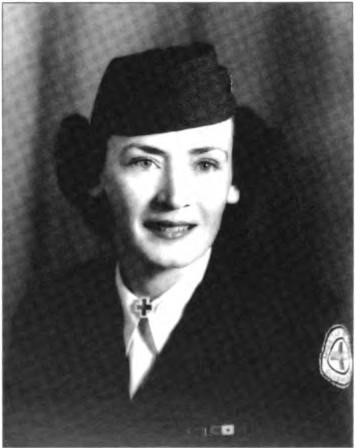
When the U. S. entered World War II, Birnelyn worked for Kaiser in the shipyards in Richmond, California, for IBM, in the computerized payroll department. Then she joined the American Red Cross. After going to the American University in Washington, D.C., she was sent to England in 1943. In Europe, she was an American Red Cross clubmobile driver for 15 months as a member of a mobile unit. Attached to the First Division of the First Army, she drove a 10-ton truck converted into a portable kitchen, serving coffee and doughnuts to the troops. Right after D-Day her unit went to France and served the troops that fought the Battle of the Bulge. Though not personally involved in medical work, she saw the carnage of war near the front lines. Ending up in Czechoslovakia, she finally returned to the U. S. in October 1945 after 25 exciting months overseas. “I changed a lot during the war. I realized how unimportant all this stuff was. I was no longer protective of my feelings and had lost my inferiority complex.”
After working for two years with the American Red Cross at the Merchant Marine Hospital in San Francisco, attending patients, she went to Japan for two years with the Army Special Services as a civilian in uniform, during the Allied Occupation.

Birnelyn returned to the U. S. and again worked for various companies. Finally on 28 September 1958 she was married to William S. Piper in Carson City, Nevada. It was his second marriage. For the next five and a half years they lived at his home in Guerneville. Then they were divorced, with no children. At this point Birnelyn decided to get a job doing general office work at the University of California at Davis. She invited her mother to go with her, and they spent the next 17 years living happily together, as described above.
As a young girl, Bimelyn was very attractive and intelligent, and such an excellent swimmer, it was even suggested she should try out for the Olympic Games. Like her mother, she spent much of her life helping others, and she also liked to talk a mile a minute. She was deeply devoted and loyal to her mother; they lived together and were close companions during much of their lives.
Bimelyn cared for Winnie lovingly and unselfishly during her later life. In 1981 she moved with Whittle to a mobile home park in Sebastapol, California.
Image: Birnelyn was stationed at Camp Crawford in the late 1940s, in Hokkaido, Japan. Her cousin, Jean Parker, was also there, and the two of them did broadcasting for the Armed Forces Radio.
Jack Lawton Seymour. Born on 24 May 1918 in Berkeley, California, Jack graduated from high school from the Montezuma Mountain School in Los Gatos. He was a pretty good athlete as a youngster.
When Jack was 14 years he fell in love with flying airplanes. He had a total devotion to it throughout his life. His sister Birnelyn recalls that he worked at the Star Grocery in Berkeley stocking shelves to earn money for flying lessons in Oakland. This was in the mid-1930s when lessons were very expensive and it was hard to log in a few hours. Jack started flying before most people. In about 1937 he enrolled at the College of the Pacific, with a major in political science. Finding it boring, he dropped out in the middle of his sophomore year and tried to enroll in the U.S. Air Force. They would not accept him, due to his lack of mathematics credits, so he decided to try to pursue his flying career in Canada instead.
In the late 1930s Jack went to Canada and enlisted in the Royal Canadian Air Force. He went through the entire flight training program. Ed Martin recalls that once while flying solo in Canada he looped the Hudson bomber (a British two-engine airplane), which was against regulations. He was caught because everything not attached to the body of the plane was in a shambles when he landed. In exchange for showing his spirit, he spent a couple of days in the guard house. It was a minor infraction.
While in Canada for 18 months Jack met his bride-to-be, Martha Elizabeth “Betty” Hogarth, in Winnipeg in mid-1941. When the United States entered World War II, the U.S. Air Force paid $10,000 to have Jack transferred back home to fly with them. He was a lieutenant stationed at Perrin Field, Texas (July 1942), then Kelly Air Force base (in San Antonio, Texas). Shortly afterward Betty moved to the United States, and they were married in San Antonio, Texas, on 1 January 1943. Betty, was born on 21 August 1921 in Ottawa, Ontario, Canada. She was the daughter of Grace Elvie Little (born in Toronto, Ontario, Canada) and Bruce Bowers Hogarth. From Kelly Air Force base, Jack and Betty were transferred to Fort Worth, Texas. From there he was sent overseas, to Europe, where he flew—but he was not in Europe during World War IL He also flew “The Hump” from India to China, as did his cousin-in-law Willard Miller.
Jack and Betty’s first child, Judith Carolyn Seymour, was born in December 1943 in Winnipeg, Manitoba, Canada. Betty went home to be with her parents to have the baby while Jack was overseas.

After the war, Jack returned to civilian life. He worked for his father with Dick Seymour in 1945. From January 1946 until September 1948 he worked as a salesman for the A. J. Kiss Co. in El Cerrito, California. But Jack longed to return to flying, so when he heard that the U. S. needed pilots for the Berlin Air Lift he reenlisted, returning to active duty in the U.S. Air Force on 9 September 1948. He and Betty lived on or near military bases where he was stationed, consecutively in Long Beach, California; Wilmington, Delaware; Topeka, Kansas; and Shreveport, Louisiana.
The Berlin Air Lift, undertaken in response to the USSR land blockade of Berlin’s Allied Sectors, ran for 17 months, from 1 April 1948 to 30 September 1949. British and U. S. airplanes lifted 2.3 million tons of food and coal to the city. For pilots, including Jack, it was a harrowing experience, for a plane had to take off every 90 seconds, no matter what. Many pilots lost their desire to fly after the lift was discontinued, but not Jack.
He won an Occupation Medal for his performance there. Yet it took its toll. He had stuttered as a child, and he started again after the lift from severe strain and fatigue; it left him after about a year. Yet Dick Seymour recalls: “I spent a great deal of time with Jack and I have never heard him stutter.”
Jack and Betty had many good times together but gradually their marriage became unstable. In 1946 they moved to Pleasant Hill, California. Anne Seymour was born on 9 November 1946 in Oakland, California, while the Seymours were living in Pleasant Hill. In early 1947 they were separated briefly. Later that year they were reunited. A final separation took place in 1950, and they were divorced in 1954. He never remarried. Jack was, on occasion, a heavy drinker and that was a major cause of his marital problems. He had many derogatory mannerisms and was not a good family man. Betty recalls that “Jack’s idealism and inability to cope with everyday life was another very strong factor in the divorce.”
Jack’s discharge papers show that he stayed in the Air Force after the Air Lift and until February 1954, at which time he had 11 years and 9 months of Air Force service to his credit. He was a First Lieutenant, 5 feet 10 inches tall, weighing 155 pounds, with blue eyes. He was then a highly experienced pilot, with more than 10,000 hours of flight time. His permanent address was 5 The Uplands in Berkeley. He used Dick Seymour’s home as his base.
Parlaying his experience into a new career, Jack started freelancing in Europe. In the years that followed, he served as the personal pilot for some of the world’s most famous and influential men. Some of his early work was with the Leer Jet Co. in Europe, selling and flying their jets. He sold one of their big jets to El Cordobes, the famous Spanish bull fighter and reputedly the highest paid athlete in history, making over $50 million a year. Jack went to Spain, stayed with El Cordobes, and trained his pilot, while also piloting El Cordobes himself. Later El Cordobes wrote him saying, “I’ve got $30,000 to spend. How about meeting me out in the Orient and let’s have some fun.” For a few months he was the private pilot for Willi Brandt, the chancellor of West Germany. And when baron Guy de Rothschild’s pilot was caught smuggling, the Lear Jet Company asked Jack to take his place. So Jack flew the Baron around France and down to inspect his mines in Spain. Later he flew for the shah of Iran, and from late 1955 until at least mid-1956 he was in Jedda, Saudi Arabia, flying for the king. There he was treated like royalty, at a level of luxury most people have never glimpsed. On 23 November 1955 Jack wrote his mother, Winnie: “For the last three weeks we have flown every day, moving the king’s family from the Jedda palace to the Riyadh palace. This took an average of 10 planes a day so you can see he has quite a family.” During the flight, a princess came forward and handed him a big wad of money, then a slave gave him a superb new gold watch. “This kind of thing happens frequently while flying the royal family.”
The king insisted that Jack use his personal yacht and indoor swimming pool. Jack helped set up the airlines in Indonesia (they never paid him), then worked as a pilot for a small commercial airline in Hawaii.
He did a lot of drifting during this time. For six months or so in the late 1950s, he worked for Ed Martin’s construction company in the Bay Area. He also worked for Lawton Shurtleffs Thorsen Tool Co. in about 1940.
Throughout his life, Jack hung out with the Flying Finn Twins. They did lots of adventuring together around the world.
What kind of a man was Jack? Ed Martin, his lifelong friend: “He was a very pleasant, sociable guy. Quick, sharp, alert, with a good mind and good sense of humor, he was very well liked and had a million friends. He wasn’t interested in much other than flying. His mother hassled him quite a bit for his drinking.” Birnelyn Seymour Piper, his sister: “Jack married an airplane. Planes were his life. He led a very exciting and interesting life. A brilliant person with a good memory, he read a great deal and was lots of fun. Everybody liked him. He and Harry Lawton were two of a kind. But he had a tremendous restlessness.” Betty Seymour, his wife: “Jack never lost his love of flying. He tried to do a few other things, but always went back to that. That was never a problem for me and it did not take him away from the family too much. He was attractive, highly intelligent and very verbal, a very independent thinker and usually a perfect gentleman. He could do almost anything. He was extremely fond of his mother. He was hyper, had lots of energy and didn’t know where to channel it. He really loved to talk. He seemed quite self-assured, but was not inside. It was very hard for him to make good relationships and he was quite dependent on others. He and Birnelyn are very much alike.” Lawton Shurtleff, his employer for a short time: “Jack was a born hell raiser. When he worked briefly for me at Thorsen Tool Co. he was always dreaming up ways to make a fast buck. He was a hot shot pilot, an adventurer and soldier of fortune to the very end.”
But Dick Seymour has different memories: “I have lived with Jack in several countries in the Middle East and East Asia. We had drinks but never have I seen him out of line. Most ‘hot-shot’ pilots crashed. But Jack was all business in and around aircraft. He took his flying very seriously.”
Gene Shurtleff recalls his last meeting with Jack: “The last time I ever saw Jack Seymour was in about 1970. Betty and I flew from San Francisco into Honolulu and were to transfer to a small plane for the last leg of the flight to the big Island of Hawaii. When we checked into Pacific Air the pilot of the plane was waiting to meet us. To our surprise it was our long lost cousin, Jack Seymour. He was wonderful, telling us that we were the only ones on board his small plane. It was a private flight, with special viewing of the weeping walls of Molokai, as we flew to the new resort of Mauna Kea. It was a warm and pleasant reunion. We never saw him again.”
Jack smoked on and off throughout his whole life. In about 1973 he had to have surgery for throat cancer and after that he had to talk through a voice box. He died on 23 August 1978 at the Veterans Hospital in San Francisco, of throat cancer. Ed Martin, visited him and later had his ashes and his name committed to the Lawton plot at Mountain View Cemetery on 12 September 1978. Jack and Betty Seymour had two children:
- Iudith Carolyn Seymour born 2 Dec. 1943 in Winnipeg, Manitoba, Canada. Presently she lives in Alameda, California.
- Anne Seymour born 9 Nov. 1946 in Oakland, California. Presently she lives in San Francisco, California.
Image: Judith Carolyn Seymour at her Alameda home, 2004.
Here, in 2004, is the story of the two sisters as told by Judy:
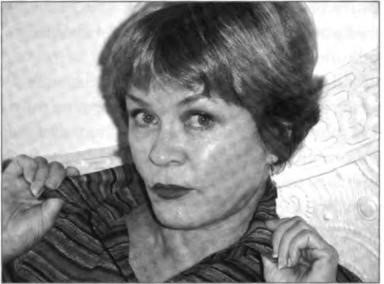
Judy (Judith) and Anne Seymour are Jack Seymour’s daughters. Their grandmother was Winifred Seymour, sister of Hazle Lawton Shurtleff. Although Jack Seymour and his wife, Elizabeth (Betty), divorced, Judy and Anne spent many happy summers, while growing up, with their “Gramma” Winnie Seymour at her Russian River home in Monte Rio where they learned to swim, water ski and canoe. After they finished college, both Judy and Anne moved to the Bay Area from the Midwest and started their careers. Upon her arrival, Judy lived with her grandmother, Winnie, in Berkeley for a few months until she settled in San Francisco.
Although Judy had gone to college and, subsequently, graduate school for degrees in English and philosophy, she found a career in the computer world, working for Levi Strauss and eventually running her own successful software consulting business for over 15 years. Among her clients were the University of California at San Francisco (UCSF), John Muir Hospital in Walnut Creek and NUMMI (Toyota) in Fremont.
Judy owns a beautiful, 4 bedroom Victorian home in Alameda and enjoys theater, tennis, cooking and the company of many friends. She is very happily employed as a software developer at a company in Novato, which supplies private label wines to Albertson’s and Costco. She loves working in the wine industry. She has been a long time (although inactive) member of Mensa (authors’ note: Mensa is a worldwide organization lone hundred thousand members in one hundred countries] who have tested with an I.Q. in the top 2% of the population!).After completing a long career in the airline industry, sister Anne went on to get a business degree from the University of San Francisco and became a human resources consultant. She lives and works in San Francisco. Their mother, Elizabeth, lives in Ashland, Oregon, where she is a volunteer for the famous Shakespeare Festival, the Ashland Information Center and the Senior Center. She is an active member of the Ashland Methodist Church.
On a different note… Judy and Anne had reunited with their world traveler father, Jack, after they moved to the Bay Area. Although they were both busily involved in the start of their careers, they often enjoyed dinners with him. When Jack became ill with tuberculosis, both Judy and Anne visited him at Letterman Hospital. Jack asked that they not visit frequently since he was somewhat uncomfortable with exposing them to that environment. He recovered well from that illness and went back up to live in Paradise County.
A few years later Jack became ill with throat cancer and was again admitted to Letterman Hospital. Judy received a postcard from her Gramma Seymour simply stating that he was again hospitalized. Because they were unaware of the seriousness of his illness, and also wanting to respect his wishes that they not see him at his worst in the hospital, very sadly neither Judy nor Anne saw their father again before his death. When Judy called the hospital, her father had already passed away. Jack is, no doubt, looking down from heaven happy to see that both of his very intelligent daughters have done well and are leading full lives.
Robert Le Monde Seymour (1920-1938). Born on 16 November 1919 at Carneyville, near Sheridan, Wyoming, Bob was a very special young man. As his older sister, Birnelyn, recalls: “Bob had a violent temper as a little boy, but by the time he reached high school it was completely under control. He turned out to be a marvelous person. At age 15, he had the maturity and stability of a 40 year old and was very caring. He adored guns and cars. We’d go target shooting together in the Berkeley hills.”
Jean Lawton Parker adds: “Bob was such a superior person, and Winnie loved him so much. He was the most giving of her children, and was so concerned for her. All who knew him realized that he was such a dear, wonderful, caring son.” Lawton Shurtleff remembers him as “very soft spoken, intelligent, good looking, a darned nice kid.”
According to Birnelyn, Bob had developed a deep interest in Christian Science by the time he was in high school. He had broken his arm in a fall, and it had been healed in Christian Science without going to a doctor. Once when a flu epidemic was going around, Birnelyn overheard him say to Winnie, “You know its so nice to be raised in Christian Science where you don’t have to be afraid. Everybody at school is afraid.”
But when Bob was about 17 years old, while he was a student at University High School in the 11th grade, people began to notice that something was wrong with him. Jean Lawton Parker remembers:
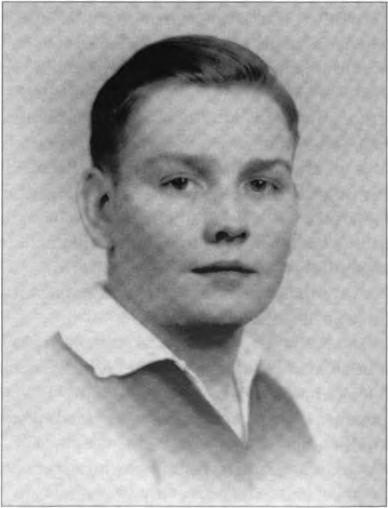
Bob drove up with a friend to see our family in Seattle. We were at the airfield and my mother, Joyce, said “Oh, there’s Harry’s plane now.” Bob said, “Where?” At that point we became aware that something was dramatically wrong. He wasn’t seeing correctly.
Harry took Bob to an eye specialist in Seattle and the man said, “We’ve got a serious problem here. Something must be done.” My recollection is that Harry then flew with Bob down to Berkeley, or he may have just talked with Birney Seymour by phone and urged medical help. Harry was not a Christian Scientist, and his own wife, when ill, was treated by regular medicine. Within a week after that Bob was taken to the hospital. I think that was 6 to 12 weeks before he died.
Lawton Shurtleff remembers a similar incident in about 1935-36. He and Bob went dove hunting together in Willows, California. Lawton noticed that Bob seemed not to be able to see well; he couldn’t find a dove Lawton shot that fell near him and, while driving, he backed Lawton’s car into a tree. Lawton told his mother, Winnie, that he felt something was wrong with Bob’s eyes, but as far as he knew, no medical help was sought, because of the family’s strong belief in Christian Science. “When I spoke to Winnie about Bob, it was as if this was the first time that anyone had ever mentioned the problem. She doubted the correctness of my observations. Bob died shortly after this hunting trip.”
Ed Martin, who knew Bob well, recalls, After watching his son’s condition deteriorate, watching the poor kid suffer, Birney finally said, “This is nonsense. I’m going to take him to a doctor.” Winnie said, “No. You let that boy alone. We’ll heal him our way.” But Bob had been hearing bells and sirens for a long time. He was blinking, stumbling, feeling dizzy and losing his balance. So Birney took him to the doctor. The doctor said, “My God, why didn’t you bring this boy in before. This is terrible. He has a brain tumor and he needs to be operated on. You may have let it go for too long.” Birney said, “God dammit, let’s do what we can.” They operated and found a brain tumor the size of a tennis ball.
Bob died about four days after his operation, on 14 March 1938, in the hospital Oakland, California, at age 17.
According to Birnelyn who, as we know, was a devout Christian Scientist:
There was a struggle over what to do for Bob. Mother later said that if she had to do it again, she would never have allowed him to go to the hospital. Father insisted that he go. That thought was so destructive and so total. Mother would have kept him at home and had a Christian Science practitioner work for him. Bob wanted Christian Science healing for himself since he had seen so many healings in our family. Father was very fearful and medical minded. You can’t believe the negativity in his thinking. Bob’s loss was terribly hard on Mother.
Richard Roger Seymour. Born on 9 March 1923 in Berkeley, Dick almost didn’t come into this world. As Birnelyn recalls, Winnie had had a miscarriage between Bob and Dick, and so she stayed off her feet at her parents’ house when she was pregnant with Dick. When a miscarriage started again she called a Christian Science practitioner and it was averted. The day that Dick was to be born, the doctor told Winnie that her child was in the breech position. He advised her to call a practitioner, which she did. The doctor went into the other room, there was a complete change in position, and the birth was perfect. Indeed, Dick was a very large baby.
Dick graduated from John Muir grammar school, Willard Junior High, and Berkeley High. He started college at Cal in 1941, but when World War II began, he left to join the military (Air Force) like so many of his classmates.
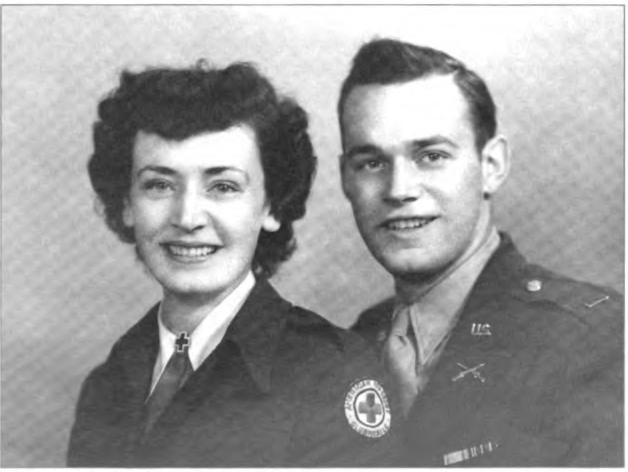
After being stationed in San Antonio, Texas (Air Force) and Fort Benning, Georgia (at officers’ infantry training school), he was cargo security officer on a merchant ship in convoy to North Africa. He was in the First Infantry Division, the Big Red One. He went through the North Africa Tunisia, and Sicily campaigns. Near the end of the Sicilian campaign, he was hit with shrapnel and returned to North Africa for treatment. In the hospital he met a Royal Air Force (RAF) pilot who was being discharged the following day and was flying to Palermo, Sicily. Richard left the hospital (AWOL) with the RAF pilot. From General Patton’s headquarters in Palermo, Richard received a high-priority flight pass to meet his regimental combat team afloat in Algiers Harbor, then on to England for D-Day.
Later his company commander received an “AWOL notice” from the hospital in Sicily, which the commander immediately tore up.
His was one of the first divisions to go into France on D-Day (from Weymouth), and he was hit five days later by a sniper in France. He spent three months in a series of hospitals in the United Kingdom, then was flown to a hospital near Stanford University. He was able to return to limited duty as an instructor in a military combat tactics school at Camp Fannin, Texas. He was discharged in 1945.
In February 1947, Dick was married to Patricia “Pat” Forster in Berkeley, California. She was born on 29 October 1924, the daughter of Jim and Elsie Forster. Dick and Pat soon had three children. Richard, Jr. in 1947, Lynn in 1950, and Diane in 1953. From 1947 to 1949 Dick worked for the Palmolive Peet Company, then in 1950 he went into the construction business, working for various firms.
In 1963 Dick and Pat were divorced. Four years later, on 28 January 1967 he married Janet Horsley. Born on 7 June 1932, she was the daughter of Henderson and Gertrude Horsley. They had no children.
In 1976-77 Dick worked in Saudi Arabia for Tumpane Company (a maintenance support company) as head of projects. Finishing this contract, he went to Athens, Greece, for two months, then back to Saudi Arabia with Lockheed Aircraft (1977-79). Returning to California, he and his wife Janet took a long trip through the United States. Then he returned to Saudi Arabia and worked five years (1980-85) as maintenance engineer for Aramco (Arabian American Oil Company).
Dick retired in 1985 to Carson City, Nevada, Where he lived with his wife, Janet, and managed and operated his real estate investments. Richard died on 30 May 1998 in Carson City. He was buried at Mountain View Cemetery in Oakland, California.
Birnelyn Seymour Piper, Dick’s older sister, recalls: “Dick and Uncle Don Lawton were very much alike, and even looked alike. Both had a great sense of humor, with many funny remarks.” Lawton Shurtleff: “Dick was a very pleasant and competent person. He was the spitting image of his uncle, Don Lawton—always upbeat, outgoing, humorous. As a young man (about 1950-52), he worked successfully for me (his cousin) in housing construction as an expediter at Mackay Homes, then later for his cousin Ed Martin in building maintenance. He started his own a building maintenance business. Sensing a far greater opportunity overseas, he later spent 9 years working in Saudi Arabia.” Richard Seymour and Patricia Forster had three children:
- Richard Rogers Seymour. It. Born 13 Oct. 1947 in Berkeley, California. He graduated from Berkeley High School, attended several semesters at Merrit College before enlisting in the Naval Air Corps during the Vietnam war. He served as a radio operator in planes flying out of Alameda, Moffett Field and Point Mugu in Southern California.
He presently works as head technician for Stangenes Industries, Inc., in Palo Alto. Richard is a licensed airplane pilot. He lives in Berkeley, California.
2. Lynn Seymour. Born 15 Feb. 1950, Berkeley, California. Married Gregory James McAdams on 21 March 1970, Berkeley, California. Greg was born 20 Aug. 1946 in Berkeley. His parents are Herbert Franklin McAdams (born 12 Dec. 1913, Omaha, Nebraska) and Shirley Ann Heppler (born 8 Sept. 1915, Richfield, Utah). Both parents are deceased.
Both Lynn and Greg grew up in Berkeley. Lynn attended John Muir Elementary and Willard Junior High School (just like her dad-Dick Seymour, her brother Dick, Jr., and sister Diane). Both Lynn and Greg graduated from Berkeley High School (Lynn ’68 and Greg ’64). After high school, Lynn resided in Hawaii with her dad and upon return to the mainland, attended Merritt College and Diablo Valley College. Greg attended Merritt College and graduated from Armstrong College, Berkeley. Greg served in the United States Marine Corps.
Lynn and Greg relocated from Menlo Park, California to Boise, Idaho in 1983. Lynn has worked at Boise State University in the registrar’s office since 1984 and plans to retire in 2005. After college, Greg began a commercial banking career in San Francisco, with the Bank of California and has been with U. S. Bank and predecessor Idaho First National Bank, since 1983. Retirement not in sight. In their free time, Lynn and Greg enjoy gardening, swimming (Lynn has the Lawton/Seymour swimmers’ blood), walking, skiing, canoeing, camping, bicycling and entertaining.
Lynn and Greg have two children, both born in Walnut Creek, California:
a. Christopher Gregory McAdams. Born 18 June 1974. Graduated from Boise High School ’92 and University of Oregon ’96 (BA in Economics). Affiliated with Beta Theta Pi fraternity. Christopher was active in athletics in high school (baseball, basketball, and foot ball) and earned his Eagle Scout award at 16 in 1990. Christopher came back to Boise after college. He married Heidi Lynn Carson (born 20 May 1971 in Worland, Wyoming) on 5 Aug. 2000 and his job took him back to Eugene and then back to Boise. Heidi has a daughter, Lyndsay Megan Carson (born 3 Feb. 1990 in Boise) and Christopher and Heidi have a son, Christopher Gregory McAdams, Jr. (born 15 Nov. 2001 in Eugene, Oregon). They have another child on the way (due March 2005). Christopher, Sr. is a sales rep for Janssen Pharmaceutica, Inc. (Johnson & Johnson). Heidi is a stay-at-home-mom. Heidi’s parents are Gary Carson (Twin Falls, Idaho) and Dixie Rudolph (Boise, Idaho).
b. Dana Lynn McAdam. Born 12 July 1976. Graduated from Boise High School ’94, University of Oregon ’98 (BA in History) and University of Idaho College of Law ’02 (Juris Doctor). Affiliated with Delta Gamma sorority at University of Oregon. Dana was active in athletics in high school (skiing and volleyball) and like her mom, inherited the Lawton/Seymour love of water and was a lifeguard for seven years through undergraduate and graduate schools. Dana was married 30 July 2004 to Matthew Joseph Ryden (born 12 Nov. 1968 in Chapel Hill, North Carolina). They met in law school. Matt’s parents are Ray and Ann McGaughlin Ryden (Boise). Dana and Matt are attorneys. Professional careers getting started. Children in the plans.
3. Diane Seymour. Born 10 March 1953 in Oakland, California. She married Mark Steven Cyker on 20 June 1982. He was born in Boston on 18 Oct. 1953. As of 1987, they lived in Montague, Massachusetts. Diane, Mark, and their children, Ariel and Joshua Cyker moved from Montague, Massachusetts to Harvard, Massachusetts July 1990. Located about 1 hour outside of Boston this small New England town of 5,000 people is mostly made up of apple orchards. Mark presently is a partner in a dental supply and equipment company. The main headquarter is located in Windsor, Connecticut. Their two children are:
a. Mel Lina Cyker born 1 Sept. 1983. Ariel graduated from The Bromfield School in Harvard, Massachusetts in June 2002. She started college in Sept. 2002 at the University of Massachusetts at Amherst. Ariel is currently a junior and living in Amherst, Massachusetts.
b. Joshua Daniel Cyker born 28 May 1986. Joshua is currently a senior at Minuteman Technical Regional High School in Lexington, Massachusetts. For his vocational area Josh is specializing in heating, ventilation, air conditioning and refrigeration, Josh will graduate in June 2005 and will continue on to college in the fall of 2005.

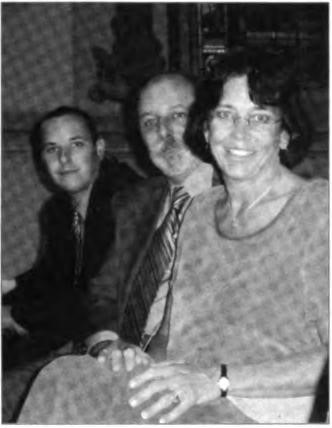
 Shurtleff & Lawton Families Genealogy & History - Second Edition (2005)