** All Text on these chapter pages has been copied verbatim – with permission – from this book: “Shurtleff Family Genealogy & History – Second Edition 2005” by William Roy Shurtleff & his dad, Lawton Lothrop Shurtleff ** Text in pdf convert to word doc – any spelling errors from the book may or may not have been fixed. **
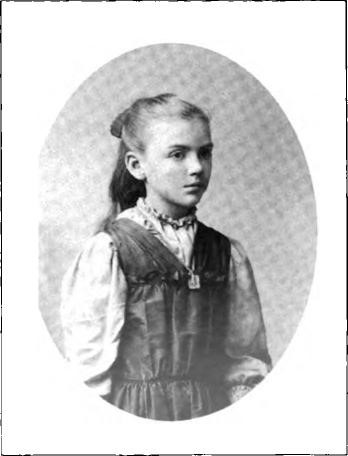
in Grass Valley circa 1891, when she was about 11
Nettie Meek, the youngest of the three children of John David and Charlotte (Avery) Meek, was born on 31 May 1880 in Grass Valley. She was only three years old when her father died. Two years later Charlotte married the widower, Samuel Shurtleff, after which she and her two younger Meek children moved in with Samuel and his two much older daughters into his Nevada City house on Piety Hill.
Nettie spent her early years in Nevada City until, in 1897, she graduated second in her class of 13 students from Nevada City High School. Shortly after her graduation in 1897 (and after the death of her stepfather, Samuel, in 1889), Charlotte moved with Nettie, age 17, and Nettie’s 10-year-old half brother, Roy Shurtleff, to Berkeley, leaving behind family and friends, to fulfill her dream of a college education for her two youngest children. In those days in northern California that meant either the public university at Berkeley or the private university at Stanford in Palo Alto, 50 miles to the south. As it had been for Maria Louisa years before, so was it for her daughter, Charlotte, that a good education for her children was of the utmost importance. Nettie chose the University of California at Berkeley.
After graduating from U.C. Berkeley in 1901, Nettie badly needed income to help her financially hard-pressed mother raise young Roy Shurtleff. Nettie recalls that her mother’s limited income came from the rent from her old home in Nevada City or Grass Valley and a small store she still owned there. According to Nettie’s letters, her mother also took in sewing and did dressmaking to help make ends meet.
Having finished four years of college, Nettie began a lifetime of work that didn’t end until she retired in 1945 at age 65.
In San Luis Obispo she taught two terms in elementary school, one year in the small town of Arroyo Grande in the same county teaching English and Latin, then three years in Berkeley teaching seventh grade only. She resigned her teaching career for reason of health (dyspepsia) and went to a business school for three months to learn typing and shorthand. All of these experiences prepared her for her next and final professional job in the engineering department at her alma mater. She stayed there for 35 years. Her stylish “Spencerian” (slanting) penmanship, her outstanding typing, and her untiring devotion to her job led her to the lofty position of assistant to the dean. The dean was the renowned Dean Derleth, for years head of one of the most prestigious university civil engineering departments in the country.
In April 1973 at age 95, Nettie wrote to Bonnie Meyer of another of her lifelong interests, the Masonic order, an interest shared by Charlotte Meek (her mother), Charles A. Meek (her brother), and Elwood Meek (her nephew; Charles’ son).
The Eastern Star and the Meeks:
The Eastern Star is a Masonic Order to which the wives, daughters and sisters of Master Masons are eligible. I joined in Berkeley in Feb 1902, on the basis of my father’s membership in the Masons.
That is an international fraternal order with several grades leading to the highest of Knight Templar, the Eastern Star is one of several: Order of the Amaranth, White Shrine, Ladies of the Nile, I am the only surviving charter member of the Amaranth in Berkeley which was organized in 1907. So, I have been a member of the Eastern Star since 1902 and the Amaranth since 1907 and have received my pin ranking me a life member of each. Mother joined in Grass Valley before I was born, and then changed to Berkeley in 1902, just missing by a few weeks being a charter member. In Nevada City, Jessie joined Evangeline chapter, but later resigned after she married and moved away. Charles A. Meek and Charles E. Meek were both Masons in Berkeley.
Nettie, like her older sister Jessie, was, as uncle Charlie described her, tall and erect—a strong and handsome young lady. She once confided in Roland’s wife, Bertha Martin, that she had had a severely disfiguring operation when she was younger that had caused her breakup with a young man she had been dating. She felt that the operation made it unlikely that she would every marry. In any event she never did marry and lived the rest of her life in Berkeley, keeping an active interest in friends and family and spreading goodwill wherever she went.
Like her brother Charles and sister Jessie, Nettie played an important part in the lives of Roy’s children, Lawton, Gene, and Nancy. They remember her well at Charlie Meek’s house in Berkeley, or visiting their family at Lake Tahoe or their Martinez ranch. Much like her sister Jessie, she was a large and commanding lady with a booming voice. At Tahoe, the Shurtleffs had a croquet court on a lush lawn under the fir trees. The children remember her watching as one of them clamped a bare foot on top of the wooden croquet ball in preparation for knocking his opponent’s ball “galley-west,” as Nettie would say. They can still hear her command: “Grab that ball with your prehensile toe and don’t let go.” This was a reference to a tendency in the family to have a second toe longer than the large toe. According to the scholarly
Nettie, our prehensile (a word they had never heard before) toe was an appendage made for “grabbing or grasping.” She was a great lady with a wonderful way with words and stories.
It was also at Tahoe that the children noticed her stuffing a large towel under the upper part of her bathing suit. Hazle Shurtleff explained that years ago her breast had been removed and the towel helped make her figure look more normal. Charlotte Meek Adams, her grandniece, remembers seeing Nettie and Jessie being fitted for corsets at Jessie’s house, and that Nettie’s corset always had padding. This was obviously the operation that, Bertha recalled, may have kept her from marrying. It must have been a pioneering operation in those days when such things were never discussed between the sexes.
Nettie’s letters describe how she had saved her money for a trip to Hawaii in 1904, then, in 1907, she treated her mother to the same trip with Eastern Star ladies. That was when Nettie was only 27 years old! She describes the real estate boom in Berkeley and how she had speculated on a piece of property with a friend and sold it for a profit that helped pay for her mother’s trip. Quite an activity for a young lady who soon had her brother, Roy Shurtleff, investing money for her until, as she writes, “Then came the Great Depression.” Even so, Roy helped her invest money for the rest of her days—a service he provided for other members of his extended family. In later years Gene Shurtleff offered the same help to younger members of the family.
One of Nettie’s letters describes the great Berkeley fire of 1923:
The Berkeley fire was September 16, 1923—a day of horror for Berkeley. There was a hot wind blowing. At noon I had gone down to Berkeley, and on the way back to the office in the old civil engineering building just beyond the Campanile, I had to fight the wind, and there was a great smoke coming over the hill above the Big C. By mid-afternoon it had burned all the hill area and was working toward the campus. I wanted to get home, but had too many records under my charge to leave. The office was a wood frame addition on the old building and I had some students help me carry files down to the first floor and pile in the brick part of the building. Mother phoned for me to come and when I could get away I ran all the way home to find the place in flames. Mother had piled a Jew possessions in a sheet: I rushed to mi/ room for a few things and left the most valuable behind. We each grabbed a sheet of stuff and threw it over our shoulders and in one hand 1 had a bag with my mother’s two Maltese kittens. A man came along in a car and took us down to Grant and Carlton Sts. where Jessie lived. I then left Mother with her and ran back to Hearst and Oxford streets, but the house and the whole neighborhood was in ashes. All I had were the clothes on my back. Something like 600 blocks were destroyed and nearly all of north Berkeley was in ashes. That fire was second to the San Francisco fire of 1906. The shock of losing her home was too much for mother and she died September 17, 1926 of angina brought on by the tragedy. The fire was started by a broken electrical wire over the hill near Wildcat Canyon. The destruction took only a few hours, then the wind changed and the houses that seemed to have escaped also went down.
Charlotte Adams, her grandniece, describes Nettie’s generosity to members of her own family —never forgetting a small check or gift at holidays and anniversaries. Her generosity so impressed Charlotte’s daughter, Vicky, that she has hopes to carry on that same tradition.

After Nettie retired from the University of California, she had more free time. In the late 1940s Roy and Hazle Shurtleff had separated, leaving Hazle alone and in ill health at their Martinez ranch. Nettie stayed with Hazle for a time, offering her seemingly limitless strength and energy. This was a touching display of family support in an hour of need. Isn’t it a sad irony that Nettie, after a life spent helping others, would write to Bonnie Meyer in 1969 that she (Nettie) “did absolutely nothing for her country (except pay income tax).” At another time, upon having to leave her home of many years, she wrote, “I’m in a state of shock and can’t eat, think or sleep. Somewhere there must be a place for me. Now’s the time I wish I had some children or family. That is the penalty for being an old maid—and the last of the family.”
In August 1969 Bonnie Meyer, a distant relative who was now deeply interested in her family history, wrote Nettie to ask about her life and the life of her ancestors and relatives. Nettie, age 89, was living at 2115 Delaware Street in Berkeley. Bonnie and Nettie exchanged 14 letters and cards between 1969 and January 1976. They are a gold mine of family history and bring to life many members of the Meek, Martin, Avery, Avann, and Reanier families from long ago. Nettie also sent Bonnie precious old family photographs, some over 100 years old (many of which appear in this book), and even treasured heirlooms and trinkets, handed down in the family for generations.
Nettie once wrote Bonnie that “except for my brother Roy (whom I seldom see) there is no one in my family with whom I can talk of the past. The present generation has left me trailing in a dense cloud of dust.” Bonnie Meyer, in recent correspondence with Lawton Shurtleff, writes, only half seriously, “Something did happen to separate the branches. Guess we were the poor ‘peasant’ relatives! Oh well, we are now getting back together.” Lawton feels that the separation was only partly financial.
As she neared age 90, Nettie was no longer driving a car. Her halfbrother, Roy Shurtleff, was living in San Francisco with his new wife, Mabel, who had never known the Meeks. Time and distance had simply made visiting almost impossible, but they surely remained close friends. So this family story may well serve another happy purpose.
Much of what we know about the Meeks and Martins is gleaned from Nettie’s letters and from anecdotes shared with us by Roland’s children, Charlotte and Roland, Jr., and Herbert’s daughter, Lynette, and from Charles Meek’s 1934 Genealogy and many other writings, plus the memories of Roy Shurtleff’s children.
Roland, Jr., recalls half humorously that “Jessie and Nettie were very buttoned up, proper Victorian ladies—very well corseted in body and mind. But Nettie became more open as the years passed. She would even enjoy a cigarette and a glass of wine when my sister, Charlotte, visited her.”
Roland, Jr., also remembers that he, his father and mother, and his two sisters, Charlotte and Joyce, were always invited to Nettie’s home for Thanksgiving and Christmas.
Charlotte remembers:
Nettie was very much loved in our household. She always had enough eggs, oranges, etc., since in those days we did not have a lot. These were her treats for us. She and I became friends, so at different times I would stop by her home to visit. At one time I was smoking cigarettes, but of course I would never smoke in front of Jessie (Amu) or Nettie or anyone at Grant Street. My mother knew I smoked. One day I stopped by to see Nettie and tell about some tragic development in life or with my friends. I was very stressed. I sat down and we started talking. Finally I said ‘Nettie would you mind if I had a cigarette?’ I had reached that point. She said, ‘No let me join you!’ We smoked ’til the air was blue and just had this down-to-earth talk which greatly deepened our friendship and kind of changed the ground rules. Not long after that I went to visit Nettie again. Now she would automatically take her cigarettes out of the table drawer and we smoked together again. Nettie said she would never tell Jessie and my grandmother that she or I smoked.
Nettie died of old age on 5 March 1977. She was 96 years old. Her ashes are at the Chapel of Memories on Howe Street in Oakland. With hers are the ashes of her mother, Charlotte, brother, Charles, and his wife, Minna, and her sister, Jessie. Nettie never married or had any children.
Lawton Shurtleff recalls that his grandmother, Charlotte, would visit the family in Burlingame, and he remembers long walks through the countryside with her looking for persimmons for his Roy’s “Namu” to make a pudding. At 372 Euclid Avenue in Oakland he remembers the socks and sweaters she would knit for every occasion—and of the licorice candy she always brought. In those early days, prior to her death in 1926 the family saw much more of grandmother Shurtleff (Charlotte), than they ever did of grandmother Lawton (Fanny). After all, Charlotte, Nettie, and Uncle Charlie were mostly alone. The Lawtons had a very large family all living very close to each other and actively engaged in each others lives, including the practice of Christian Science. Roy’s mother never saw her son’s impressive new home in Piedmont. She died just about the time Roy was moving.
The Shurtleff-Meek clan is one that we younger Shurtleffs are proud to be a part of. One look at the territory they crossed and finally settled in, and their old photographs, letters, and memorabilia, reveals them as adventurers, explorers, and finally settlers. Beyond that, they were serious and hardworking, and had an abiding faith in the value of an education. We who follow them can identify with their love of the land, of gardening, of all kinds of animals, and of adventure and learning.
We are greatly encouraged by their longevity —Jessie living until 93, Nettie past 96, and Roy past 97. We are not so encouraged by the arthritis they seemingly bequeathed to us, starting long ago with Samuel’s sister, Helen, then Nettie, then Roy—now shared by Lawton, Gene, and Nancy.
Maria Louisa seemed to set the pace for this fascinating family when she left Tenterden in 1840, a 16-year-old newlywed heading for an unknown land. Others in the family have endeavored to keep the tradition alive; we aspire to do likewise.
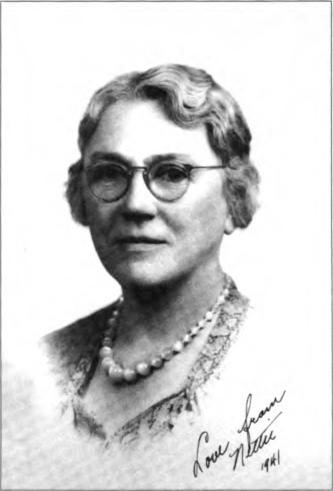
Image: Nettie in Berkeley in 1941 when she was 61 and still at the university. She worked for 35 years at UC Berkeley, ultimately as assistant to the dean in the civil engineering department.
 Shurtleff & Lawton Families Genealogy & History - Second Edition (2005)