** All Text on these chapter pages has been copied verbatim – with permission – from this book: “Shurtleff Family Genealogy & History – Second Edition 2005” by William Roy Shurtleff & his dad, Lawton Lothrop Shurtleff ** Text in pdf convert to word doc – any spelling errors from the book may or may not have been fixed. **
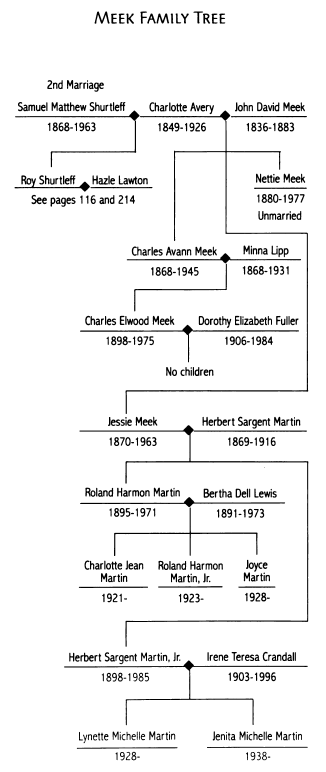
Charles Avann Meek was born on 6 April 1868 in Grass Valley, California, and lived most of his early life there. However, in 1883, following the death of his father, John David Meek, he moved to Ohio (where his mother, Charlotte, was born) to stay for a few years with her elder brother, Will Avery. He probably finished high school there and went on to earn his degree in dentistry. He then moved back to Nevada City, only a few miles from where he was born in Grass Valley. There his mother, now Charlotte A. “Lottie” Meek Shurtleff, still lived with her two daughters, Charlie’s sisters, Jessie and Nettie, and their young half brother Roy Shurtleff.

Charles’s maternal grandmother, Maria Louisa Avann, lived on her own farm in Wheatland, California, about 30 miles southwest of Nevada City. Young Charles often visited her, and it was probably during one of these visits that he met his bride to be, Minna (“Min”) Lipp, also of Wheatland. We do not know when or where they were married. Min was born on 8 February 1868 in Wisconsin Hill, Placer County, California. Her father was Wesley Powell Lipp, born in Virginia, and her mother was Minna Tiele, born in Germany.
Charles and Min’s first and only child, Charles Elwood Meek, was born in Chico, California, in 1898.
In 1903 Charles started his dental practice in Berkeley, California, where he soon established himself as an excellent dentist. In their early years, Roy Shurtleff’s two sons, Lawton and Gene, were among his patients. They vaguely remembered that in those days his office was in his home. By 1908, his office was at #405 in the First National Bank building in downtown Berkeley. He and Min resided at 2610 Derby Street in Berkeley; by 1913 they lived on Virginia Street and by 1914 at 2339 Regal Street. For the next 27 years they lived at 850 Regal Road in Berkeley.
In the 1920s, after his 50th birthday, Charles began writing about his childhood and youth. His first work, titled “Memories of Grass Valley in the ’70s” was a seven-page typewritten treasure.
Memories slumbering during these many years have lately emerged from the ashes of time and press me to give them expression as they arise, Phoenix-like, from an almost forgotten past.
I see myself a barefoot boy with an old straw hat and a pair of well-patched trousers, running down School street shouting gleefully to playmates that the weather is fine and the reservoir on top of the Reuben Thomas hill is full, and the last fellow in is ” —.”
Who is the boy who can forget those wonderful days! As the sun in its golden radiance gradually sinks into the west, someone remembers it’s time to go home. Regretfully we emerge from the cool water, seek our clothes and replace them upon our dripping bodies, provided that some one don’t have to “thaw bacon,” because some youngster had previously tied into hard knots shirt sleeves or pantlegs.
We start home by another route, over on Alta Hill by the old slaughter house that belonged to Frank Aumer and the Wilhelm Brothers, . . . and then homeward by the old baseball grounds where the Old True Blue team used to meet the Marysville Intrepids, or the San Juan White Stockings. Who is there that can remember the old team? I think I can name seven of the nine . . .
Pause for a moment and see how we finish the day. We drop David Shoemaker at his gate, then Wolf Williams steps out of the gang; next Arkle and Nelsen Stevens give us a parting salute, and Darcy Ridge finds his way through the back door to hear old colored Mammy Smith, who was the queen of the kitchen and the rest of the house also, greet him with “Wha yo’ all been, honey?”
Monday morning, out of the stillness of early day, is heard the deep and resonant tones of the old school bell as it calls us to lessons . . . Perhaps we linger as we pass the Deemer Soda Works, and if Mr. Deemer was in good spirits and felt at peace with the world, he would give us a bottle of pop . . .
Those were the days, – new memories!
He also describes in detail the excitement of an old-fashioned Fourth of July celebration, with a big parade, ending with a visit to Chinatown , which was somewhat of a center of activity; the large flagpole that stood in the middle of Main Street during the Civil War; how a man named “Kneebone” won $40 racing his team of eight mules on Main Street; completion of the Nevada County Narrow Gauge Railroad to Nevada City; and an old-fashioned camp meeting at Indian Springs that “amused a renewed religious zeal.” A list of the town’s prominent families includes the Elsters and Reaniers.
In 1926 Charlie’s mother, Charlotte, passed away. Only four years later, she was followed by his dear wife, Minna, who died on 8 October 1931 in Berkeley. She was interred at Chapel of the Memories, on Howe Street in Oakland, just one block up the hill from Mountain View Cemetery.
To try to soften his grief and loneliness, Charlie, now in his 60s, devoted more time to research and writing—with great nostalgia—about his earlier years in the gold country. In 1934, assisted by his sister Nettie as typist and editor, he self-published his Genealogy: Avery-Meek, which is the source of much material in this chapter. In the introduction he writes:
I have delved into my memory to write this story so that the future generations of our family may have some knowledge of our grand and great-grandparents—trusting this may give some idea of their pioneer lives, where they were born, emigrated, settled, and lived; a few instances of their lives without going into minute details or historical romance, or what prompted them to undertake their great adventure into a new land destined to become great beyond measure.
During the early 1930s, Charlie made an annual pilgrimage to the Grass Valley area where he was born. Starting in 1934 he wrote a series of articles of his reminiscences of Grass Valley for his friend Edmund G. Kinyon of the Grass Valley Union. These appeared on 20 October 1934 (p. 8), 14 July 1935, 3 September 1935, 30 September 1935, 30 August 1936, and November 1941. Several contained portrait photos of Dr. Meek.
He wrote a long article titled “Oldtimer Looks Back” that was published on 13 December 1936 in the Knave section of the Oakland Tribune:
As I drove into Nevada City over the modern steel bridge which spans Deer Creek from the Piety Hill section to the business portion of the city, my mind traveled back to the ’90s and I visualized the old suspension bridge as it swayed under the strain of traffic. Far below in the creek bed I could see again the huge boulders painted with advertisements of cure-alls and patent medicines and threats of dire destruction for sinners. There was one I shall never forget which read: “Use Smith’s Bile Beans,” under which some wag had added “And Prepare to Meet God.”
In December 1940 he wrote a three-page typed story titled “My Grandmothers,” full of loving memories of Maria Louisa Avann and Grandma Meek (his Indiana grandmother).
After briefly residing in Chico and Redwood City Charles Meek died on 11 November 1945 at his longtime home in Berkeley. Age 77, he was interred with his wife. Charles and Min had one child.
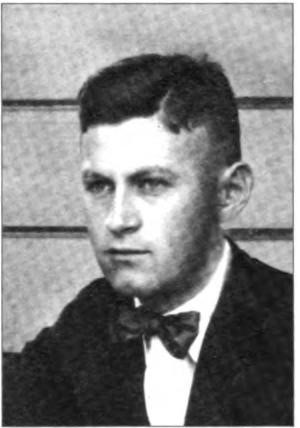
Charles Elwood Meek was born 3 January 1898 in Chico, Butte County California. In his youth he was called Elwood. Charlie, as he was referred to in his professional life, graduated from the University of California at Berkeley with a degree in geology and started his career working for the Standard Oil Co. of California. Early on he was assigned to exploration work in Alaska, then in Central and South America, where he contracted malaria. Following his recovery, he was told he would be unable to father children, so he decided not to marry. He left the petroleum industry and joined his uncle, Roy Shurtleff, at Blyth & Co. in San Francisco, bringing his analytical talent to stock market theory. He charted the stock and bond markets and developed theories for predicting market trends. During World War II, he left Blyth and was associated with Stanford University, where he developed methods for testing the potential of applicants for military pilot training. After World War II he returned to Blyth, where he applied the same evaluation techniques to employee applicants for the securities business. Through their association at Blyth, Charlie, Roy Shurtleff, and Gene Shurtleff became well acquainted.
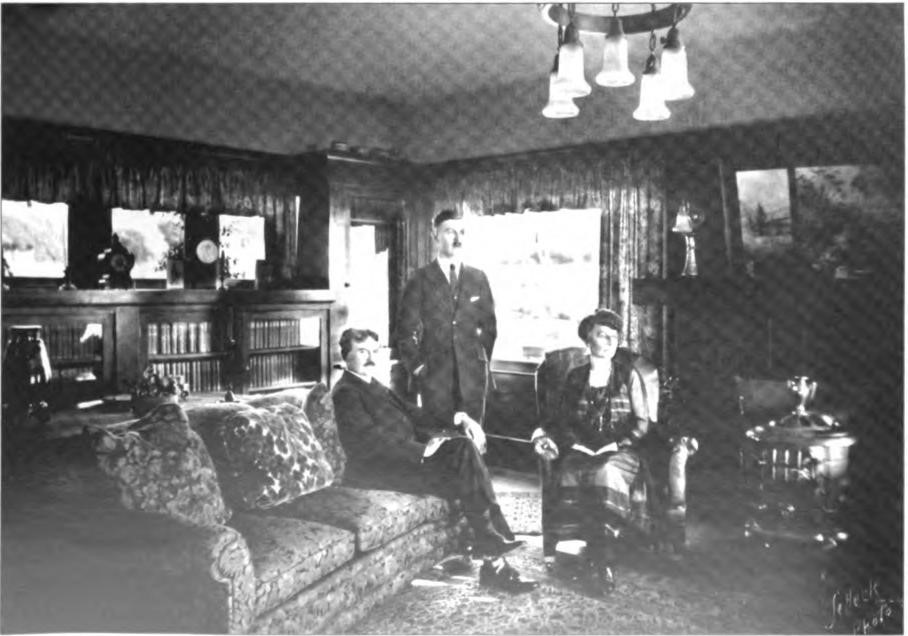
In his youth, Elwood is remembered for his visits to Roy and Hazle’s home in Piedmont where his gentle sense of humor, his storytelling, and his upbeat piano playing entertained the family. Lawton recalls that from time to time the Shurtleffs were invited to visit Charlie, Min, and Elwood in their fine home at 850 Regal Road in North Berkeley, where a festive gathering always resulted. Often Jessie and her two stalwart sons, Roland and Herbert, and her sister Nettie would complete the family gathering.
Gene remembers living with Charlie and his son Elwood, two bachelor men, during his sophomore year at Cal, when his parents were living on the East Coast. It was Nettie’s suggestion to Roy and Hazle that Gene’s poor grades resulted from fraternity house living and too much partying. They were delighted to accept the offer from the Meeks to provide Gene with housing as well as wise counsel and discipline. The results were excellent and Gene went on to graduate with his class.
Later in life, on 27 October 1945 when Charlie was 47 years old, he married Dorothy Elizabeth “Dode” Fuller in North Hollywood, California. Born in about 1906 in Washington state, she was the daughter of Percy Francis Fuller (born in Canada) and Ruth House (born in Michigan). As the result of his earlier malaria, they were unable to have children. These would have been the grandchildren that Charlie wanted so badly. Thus, the Meek name in the line descended from John David Meek (1836-83) was lost.
Charlie and “Dode” lived close to Nettie Meek and took excellent care of her in her later years. Charles Elwood died 22 June 1975 in Berkeley; he was interred at Sunset Cemetery in nearby El Cerrito. “Dode” died on 7 November 1984 at Rossmoor, a retirement community in Walnut Creek, California. She was interred with her husband.
 Shurtleff & Lawton Families Genealogy & History - Second Edition (2005)