** All Text on these chapter pages has been copied verbatim – with permission – from this book: “Shurtleff Family Genealogy & History – Second Edition 2005” by William Roy Shurtleff & his dad, Lawton Lothrop Shurtleff ** Text in pdf convert to word doc – any spelling errors from the book may or may not have been fixed. **
In the previous chapters 13 through 23, we have followed the lives of Lawton, Gene, and Nancy as they grew up together. Nancy’s early life was described in great detail. Now, we will tell the story of Nancy’s later years.
Nancy Lee Miller was born on 7 August 1919 in San Mateo, California. After two years at a finishing school and two years of college on the East Coast, Nancy entered UC Berkeley in the fall of 1939 as a junior and joined the Kappa Kappa Gamma sorority, where most of her childhood friends from Piedmont now lived. It was a joyous, long awaited reunion. In early March she passed the traditional five pound box of candy at the sorority to announce her engagement to George Willard Miller, Jr., her sweetheart since Piedmont grammar school days.
Willard, born 3 November 1919 in Sacramento, California, was the son of George Willard Miller Sr. and Ednah Simmons of Piedmont. Mr. Miller Sr. was a partner at Dean Witter & Co. in San Francisco. Willard had attended Dartmouth College in Hanover, New Hampshire, where he was in the Zeta Psi fraternity. He had decided to drop out at the end of his junior year to marry Nancy. His father had a fit upon hearing of his decision not to graduate and temporarily disowned him. As Willard reminiscences: “He had a hot temper and so did I. We’d both blow our stack at each other, then be friends again.” In any event, Willard left Dartmont, and Nancy left Cal at the end of her junior year with an “honorable discharge.”
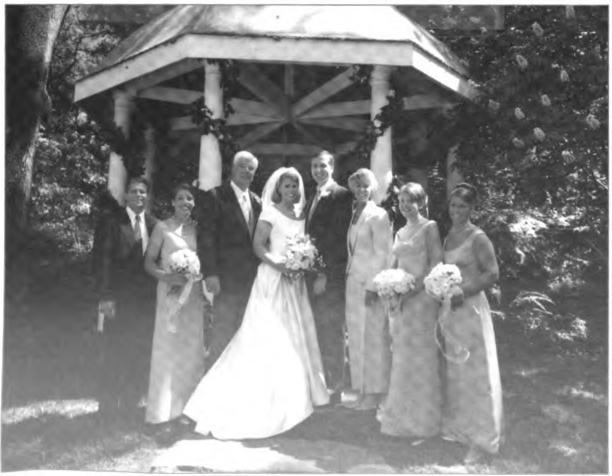
They married at 2:30 p. m. on Saturday, 24 August 1940 at the family’s Ranch in the Alhambra Valley near Martinez. The matron of honor was Rose Kerner Shurtleff and the maid of honor Miss Eleanor (Nonie) Peet, the bride’s cousin. The bridesmaids were Misses Nancy Miller (the groom’s sister) plus Martha Dexter, Gail Grigg, Eleanor Wishard of Honolulu, Jean Campbell, Barbara Sherwood, Harriet Johnston Shirley Makinson, Betty Noble, and Shirley Okell, most of whom were Nancy’s long time friends. The best man was Henry “Bud” Miller, the groom’s brother. The colorful country garden wedding was followed by a buffet supper on the terrace, then a motor honeymoon to Oregon. Many people still remember this as one of the most beautiful weddings they have ever seen (see p. 178 ).
Before they were married, Nancy and Willard thought that Willard’s father was going to give them a small lot in Orinda, California, that he had been given when he joined the Orinda Country Club. Although it was a pretty poor piece of property, they had spent lots of time when they were in New York drawing up plans for a house on that lot.

Then one day while driving around Orinda, they spotted an attractive piece of land at 30 Las Cascadas Rd. It was not listed as being for sale. The lot had nice oak trees on it, but it also had a steep ravine, a water runoff right down the middle. They nevertheless tracked down the owner through the county land office, then called to ask him if he might be willing to sell. To their surprise (and his) they discovered that he had forgotten that he owned the land. An architect in Martinez, he had been given the lot free of charge some years before as part of the deal when he joined the Orinda Country Club. He said he would be glad to part with it for $400 if Nancy and Willard would pay the $400 in back taxes. Even in those days, this was a steal!
But Willard had no money at the time, not even $400. So he asked his father, Bill, if he would be willing to finance the lot. Bill and Ednah (Willard’s mother) kindly bought the lot, paid all the back taxes, then gave it to the newlyweds as a wedding present.
By the time of the wedding, plans for their new home were finalized. They obtained a newly created FHA loan for $4,000, broke ground, and soon had built a new home, in which they have lived ever since. Nancy recalls that “Roy and others thought we were crazy for going so far into debt.” Lawton Shurtleff and Willard almost came to blows over the deal because Lawton felt that the “borrow now, pay in 40 years” concept could ruin a man’s self discipline. (Several years later Lawton was running a very successful housing business based on this concept.)
After their honeymoon, while their home was being built, Nancy and Willard lived for 6-7 months in San Carlos, on the Peninsula, in a home they rented from Willard’s father. Willard commuted by train to work at the American Trust Company on California St. in San Francisco. A good friend of his father’s who was the chairman had kindly given the degree-less young applicant his first real job.
On 7 December 1941, the Japanese attacked Pearl Harbor, marking the entrance of the United States into World War II. Willard immediately reported to work, with Gene Shurtleff, at the Richmond shipyards. Only days later, on 16 January 1942, Sandra Lee Miller, a girl, was born at Merritt Hospital in Oakland, California—Nancy and Willard’s first child. Sandy’s middle name, Lee, was the same as her mother’s, taken from the long-held belief in the Lawton-Rogers connection with the family of general Robert E. Lee.
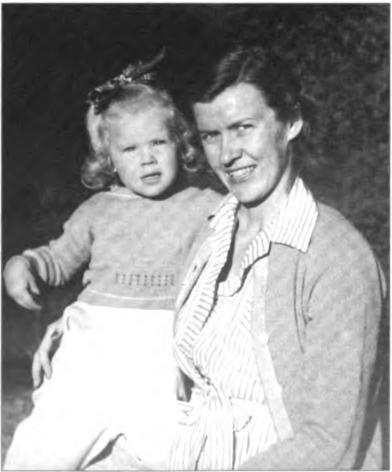
Willard worked at the Richmond shipyards for about a year (he and Gene drove back and forth together), then went with Nancy to Susanville, northern California, and took a civilian flight course for 4-6 weeks to get his solo license. They then headed for Fort Stockton, in west Texas, where Willard attended a flight school (owned by his father). Having passed the instructors training program, he began to teach cadets about airplanes and how to fly them.
Tiring of the simple, boring work after 18 months, he went to Dallas and joined the Army Air Corps as a flight officer in the Ferry Command. For the next 3-4 months he ferried airplanes around the world and loved the work. Then in early 1941 he was ordered to duty overseas.
At Tezpur Air Base near Dispur, one of 11 U.S. air bases in the Assam Valley in the northeast corner of India, he began to “fly the Hump,” carrying military supplies up over the towering Himalayan range and down into the two U.S. air bases in southwest China at Kunming (Yunnan province) and Chengdu (Sichuan province). There were two humps. The first one, 12,000 feet high going into Burma, was heavily patrolled by Japanese fighter planes. The Big Hump was in China, just north of Burma, around Kunming.
On typical trips, he would pilot big four-motored, unarmored B-24s, C87s or C-109s, which had been converted to tankers to deliver gasoline. Circling slowly up and down the valley for as long as 31/2 hours to gain altitude, he would finally strike out over the northern tip of Japanese-occupied Burma and the lower Himalayas. Eventually he would climb as high as 24,000 feet, where it was so cold (40-50 degrees below zero) that each pilot had to wear a special electric suit to keep from freezing. Under air support from the famous Flying Tigers, he would deliver his supplies at the U.S. bases in China, grab half art hour sleep, and head back to India, sometimes evacuating wounded Chinese. These bases in China were, at that time, the closest U.S. bases to Japan. From them Colonel Curtis LeMay’s 20th bomb group would fly their huge B-29s on bombing raids of Tokyo, or protect Chiang Kai-shek’s armies in China.
Willard had to use 7,000 gallons of high-octane gasoline to deliver a cargo of 2,500 gallons of gas to China. This gasoline came from Saudi Arabia by ship to Calcutta. It was then sent on big barges up the Brahmaputra River. One hundred miles from the air bases, where the big barges could no longer pass, it was transferred to smaller barges, that were pulled by coolies the rest of the way.
Willard’s work was dangerous and exciting. His group lost more airplanes and crews flying The Hump than the famous 8th Air Force in Europe lost defending England and bombing Germany. Interestingly, they lost more planes to the weather than to the enemy. Japanese fighter planes could climb no higher than 20,000 feet, whereas America’s turbo-charged B-24s could go up to 24,000 feet. During the five-month monsoon season, the air rising along the towering Himalayas would create huge thunderheads that went up to 30,000 feet, with tremendously high velocity updrafts inside. A plane could get hit by lightning, tossed around viciously, or simply get blown off course and lost. Willard recalls seeing old stoves and Ford motors floating around inside these swirling wind tunnels, where a pilot could easily find himself, since flying at night was preferred and there was no radar. Other planes crashed from poor maintenance or defective equipment. When Willard became chief pilot at his base, he made each crew chief, who was in charge of equipment and maintenance, fly the missions. As Willard remembers, only half in jest, “The accident rate really went down when those crew chiefs had their asses on the line.”
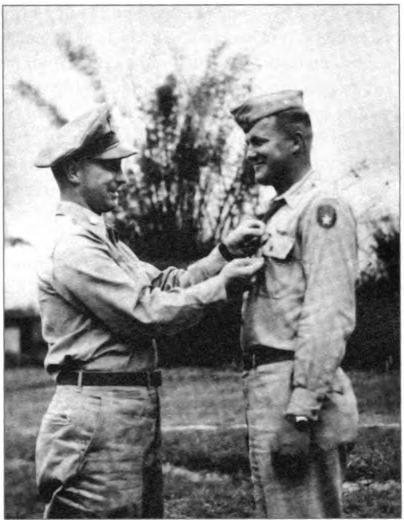
With Willard overseas Nancy moved back to Orinda and on 12 April 1944 Stephen Roy Miller was born in Oakland, California—”all 101/2 pounds light.” Willard had to wait for almost two years to see his new son upon his return from India.
With Steve’s arrival in 1944, it became apparent that the small Miller home needed more rooms. With Willard still in India, Nancy began supervising the addition of what Willard called the “East Wing.” This addition included a new bedroom for Steve, a new master bedroom for Willard and Nancy, two bathrooms, and a lanai on the back of the house. With wartime restrictions in effect, to obtain building materials, bathroom fixtures, and the like, Nancy had to sign a paper stating that she was doing the construction in order to take in boarders to help pay the bills while her husband was away. Since she had to pick up all the materials herself, she rented a truck. Willard was kept well informed of developments with photos and letters. These were the first of many additions and improvements to the house they had built in 1941.
With Willard away, Nancy supervised every aspect of the new construction projects—from plumbing to electrical wiring. She soon discovered that she really enjoyed this sort of mechanical “men’s work”—much better than playing bridge or going to luncheons. These kinds of practical, useful interests and skills—quite unusual for most urban and suburban women of her generation—would last her entire life.
From 1944 to 1946 Nancy did volunteer work at Juvenile Hall in Martinez and at Children’s Hospital in Oakland. She continued to do hospital volunteer work for the rest of her life, starting in 1947 at Merritt Hospital in Oakland.
Since gas was rationed, Nancy and Rose Shurtleff shared a motor scooter to drive around Orinda. While their husbands were gone, Nancy Rose, and Bobbie Shurtleff often congregated at the family’s Ranch in Martinez. Their children played together and grew to know one another.
During the War, in 1944, Willard’s parents bought a large house at Alta, a private PG&E lake off Highway 80, only a few miles from Dutch Flat. The previous owner was Steve Bechtel. Bill and Ednah Miller hoped that their children and grandchildren would use the place during the summers, which they did.
Willard returned from the war in December 1945, then in January 1946 he went to work for Dean Witter & Co. in part because many of his friends and his father were there, and in part because the firm offered a good, formal on-the-job training program, complete with classrooms.
Willard had first talked to Roy Shurtleff about a job at Blyth, but found that Roy couldn’t help since Blyth & Co. had a policy that management people could have only one relative working there. Roy already was way over staffed with relatives: Ed Martin Sr., Charlie Meek, and his son Gene. Initially Willard was not too excited about working at Dean Witter & Co. where his father was a partner, in part because the two of them were often not getting along that well.
When Willard told his father of his decision to work at Dean Witter, Bill said, “If you enter this business, you’re going to have to make it on your own, with no special help or favors from me.” He wanted Willard to succeed by himself. After six months in the sales training program, Willard went on the road. His monthly income consisted of $125 from Dean Witter, $100 from the G.I. Bill, and $75 help from his father. Looking back, Willard reflects: “I think, as things worked out, it was really harder for me to get ahead because of my father’s position. Management bent over backwards to make sure I wasn’t getting any favoritism. So I had to be almost twice as good as the next guy to get the same job. That’s really true.”
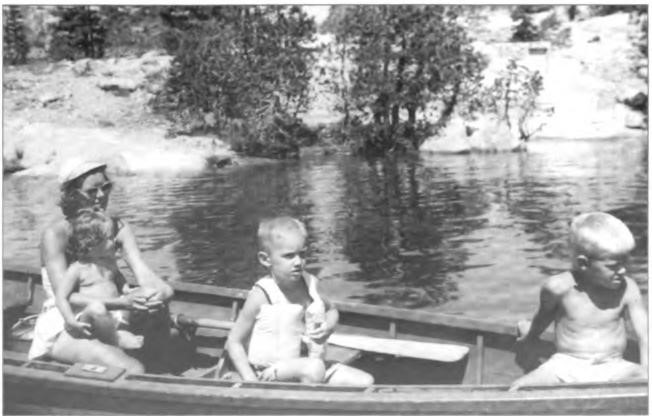
Wanting a larger family, Nancy and Willard adopted two children: Nancy Lawton Miller (born 19 November 1948 in Oakland, California, named after her mother, and called “Nan” or “Little Nancy”) joined the family when she was only 3 days old. Roy Shurtleff Miller (born 23 December 1950, and named after his maternal grandfather) joined the family when he was one week old.
Pictured: Nancy Miller, little Nancy, Jack Hansen and Steve in the Putt Putt at Echo Lake, circa 1950
In 1948 Nancy, with her tireless energy, remodeled the breezeway to the garage. The area was enlarged and converted into a playroom and rumpus room, causing Willard’s pride and joy, the tool room, to go, in his own words “down the drain.” And so started the modifications of the “modest home” that today is jokingly referred to as the Millers’ “Winchester” house—an allusion to the Winchester’s Mystery House in San Jose which allegedly contains 160 rooms.
For the next several decades, enlarging their home was a main focus of the Millers’ lives. On their 30th wedding anniversary, 24 August 1970, Willard gave Nancy a very special album that he created for her. Titled “Thirty Years at Thirty Las Cascadas Road,” it records with great good humor by decades, beginning 1941-1950, his fondest memories of Nancy’s limitless creative energy. When friends spoke of Nancy’s mother, Hazle, they used to chide that Hazle was never happier than when she had an elephant to wash.
Quotations that appear during the next few decades are taken directly from Willard’s album.
In the 1940s, their furniture was sparse but they owned their home and almost one acre of land—along with the bank. During those first years many hours of toil and sweat went into the original yard which has since been reworked many times.
In that year Nancy made her next move when, as Willard writes: “good old Marietta, our contractor friend, built the swimming pool. It was fun and we had many happy days by the pool, but it was constructed of wartime materials and could not stand the gaff [hard usage] so was completely redone at a later date.”
Recall from Lawton and Gene’s stories that in 1949 together with Nancy (who had the only checkbook handy) they purchased “Interlachen,” the Fred Macondry house on the channel between upper and lower Echo Lake. During those early years at the house on the channel all ten of the children, ranging in age from Linda, age one, to Bill age 8, had the summer-times of their lives, swimming, water skiing, hiking, fishing and enjoying endless friendships in this isolated high mountain setting.
In 1952, the big event in the Millers’ life was the purchase of their first Cadillac, a convertible. After much arranging, they finally bought it in Detroit for $3,000 and drove it home to California.
In 1954 in Orinda, with each of their four children growing up, Nancy and Willard again felt that more space was needed, so the West Wing was added including a new room for Sandy and a bedroom for Mary (who for years helped Nancy with the house work). Willard kept an album showing all the many additions. At that point Willard notes “Nancy (Winchester) Miller is now through! She has a room for everyone and she has run out of land. But, heaven forbid! Nancy outsmarted us and in 1955 she bought 21/2 acres of adjacent land from the Water Company. This, of course, could not be allowed to stand idle, so the entire pool area was redone, complete with croquet, badminton court and the whole ball of wax which pretty well used some of the new land. In 1959 the living room and dining room just had to be enlarged as the house had now outgrown these two rooms.”
In 1956 Willard and his son, Steve, bought an electric train and tracks, then built an entire world of trestles, tunnels, sidings, miniature lakes, trees, etc. inside a rectangular wooden frame. It was the size of the wall of their lanai (north wing) room, and—most amazing—the entire thing was hinged at the bottom and hoisted into the wall of the room and disappeared, looking just like the wall of the room. For many years Steve’s cousins (the children of Lawton and Gene Shurtleff) visited the Miller home on Christmas day and spent hours playing with that train. Nancy adds (Aug. 2004): “At his home in Atherton, Steve now has a much better train than that one; it’s a whole floor that comes down from the ceiling. Its his hobby.”
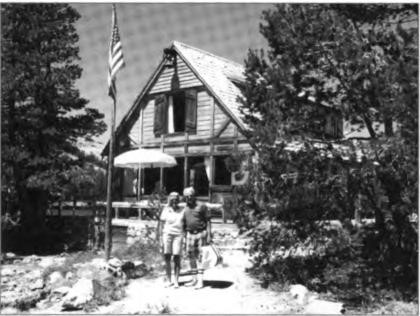
In 1958 at Echo Lake, after almost ten years of a truly wonderful family partnership, Willard and Nancy decided they wanted more time at the lake than the three weeks available while sharing the summer months with Lawton and Gene’s families. That spring, they found a house at nearby Mermaid Cove that they liked very much, but which was not for sale. They offered the owners $7,000 but the offer was refused. A slightly sweeter offer of $9,000 cash, however, changed their minds. Having sold their one-third share in the original Echo cabin, the entire Miller family spent their first summer at Mermaid Cove, starting in May 1958. Also located on lower Echo Lake, this cabin was less than half a nautical mile from their former home on the channel.
Nancy recalls that first summer in Mermaid Cove: “Almost immediately young Steve and I went to Lake Tahoe and purchased a speedy outboard motor boat and then once again, to surprise Willard, purchased an inboard ‘Correct Craft’ that we named the PDQ. It was hidden in the chalet’s boat house with a sheet hanging over it to surprise Willard when he arrived back at Echo for the week end.” Sandy can remember Nancy boiling pots and pots of diapers each day until they finally bought a used gasoline washing machine when they moved to the Mermaid Cove house. Willard and Nancy loved having the house full of kids, so there were always plenty there.
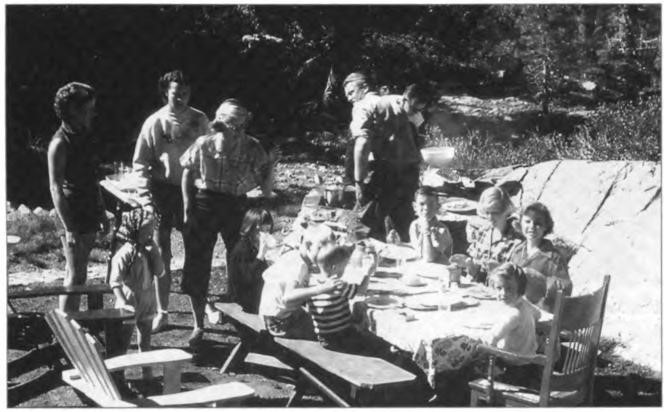
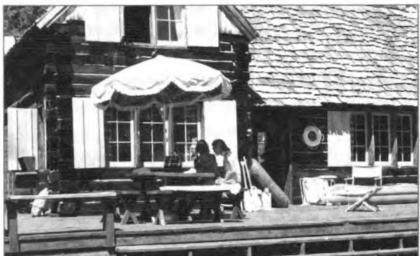
Night after night was spent playing Monopoly games in the cabin with gasoline lights. Echo Lake only had a few homes, out of a hundred or so, with indoor plumbing and toilet. Nancy and Willard drove the boats constantly for many of their friends and their children. Willard paneled the inside of the house in about 1959 and sanded and refinished the rough wooden floors. Steve lived at Echo and worked in Safeway at Lake Tahoe for two summers. Sandy worked at the Echo Lake Chalet for two summers.
Willard thought Echo was so great for the kids growing up, as the only way you could get to their house was by boat and thought that would keep them close to home. It did, until they all had their drivers’ licenses and then at night he started worrying until they would finally come home crossing the lake after a late evening at Tahoe. Willard would spend about two weeks at Echo. The rest of the family spent most of the summer there, leaving Nancy with the four kids! So naturally Nancy had to learn how to do everything: switch butane tanks, start the gasoline washing machine, and the gasoline generator, but it was all worth it as Echo was a great time in their lives.
Lawton Shurtleff liked to note in later years that he and his wife, Bobbie, were concerned that the Miller kids would turn out badly. He felt that Nancy spoiled her kids, and that she would side with them whenever Willard tried to exert a little discipline. Nancy defended her actions saying, “I disliked conflict or friction. If siding with the kids would prevent an argument, I would do it.” Years later, Lawton conceded that the Miller children turned out in ways that would make every parent proud.
In the late 1950s Nancy started doing a lot of woodworking and woodcarving. For example, she made about 30-40 figures of St. Francis of Assisi, each under a little roof, which she gave to friends to hang on the outside walls of their homes. She also painted little figurines on furniture in her kids’ rooms and re-wallpapered their rooms.
In about 1960 Willard gave Nancy a Shop-smith as a Christmas present. Located in the tool-room near the lanai, it was an all-purpose woodworking machine with a lathe, table saw, band saw, sldllsaw, router, planer, etc. Nancy used it to make mail boxes, signs (using the router) for all the schools in Orinda (where Steve was in high school) and even for the Bohemian Grove. Nancy continues to use her Shopsmith to this day.
Why these new interests? Nancy: “I always wanted to be there when the kids came home from school. So I had to have something that I was at home for. From the time Sandy started to go to elementary school in Orinda, there was never a day that I didn’t greet them at the back door, sit them up on the kitchen counter, and we’d talk about the whole day. I would be cooking dinner so that they didn’t think they had to relay everything to me, sitting down and looking at me. Also, I just loved to be home.”
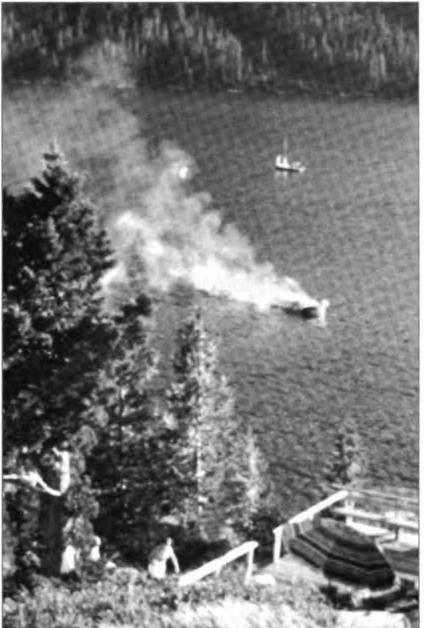
For whatever reason the POQ finally gave out. Its last effort was towing Steve again, when it exploded, burned and sank, PDQ (Pretty Damn Quick) in Mermaid Cove. A terrifying experience but fortunately no one was seriously hurt, circa 1969.
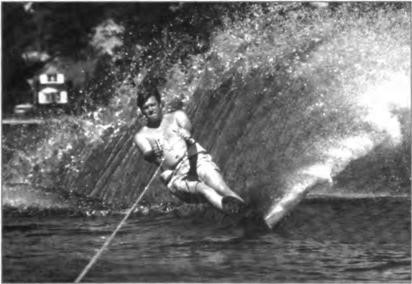
One evening in 1960 Willard came home from work with the exciting news that he had been offered a job in New York as assistant to Lee Limbert, the senior vice president there. He was elated but Nancy was devastated. She was adamant about not going, as she remembered only too well how unhappy her own mother had been in 1936, when she was uprooted from her home and friends to go to New York, and how hard this had eventually been on the entire family. After many conferences with various respected friends and counselors (above all, Roy Shurtleff, Nancy’s father, who unfortunately had been through the same sad experience), Willard wisely turned down the offer.
Nevertheless, that year Willard became one of 35 general partners and manager of the San Francisco office. In 1970 he became president of Dean Witter & Co., the arch rival, in the investment banking business, of Roy Shurtleffs Blyth & Co.
In Orinda, Willard wrote in his anniversary book: 1961-70 “In 1962 Nancy had too many clothes to jam into her dressing room so we found a little space behind the master bedroom and added a dressing room. This was okay because Willard got Nancy’s old dressing room and it has been a godsend ever since.”
On 28 December 1965 Sandy married Peter Rowe; about two years later, on 24 June 1967, Steve married Terry Perrin, Nan went away to school and Roy entered Cal. Now the motel “was too big and the problem was how to give back some of these additions.” Willard relaxed and said, “there is no way we can add on any more,” but no, Nancy found a way, and in 1967 Roy’s room was converted into a den, complete with bar, fireplace, the whole works, and with all the children away Willard relaxed again. But he had forgotten one thing—grandchildren arriving.”
Their first grandchild, Meredith Rowe, was born on 20 July 1967. (Another important occasion on this day was the first landing on the moon in 1969!) Their second grandchild, Steve, Jr., was born on 9 October 1969 (the wedding anniversary of his paternal great-grandparents!).
“We found we needed playpens, cribs, baby beds, bassinets, and what-have-you, and do you know what happened then? We had to add a storeroom to house it all! And the ironic part of it is that in the 30 year span the storeroom cost twice as much as the original house!”

On 24 August 1970 Nancy and Willard celebrated their 30th anniversary. To acknowledge all that had been accomplished in their years of marriage, Willard wrote, “Nancy, I give you all the credit. Happy 30th Anniversary, and let’s hope for 30 more at 30 Los Cascadas Road.”
Thus ends Willard’s story of Nancy’s Winchester house and that part of their lives.
However, never to be deterred, during the next 30 years, Nancy added a big new beautiful kitchen, family room, computer room and garden room.
Now we come to the story of how Nancy and Willard bought a house on Lake Tahoe. In June 1959, Lawton and Bobbie Shurtleff had purchased a beautiful old log cabin, called the Honeymoon Cottage, near Meeks Bay. In 1965 Lawton and Bobbie invited Willard and Nancy to visit and stay with them at the Reinhardt cabin (which they owned) adjacent to their own cabin at Tahoe. Willard was coming over from a meeting in Reno; Nancy was coming from Echo. Lawton had heard that the next door neighbor’s house owned by the Daileys (who the Shurtleffs knew slightly), might soon be for sale. When Nancy arrived, the Daileys weren’t there, so Lawton and Nancy went quietly over, turned on all the inside lights and had music going, making the place look very lovely, dramatic, and enticing.
When Willard arrived, Lawton, as previously contrived, suggested that just for fun he and Nancy take a look at the house. Willard never suspected that it might soon be for sale. It had two bedrooms and a bath downstairs, two bedrooms and a bath upstairs, plus a loft with two beds. Willard saw it and immediately fell in love with both the cabin and the gorgeous view!
Lawton suggested to Willard that it might be for sale. The next day Willard called the owner, Bud Dailey, just as Dailey was about to walk his daughter down the isle; he told Willard he’d call back later in the week. On 1 February 1965, after many offers, they got together on a price; Nancy remembers it was around $69,000—with an inboard Chris-Craft included.
So from 1965 on, Nancy Shurtleff and her brother, Lawton, and their respective families owned beautiful lakefront cabins next door to one another with one of the most gorgeous views of Lake Tahoe—and only a few miles from where they had grown up as kids at Homewood.
Soon after the sale was completed, Nance, of course, started to add a connecting guest house (which they called “The Chalet”), with a living room, bedroom, bath and laundry room and upstairs loft which opened up to their own upstairs bathroom. Over the next years they made many improvements to the Dailey house, as it was more of a ski cabin with brown concrete floors, couches nailed to the walls, etc. Willard and Nancy put in attractive furniture and hardwood floors, changed the door opening from the side facing Lawton’s to a sliding glass door from the living room opening on the deck, which they also enlarged, making it all very spacious.
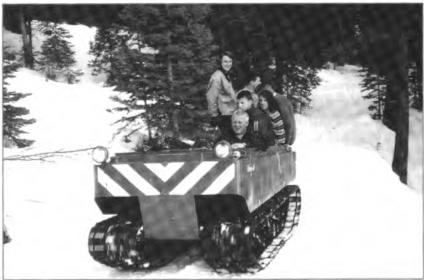
One of the big attractions for Willard in buying the house was “The Weasel,” an old army tractor made specially to drive on dry land or in the snow. They kept it in the garage and it was Willard’s toy for many years. When they bought the property at Tahoe, it came with three nice lots behind theirs. They gave Sandy, Roy and Nancy the three lots (which they later bought back from them) so they paid twice for them as they really weren’t buildable. Steve got the house at Echo—again many happy memories of both skiing in the winter with all the kids and boating and swimming in the summer.
The four children and later the grandchildren and great-grandchildren were by far the most important parts of Nancy and Willard’s life. There were many swimming parties, large family groups, badminton, croquet, and many ski trips to Alta and Sugar Bowl, also trips to Mexico, Bahia de Palmas, and the Hawaiian Islands. Nancy and Willard participated in all their activities, be it academic, sports or social.
During all their years of marriage while Nancy was busy with the children, the houses and the garden, Willard, for 45 years, got to the office, an hour away across the San Francisco Bay Bridge, by 5:00 a.m. and home about 6:30 p.m. Until 1948 the New York Stock Exchange was still open on Saturday, from 5 a.m. until noon—so half of Saturday was also a workday for Willard.
Willard retired from Dean Witter & Co. in 1982. In October 1984 Nancy and Willard received the exciting news that their eldest son, Steve, had followed in his father’s footsteps, being named President of Dean Witter Reynolds, and chairman and CEO of Dean Witter’s Individual Financial Services Division, which required that he move to New York City. Steve, however, lacking his father’s (and mother’s) foresight when it came to the wisdom of moving to the East Coast, packed up and left California. It took the actual experience of moving back there to realize that the pull of California was irresistible and the job would have required too much time away from his family. For strictly family reasons he returned to San Francisco, relinquishing the Presidency of Dean Witter, Reynolds. Fortunately his wife, Terry, and children had stayed in California until the kids finished school that year, so they didn’t sell their California home or buy one on the East Coast.
In 1983 Nancy brought the Miller family into the world of modern electronic technology when she purchased a Betamax, an early type of VCR (video cassette recorder) engineered by Sony. Nance recalls: “Nobody I knew had ever heard of a Betamax or a VCR.” Willard subsequently used it to record, on videotape, his favorite TV programs (especially football games), so he could watch them when he wanted.
Willard so enjoyed duck hunting that he belonged to four duck clubs at different times. He started hunting in 1941, continued on until 2000 when he was invited to join the very prestigious “Green Head” club. Willard’s hunting had many benefits for Nancy, including many delicious duck dinner parties. Since Willard had two black Labrador Retrievers, Nance had to fence in the entire garden to keep the dogs accounted for. Then she had to take over complete care and training of them. At that point Nance decided it was only fair that they build a separate caretaker’s cottage for live-in help to assist her in caring for the dogs and gardening. Since Willard had all the luxury of hunting and duck clubs, surely she should have a house at Tahoe. She ultimately prevailed when in 1965, as previously described, she had her Tahoe home, hence the album “Nancy’s Duck Club” that sits on the coffee table at Tahoe with pictures, instructions, guest’s comments—their Tahoe Bible.
Nancy and Willard had earlier joined the Orinda and, later, the Claremont Country Club where they golfed with family and friends. Their teenage children learned golf and tennis and made many new friends.
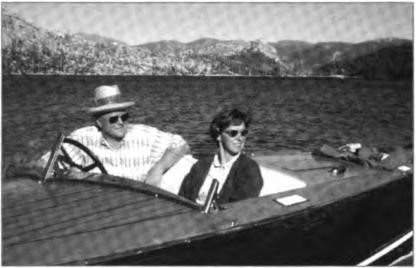
Willard had a fascination with speedboats. Remember he was an airplane pilot in World War II. At Echo Lake, in 1949, the family started with the 60 horsepower Da (later renamed the Triad.) That wasn’t enough horsepower for Willard, so the Da’s engine was upgraded to a 112-horsepower—which made it the fastest boat at Echo.
At Lake Tahoe in 1965 Willard’s first boat (after the Fa, a Chris-Craft he inherited from the Daileys) was the JJ, a Chris-Craft mahogany runabout with a 285 horsepower engine far larger and faster than the Fa or the Da, and just for their shared love of boats, he and Lawton Shurtleff, together, purchased a speedy double-pontoon sailboat. But the story doesn’t end there.
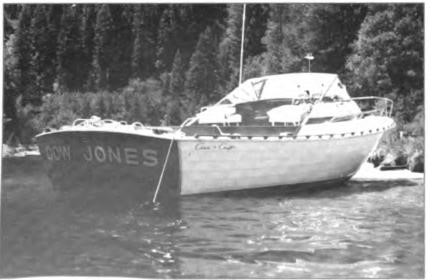
One evening in 1968 with his wife, Nancy, and Lawton and Bobbie Shurtleff, at a boat show in San Francisco, Willard spotted a large, 30-foot, white lap-strake cabin cruiser built by Chris-Craft. Intrigued by its two powerful 185 horsepower engines, he bought it on the spot.
It was delivered to a marina in Oakland, where Willard and Nancy drove it up the river to Sacramento. There it was berthed alongside Gene and Betty Shurtleff’s even larger 36-foot cruiser, which they had planned to use for weekends on the Sacramento River delta. Their plans, according to Betty didn’t work out, so after only a year the Shurtleffs sold their cruiser.
Willard’s boat (which he christened the Dow Jones) was then shipped to Lake Tahoe, where he took possession and drove it to their cabin. It was too large and valuable to moor nightly offshore at a buoy, so they added a large covered boathouse to their pier, complete with electric pulleys to raise it out of the water and under the cover of the new boat house. The Shurtleffs next door used to joke; it only partially blocked their own view of the gorgeous lake.
There was only one small problem: when the water level at Tahoe is low (as it often has been of late) the Dow Jones draws too much water to get it into the boat house. Despite this small problem, the Dow Jones remains in the family as its prize possession—mostly anchored out at the buoy.
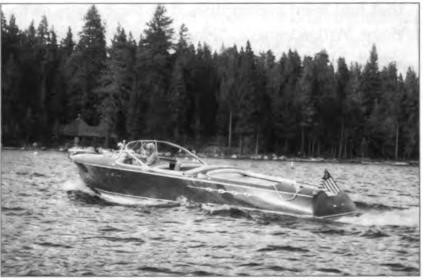
Willard’s purchase of a Riva is a separate story. That class of boat was reputedly first designed for Italian royalty. Nancy was in Orinda (where she would go back every 10 days during the summer to check on her garden) when in
1985, Willard got the “bee in his bonnet” to own a Riva. Unbeknownst to Nancy, he bought the Riva from Sierra Boat one day and took the Dow Jones there to list it for sale. The next day when Nancy came back to Tahoe, she made Willard go back to Sierra Boat to take back the Dow Jones. They were grateful for this later, as after 6 years of enjoying the Riva (Bella Barca) Willard once again, unbeknown to Nancy, in the beginning of summer, sold the Riva. The reason being, he explained, the lake was too low to get it into the boat house and he felt never in his lifetime would the water level rise again. The Riva was simply too elegant a boat to be exposed all summer to Tahoe’s burning sunshine.
So in 2001 Willard owned the JJ and the Dow Jones. In that year of low water, Willard sat happily on the porch at Tahoe admiring his two last boats floating at their respective buoys.
Another great love of Willard’s was fly fishing, he and Nancy traveled to Europe, New Zealand, Hawaii, Alaska, Montana and Idaho, almost always fishing with friends and relatives.
An important part of Willard’s life was his memberships in both the Bohemian Club and the Bohemian Grove. How he loved the summer stays at the Grove, three weekends in July. He liked all card games and was a champion at dominoes, which he played every day at lunch with his many “cronies in both the Bohemian and Pacific Union Clubs.”
Willard provided very generously to his children in trusts and helped the grandchildren finance their first home purchases in the same way.
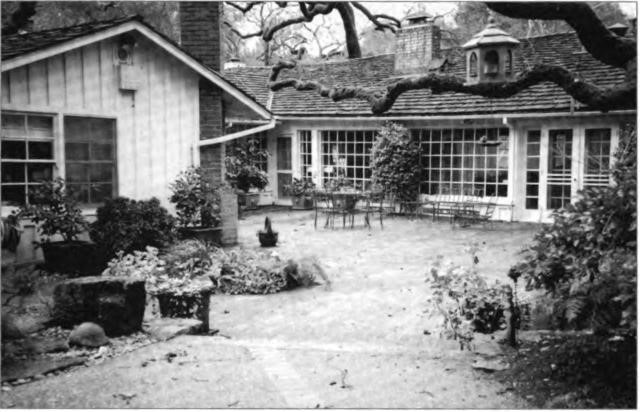
The focus now turns to Nancy, who began concentrating on her gardens, where one can feel her passion for gardening and the fish, birds, and the wildlife that add to its beauty. In 1985 Nancy started the extension of her then small garden in preparation for the graduation from high school of her granddaughter, Meredith Rowe. It soon became one of her main interests in life. We will let excerpts from two articles from local publications tell the story. The first is from Diablo in Sync (June 2000):
For more than 60 years, Nancy Miller has watched her garden grow. In 1940 when Nancy and her childhood sweetheart, Willard, married, they decided to settle in Orinda on a piece of property—a wedding gift from Willard’s father—that measured just less than an acre and straddled a ravine filled with blackberries and poison oak.
The developer filled in the ravine and cleared enough space for the Millers to build a small ranch-style home and a modest garden around its walls. A few years later when the adjacent land owned by the water company became available for sale—and much to the dismay of her practical friends—Miller borrowed $600 from her father and bought 3.5 more acres of untamed land.
Since that time, she’s gradually cultivated those acres into a magical park like garden complete with ponds, waterfall, a dramatic gazebo, a massive arched bridge and hundreds of flowering trees, shrubs and perennials.
In 1985 (in preparation for a party for Meredith] Miller embarked on a dramatic expansion of the garden’s design after consulting with Aerin Moore, landscape designer and owner of Berkeley’s Magic Gardens, about appropriate planting s for the area around the Japanese pond and small waterfall.
“1 didn’t have an overall plan in mind,” she says. “In fact, I never dreamed it would turn out to be such a big garden. But I liked what he (Aerin Moore) proposed for the first little area above the pond and we went from there.”
They used flagstone paths to connect the lower garden with the upper lawn area that had served as a croquet space for the Millers’ four children. When planning a focal point for the upper section, Miller recalled fond childhood memories of the large gazebo on Lake Merritt in Oakland. Together, she and Moore designed a similar gazebo out of large redwood columns covered with a domed top that Moore describes as “temple like.”
“One of the essential elements of this garden is the sound of running water,” referring to the natural woodlands water sound achieved with three separate waterfalls.
At the upper end of a bridge lies the sunniest portion of the garden. Miller chose hundreds of roses to fill the hillside—most of them single blooms for easier maintenance.
However, Nancy Miller says her favorite season is the spring, when all the dogwoods are in bloom and the rhododendrons are beginning to flower: “Other people have other times of the year that they prefer,” says Miller: “But they all seem to enjoy the garden whenever they visit; it has brought a lot of happiness to a lot of people over the years.”
Miller recalls a young neighbor girl who would often knock on her door and ask if she could just go sit in the garden or show it to a friend. “1 always tried to give her privacy in the garden while she was there, though I enjoyed seeing her scampering up and down the paths talking to some imaginary playmate,” she recalls. “Her mother later told me that when the little girl was feeling blue, she would tell her to go down to Mrs. Miller’s garden for a while, and she knew she would feel better.”
We listened to the play of water in the ponds and the bird song in the trees (though we’ve missed the heron and red fox who also came to visit!). We’ve walked with Miller in her garden and seen her loving attention at work in every corner of the truly enchanting property.
The excerpt from the Contra Costa Sun (4 April 2004) told the story somewhat differently:
Nancy Miller’s Orinda garden takes the visitor to another world, inspiring plant lovers to create lush retreats in their own backyards.
Twelve years ago, the sloping land behind Nancy and Willard’s home was a tangle of berry bushes, poison oak, sweeping oak trees…
The result is a Romantic-style garden—mix of the best of worldwide gardens. A Japanese pond with a waterfall and sleek Koi [carp] cheerfully splashes at the base of the hill. A magnificent white gazebo perches on the hill near natural bogs surrounded with iris and catnip echoes of traditional English gardens.
Miller had always enjoyed gardening. Her parents were avid gardeners while she grew up in Piedmont and on a ranch in Martinez, but while her children and grandchildren were growing up she preferred to keep a swing set and a croquet set in the backyard. She didn’t have the time for a large garden.
In fact, she never intended to undertake landscaping her entire yard. It just happened, and now garden clubs from the Bay Area visit her garden.
This is a real collector’s garden. Even when very knowledgeable gardeners come they always find at least one plant they haven’t seen before.”
Miller has three compost piles, each one located at a different corner of her garden. “it’s ridiculous for people to waste time or money planting in soil that is no good. They will lose interest, because nothing will grow,” she said.
Aside from her decorative garden, Miller keeps a vegetable garden. At the toe of the hill she plants potatoes, tomatoes, lettuce, beans, squash, broccoli and more. But as much as she enjoys reaping the fruits of her labor, the delicate collage of color never ceases to fascinate her. For her heart will always be in her Romantic garden.
Now that we know of the beauties of Nance’s garden what else does that tell us about Nancy (Shurtleff) Miller?
We know that in addition to her kindness to the young neighbor girl who found comfort in Nance’s garden, that her garden was always available for many staged “garden tours,” that tea parties were arranged for each one of her five granddaughters when they graduated from high school and that her grand daughter, Courtney Rowe was married in a splendid wedding at the top of the garden.
For many years Nance has been an active member of the Orinda Garden Club and now, at age 85, serves as an associate member. Gardening, even today, is Nance’s way of expressing her love of nature in all its beauty.
In so many ways, Nancy was like her mother, Hazle Shurtleff—compassionate, sensitive to the needs of others, kind, caring, warm, open and trusting, with a good sense of humor. Sandy Miller, Nancy’s eldest daughter, noted that Nancy never locked the doors of any of her homes when she was there. Nancy said simply: “I didn’t want to feel shut in.”
Throughout much of her life, Nancy did a great deal of volunteer work. When younger, she loved to load up her car with school kids and drive them on countless field trips. After her kids had grown up and left home, she did even more. In 1987 she was awarded a pin for 2,000 hours (and 30 years) of volunteer work at Merritt Hospital.
She also volunteered to help many of her friends in times of crisis or need—often serving as a caregiver and nurse for weeks or months at a time. She took many to and from the hospital. For friends in need, she is a friend indeed.
By staying in good health, Nancy has been able to keep her driver’s license longer than many of her friends. As of August 2004, she still drives.
In 1990 a few people began to ask Nancy what her fax (facsimile machine) number was. She decided to get a fax. She bought it and installed it herself—just as she had with the Beta Max. The fax required an extra telephone line into the Millers’ home. Nancy recalls that Willard thought “that was absolutely the dumbest thing he ever heard of,” and that Nancy would never use it. Later Willard had Nancy fax all of his business messages; he would never learn how to use a fax machine.
In about 1994, at age 75, while recovering from a hip operation, Nancy had a problem. She wanted to keep track of the large number of plants and sprinklers in her garden. When a sprinkler broke, she needed to fix it quickly before any damage was done. She decided to try to solve the problem by purchasing a personal computer—at a time when not many people (and none of Nancy’s friends) had a home computer. When asked why she did this, Nancy answered, “Because it was a challenge. I like challenges.” She approached the problem systematically, took computer classes at the Community Center in Orinda (“to see if I even could handle it”), read books, then took private lessons twice a week from a teacher who used an Apple computer—which Nancy found easiest to use.
Finally, she drove to an Apple computer store in Berkeley and met a young computer technician and Cal student named Danny, who helped her to choose the right hardware and software (including a modem and e-mail software), then to set it up at home in a lanai off the kitchen. Danny took a real liking to Nancy and Willard; he came to their home once a week, taught her how to use a personal computer, and fixed any problems. He and Nancy designed her plants database so that each record had fields for the common plant name, botanical name, location in her garden, color, and blooming time. Willard would say: “I’m not learning this stuff; it’s ridiculous. You’ll never figure it out.”
Danny got Nancy an Internet service provider so she could use her new modem to communicate with her friends and relatives by e-mail—the World Wide Web did not even exist yet. Nancy was among the first one to two percent of all Americans to start using the Internet; in fact, only three million people worldwide used it by 1994—the year the World Almanac first wrote about it and the first year it began to enter the consciousness of many Americans! The main Internet users in 1994 were government officials, scientists, and corporate researchers. Nobody that Nancy knew had even heard of the Internet or e-mail.
She started with her close friend and former neighbor, Gail DeWitt, who had moved to Healdsburg, California. Nancy convinced Gail to buy a computer and modem, and to learn how to e-mail so they could keep in touch. Before long Nancy had become an avid e-mailer. In October 1996 when Nancy first e-mailed her granddaughter, Perrin, at the University of Colorado, Perrin’s friend said in disbelief: “You got an e-mail from your grandmother?” The younger generation had come to view the Internet as its own domain. She would e-mail her son, Steve, at his office in San Francisco, and years later e-mail her brother, Gene, at both his home and office in San Francisco. As news from friends and relatives arrived on her computer, she would say to Willard: “Look at this e-mail I just received.” Peering over her shoulder, he began to get interested. After several years (and a talk with Danny) Willard overcame his resistance and realized that he, too, could become computer literate. Danny said to Nancy: “I’ll really get him interested; you watch.”

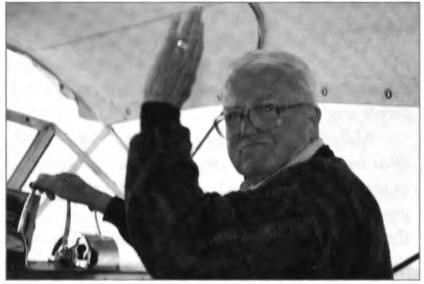
In about 1999 Nancy gave Willard her original desktop computer and Danny installed a screen-saver that showed the cockpit of the plane that Willard had flown over “the Hump” in World War H. Willard was hooked! Danny installed music, CDs, and software so he could write personal letters, pay bills over the Internet, keep track of his Dean Witter records and personal investments (some recommended by the famous Warren Buffet), etc. Sandy Miller recalls: “For the last two years of his life, Willard had his own desk at home for his computer. Having fought it for years, he just loved working and playing on it. You would have thought that he had invented the computer.” In the meantime, Danny got Nancy an even newer computer (an iMac).
Recall that Nancy’s mother, Hazle, grew up in a family where Christian Science was a strong influence. Nancy generally hated to take medicines—in part because most of them made her feel worse. She “feels that she can do better without most medicines.” She had never taken medicine for the arthritis pain in her fingers, but she has long taken medication to control blood pressure. Sandy, Nancy’s daughter, recalled in Aug. 2004, that she, for a long time, had suffered from arthrites in her thumb. When she was about 50 she asked her mom what she could do about the terrible pain. Nancy’s reply was typical: “Buck up.” So like Nancy. Nancy is very clear of mind, walks a lot and worked hard to keep in shape.
On 24 August 1990 Nancy and Willard celebrated their 50th wedding anniversary.
Willard had diabetes for the last 15 years of his life, but he passed away on 26 July 2001 from lung cancer. A memorial service was held, mainly for the family, in the lovely rear patio of their home, surrounded by Nancy’s breathtaking garden. It was a moving ceremony where children and grandchildren arose to remember Willard.
For Lawton Shurtleff, one of the most touching parts of the service was that Willard was referred to by one and all as “Bobo,” never as the more formal “grandpa” or “grandfather,” so often used, but just their dear friend “Bobo.” With Nancy sitting sadly nearby, surrounded by her children, grandchildren and great grandchildren, it was always Bobo and Me Ma or Mi Mi, their adored elders. To Lawton, this was the truest expression of love and affection, generously given, and love and gratitude, gratefully returned. A truly loving family!
Willard’s ashes are in his niche at Mountain View Cemetery in Oakland, California.
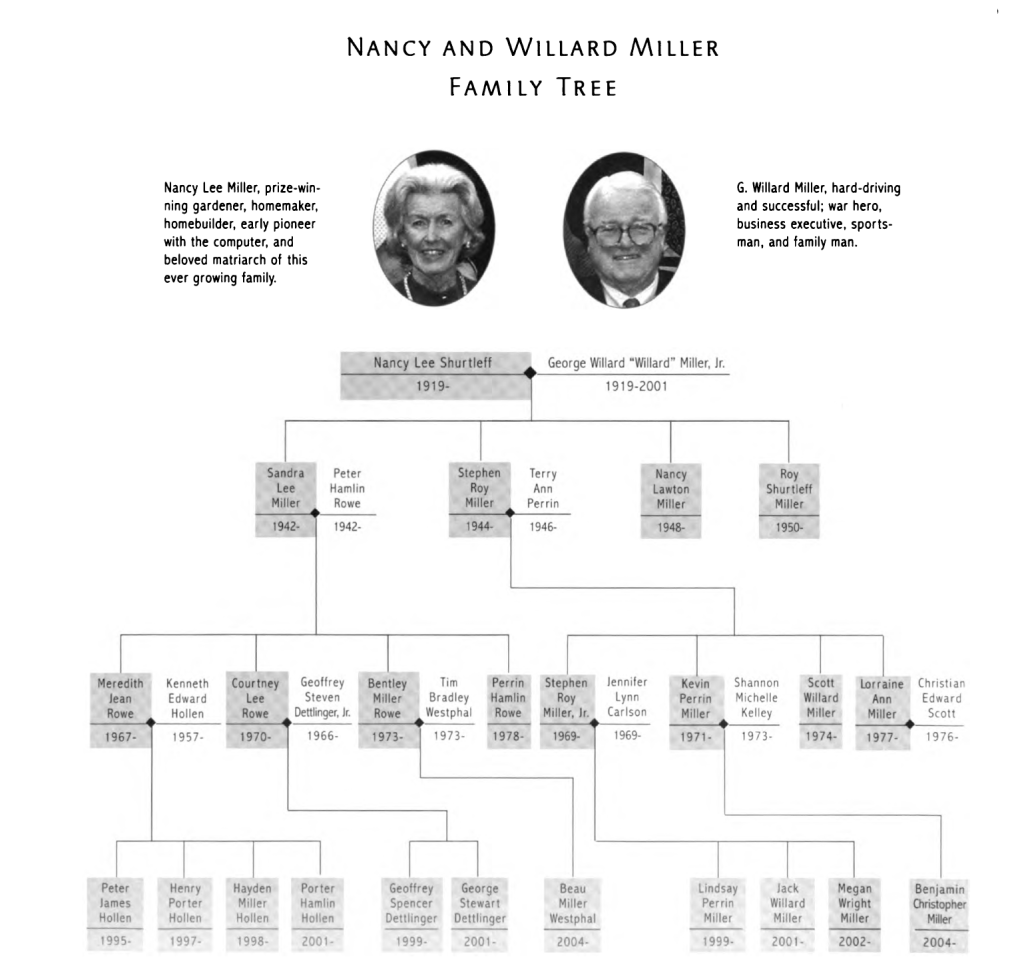
Nancy and Willard’s children were:
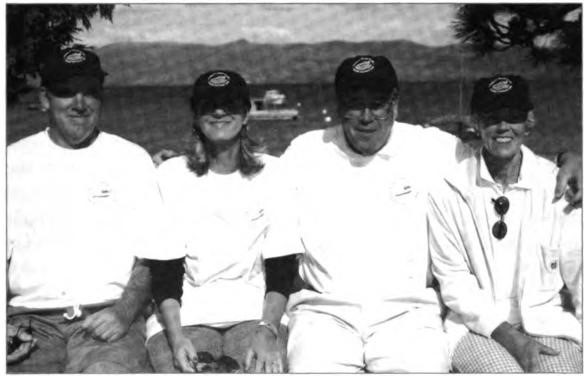
Tahoe 1999.
1. Sandra Lee Miller, born on 16 Jan. 1942 in Oakland, California at Merritt Hospital. She attended Orinda Intermediate School, Phone Grove, and Anna Heads, a school for girls from which she graduated in 1959. She was a debutante at the Winter Ball. Her big interest was horses and riding with her Grandma Miller. She attended the University of Colorado, then transferred to San Jose State University in California. In 1963 (before graduating), she went to work in San Francisco for Eubanks and Myerson, then moved to San Francisco and worked for Wells Fargo. Sandy met her future husband Peter Rowe at baby parties, as their mothers were good friends. They renewed their friendship when the Rowes and Millers happened to go to New York looking for colleges. They got together one night in New York and things progressed from there.
Sandy was married on 28 Dec. 1965 to Peter Hamlin Rowe at St. Leo’s Catholic Church in Oakland, California. The reception was at the Claremont Country Club. He was born in Rochester, New York on 5 Jan. 1942, son of Albert Porter Rowe, a famous allergist, and Mignon Hamlin. Peter attended Piedmont High School and then Stanford University, from which he graduated in 1963. Sandy and Peter married while Peter was in medical school at Bowman Gray, North Carolina. After obtaining his degree in 1965, Peter worked for two years as an intern at Baylor Medical College in Houston, Texas. He then took a residency at the University of California Los Angeles, followed by a fellowship in nephro-logy at the Public Health Hospital in the Presidio, San Francisco, where he worked for two years. Next he went into private practice with his father, and soon started his own practice in Oakland and Walnut Creek. He later formed his own doctors hospitalization group at John Muir Medical Center in Walnut Creek. Sandy and Peter had four daughters:
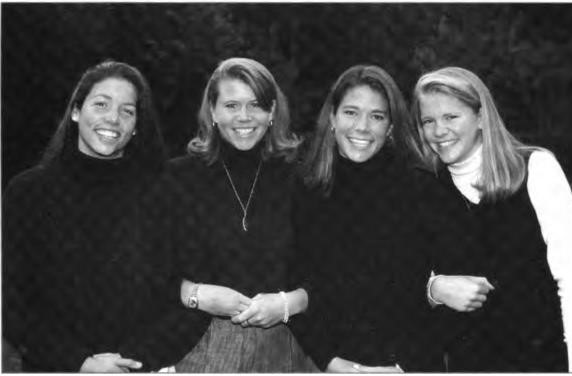
Meredith, Courtney, Bentley, and Perrin, Tahoe, mid-1990s
- Meredith lean Rowe born on 20 July 1967 in Houston, Harris Co., Texas. She attended Castilleja School, where she was a Winter Ball debutante, and Stanford University, where she was in the Pi Beta Phi sorority, majored in English, and earned her teaching credential. She then started teaching at Castilleja School. Meredith married Kenneth Edward Hollen on 30 Dec. 1994 at St Margaret Mary’s Church in Oakland, California. The son of Jean Edward Hollen and Shirley Ann Haabstad, Ken was born on 28 Dec. 1957 in Bronxville, Winchester Co., New York. He graduated from Leheigh University and is an entrepreneur. They had four children:
- Peter James Hollen, born on 22 Oct. 1995 in Walnut Creek, Contra Costa Co., California.
- Henry Porter Hollen, born on 23 Feb. 1997 in Colorado Springs, El Paso Co., Colorado.
- Hayden Miller Hollo, born on 22 Nov. 1998 in Colorado Springs, Colorado.
- Porter Hamlin Hollen, born on 11 Jan. 2001 in Denver, Denver Co., Colorado. They currently live in Denver, Colorado.
- Courtney Lee Rowe born on 3 Oct. 1970 in Los Angeles, California. She attended Castilleja School, the College Preparatory School (C.P.S.) in Oakland, California, where she was a Winter Ball debutante. She graduated from the University of California at Berkeley, where she was also a Pi Beta Phi sister. She worked at Dean Witter and Co. in Philadelphia, Pennsylvania. Now she works in her dad’s office. Courtney married Geoffrey Steven Dettlinger, Jr., on 13 June 1998 in her grandparents’ (Nancy and Willard’s) garden in Orinda, California. Born on 3 Aug. 1966 in Royal Oak, Oakland Co., Michigan, Geoffrey was the son of Geoffrey Steven Dettlinger and Judy Ruth Snider. He also graduated from the University of California at Berkeley, and is now a vice president with Morgan Stanley. They had two sons:
- Geoffrey Spencer Dettlinger born on 1 July 1999 in Walnut Creek, Contra Costa Co., California.
- George Stewart Dettlinger, born on 18 Nov. 2001 in Walnut Creek, California.
- Bentley Miller Rowe, born on 8 Nov. 1973 in Oakland, California. She attended C.P.S. in Oakland, California then graduated from Acalanes High School, where she was a Winter Ball debutante. She started college at the University of Oregon, where she was in the Kappa Kappa Gamma sorority, then transferred to and graduated from St. Mary’s College in Moraga, California. After graduating she worked in sporting goods stores. Bentley married Tim Bradley Westphal on 14 Sept. 2002 in Squaw Valley, at Lake Tahoe, California. Born on 12 March 1973, Tim was the son of Roger Lewis Westphal and Penny Lynn Truitt. He graduated from Whittier College, and now works with Bay Alarm. They had one son:
- Beau Miller Westphal, born on 8 May 2004 in Newport Beach, Orange Co., California.
- Perrin Hamlin Rowe, born on 10 Jan. 1978 in Oakland, California. She attended Havens School, Happy Valley School, Acalanes High School, where she was a Winter Ball debutante, and the University of Colorado, where she also was in the Kappa Kappa Gamma sorority. She now works in her father’s office.
2. Stephen Roy Miller born on 12 April 1944 at Merritt Hospital in Oakland, California. He attended Sleepy Hollow School and attended St. Stephens Episcopal Church, where he was an acolyte for 10 years. In 1962 he graduated from Miramonte High School and he was chosen all league in football. He received the highest Boy Scout honor, the “God and Country Award.” In 1963 he received a college football scholar ship and attended the New Mexico Military Institute for a year, then worked for a summer (1963) in the mail room at Dean Witter. In 1964 he entered the University of Southern California. In 1965 he was voted USC yell leader by the student body, and in 1966 he was elected president of the Beta Theta Pi Fraternity and played football. Steve was married to Terry Ann Perrin on 24 June 1967 at St. James Episcopal Church in Los Angeles, California. The reception was held at Wilshire Country Club. Born on 4 Feb. 1946 in Los Angeles, California, Terry was the daughter of Jack Louis Perrin and Lorraine Edwina Yourell. She attended the University of California, where she was in the Kappa Kappa Gamma sorority, then transferred to UCLA and graduated from there.
Like his father, Steve had an outstanding career in the field of investment banking at Dean Witter & Co. His maternal grandfather, Roy Shurtleff, had founded Blyth, Witter & Co., from which Dean Witter & Co. had originated. And his grandfather, on his father’s side, was an active partner in Dean Witter & Co. In 1965, prior to graduating from the University of Southern California, he joined the firm as an account executive in Los Angeles. He moved quickly up the management ranks, becoming assistant manager of the Los Angeles office in 1967, branch manager of the Palo Alto office in 1974, becoming one of the youngest branch managers in Dean Witter’s history. He then became branch manager in the San Francisco office in 1977, following in father’s and grandfather’s footsteps. His appointment to manage the San Francisco office marked the first time in the firm’s history that three generations had managed the same office; it has never been repeated since. He was elected to the board of directors of Dean Witter in 1978—the youngest member ever. He became senior vice president and regional manager of the Central California and Nevada region in 1979. Then in 1981 he became executive vice president and divisional manager for the western half of the USA, based in San Francisco. On 30 Oct. 1984 he was president of Dean Witter Reynolds Inc. and chairman and chief executive officer of Dean Witter’s individual financial services division, including brokerage operations and investment banking. His new duties placed him in charge of some 400 offices and 4,000 account executives. At age 40, he became the youngest ever president of Dean Witter. In 1997 he was president of Lombard Brokerage; in 1998 president of Discover Brokerage Direct; 1999 Western Divisional Director, 2000 Managing director and Director Private Wealth Management; in 2001 he was an Advisory director. He retired at age 57. Steve and Terry had four children:
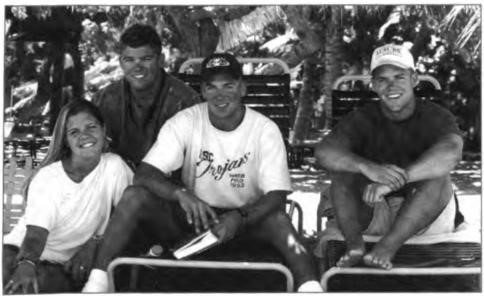
- Stephen Roy Miller. Jr., born on 9 Oct. 1969 in Torrance, Los Angeles Co., California. He was christened at St. Stephens Episcopal Church in Palos Verdes, California. He attended Menlo School, was All-League in football, and graduated from USC, where he was president of the Beta Theta Pi fraternity, following in his fathers footsteps. He went to Chicago Business School, then worked for Merrill Lynch in New York. He married Jennifer Lynn “Jenn” Carlson on 19 Oct. 1996 at Piedmont Community Church in Piedmont, Alameda Co., California. The reception was at the Claremont Country Club. The daughter of Richard Henry Carlson and Susan Moscrip, Jennifer was born on 23 May 1969 in Berkeley, California. She attended and graduated from UCLA, where she was a Delta Gamma. She started work as a graphic artist. Merrill Lynch transferred Stephen to California as managing director in Palo Alto. They now live in Atherton, California. They have three children:
- Lindsay Perrin Miller born on 4 Feb. 1999 in Palo Alto, Santa Clara Co., California.
- Jack Willard Miller born on 30 Jan. 2001 in Palo Alto.
- Megan Wright Miller, born on 2 Oct. 2002 in Palo Alto.
- Kevin Perrin Miller, born on 22 July 1971 in Torrance, Los Angeles County, California. He was christened at St. Stephen’s in Palos Verdes, California. He attended Menlo school, was All-League in football, took a fifth year at Lawrenceville, and then graduated from USC, where he was president of the Beta Theta Pi fraternity, following in his fathers footsteps. From there he went to Notre Dame Business School. He started work at Network Appliance in Sunnyvale, California, where he became vice president of marketing and sales operation. He married Shannon Michelle Kelley on 9 Nov. 2002 at the Woodside Village Church, Woodside, San Mateo Co., California. The reception was held at the Menlo Country Club. The daughter of John Dale Kelley and Carole Anne Dunn, she was born on 4 Sept. 1973 in Phoenix, Arizona. Shannon graduated from the University of Arizona, where she was a Theta, and now works at Sun Microsystems in Menlo Park, California. They had one son:
- Benjamin Christopher Miller born on 11 June 2004 in San Francisco, California.
- Scott Willard Miller, born on 10 May 1974 at Torrance, California. He was christened at the Presbyterian Church in Menlo Park, California. He graduated from the Menlo School, where he played football, and was All-League. He graduated from USC and was in the Beta Theta Pi fraternity. He began work at R.R. Donnelly in 1997, and now works at C. B. Richard Ellis Commercial Real Estate in San Francisco, and lives in San Francisco. Lorraine Ann “Laurie” Miller, born on 21 April 1977 at Stanford, Santa Clara Co., California. She was christened at the Presbyterian Church in Menlo Park, California. She attended Menlo School and the University of Southern California, where she was in the Delta Gamma sorority. After graduating she went to College of Notre Dame in Belmont, California, earned her teaching credential and went on to teach at Las Lomitas in Menlo Park, California. She married Christian Edward Scott on 28 June 2003 at Valley Presbyterian Church in Portola Valley, San Mateo Co., California. The son of Jerry Lawrence Scott and April Lynn Crowley, he was born on 17 March 1976 in San Jose, California. He attended and graduated from USC, then worked for Verity in California and was later transferred to Washington D.C. as Federal Account Executive for Verity.
3. “Little” Nancy Lawton Miller born on 19 Nov. 1948 at Oakland, California. In 1978 at 30, she became a born-again Christian and that has long been an important part of her life. She attended Sleepy Hollow Grammar School and Miramonte High School. She attended Centary Jr. College, Hackettstown, New Jersey (1966-1968), and then Denver University, Colorado, and finally California State Hayward, from which she graduated in 1973. She worked at Blyth & Co. as a secretary, then at Cooley Garthwait Law Firm as a secretary. She also did catering and home staging. She has lived in Novato and San Rafael and in 2004 bought a house in Sonoma, California.
4. Roy Shurtleff Miller, born on 23 Dec. 1950 at Oakland, California. During 1962-63 he attended the Athenian School, a private school at the foot of Mt. in Diablo. In 1966 he graduated from Miramonte, a public high school in Orinda. He attended the University of California at Berkeley, then the University of Nevada, graduating in 1971. Recognized early as an intellectually gifted child, Roy became a brilliant physicist, and worked at the Stanford Linear Accelerator near Stanford University in California. He loved the work and was very adept at it, but he became disabled from the effects of electro-magnetic fields and so retired on disability in 1998. He is now living outside of Elko, Nevada on a small farm.

 Shurtleff & Lawton Families Genealogy & History - Second Edition (2005)