** All Text on these chapter pages has been copied verbatim – with permission – from this book: “Shurtleff Family Genealogy & History – Second Edition 2005” by William Roy Shurtleff & his dad, Lawton Lothrop Shurtleff ** Text in pdf convert to word doc – any spelling errors from the book may or may not have been fixed. **
s Roy began to consider retiring, he started to look for a new avocation that would be challenging and worthwhile, to keep him active. Because he had always loved gardening, he was thinking of going into raising orchids, so he began to study them. Then he began to review some of his earlier correspondence with Benjamin Shurtleff, who had published the first major genealogy of the Shurtleff family in 1912. In late 1961 Roy applied for membership in the New England Historic Genealogical Society. A letter dated January 1962, confirming his acceptance and asking for more information on his own genealogy and personal history, is the earliest evidence we have of Roy’s growing new interest.
On 27 December 1962 Roy Shurtleff retired from Blyth & Co. at the age of 75 in excellent health and spirits, and of very clear mind. Roy had watched at least one elderly friend as he grew less capable, try to stay on and manage a company; Roy had vowed earlier not to make the same mistake himself. Top management had to retire voluntarily, since there was no company policy on retirement to force them out. At the time of Roy’s retirement, George Leib was Chairman and Stewart Hawes was President of Blyth & Co. Roy encouraged George Leib, who was about Roy’s age, to retire to let the next generation have some new incentives in the form of management openings. But Leib preferred to work until the end. He eventually died in the harness from a stroke roughly 10 years after Roy retired.
Roy told the Executive Committee he would retire if they would provide him with a full-time secretary, an office in the Blyth building, and a telephone connection through the Blyth switchboard for as long as he wanted. He was also given the title “Honorary Chairman of the Executive Committee.” Blyth & Co. exercised its option to purchase all of Roy and Mabel’s preferred and participating preferred stock. So they were required to sell all of their shares at book value back to the company, which retired them. Roy’s children (except for Gene, who worked for Blyth and was therefore allowed to keep his stock) had to do likewise. Together Roy, Mabel, Lawton, and Nancy had 55,454 shares of Participating Preferred Stock and 710 shares of Preferred. Both types of stock were worth $4,028,614.
Roy had been a generous father. His Christmas gifts from 1940 to 1961 of $3,000 worth of stock to each of his three children had added up over the years. In addition, each of his children had inherited 205 shares of preferred and 2,355 shares of participating preferred stock from the estate of their mother, Hazle. A letter from the Bank of California to Roy dated 27 December 1962 states that the bank is enclosing checks for the following amounts: $2,185,343 payable to Roy, two checks for $511,697 each payable to Nancy S. Miller and Lawton L. Shurtleff, and $101,483 payable to Mabel M. Shurtleff. Note: These four amounts add up to $3,310,220 which, for some unknown reason, is $718,394 less than the $4,028,614 mentioned above.
Starting at Christmas 1963, in place of Blyth & Co. stock, Roy gave his children PG&E stock. He wrote in 1963: “It’s true, it is also unexciting, doesn’t move very much, and pays small dividends. However like Blyth, it is a growth company and some day its stock will again take off on the up side.”
Starting in 1962, the year of his retirement, Roy also gave each of his grandchildren a special keepsake, on his or her 21st birthday. For example, to his oldest grandson he gave a fine Swiss Patek-Philippe vest-pocket watch and chain. On the back was engraved “R.L.S. to Bill Shurtleff 4-28-62.”
On 30 April 1962 at the Sunny Hills Annual Meeting, a letter of tribute and appreciation from the Board of Directors was read to Roy, and he was made an Honorary Vice President. A portion
of the 1928 minutes were also read: “Our Infirmary is built as a memorial to a former beloved Board member, Mrs. Charlotte Shurtleff, the mother of our present Endowment Chairman, Roy Shurtleff…” The endowment that Roy helped to raise grew to over $108,000 before the Great Depression.
Roy’s contribution to Blyth & Co. from its beginning in 1914 to the day he retired was of great importance. Although the company never had an “official” general manager, Roy came the closest to filling its requisites of anyone in the business. For many years he was the Chief of Operations. If a man was to be hired or a salary increased, Roy’s approval was needed. If an office was to be opened or closed, it was his decision. He had an abundance of that very rare quality called common sense and, although he was modest in stating his views, he defended them with great vigor. For many years his counsel was of the wisest, and in retirement it was still sought Roy was a good negotiator, but was exceedingly matter-of-fact.
Lawton recalls that while he was only a boy, working summers at Blyth as a “runner,” he was told by the door man, telephone or elevator operator, and secretaries that it was Roy who made the office run and the company was a replica of his personality. They commented on his humility and sense of fair play in dealing with his employees.
September 19, 1962 was Roy’s 75th birthday. His children and their spouses drafted a long poem about the high points of his life and enduring values, starting with his early days in Nevada City. It was titled “The High Road, To Dad on his 75th Birthday.”
Bobbie Shurtleff also wrote a birthday poem for Roy:
Here’s to Dad, who at 75
Is more alert and more alive
Than many of us, tho’ our years be fewer.
He can crack more jokes that are gayer and newer
Drink more martinis and keep his balance
Act more modest in spite of his talents
Catch more fish and name more wines
And enjoy the opera in spite of the lines.
His clothes are more sporty, his dahlias are bigger
His dominoes always produce the right figure.
We’d all get discouraged except that we, too,
May start livin’ at 75 just like you.
In 1963 the San Francisco Bond Club named Roy the Investment Banker of the Year.
Also in 1963, as part of his growing interest in the history of his family, Roy had a new Shurtleff gravestone made. It was erected in Nevada City, in the Pine Grove Cemetery, off Boulder and Red Dog Streets, in the old Shurtleff family plot. Chiseled into the black marble under the large letters SHURTLEFF are the names Varilla Marston (1841-1882), Matthew Samuel (1839-1890), Clara Lucia (1868-1885), Lodema Caroline (1843-1896), and Helen Shurtleff Stevens (1881-1963).
Roy was surprised and happy to learn in 1963 that the first of his grandchildren had married: Bob Shurtleff and Janice Ellen Taylor exchanged vows on 13 January 1963 is Las Vegas, Nevada. Later that year they presented Roy with his first great-grandchild: Sue Ann Shurtleff was born on 24 October 1963 in San Diego. Bob and his first wife were divorced. He remarried to Barbara Vincent, and they had a son, Kenneth Kerner Shurtleff, on 14 August 1965. Kenneth was Roy’s first male great-grandchild. By the end of the 1960s Roy had five great-grandchildren.
Roy looked very young almost all his life and it used to bother him. According to Soher (1964), Gene Bashore once said he was the only man of 65 in the United States who wished he looked more mature. Roy mellowed nicely with age and developed real dignity.
In 1964 Blyth celebrated its 50th anniversary. It published The Blyth Story (Soher 1964) to commemorate its history to date, from which much of the above business history has been taken. Gene Shurtleff was assigned responsibility for coordinating the project by Blyth’s Board of Directors. Bert Soher, a newspaper reporter (not a Blyth employee) was hired to write the book. A graph at the beginning of the book gave a vivid picture of the securities business from 1914 to 1964 (see p. 157)
After retirement Roy actively pursued his interest in the family genealogy. He traveled to Massachusetts to visit with the sister of Benjamin Shurtleff, the man who had written the first Shurtleff genealogy. Eventually he met Mrs. D. Ray Shurtleff, a widowed Mormon living in Salt Lake City. She gave Roy, with her blessings, many hundreds of pages of handwritten notes on the genealogy of the Shurtleff family collected by Benjamin Shurtleff between 1912 and 1952, including Benjamin’s list of Shurtleff contacts.
This gave Roy a good start, in 1962, on what he decided to make his next project—a thoroughly updated and revised edition of the family genealogy, Descendants of William Shurtleff, the original edition of which had been published in 1912 by Benjamin Shurtleff.
Roy went to the office every day, just as though he were going to work for Blyth. He tackled his new and mammoth project with characteristic vigor and thoroughness—and the help of his devoted and efficient secretary, Mrs. Grace E. Franks, whose salary was still paid by Blyth. He walked up the street to the telephone company library and looked through all the telephone books published in every part of the United States. He employed a number of professional genealogists in the U.S. and England. He and Mabel traveled to England to inspect the Ecclesfield parish records back to the 16th century. Eventually he developed a list of some 2,800 Shurtleffs that he got largely from the phone books. Then he began to correspond with them.
During the 1960s, while Roy was in his 70s and during his active semi-retirement, he and Mabel continued to be avidly interested in fishing. Each spring they went for three to four days on a fishing trip to Oregon, boating down the McKenzie River. They always went with friends, including Bill and Ann Mordy, Elmer and Jan Peterson, and Judge and Mrs. Holloway, or with Roy’s children and their spouses.
On one of these trips, in September on his birthday, Bobbie Shurtleff wrote Roy a poem to celebrate the occasion:
Some folks like to troll for fish
Or spear them in a frenzy—
But Dad would go where the rainbow grow
Up north on the green McKenzie.
There are May Flies and caddises
And guides to tie ’em on.
You can catch a trout when the hatch is out
And that’s not just at dawn.
You have a nip and a picnic lunch
Beside some deepening pool,
When the sun is high in the northern sky
And the shady bank is cool.
You whistle in summer and hum in the fall And in winter you only dream.
But along comes spring and you start to sing As you head for that hallowed stream.
Happy Birthday and many more happy trips to the beautiful McKenzie
—Love, Bobbie & Lawton
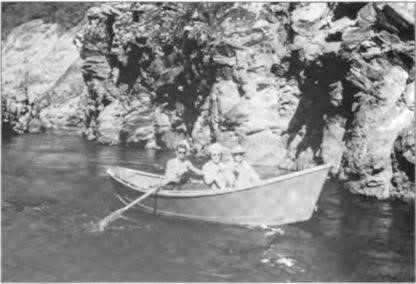

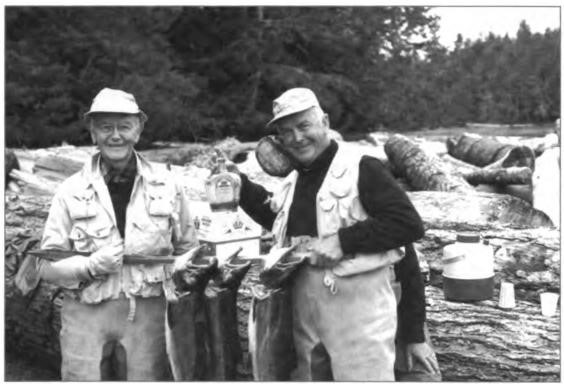
Roy and Mabel also fished at the San Francisco Fly Casting Club on the Truckee River. They would wade into the river and fish dry flies (or occasionally wet flies). Fishing trips with friends and relatives also took them to Alaska and British Columbia. Roy became a member of the Dunes Club on the Tlell River (pronounced tuh-LELL) on the Queen Charlotte Islands in British Columbia. There he fished for the large coho salmon each fall. (Note: The Dunes Club burned down in the early 1970s and is now the Naikoon Park headquarters building.)
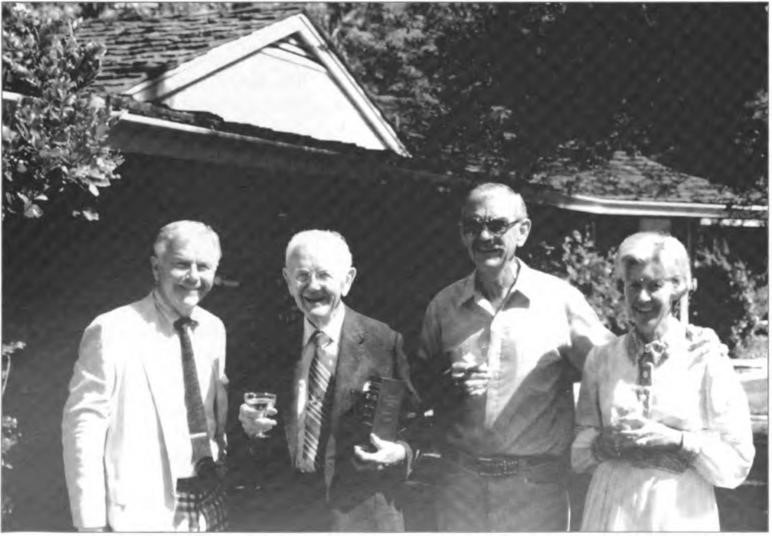
A photo from May 1962 shows Roy and Mabel with Gene and Betty on a McKenzie River trip. In 1964 they are outdoors by a river with Nancy and Willard Miller. In 1965 we see them riding horses in the Coldfish Lake area of northwestern Canada. In May 1966 we see Roy on the McKenzie River in Oregon with his son Gene. In July 1966 they are standing by a float plane on a fishing safari with Lawton and Bobbie Shurtleff. And in October 1966 he and Gene are each holding two large coho salmon they have caught on the Tlell River in Oregon.
In September 1967, on Roy’s 80th birthday, all three of his children with their spouses took him and Mabel on a five-day boating and fishing trip down the Rogue River. They rowed in wooden boats, and a float plane (with pontoons) took them part of the way. Roy dove off high rocks and swam back and forth (overhand crawl) across the swift river, and had a wonderful time with his family. This had been planned as a fishing trip for winter steelhead. Unfortunately the weather was so unseasonably hot that the steel-head weren’t biting. So everyone put on life jackets and floated down the river, including through rapids, with the boats behind them. Roy remarked after the trip, “I had such a good time playing with you guys, if there had been any fishing, it would have been redundant.”
It is interesting to look back and see that during the 1960s and increasingly after Roy’s retirement, Mabel’s relationship with Roy’s children and their spouses and with Roy himself began to deteriorate. Nancy recalls having many unusual run-ins with Mabel in the early 1960s. Then in May 1965 Mabel had a slight heart attack, after which she had to take medication for high blood pressure for a while. These pills apparently made her feel depressed and increasingly irritable.
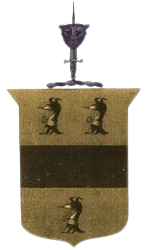
Then a year or two later a major incident occurred. Before Christmas Nance and Bobbie went to Roy and Mabel’s house, at a time they knew Roy would be at the office, to ask Mabel if they could borrow a facsimile of the Shurtleff coat of arms for use in making Roy a pair of cuff links as a surprise present. Mabel didn’t happen to be home, so they explained to the maid what they intended, and she let them in. They borrowed the coat of arms. As soon as Nancy got home she received a phone call from Mabel, who was irate: “You are never to set foot in this house again. It’s my house, not your father’s house. You are not to enter it under any circumstances.” Nance burst out crying, put down the phone, and couldn’t say another word. Then she called Bobbie.
After that, things went from bad to worse, as Mabel began to make things pretty difficult for everyone. One Christmas she told Roy’s children that she no longer wanted to exchange presents with them. On another occasion the kids commissioned an artist to draw a picture of Roy and Mabel’s home with a cable car in front of it and also gave them a Currier & Ives print of Nevada City. Mabel said sharply, some time later: “I’m sick and tired of hanging your gifts on my walls.” The relationship between Mabel and Roy’s children grew cool. Yet she continued to depend on Gene and he never let her down.
During the 1970s Mabel’s irritability began to extend from Roy’s children to some of his close friends and fishing companions, such as the Holloways and Mr. and Mrs. Gage Lund. One by one she alienated them. Once at the San Francisco Fly Casting Club several ladies, who were very dear friends with Roy, decided to hold a birthday party for him—but failed to consult Mabel. She was simply furious and “told them off.” Mabel also had a difficult time keeping her household help. Ruby, her black cook and housekeeper, quit and was rehired several times. Gene hired several chauffeurs but none was willing to put up with her bad disposition. She became a disagreeable and
unhappy woman. All this, of course, was very hard on Roy, but he learned to take it philosophically and didn’t let it bother him too much. Perhaps this was a wise and protective approach he had learned in raising three strong-willed children! He would often comment, with a little smile: “That’s just her Irish makeup. She’s forgotten it 2 minutes after it happens and she doesn’t hold a grudge.” That wisdom allowed for the many good times that followed.
In July 1968 Gene Shurtleff was elected a Senior Vice President of Blyth & Co. and member of the executive committee in charge of the offices in Blyth’s Northwestern Region (Northern California, Reno, Salt Lake City, and Honolulu). In mid-1969 Blyth & Co. moved its San Francisco offices from the Russ Building into the 43rd floor of the Bank of America Building at 555 California Street, in San Francisco. There were spacious quarters for two retired officers, Roy Shurtleff and Dick Ponting, and their secretaries. During the early 1970s Roy spent a great deal of time researching and revising the family genealogy. Toward the end of the project, he felt a great deal of pressure from its complex demands. For a short time he studied and practiced meditation to help him relax and retain sufficient detachment. He was plagued with the worry that he might never complete his huge task, and he often asked for assurances that one of his sons would complete the book if he were unable to. But he persisted.
In January 1970 the Board of Directors of Blyth & Co. Inc. entered into a merger agreement with INA Corporation. Under this agreement the stockholders of Blyth exchanged all of their shares for stock in INA valued at $55 million, which was almost twice Blyth’s book value. INA was a large conglomerate, whose principal asset was the Insurance Company of North America, founded in 1792. Because of the confidential nature of the transaction, Roy (who was now retired) had not previously been told of the sale of Blyth to INA. He found out while attending a Broadway Hale Department Store Directors’ meeting. Broadway Hale, along with all of Blyth’s principal clients, had been notified before the news was made public. The discovery was a tremendous blow to Roy, for he had made a personal sacrifice so that the younger management would have ownership interest in the company. Many others were also disturbed by the sale at the time.
Yet according to Gene Shurtleff, who was present at the board meeting, the decision to sell had been a complex and difficult one for Blyth’s Executive Committee and Board of Directors; it was made carefully, based on sound judgment and reason, and was basically a protective decision. The major problem was that two people (Bud Devlin and Jimmy Miller) had come to own 30 percent of the company. If something had happened to either one of them or to both, or if they had wanted to leave or retire, the firm would have had to use most of its capital to redeem their interest. This would have left insufficient capital in the business, just at a time when it was very vulnerable; after deregulation under the Nixon administration in the late 1960s, capital requirements in the investment industry became much greater than they had been previously. In retrospect, Gene considers the move to have been a good and successful one, and believes that if Roy had understood the details of the case, he would have agreed with the board’s decision. Moreover, Roy and Charlie Blyth had once sold Blyth to Blueridge during the Depression, then bought it back later for 50 cents on the dollar.
The INA management was unfamiliar with the investment banking and brokerage businesses. In 1972, lacking confidence in and apparently dissatisfied with its investment in Blyth, INA management merged its Blyth subsidiary with another investment firm, Eastman Dillon Union Securities Co., to form Blyth Eastman Dillon & Co. Inc. Then in November 1979, for no apparent reason, INA arranged to sell its interest in Blyth Eastman Dillon to another brokerage firm, Paine Webber. Blyth Eastman Paine Webber was organized in January 1980, then renamed BEPW. Finally on 1 June 1984 the Blyth name was dropped completely, gone forever, as the company name was shortened to Paine Webber. On 1 November 1984 Paine Webber moved out of the Bank of America building, down the street into the 100 California Street Building. The company decided, as it was phasing out investment banking, that it did not need a headquarters-type office in San Francisco.
Paine Webber commenced to phase out its investment banking activities, putting greater emphasis on the brokerage business. Reduced need for prestigious office space suggested a move to more modest office accommodations. INA merged with Connecticut General to form CIGNA, effective 31 March 1982.
After Roy’s 80th birthday in 1967, he and Mabel continued to go on fishing trips, often transported by a Cessna 185 float plane (with pontoons only) or an amphibious plane. From 1969 to 1973, Roy kept a brief log of these trips. This and dated photographs and letters allow us to reconstruct some of these trips:
- 1969 July 2-10. British Columbia, Fishing Safari. Travel by Cessna 185 (pilot John Lightbown) to Bob Stewart’s Lodge at Nimpo Lake, Kaschek Lake, Craig Smith’s Tsata Lake Lodge.
- 1970 June 20-29. Alaska trip. Enchanted Lake Lodge (Ed and Josefina Seiler) in King Salmon, Alaska. Friends: Lamar and Gage Lund, plus the Petersons.
- 1971 July 20-27. British Columbia. Fishing Safari. Redfern Rapids, Craig Smith’s Tsata Lake Lodge, Inzana Lake, Nimpo Lake (Bob Stewart’s Lodge). Segutlit, Tasha, and Inzana.
- 1972 July 14-20. British Columbia Safari. Redfern (Mr. Peyton Hawes), Nimpo Lake, and Segutlit Lake.
- 1973 June 28-July 2. British Columbia fishing trip. Nimpo Lake.
- 1975 July 10-15. British Columbia, Stewart’s Lodge and Camps on Nimpo Lake. With pilot John Lightbown in a charter flight from West Coast Air in Vancouver.
- 1977 June. British Columbia. Fraser River and Nimpo Lake. Roy would be age 90 in three months.
- 1978 June 10-14. McKenzie River Trip with the Shurtleffs, Mordys, Petersons, and McCammons. Holiday Farm, Blue River, Oregon.
Each year for many years Roy and Mabel traveled to Hawaii, staying at the Kona Village, to celebrate their wedding anniversaries. They also traveled to Europe.
Roy continued to be active with various boards and clubs. He was on the board of the St. Francis Hospital and the Civic Light Opera (Gene took his seats after he retired). Roy also enjoyed “grand” opera performances, his favorite being La Traviata. He supported the opera by keeping his fabulous seats in the “orchestra” and many friends, both young and old, enjoyed his being there. His club memberships included the Bohemian Club, the St. Francis Yacht Club, the Pacific Union Club, and the San Francisco Fly Casting Club. He was a director of Carter Hawley Hale stores, Consolidated Freightways, Del Monte Properties, and Iron Fireman Mfg. Co. During this period, Roy enjoyed excellent health, and only his hearing showed signs of his advancing years.
On his 85th birthday, in 1972, as they had done for many years, Roy’s children made a gift in his name of $3,000 to the St. Francis Memorial Hospital Building and Equipment Fund. Donald Doyle, the president of the hospital’s board, wrote Roy to acknowledge the gift: “I am sure that the other members of our Board of Trustees join me in the thought that no better gift could be made in honor of the man who has done so much, personally and in the influencing of others, to further the interests of Saint Francis.”
On July 4, 1976, on the bicentennial of the United States, after 14 years of hard work, Roy published his two-volume, 1,205-page magnum opus and genealogy, Descendants of William Shurtleff in San Francisco—no small feat for a man now 89 years old. He finally published a total of 850 sets. These were mostly sold to relatives for $26 per set, but 32 sets were donated to major libraries interested in genealogy. Each set cost Roy $47.64 for typesetting, printing, and binding. By 26 May 1976 he had received paid orders for 602 sets, and eventually he sold or gave away all 850 sets.
As he revised and updated Benjamin Shurtleff’s original genealogy, Roy made one basic change in its structure. As he wrote in the Foreword:
The original edition carried all descendants through all generations where information could be obtained. In this edition descendants of daughters have been carried only to the fourth generation from a Shurtleff male, the daughter being the second generation. This has allowed the elimination of many pages of the old books to make room for new names, and has kept the new names to manageable proportions. Professional genealogists have concurred that this is sound practice.
Both Benjamin Shurtleff, and Nathaniel Bradstreet Shurtleff (1810-1874) before him had assumed but never proved that the Shurtleff family was descended through the first William from the Shiercliffe (various spellings) family of Ecclesfield, England. Roy made exhaustive efforts to try to prove this connection. He and Mabel visited the Ecclesfield Parish to pore over the records, wrote seven Shircliffe families in Sheffield and searched Sheffield Parish records, employed three professional British genealogists over a period of years, and searched fourteen American publications of lists of emigrants and passengers to the colonies. But to his great disappointment, Roy was never able to locate records of the English parents of the first Shurtleff immigrant ancestor to America, William Shurtleff, nor to discover when, on which ship, and where he arrived in America. Roy was left to conclude in his foreword:
Therefore, from information now in hand, I feel this genealogy cannot, with certainty, go further back than the ten year old boy who was apprenticed to Thomas Clarke, a carpenter, September 2, 1634, in the Plymouth Colony.
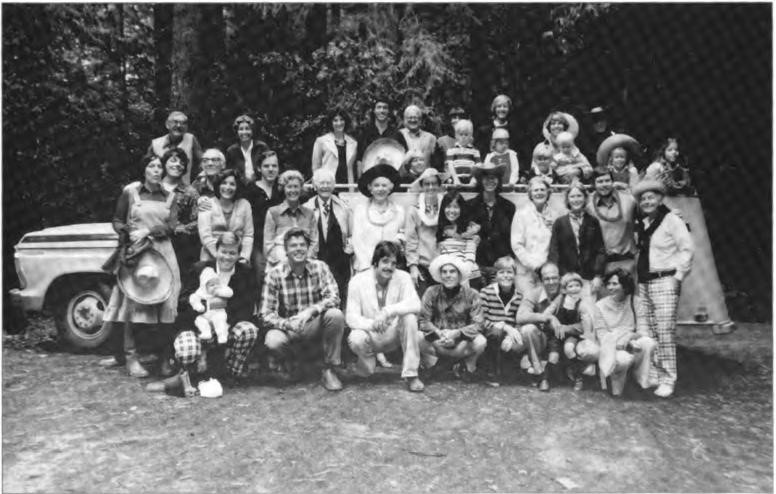
On Saturday, 18 September 1976, a family party was held at the Lawton Shurtleff home, outside on the patio beside the swimming pool, to celebrate the publication of Roy’s genealogy. Approximately 20 family members were there on the lovely fall afternoon. As Nance recalls: “Bobbie, though suffering from cancer, showed the type of loyal, caring person she was by hosting this party.”
To start things, Gene Shurtleff read a toast he had composed:
Here’s to the guy who recorded our past
Who strengthened the record so it would last.
Here’s to the mental and physical strength
That kept him going throughout the length
Of all the pages which we now see—
Telling the story of who are we.
Here’s to the hours, the days and the years;
Printers and typesetters, apprehensions and fears
Which have contributed to the final creation
Of these books which name each and every relation.
It started in sixteen twenty four
With William Shurtleff to whom was born
One Thomas but also William two
Whose thirteen children provide the clue
To twelve hundred pages of Shurtleff relations
Including all eleven generations.
So here’s to our patriarch—head of the clan;
Roy Lothrop Shurtleff—author, publisher, superman.
The get-together also included an “interview” with Roy, in which his oldest grandson, Bill Shurtleff, served as moderator. The many spirited and interesting questions from those present gave Roy ample opportunity to recount highlights (and low points) from his years of research, and to read from the finished work.
One humorous aspect of the reading was that it showed Mabel to have been born in October 1901; she was therefore almost 75 years old. Since she had made it a point throughout the years never to divulge her age to any of Roy’s children, having it read aloud at such a gathering was unexpected and quite hilarious.
For Roy, an era had ended when he completed his mammoth genealogy of the Shurtleff family.
 Shurtleff & Lawton Families Genealogy & History - Second Edition (2005)