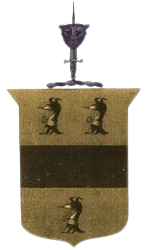
** All Text on these chapter pages has been copied verbatim – with permission – from this book: “Shurtleff Family Genealogy & History – Second Edition 2005” by William Roy Shurtleff & his dad, Lawton Lothrop Shurtleff ** Text in pdf convert to word doc – any spelling errors from the book may or may not have been fixed. **
Roy and Hazle’s marriage and subsequent life together, to their many friends and family, had always seemed a joyous and happy one. So it came as a great surprise and shock to all who knew them to learn of their sad estrangement. In 1939, after Gene and Lawton had left home, Roy moved out of the room at The Ranch he had shared with Hazle into one of the empty rooms, so that he and Hazle would disturb each other less. Nancy recalls: “By early 1945 they were not getting along one little bit.” Roy once said to Nancy after a flare-up, ‘I just can’t take this anymore.’”
The separation which followed, like that of all good people long devoted to one another, was full of pain, sorrow, and confusion. Moreover there are significant disagreements among those who watched the breakup as to what actually happened and why. Specifically there are various interpretations of the nature of Hazle’s illness, Roy’s reasons for leaving, and Roy and Hazle’s feelings for one another after the separation. Gene cautioned, “Be careful not to make their relationship look worse than it really was.” The following, we hope, is a careful, impartial examination, and perhaps gives a deeper understanding of Roy and Hazle’s individual characters and mutual relationship.
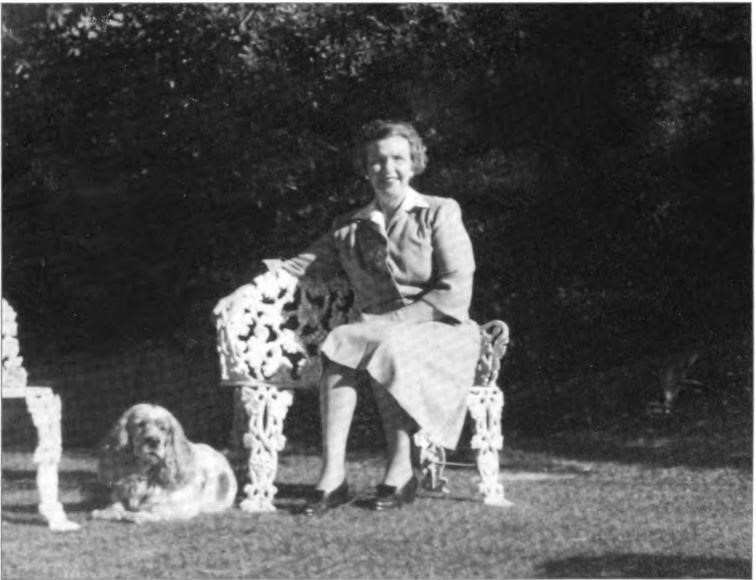
In 1945 Roy (age 58) and Hazle (age 55) had what Lawton remembers as “a serious disagreement.” As Lawton recalled the events in 1984:
Bobbie and I were in the kitchen of our small guest cottage at the Ranch. Shortly after lunch I saw Roy walking over toward his workshop near our home. He looked tired and dejected, shoulders down. It was apparent to Bobbie and me that something was wrong. I walked over to him and asked if everything was all right. He said “Well, I had hoped that we would go in to see Nettie and Jessie (it was a special occasion such as Mother’s Day or a birthday INettie’s was May 30 and Jessie’s October 25]). Your mother doesn’t want to go and is adamant that I shouldn’t go. She apparently doesn’t want to have anything to do with my side of the family. As you know, we rarely see them.”
Roy and Hazle were very close to the Lawton side of the family, but rarely had anything to do with the Meeks, who didn’t move in the same circles as, for example, Don and Billie did. I think Roy felt that his family had always been put down and that it wasn’t fair. That day would have been a good opportunity to set things right. Roy explained that he and Hazle were having ongoing problems of which this was the most recent, and asked me what I thought he should do. I suggested that he consider moving out, since his presence seemed to be one of the main causes of Hazle’s problems. Roy said, “I’ve thought of that but I am not sure if it would be helpful. What do you think the kids would feel about that?” I said, speaking for myself and Bobbie, it would have our wholehearted support. I think anything that had any chance of success in helping mother’s frame of mind would also have the support of the other kids. I didn’t see how things could get any worse than they already were. I don’t clearly recall what happened next, but I think Roy left shortly thereafter.
This was the only time I ever talked with dad on the subject of his relationship with my mother. I think most people felt that this was a happily married couple, with Hazle a sick, depressed woman to whom Roy was giving a lot of support.
On November 23 or 30 of 1945 Roy left Hazle and The Ranch, and went to live alone at the Pacific Union Club in San Francisco. Hazle was alone at the country ranch, except for Lawton and Bobbie, and their children Bill and Jeffrey, who lived at one end of the property.
Gene, who was still overseas at the time, understood later that “Roy felt his being at The Ranch caused her so much upset and trauma that he felt she’d be happier if he left. It was a totally unselfish reason. And ever after that Roy remained devoted to doing everything he possibly could for Hazle. He never shut her out.”
But Hazle felt deeply wronged. Nance, who was with Hazle a great deal during this period, recalls:
I was irate when Roy left. Hazle cried and sobbed and was so miserable and so shook up. On New Year’s eve of 1945, after an evening at Lawton and Bobbie’s house, I walked her back to her room; but she was so depressed and felt so alone. She felt that Roy had left her when she was very ill and she needed him most. I don’t agree that he did this to be a good guy. Later Roy would take his kids and their families out to dinner in San Francisco and have pictures taken. When Hazle heard of this or saw the pictures, she would sit with me in the room and was completely devastated.
Lawton believed that:
The bitter medicine of Roy’s leaving worked. During the next few years Hazle was up and out of bed more and had a more positive attitude toward life. While sick, she had turned her anxiety on her Piedmont friends. Now she went out and tried to make an interesting life for herself She bought new houses and decorated them. Spent more time with her friends and grandchildren. Drove her car to Carmel.
But Nancy disagrees with this viewpoint:
I don’t recall that she got out any more after Daddy left and she didn’t cultivate any new friends. I know that she was very hurt and bitter. I think his leaving made her worse. I don’t recall that she went out socially or happily. The move to Lafayette had to be done; she couldn’t stay alone at The Ranch. The move to Carmel was done in desperation. She was trying to start a whole new life, looking for friends, peace, happiness. But it didn’t work. She didn’t know anybody and she was terribly lonely. She never got over the terrible loneliness and grief after Daddy’s leaving. And I feel she never got the credit she deserved for much of Roy’s success.
Living with Hazle at The Ranch was often trying for Bobbie and Lawton. As Lawton recalled: “We were constantly worried, whenever the phone rang, that it might be Hazle saying she wanted to end her life.”
Hazle must have been terribly lonely, especially as the Christmas season neared. On 18 December 1945 she wrote newlyweds Ed and Janice Pike in Santa Barbara. They had been married just three days previously and were on their honeymoon. The Pikes were Lawton and Bobbie’s best friends, were delightful and entertaining people, and had little money. She wanted to help them out and she also wanted company. So she invited them to join her and Lawton and Bobbie, to live at The Ranch in the empty servants quarters (formerly occupied by Sam and Karmi) just west of the main house (to its left as one faces it) between the carriage house and the kitchen. Even in these darkest hours Hazle’s warm humor and courage shine through:
SHURTLEFF REALTY CO.
ALHAMBRA VALLEY
Mr. & Mrs Ed. Pike:
On fairly good authority I have learned that you are duly married and now looking for a place to “set up housekeeping.” I have listed, a very simple garden cottage, in a good neighborhood, probably not all the luxuries you are accustomed to, but affording some of the necessities such as swimming pool, hand-ball or squash court, a place to roam in the moonlight, etc., which I would like to offer you and your bride. The rent is negligible, in fact it is as free as the country air you will breathe. Just drop in any time of day or night as the door now stands open, for you.
You don’t have to sign a contract but take it until you can find yourselves something not quite so close to the crotchety land lady, who I understand is a bit hard to get along with.
I told Lawton and Bobbie I would like to offer it to you (the little guest house) and their faces were so radiant. I knew it pleased them as much as it would me to have you accept it. The house is fully equipped, so all you will need is your clothes and a toothbrush and food if you are off your champagne diet.
My dearest love to you both,
Hazle L. Shurtleff
Ed and Janice were delighted with the invitation, which seemed too good to be true. In January 1946 they moved into the vacant house; there they stayed for eight months, until August, when they moved to Orinda. Janice and Ed Pike remember this as a very happy period of their lives. But of Hazle, Janice recalls:
She was lonely, definitely very bitter, and very very unhappy. She felt that Roy had not treated her fair in leaving. Madeline Ricker used to spend a lot of time with her. I once happened to overhear Hazle talking on the phone to Roy, and she really was shouting at him. She was very, very angry. You know they say there is no fury like a woman scorned.
Ed and I had cocktails with Hazle often. She had a wonderful personality. She was amusing, entertaining and awfully good company, and we all had a very nice relationship. One incident I remember clearly. When Nonie Peet was about to be married, her mother Dorothy was all wrapped up in taking care of her other daughter, Mardy, who had polio. It was a grim time for Nonie, because no one was excited about her wedding. Hazle would stop by the Peets’ house on Tunnel Rd., bring Nonie presents and talk about her wedding. She really was just wonderful in helping to make the occasion a happy one for Nonie.
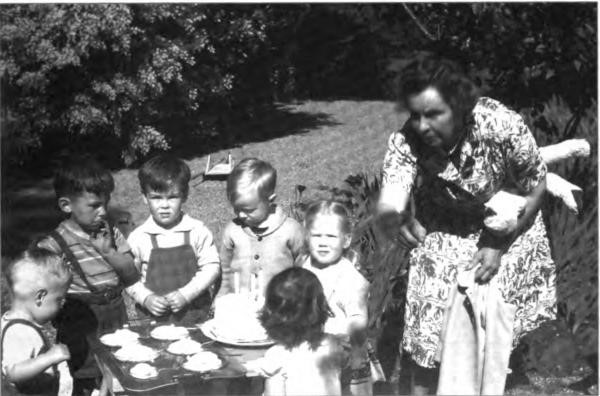
Nonie has special memories of Hazle:
She was a wow! She was lovely, beautiful, warm, generous, fun, funny, witty, hard working, loving of people, animals, gardens—determined to overcome her problems and an all-around lady. Everyone she knew thought they were her best friend and she had so many. My mother (and Hazle’s younger sister), Dorothy, and her daughter, Nancy, probably knew her better than anyone else, though, and my mother thought the world of her. There was nothing they wouldn’t do for each other—and aunt Hazle had proved that long ago—during Mardy’s illness. Even during her own long illness, when she was in pain and did not have any idea of what was actually wrong with her—she was cheerful and witty and fun and funny. And even when she could not be these things, she always tried her best. Her illness was like a humiliation to her that she couldn’t make go away. She was embarrassed to be in less than perfect shape and felt guilty that she was letting everyone down by not being perfect to her own specifications. I truly loved her, and I wish I could have done more for her to make her happier. I will always treasure her memory. She was one of the greatest ladies in the world.
In January 1946 Lawton and Bobbie, with their two young boys, moved from The Ranch to Orinda to live in a home of their own. This must have deepened Hazle’s feeling of loneliness, for now only Ed and Janice Pike were left with her at The Ranch.
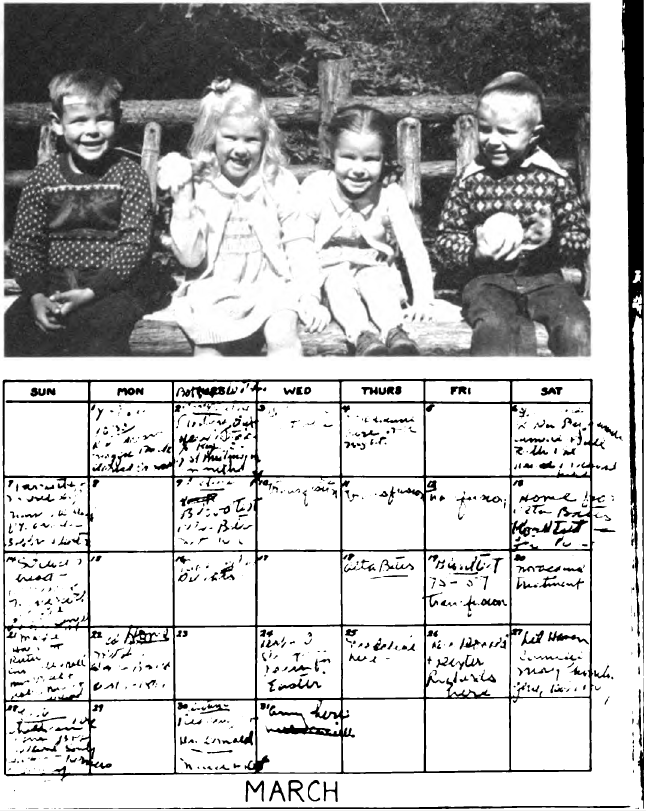
During the next two years, Hazle made every effort to keep busy, to try to ward off the pain and loneliness she was feeling. Her crowded daily appointment calendars made for her by Bobbie from the years 1946, 1947, and 1948 (each with a photo of one or more members of the family across the top half of the page) still exist, giving us a detailed picture with firm dates of her many activities. During 1946 Hazle started to renew ties with old friends. Some, like the Solinskys and Witters dated, from her high school days. Frequent visitors and overnight guests included Camille Cavalier, Nettie Meek (Roy’s half-sister who spent a great deal of time with Hazle during her last years), Ruth Solinsky, Billie and Don Lawton, and Dot and Harry Peet. Hazle looked for ways to fill her days. She attended the symphony frequently, driving her car to Berkeley then sometimes going by car on the ferry to San Francisco. And there were meetings of the Reading Club each Tuesday in Piedmont; Hazle had attended it since the time when she lived at 209 Crocker Avenue An outside person would review a current novel she had read, then the group of 10 to 15 friends would discuss it. There were also meetings of the Hill Branch group which raised money for the Oakland Children’s Hospital, and weekly appointments at Elite (apparently her hairdresser, in Montclair). Hazle often stayed with her grandchildren, and frequently went out for dinner at the homes of her children, or had them for dinner at The Ranch. On 15 April 1946 Hazle had what was apparently her first appointment with Dr. William G. Donald, a general internist and an old family friend who worked at the University of California Hospital. According to Gene, Dr. Donald was planning to administer shock treatments to Hazle for her deep depressions. Before doing this he gave her a physical examination and diagnosed her as having accute leukemia. Nancy recalls Dr. Donald stating that Hazel’s physical and mental ailments, dating back to her confinement at the sanitarium on the East Coast almost 10 years earlier and including her depressions at The Ranch in the early 1940s, could very easily have been caused in part by the leukemia. After this time some of the family’s friends began to view Roy as a man who had left his wife shortly before she was found to have cancer (leukemia). Nancy recalls that Dr. Donald told Hazle’s three children that she had leukemia, but left it up to them whether or not to tell her. Gene and Lawton recall that Hazle was told directly by the doctor that she had leukemia, and that she talked and studied about it.
In the following months Hazle often said she felt that life was not worth living. From Hazle’s point of view the separation did not result simply because she was having problems and Roy did her a favor by leaving. For example, she once remarked after the separation: “On my birthday I would be hoping for a rose. But Roy’s idea of how to make me happy, because he couldn’t do it any other way, was to give me a $10,000 diamond ring, or a fur coat, which I had no particular interest in.” In this way, after the separation, she described the kind of materialistic man she felt Roy to be. But Gene feels it is important to see the matter from both sides: “It was Roy’s tradition to make lavish gifts when he could but there was no one who enjoyed, indeed loved, material things more than Hazle. She enjoyed receiving them and she enjoyed buying them for herself.”
Mardy Love notes: “The separation must have hurt Hazle since a number of her brothers and sisters had really great relationships with their spouses: Dorothy and Harry Peet, Helen and Ed Martin, Sr., Harry and Joyce Birbeck, and Don and Billie Spaulding. Only Hazle and Winnie Lawton had hard times in their marriages.”
After the separation, according to Lawton and Gene, Hazle refused to ever see Roy again, and she never did, except once when the children arranged for Roy to join an Easter celebration at the ranch. As Gene recalls, “Hazle reluctantly agreed and Roy said he’d be delighted if he’d be welcome.”
So on 20 April 1946 at 10 in the morning, Roy and Hazle met for the first time since their separation. The next day, Easter, all her children and grandchildren (plus the Kemers, the Peets, Don and Billie Lawton with unicycle) came to The Ranch for an Easter egg hunt in the woods around the big front lawn. Each of Hazle’s older grandchildren were given a live Easter bunny. This was the first and last time she and Roy ever saw one another after their separation.
Gene continues: “But Roy and Hazle didn’t enjoy that day. She didn’t speak to him, and, as a result, he didn’t really spend much time with her. It was awkward and uncomfortable for both sides, and didn’t solve any problems. After this Lawton and I tried on several occasions to bring them together but Hazle would never permit it. It was always she who cut off the communications.” Lawton too recalls that “Roy was always willing to communicate, but Hazle didn’t want to see Roy, even toward the end.”
Later in April 1946 Hazle again saw Dr. Donald. She saw Amy Warburton several times a month, and generally attended her weekly lectures in Berkeley. During these difficult times, their friendship deepened.
In about May, Hazle started to spend time at Cannel-by-the-Sea. Late that month she took a trip there with Nancy Miller and Ruth Solinsky. Initially she stayed at an inn or with friends, but at some point during 1946 Hazle bought a small vacation house near the ocean front on San Antonio Avenue, between 10th Street and 11th Street. It was called “Toujours Gai” or “Happy House,” and as of 1987 it was still there. She had several close personal friends in Cannel. Margaret Witter Page, a friend since high school, had a house right behind hers. And she soon became close friends with a woman realtor.
On June 2 she attended the christening party for Sandy and Steve at Willard Miller’s parents home.
Hazle began to look for a smaller home nearer to her children and to San Francisco. The upkeep at The Ranch was too much, as were the memories. On 13 June 1946 she paid the deposit on a home in Lafayette on 3571 Boyer Circle, a very attractive two-story, English-style place with lots of brickwork, oaks, and ivy. It was on a hill overlooking the town and with a nice view of Mt. Diablo. Two days later she sold The Ranch to Tom Coakley, an attorney. The money from the sale of The Ranch, part of which she invested through Gene, paid most or all of Hazle’s future bills. It is not clear to what extent Roy continued to help her financially.
Coakley later divided the land into four parcels. In 1987 the address of Roy and Hazle’s former house at The Ranch was 5324 Alhambra Valley Road. Lawton and Bobbie’s cottage was 5328, and the red stables was 5300.
On August 22 Hazle moved to Lafayette. But even from the first night she did not feel like the house was hers; there were too many hills and steps. On October 26 she attended young Ed Martin’s wedding in Sacramento and on November 6 held a birthday dinner for Lawton at Trader Vic’s.
In November she apparently decided to move permanently into her house in Cannel, where she was spending more and more time. So on December 11 she sold the Lafayette house, and on December 24 she moved to Cannel, taking some garden furniture with her. Her first big project was to redecorate the tiny cottage and to add on a new little back porch. She had a marvelous time buying the antique furnishings. She designed nine-inch-high paper cutouts, which a carpenter used as the pattern for a decorative wooden trim around the outside of the house, to make it look like a gingerbread house. But when she was finished, she had nothing left to do. Loneliness again overtook her. Nance remembers: “I talked to her by phone day after day. She tried to stick it out there, pretending her move to Cannel was not a mistake. But she was terribly lonely.”
During 1947 Hazle spent time with her many long-time close friends, many of them old Piedmont friends. In addition to her 1946 companions, these included Gladys Kiplinger, Harriet Hawley, Hazle Hunt, Helen Wheeler, Madaline Ricker, and Win and Birnelyn Lawton from her family. Most of her time was spent in Carmel, where Amy was her frequent guest. She also spent lots of time with her children’s families (sharing fairly equally with each) and her grandchildren. In April 1947 she wrote Nance after attending Steve’s birthday party: “I always enjoy seeing the grandchildren who are so congenial. My greatest pleasure now is to see happiness expressed. I guess it has always been my greatest desire, but it is a real tonic for me now.” A month later she wrote Nance from Cannel:
I decided to stay down here a little longer as I had so much to do in my garden and in the house… Amy “Warbeling” came down with me in her car and left Sunday about noon. We had a wonderful visit and cleared up lots of confusion in my mind. She is an inspiration to me always and so generous in her eagerness to help, not only me but anyone who needs her understanding. I have done quite a bit of reading. It is so quiet and no interruptions by phones, etc… I feel it is best to stay here and get my mind settled as to just where my home is.
There were quite a few doctors appointments with Dr. Donald and (after October) Dr. Whitten (or Whittier), and with her dentist Dr. Petray.
These increased in frequency toward the year end.
On May 12 Hazle apparently moved to the Woman’s Athletic Club, a lovely private club on Lake Merritt in Oakland where her friend Madeline Ricker lived. But she didn’t stay long.
On 1 July 1947 she paid the deposit on another home in Orinda at 9 Brookside Road, near the corner of Orchard Road, just a short walk from Lawton and Bobbie’s home at 175 Moraga Road, and in the same town as all her children. On August 29, after two weeks stay at the Millers’ home, she moved into her Orinda home. In September, she remodeled this house and did a lot of building and adding on. She made peep shows for her little grandson, Bill Shurtleff, who would stop by on his way walking or biking back from Glorietta school.
During most of her stay in Orinda, a black lady, named Marie, was caring for her. As Nancy recalls: Marie was a “Real lady, a wonderful person who was devoted to Hazle and took excellent care of her. She did the cooking and some nursing, as she had been a practical nurse.”
In December 1947 Hazle became seriously ill. Her trained nurse, Miss Ruth Reeder, was with her constantly. Her calendar reads: “December 14.
Dr. Donald here to see me. Very low. Dec. 16. Go to Alta Bates hospital.” The next week she received four blood transfusions. “December 29. Home from hospital. Wonderful letters from many friends. Harry and Dot (Peet) here. On my way up for a wonderful New Year 1948.”
In early 1948 Hazle had to go frequently to Alta Bates hospital for blood tests, transfusions, and X-rays. She was often bedridden and generally unable to drive her car. Many of her closest friends came to visit at her home in Orinda. On April 28 she underwent surgery and on May 13 came home by ambulance. She died three weeks later in her bed at home on 19 May 1948 at 3:40 p.m. of lymphatic leukemia. She was 57 years and 5 months old, and had been separated from Roy for about 21/2 years. Only her nurse Ruth Reeder was present; her daughter, Nancy Miller, arrived about 5 minutes later. Dr. Donald, on her death certificate, listed the duration of her leukemia as “over 1 year.” But she may have battled her leukemia for much longer than that. Of the six Lawton children who had survived infancy, she was the second to die; her sister Helen had been the first. After funeral services at the Tower Chapel of Mountain View Cemetery, directed by Albert
Brown Undertaker Co. on Piedmont Avenue in Oakland, and cremation at Mt. View Crematorium in Oakland, Hazle’s ashes were interred at Mountain View Cemetery in Oakland, in the Lawton family plot.
On 27 May 1948 Earl Warren, then Governor of California and later Chief Justice of the U.S. Supreme Court, wrote a letter to his friend (and Hazle’s elder brother) Harry Lawton in Seattle: “Dear Harry: Nina and I were extremely sorry to learn of Hazle’s passing. We want you to know we are thinking of you in your great loss and sending our deepest sympathy. Sincerely, Earl.”
Hazle lived long enough to know six of her grandchildren. Lawton wrote in his family journal in 1958 that Hazle “was a fine and strong mother to Nance, Gene & me, a devoted mother-in-law and a beloved Gama. We will remember her for those qualities and forget and forgive the melancholy and difficult days that came later. She knew and loved our earnest and ambitious Bill and our infectiously happy little Jeff—but she was never to see her dimpled blonde granddaughter, our Linda, born in 1949.”
Hazle’s will was simple but eloquent: She left one dollar to Roy, all of her jewelry to Nancy (she felt jewelry should stay in the family, and that Bobbie’s and Rose’s mothers would pass on their jewelry to their daughters), and the rest of her possessions to her three children, to be divided equally among them, including her treasured Carmel home and all its furnishings. She had a beautiful green ring with a diamond set in the middle that Roy had given her; she left it to her eldest female granddaughter, Sandy Miller, who treasured it.
Gene recalls that Hazle’s first will had apparently been written, with the help of attorney Arch Tinning, in the early 1940s. After that, during the war, Roy wrote his first will. Of the portion of his estate left to his children, Lawton and Gene were to receive theirs outright, while Nancy was to receive hers in trust. Roy seemed to lack confidence in Willard’s maturity, since he had considered eloping with Nancy and had dropped out of college. Hazle took objection and modified her first will by hand, favoring Nancy with all her jewelry, in a holographic will, which Tinning finally probated.

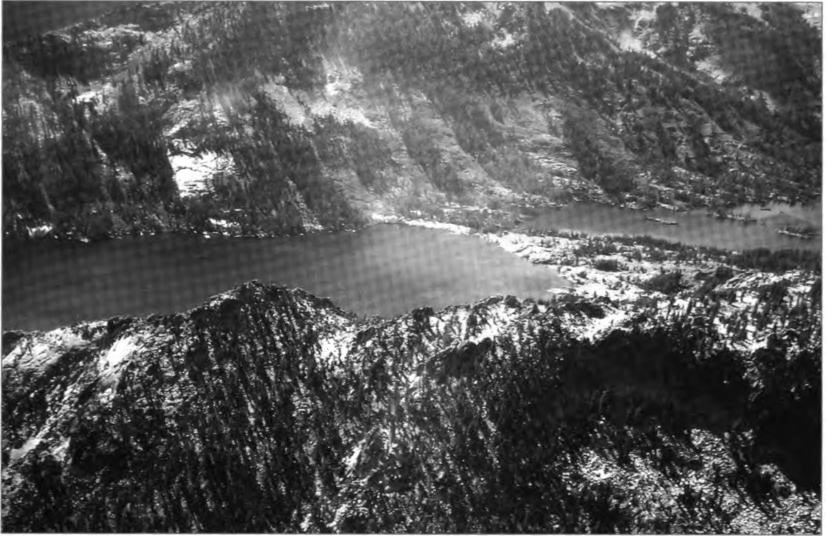
By sheer good fortune, one early morning in the summer of 1949, Lawton received a phone call at Thorsen Tool Co. from his old friend Dyke Brown, who said that a very special cabin at Echo Lake, located high in the mountains above Lake Tahoe, was about to be listed for sale. After Hazle’s death and the sale of her Cannel house, Lawton, Gene, and Nancy had talked often about buying a cabin together using funds from their mother’s bequest. So Lawton immediately called Gene at Blyth & Co. and asked him if he’d like to drive up and see it. Gene felt he could not just drop everything and leave work on a Monday morning so soon after the weekend. Lawton then called Nancy, who had just gotten out of the shower with her hair up in curlers. She said, “Let’s go! How soon can you meet me?” Typical Nancy. She then left a message for her husband, Willard, to tell him she would have to miss the dinner party that evening at their home. The food was all ready; she asked him to take care of everything and be a good host. Lawton called Gene back and Gene said, “Don’t go without me.” So the three drove up to Echo Lake that same day in Lawton’s car—Nancy with a scarf over her curlers, wearing a sweatshirt and blue jeans. Gene and Lawton had fond memories of beautiful Echo Lake from the summers they had spent there as boys at Frank Kleeburger’s Talking Mountain Camp. Nancy also had memories of when she would go to the camp with Hazle, who would visit her sons, then give each of them a haircut.
At the Chalet on lower Echo Lake, they caught a water taxi and arrived at the house at dusk. A real estate agent met them at the dock. Located along the channel that joined upper and lower Echo Lake, the large one-and-a-half story cabin named Interlachen, had been built in 1934 by Fred Macondry. It came with a large wooden dock/pier, a covered boathouse, and three boats—a Chris-Craft speedboat (originally named the Da but soon rechristened the Triad, after the three new owners) with a 60-horsepower (later a 112 horsepower) inboard motor, a rowboat called the Putt Putt with a small Johnson Sea Horse outboard motor, and a small sailboat named the EZ.
Railroad tracks ran from the lake into a long room attached to the cabin that served as boathouse in winter. The cabins at Echo had no telephones or electricity; Flamo gas from a pressurized tank provided indoor light (via wicks) and hot water. Many cabins had outhouses, but this one had an indoor toilet. Water for the cabins had to be pumped from a lake or spring. The water was cold and clear, and swimming around the pier were hundreds of little fish called “minnows,” and a few “suckers.” Most of the land around both lakes and in the vast Desolation Valley Wilderness Area beyond was owned by the U.S. Forest Service.
But Nancy had to get Willard’s okay and to check that there were sufficient funds in their family bank account to cover the purchase of the cabin. So she took the water taxi back down the lake and called him from the Chalet. While she was gone, Lawton visited a few of the neighbors. In the house behind the cabin he found, to his surprise, a familiar face, Frank Hamilton, who had been the head counselor at Talking Mountain Camp years before. Frank said he had friends coming from Colorado that same evening to buy the cabin. At another cabin just up the hill, Lawton found Ronnie Johnson, who had been their immediate counselor at Talking Mountain Camp. He said, “If you don’t grab that cabin now, you’re going to lose it. Echo is a great place!” As they looked around the large Macondray cabin and property, they fell in love with it and quickly decided to buy it on the spot. The timing was perfect.
On that memorable August evening, Nancy (who had the only checkbook) wrote a personal check for the full price of the house—$13,700. But actually the funds came from the sale of the Carmel house inherited from Hazle. Later, the antique furniture from Hazle’s Carmel house (Victorian pieces, marble top tables, chiffoniers, etc.) was used to decorate the rustic Echo cabin.
On the way home they stopped at Strawberry Lodge (on Highway 50) to celebrate their purchase with cocktails.
A week or two after buying the cabin, but before escrow closed, the three returned to Echo lake with their spouses. The wind was blowing a gale and shaking the whole cabin. Willard turned to his wife, Nancy, and said, “What in God’s name have you bought?” Meanwhile, before they actually owned it, the three men cut a door from the bathroom into the adjoining boathouse, to connect it with the main house so that it could better serve as a sleeping porch for their kids.
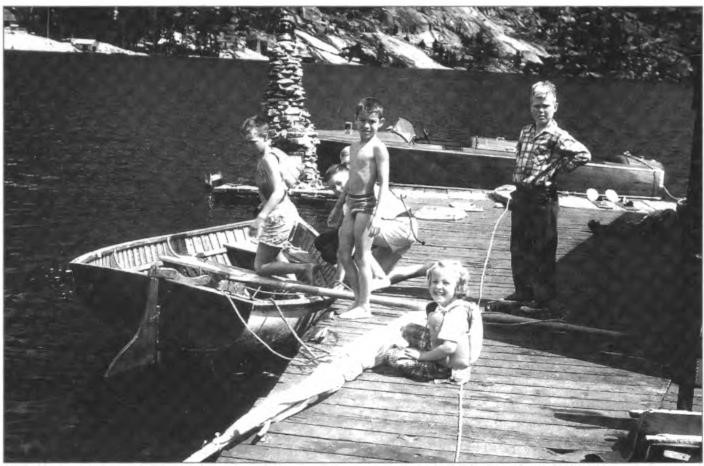
For the next decade each of the three families spent three glorious weeks, at different times, each summer at Interlachen on Echo Lake, boating, water-skiing, fishing, swimming, hiking, learning about the plants and animals, playing, and relaxing in the High Sierra, far from civilization. Hazle would never know how much pleasure her “gift” had brought to her children and grandchildren.
To avoid any possibility of future conflict among the three families, Lawton felt it was important to draw up an agreement that would cover every foreseeable problem of joint ownership. So he and Dyke Brown (an attorney) immediately set to work on such a document. After a few revisions, it was signed by the three families. It served its purpose well in the years to come, for example, in 1958 when the Miller family decided they liked Echo Lake so much they wanted to spend more time there each summer and own their own cabin. Exercising the ownership agreement, Lawton and Gene bought Nancy and Willard’s one-third interest, and they in turn purchased a nice log cabin of their own across the lake on Mermaid Cove.
Each year on the Memorial Day weekend (at the end of May), members of the three families would hike around lower Echo Lake—sometimes with snow on the ground and ice on the water—to “open” the cabin for the summer. One year young Bill Shurtleff ran ahead with the keys, went inside, then ate the little “treats” he found on the tables. They turned out to be rat poison, so he had to drink a quart of salt water to vomit them all up.
At the end of each summer, on the Labor Day weekend, Lawton, Gene, and Willard would go with their male friends to Echo for a hilarious bachelor party to close the cabin.
 Shurtleff & Lawton Families Genealogy & History - Second Edition (2005)