** All Text on these chapter pages has been copied verbatim – with permission – from this book: “Shurtleff Family Genealogy & History – Second Edition 2005” by William Roy Shurtleff & his dad, Lawton Lothrop Shurtleff ** Text in pdf convert to word doc – any spelling errors from the book may or may not have been fixed. **
In the summer of 1938 Hazle and Lawton returned to California first and found a beautiful ranch on 10 acres of land next to a creek in the Alhambra Valley near Martinez. The address was simply R. F. D. #1, Martinez. One entered through a driveway lined with arching blue spruce. Giant oaks surrounded the main house, and a large lawn circled by a little forest of other trees stood before it. There was a swimming pool, extensive stables for horses, a big old carriage house next to a cottage, a fruit orchard, and a big vegetable garden. They phoned Roy, who gave his approval to buy “The Ranch” at a cost of about $35,000 from Mr. Mogensen even before he had seen it. Thus, after a little more than two and a half years in the New York area, Roy and Hazle returned to the San Francisco Bay Area in 1938. They brought with them from Connecticut Karmi and Sam, plus their caretaker-handyman Pat Riley, to take care of the chickens, dogs, and horses.
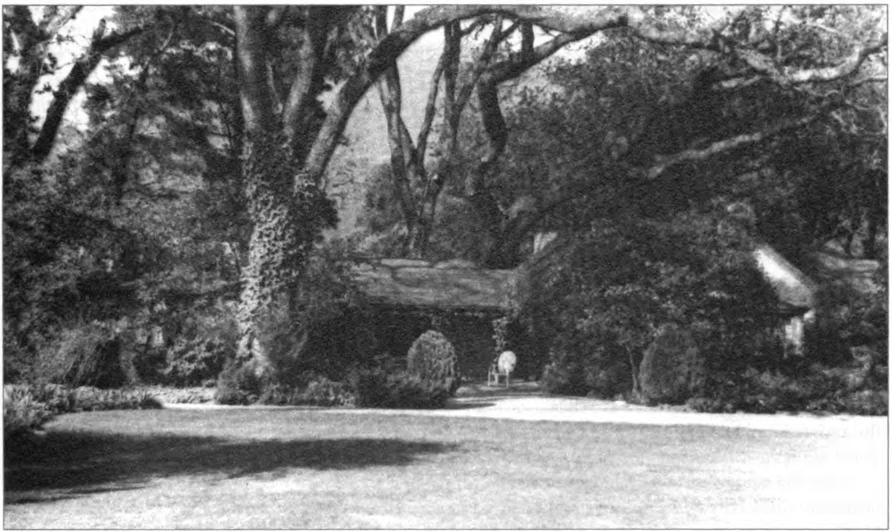

The new ranch replicated the property Hazle loved so much at Cherry Hill Road in Connecticut. It was the first real ranch she had ever lived on. The Ranch was way out in the country, far removed from the world of excessive social obligations. Twenty miles from Piedmont geographically, it was a million miles away socially. At long last Hazle was back in the environment she loved. And so was Roy.
Two major developments in the late 1930s had greatly increased the accessibility of Contra Costa County from San Francisco and reduced the commute time. The first was the completion of the San Francisco Bay Bridge in October 1936, which allowed one to drive to San Francisco from the East Bay instead of taking the ferry. The second was the related completion of the Caldecott Tunnel in December 1937.
By the late 1840s there had been a rough, steep, and windy road over the Coast Range from Berkeley; it was named Summit Road. In the late 1850s, when the telegraph line to Antioch was strung from poles along the way, it was renamed Telegraph Road. When John Olive raised fish and his wife served delicious meals at his farm near today’s Gateway Boulevard overpass, people started calling the thoroughfare Fish Ranch Road.
Then, in 1903, Alameda County drilled the first narrow tunnel through the Berkeley Hills 300 feet below the summit of Fish Ranch Road. The new road through the tunnel was named Tunnel Road; it was located about 200 feet above and to the south of what later would become the Caldecott Tunnel.
The tunnel built in 1903 was designed for slow-moving horse-drawn vehicles. When automobiles started going through at speeds faster than a walk, drivers needed to look through the bore to see if their way was clear. If it was not, the second vehicle waited for the first to exit before entering. In the early days of autos, not every vehicle came equipped with a top. Water dripped steadily down from the earthen ceiling through the wooden supports of this “high-level” tunnel, and many were the passengers to emerge from it with mud-spattered dothes. When cars went through this tunnel they turned on their windshield wipers as well as their headlights.
The Bay Bridge and the Caldecott Tunnel opened Orinda, Lafayette, Walnut Creek, and Martinez to an increasing flow of automobile traffic, and eventually transformed the area from one of farming towns into suburbs.
The Shurtleffs began immediately to make The Ranch their home. In one part of the big barn, which had been a winery, they built a professional-sized squash racquet court. In another part of the big barn Hazle had breeding kennels built so that she could continue her interest. Nearby, a hen house with straw-lined wooden nests provided fresh eggs year round. She converted the rest of the barn to a large dance floor. Though none of her children ever recall a dance being held there, it did make that part of the barn clean and neat. And it served as an ideal place for Lawton and Gene to try to learn to ride the unicycle that Don Lawton had built and rode like a “pro.” Soon a greenhouse was constructed, to supply the vegetable garden. Roy planted an acre of walnut trees. Since Hazle found that the West Coast world of show dogs was quite different, less social and far more political, than what she had known on the East Coast, she gradually turned to her new home and garden to occupy most of her time. Yet as late as August 1939, she was still showing her prize collie, Rudy, at Neptune Beach, a popular spa in Alameda.
In the spring of 1938 Hazle, now age 48, discovered a new outlet for her feelings; she began to write poetry. The scenic beauty of the Alhambra Valley and The Ranch seemed both to bring and enable her to express a newfound joy and peace of mind:
MY REVERIE
Oh! this is so calm, so beautiful
This haven of my dreams,
Abounding in Peace and Contentment
We’ve been here always, it seems.
With the grandest of families around me
A husband so true and so fine
A daughter God made to order
Two sons I’m proud to call mine.
In this world of frustration and turmoil
If all could find such as this
T’would bring love, and appreciation
The factors so many of us miss.
God gave us this world full of beauty
Our eyes and our hearts, to glean
All the beauties of Nature around us
And upon his wisdom to lean.
So let us be joyous and thankful
For this home which we now call ours
And live a life of love and sunshine
Which will radiate wide, as the stars.
TO NANCY
As I lie here contented
In this sweet little room
My thoughts now of you dear
Like flowers—do bloom.
I look through your door
With rapture I gaze
Seeing Spring pushing forth
In her wonderful ways…
My thoughts are of sunshine
And Heavenly Peace
And always of you
In this home never cease.
The family’s first Christmas at The Ranch, in 1938, was a memorable one. It was Roy’s final grand effort to give the family a “big Christmas.” To everyone’s surprise, under the great tree were three beautiful hand-worked leather riding saddles, complete with colorful saddle blankets and three sets of bridles. Just as the family was taking all of this in, a truck and horse trailer suddenly (and to everyone’s further amazement) appeared in the driveway and an old friend unloaded a handsome big chestnut thoroughbred (a former racing horse), which he had owned before selling it to Roy. No sooner had Partner disembarked than another wrangler with a truck and double trailer arrived to deliver two more beautiful horses, a lovely palomino mare named Babe, which Hazle ended up riding a lot, and a sorrel gelding named Keeno, which Roy liked to ride. The spirited Partner was enjoyed most by the younger members of the family. As Gene later noted, the finely staged Christmas morning was “a typical coup for Roy.” Soon the stable and tack room, formerly unused, became a center of family activity, providing many happy hours for the family and their friends.
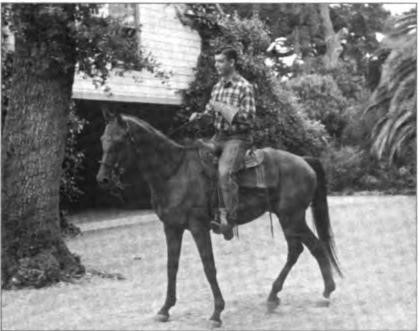
The family members rode, alone and together, for several years. Lawton remembers riding with his bride-to-be, Bobbie Reinhardt, and with his friend Ed Pike, when they were rooming together on Telegraph Hill in San Francisco. Gene and his fraternity brothers from Cal rode regularly, and much of his courtship of Rose Kerner took place riding over the beautiful Martinez hills.
In the early 1940s, before the war, Roy was out riding Keeno by himself one day. Back at The Ranch, Gene, Lawton, and his new bride Bobbie saw the horse come galloping down the driveway to the barn, without Roy. They jumped in the car and went out looking for Roy, whom they finally found walking by himself along the country road from Jim Hoy’s property. He was disoriented, could not remember where he had been, and did not have his glasses on as usual. As his memory slowly returned, he remembered that he had dismounted to open a country gate, and when he remounted, something had spooked Keeno, who bolted and threw him. They found his broken glasses by the gate. Though he was not badly hurt, Roy decided that he would not ride horseback anymore after that incident. (Roy had also been thrown once on the East Coast while jumping during a drag hunt.) The family, however, kept their horses for several more years, getting rid of them only after the boys went off to World War II.
At The Ranch, Roy had more time to do what he liked best—to tend his vegetable garden. He had probably learned gardening from his mother. While a young man on Hearst Avenue in Berkeley he had grafted fruit trees. He had had his first garden after marriage on Chester Way in San Mateo. Throughout his life he was a gardener of both food and ornamental plants. Roy also started to learn how to preserve his various crops of fruit. Based on information he obtained from the
University of California, he developed techniques and purchased equipment. As each crop ripened, he enlisted the aid of all family members in harvesting, cooking, and canning (in glass Mason jars) dozens of cases of apricots, then cherries and applesauce, and finally summer pears. It was then he bought the family’s first electric refrigerator to replace the old ice-box.
Roy also swam a lot; he had a good “overhand crawl,” a stroke that was not yet as popular as it is now, but he used a scissors kick. He liked to read, and he preferred great books to the latest popular novel. Yet for relaxation he preferred nothing more than the “pop” serials (… to be continued next week!) in the Saturday Evening Post. His special hobby was early California history. He had a personal collection of the Harvard Classics. Roy was not a religious person (in the typical sense of the word) and the family no longer went to church. But he was a student of the Bible; he always kept it at his bedside, knew it well, and would often quote passages to illustrate a point, in both public speaking and conversation. Gene recalls that occasionally when Roy was critical of someone he would say it was too bad the guy didn’t take the trouble to read the Bible, perhaps to develop a little humility. During the 1970s Roy told his grandson Bill Shurtleff that he believed that there was a higher order in the universe. But he didn’t discuss his beliefs much with others.
Don and Billie Lawton and Harry and Dorothy Peet, as couples, were Roy and Hazle’s closest friends. They often came to Martinez to help with the many projects that were always under way. They both thought Roy and Hazle were the ideal couple. (Lawton recalls that at that time Roy did not have many personal male friends, though he always had many friends in the world of business.) In 1984 Don Lawton recalled the 1920s and 1930s: “Hazle and Roy were always so nice to Billie and me. They just couldn’t have been nicer. Roy was very pleasant and active; he liked to swim, and we worked together building the ranch squash court and dog kennels.”
Roy and Hazle had certain philosophical sayings and aphorisms that they liked to use on appropriate occasions: Roy would say: “The pose of today becomes the habit of tomorrow,” as when a kid was caught stealing. And “There are never enough good men to go around, willing to work and persevere. Don’t worry if there are people who are smarter than you.” This was great solace to his children. Occasionally he would say “Callete la boca,” Spanish for “shut your mouth.” One of Hazle’s favorites from her mother, Fannie, was “You can never have so many friends that you can afford to lose one.”
Despite the beauty of The Ranch, Hazle soon fell victim to her serious depressions, aggravated by the physical afflictions that had plagued her since the early 1920s. She had frequent nursing care. Lawton and Gene, recalling those days, feel that Hazle’s problems were primarily emotional ones that she apparently couldn’t control. Lawton recalls that at times Hazle seemed as if constantly on the verge of a nervous breakdown. During a dinner conversation that she might perceive as hostile but another person might see as merely partisan, she would get so nervous that she had to leave the table, sometimes in tears. But during the very same period she would be the life of the party with her friends. She had great good humor and was sometimes called Mrs. Malaprop, after a character noted for her humorous misuse of words, her malapropisms. What a sad change from the young woman, from a remarkable family, who had been dynamic, athletic, attractive, with lots of friends. Gene recalls that Hazle was having “periods of severe depression. But then at times she’d get up from bed and work hard, almost like a man, in the garden. Then she’d just collapse and go back to bed.”
Nancy, however, who was at home with Hazle a lot from 1939 until the early 1940s, feels that her problems were more physical than emotional ones, and largely the result of her serious colitis and the constant “irrigations” (like an enema) that she had to perform, plus perhaps the early debilitating effects of leukemia, with which she was later found to be afflicted.
Nance believes that by 1940 Hazle started to be more ill than most people realized, and that her colitis was worst at The Ranch. Whether the cause was primarily mental or physical, Hazle’s physical strength was low and she frequently spent three to four days at a time in bed, often with the blinds drawn. She had a full-time registered nurse, Louise. Her periods of depression increased to a peak in about 1940. She was able to make only a short appearance at Gene’s wedding in August 1940. At times she would get upset at whoever was near her, even her closest friends and family. Then the kind and sympathetic self would return, in a cycle of ups and downs.
Nance recalls:
Hazle was basically a very outgoing and warm person. She had strong empathy for other people’s feelings, and an understanding and compassion perhaps born out of her own suffering. She inspired me very much. In later years, whenever I would do something to help others, people would say, “That reminds me so much of Hazle.” She also had a wonderful sense of humor, kidded all the time, with lots of funny little remarks. She could always get a good laugh by reciting silly poems or rhymes from children’s books, such as “Sitting on a curb-stone chewing gubberum.”
In addition, in later 1939, Hazle had a lower back operation, performed by Dr. Naffzinger, head of the Department of Neurosurgery at the University of California at San Francisco. During the operation he damaged a muscle, and for some time thereafter Hazle lost partial use of one foot (it dragged), and she had to wear a brace on her knee for about a year. Roy was quite upset at Dr. Naffzinger, but those were the days before medical malpractice suits.
Between 1939 and 1941 Hazle wrote three more poems. In “The Symphony” (1939) she again described the springtime beauty and calm of the Alhambra Valley. In 1940 she wrote of the things she considered most important in life:
TO MY CHILDREN
To be able to live, is life’s greatest prize
It does not come with patterns or dyes.
A recipe yet, has never been found
To keep ones love, both safe and sound.
But you yourself must continue to strive
To keep your love true and ever alive.
Never take it lightly or even for granted
But tend it with care, as the flower you planted.
Keep it aglow as the bloom on a rose
By the tender care, as the farmer who sows.
Sacrifice, often is all that it needs
To keep it growing from tenderest seeds.
A heart-full of love is a glorious thing
And can never be bought by even a king
This prize, my children you now possess
So guard it daily, with your gentle caress.
Its the timely thought, that counts the most
The gentle word—at so little cost.
That keeps one’s love for ever blooming,
So find the time for its fondest wooing.
It’s the thoughtless word or deed or action
Which hurts the soul with grave reaction.
To know this e’er it is too late
Will keep your love in its perfect state.
On 23 January 1939 Roy reactivated his membership in the Pacific Union Club and remained a member until the day he died. After 1945, this membership was at least as important to him as his membership in the Bohemian Club.
In August 1939 Roy and Hazle took a trip to Hawaii, Roy’s second and Hazle’s first. They stayed at the Halekulani in Honolulu, and Hazle’s two letters to Nancy indicate that they had a marvelous time.
In about 1940 Charlie Blyth stopped smoking, then laid down the law: “I don’t want anyone smoking in my office!” Roy spent a lot of time in Charlie’s office. Not long after that, Roy came home from the office one day with the flu, went to bed, threw away his cigarettes, and vowed never to smoke again. A strong-willed man, he never did.
In December 1940 Roy was named to District Committee No. 2 (covering California and Nevada) of the National Association of Securities Dealers.
Though born over a period of five years, Roy and Hazle’s three children all announced their engagements within the space of only four months, then got married and left home within the space of nine months. Late 1939 and 1940 was a busy time for all concerned, and Bay Area papers buzzed with the news. They were married in the same order they were born.
Lawton wed Barbara Anne Reinhardt on 9 December 1939 in Los Angeles.
Gene graduated from Cal in December 1939, then married Rose Kerner on 3 August 1940 in Berkeley. In 1940 he went to work full-time for Blyth & Co. in San Francisco. He had actually worked there in his youth during the summer as early as 1927-28.
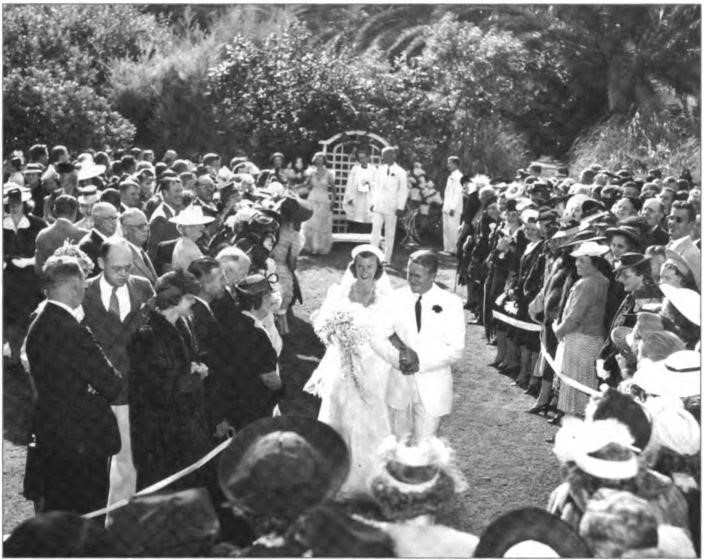
Nancy entered Cal in the fall of 1939, joining the Kappa Kappa Gamma sorority, where most of her childhood friends from Piedmont now lived. She left Cal at the end of that year before graduating and married G. Willard Miller on 24 August 1940 at The Ranch in the Alhambra Valley near Martinez.
Details of each of these weddings are given in the chapters on Roy and Hazle’s children.
What kind of relationships did Roy and Hazle have with their children? As with many parents, it was different with each child. Let us first look at Roy. All things considered, he was probably closest to Gene, who worked with him for over 30 years and, living nearby in San Francisco, spent the most time with him in later years. Gene’s respect for Roy in his later years was demonstrated, in small part, in the way he sometimes unconsciously imitated Roy’s hesitating speech. Gene remembers:
I had a warm and affectionate relationship with Roy. I still have many of his warm letters. He was not a demonstrative person, and most Shurtleffs aren’t. He was more likely to keep his feelings to himself than to wear them on his sleeve publicly. He wouldn’t put his arm around you and give you a big hug and say you were a neat guy. He just didn’t do that sort of stuff. But he wasn’t cold. In the days when we kids were growing up he was always very strict and he didn’t take any guff, but I was never afraid of him. He was fair and reasonable. He didn’t play any games. You always knew where you stood with him. He demanded certain things and you knew what they were.
I recall the summer of 1938 when I was 21 and a junior at Columbia University. Hazle was in the hospital. I lived with Roy, and we had a delightful time together. We were good companions. We laughed and played and went horseback riding and sailing and swimming together. We worked in the garden and with the dogs, as we later did at The Ranch. I genuinely enjoyed my relationship with my father as I was growing up. After I went to work for Blyth, Roy always kept me very much at arm’s length. It was not at all unfriendly, just business-like. We never worked together. I was in another office doing another thing. I recall when Charlie Blyth called me in to tell me I had been promoted to vice-president, Roy said, “This is against my better judgment.”
But after Roy retired, everything changed. I was suddenly providing him with office space. He was relying on me. Our relationship became much more of a friends relationship than one of father and son. He would call me and ask if I’d like to play dominoes. He treated me like any one of his other friends, and vice versa. I saw him every day, more than anyone else did.
Lawton, during his younger years, was away from home at school a lot. Gene feels that “Lawton was a hard guy to get along with. He was more of an adversary than a son. I think he was a difficult person for Roy to be warm to.” Or as Lawton recalls:
I’d have to say that Roy was not intimate with his children. He was certainly never affectionate to me. When we were quite young Roy did a lot of things with us, and that continued during the summers at Tahoe. But in high school I felt he took almost no interest at all in the things I was interested in. He rarely came out to watch sports events I played in, though others like Don and Billie and mother did come. I don’t think he cared about what I took in college or how I was doing. At Crocker Avenue we had a pleasant, arms length relationship. It wasn’t hostile but there wasn’t much rapport between myself and dad or mother, except sporadically, as at Tahoe. We’d only do things together when circumstances somehow brought us together. I think he always looked upon me as a sort of renegade. He would often say, “Lawton is the black sheep of our family, just like Harry Lawton was of his family.” He was talking about my being a nonconformist, being in trouble all the time at Tamalpais and never being allowed off the campus. I think I was always a little out of bounds, outside the fringe. But as I became an adult I grew to understand and appreciate Roy’s outstanding character, which set the tenor for what later became a most respectful and admiring relationship. It led me to want to show gratitude to him, as in the things we did for him on his birthdays. Gradually our relationship got closer and better in the years after I was married, though I’m not sure it got any warmer. Roy was tremendously fond of Bobbie and he showed it in many thoughtful little gestures of affection.
Nance’s relationship with Roy was strongly affected by his leaving Hazle, as she has expressed elsewhere. She adds:
I agree with those who say that Roy was not intimate with his children. He was the kind of father I doubt I would have gone to if I had a problem. It was hard to sit down and have a long talk with him. Ours wasn’t a warm relationship and Roy wasn’t a demonstrative person. He had a hard time giving of himself He had a very sweet and kind way about him, but I think that was more with business and family friends than with his children. People had an awful lot of respect for him, and we kids respected him too. But I think the closest I ever got to him was when we played solitaire during the Depression. I also remember when Sandy was born he took me to the hospital, put his arm around me, and couldn’t have been nicer. I think I always loved and respected and admired him, and I never felt a lack or thought about these things while I was growing up, until we started talking about them recently.
As we have seen above, Nancy was very close to Hazle and, perhaps because she was the only other woman in the family, tended to side with her and see things her way when there was conflict. She also spent more time with Hazle than any of the other children. Nancy notes:
I would not describe our family as a demonstrative family in terms of showing warmth and affection for one another. We were more standoffish. But I think Hazle was an absolutely perfect mother as far as her kids’ interest was concerned and doing the right things for them. Yet she may not have given that much warmth and closeness, especially to her sons. I wouldn’t say that Lawton and Gene were especially close to her. I saw it as more of a staid relationship. Remember that they were often away from home at boarding schools and also Hazle had a lot of her own personal problems. I think Hazle was more demonstrative than Roy. She made people feel warm and comfortable and I think she was a warm person. Inside, I think both were really warm and affectionate. I grew closer to mother in the years from college on.
Gene remembers his mother:
Ours was a warm, congenial, and friendly relationship, but I wouldn’t describe it as a “loving” one. Like other Shurtleffs, Hazle was not a terribly demonstrative or emotional person. She was an easy person to take problems to, but she had a lot of her own personal problems too. She did lots of things with and for us, and was extremely supportive. She was a very good, motherly sort of person, always very attentive to the needs of her children and trying to do the things that she thought would make them happy. She was not a strict disciplinarian, but she demanded certain things of her kids, especially high standards of conduct, such as honesty. If she heard someone use a naughty word, she was quick to say that she was going to wash their mouth out with soap. She was a lot of fun on our trip to Europe. We got along beautifully.
Lawton, when asked which of his two parents he felt closer to, replied honestly, after some thought:
Well, I guess I’d have to say neither. With Hazle, mine was a relationship of some distance through embarrassment. She tried very hard to be the sex educator, which Roy never did. When she’d put me to bed at night, she’d put a silk stocking on my head to keep my large ears from sticking out so far. And she’d curl my eyelashes to make them grow longer. She tried very hard to be a moral educator on sensitive subjects to us kids. I think she was an easy person to talk to or to take problems to. But the main thing is that I did not have a warm relationship with either mother or father. I would say that in the years while we were grouping up, our family was not a particularly close knit family. Also, we were always at boarding school so much.
In 1940 Harry Peet went to Roy to ask for a loan so he could buy a company named Thorsen Tool Co. in Emeryville (near Berkeley) from its owner, Sherm Haskins. Roy knew that Lawton and Bobbie were planning to return from Oregon to California and that Lawton hoped someday to be his own boss. So Roy agreed to lend Harry the money provided Harry would offer Lawton the opportunity to invest money in the venture and to work with him. Harry agreed, whereupon Roy and Harry called Lawton in Oregon to see if he was interested. He was.
So in December 1940 Lawton and Bobbie moved from Oregon to The Ranch, occupying a cottage on the property formerly inhabited by Japanese pear pickers who had worked for Mogensen. The doors were so low you’d hit your head on them. Hazle loved Bobbie, who filled the sudden void of her other children (especially Nancy) leaving home. One day while Roy was working with his two sons fixing up this cottage (which Gene called the Chinamen’s house), Gene announced that Roy would soon be a grandfather, as Rose was four months pregnant. No sooner had this been said than Lawton announced that Bobbie was five months pregnant! Roy was overjoyed.
In 1941 Lawton became a junior partner of Harry Peet and started to work at Thorsen. Harry Peet invested $14,000 and Lawton $2,999.32, giving him 17.65 percent ownership. Roy invested $5,000 as a limited partner, with no share in the liabilities. Roy gave Lawton the $3,000 (the equivalent of $25,400 in 1986 dollars), which Lawton invested. As Roy wrote in 1979 (at age 92, in response to an inquiry from Lawton): “The gift of $3,000 was partly to encourage you to return to California where all the Shurtleffs had lived so long and, of course, to give you a hand to get going in your own business and at the same time look after my partnership interest.” Lawton and the actual Partnership accounts recall Roy’s recollection quite differently (respectfully see chapter 24, col. 1, p. 220). Lawton and Bob Ringle, much later, bought out Harry Peet’s interest.
On 3 January 1941 Roy wrote the first entries in a family journal started by Lawton. By late April he had written 16 pages about his early life. This is the earliest known record of Roy’s early years. On 28 April 1941, on the occasion of the birth of his first grandchild and as war and new technology were turning the world upside down, Roy wrote his last entry in the family journal: “Television comes falteringly on its way. Atoms are being smashed that man may control the energy of matter. Many changes are taking place but boys and girls still fall in love, marry and raise families, which are held together by love, understanding, and tolerance. The greatest joy that Mother [Hazle] and I have is that our children are doing just that. Love, Dad.” In December of 1941 Roy formally returned the journal to his eldest son, Lawton, thus starting a family tradition that still endures.
Grandchildren soon began to appear quickly. In April 1941, William Roy (Bill) Shurtleff was born to Lawton and Bobbie. The next month Robert Kerner (Bob) Shurtleff was born to Gene and Rose. Sandra Lee (Sandy) Miller was born in January 1942. The Shurtleff grandchildren called their grandparents Gampa and Gama, probably abbreviations of Grandpa and Grandma. Interestingly gompa is a Tibetan word meaning “monastery.” The Miller grandchildren called Roy “Gampa Shurtie.”
From the time each of the grandchildren was born until he or she was 10 years old, Roy and Hazle bought each of them one U.S. Savings Bond or Series E Bond each month. Each bond, costing $18.75, earned 2.9 percent compound interest and was worth $25 when it matured 10 years later. Thus when each of his grandchildren was about 10 years old, Roy wrote a letter on the subject of “savings, finance, and compound interest,” presenting the child with savings bonds that cost $2,250 and were worth $3,000 on maturity. The bonds, which he transferred into the child’s custody, were then available for the child (after consultation with the parents) to invest as he or she saw fit. Eventually this generous grand-patrimony allowed each grandchild to start adult life with a nice—and for some very important—nest egg.
In May 1941 Roy and Hazle sold their house and property (five lots) at Homewood on Lake Tahoe to J. J. Jacobs and his wife, Marjorie, for (according to the deed) $10. Winifred Lawton Seymour was the notary public. Gene and Lawton recall that Hazle sold the house for more like $18,000, which Hazle invested in stocks through Gene. Roy remarked at the time that he had never made any money on his personal real estate transactions in California. The rustic furniture from the Tahoe house was distributed to the newlywed children. After that, Roy’s favorite place to go in the Sierras was the San Francisco Fly Casting Club on the Truckee River; he may have gone there as early as 1934, because he kept a copy of the by-laws of that year. A signed certificate shows that he was definitely a member by July 1947.
On 7 December 1941 the Japanese bombed Pearl Harbor and the United States entered World War II. The world would never again be the same. The many Japanese pear pickers, a number of whom were also land owners in the Alhambra Valley, got uneasy and kept out of sight. Karmi and Sam had suddenly packed up and left for Japan just before Pearl Harbor; apparently they had been forewarned by friends in the homeland. This saved them from internment in Japanese-American camps during the war. Caretaker-handyman Pat Riley was drafted into the army quite early.
Lawton, Gene, and Willard Miller returned home on leave from time to time: Lawton and Gene from the U. S. Navy and Willard from the U.S. Army. While their husbands were gone, Bobbie, Rose, and Nancy often congregated at The Ranch. Their children played together and grew to know one another. Getting together sometimes depended on the availability of rationed gasoline. Rose and Nancy shared a motor scooter to drive around Orinda.
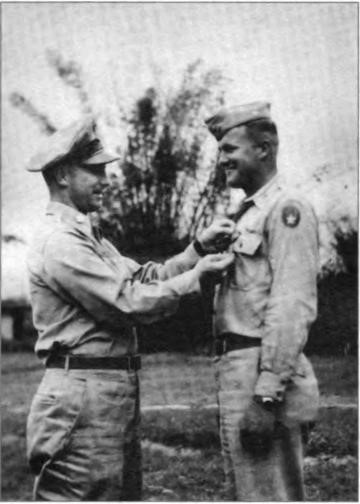
By 1941 Hazle began to spend a great deal of time with a popular psychologist/therapist named Amy Warburton, who lived in Berkeley and gave lectures and counseling there and in San Francisco and Carmel. She may also have had a center in the Santa Cruz mountains. She taught Hazle such things as “Hold a good thought.” Amy’s teachings were quite similar to those of Christian Science—mind over matter. Roy attended many of these sessions with Hazle, and spent generously on the therapy. Eventually Hazle and Amy became very close friends. The following poem, dated 1941, seems to reflect the gains Hazle felt accruing from her work with Amy, her inner struggle, and a renewed sense of hope and will to live.
MY GAIN
The desire to live, and continue to share
Has been my help, and reward so rare.
To enjoy this life which was given to me
Yet so filled with despair and futility.
Now each day dawns, with a desire to achieve
And with each night comes a joy hard to believe.
That my life could be so easily changed
From frustrated hopes to thoughts well arranged.
This change in me is now far reaching
I’m able to aid those blindly beseeching.
By helping myself, I’ll help others to grow
While in my own orbit, I’ll swing to and fro.
Nancy notes that Hazle wrote beautiful letters, but unfortunately few of them survive. One that does was written to Nancy on her birthday in August 1941, when she was in Merritt Hospital pregnant with Sandy. Turning to basic values, Hazle writes:
The greatest gift you can have and I know you have it is a deep feeling of appreciation for all the wonderful things in your life. The devotion and love of Willard alone is something some women miss and yearn for all their lives. He is beyond doubt the grandest, finest man and husband any one could ever hope for. I love him for the fine person he is, but more than that for the gentle, kind and devoted husband he is to you. He will be a wonderful father to your baby—but I have a hunch my dear you will always come first in his love.
All I ask is your happiness, because your happiness is my happiness & I might go further and add it is my health too. “Smile awhile, and when you smile another smiles, and soon there’s miles and miles of smiles.”
Best of love and happiness, Devotedly, Mother
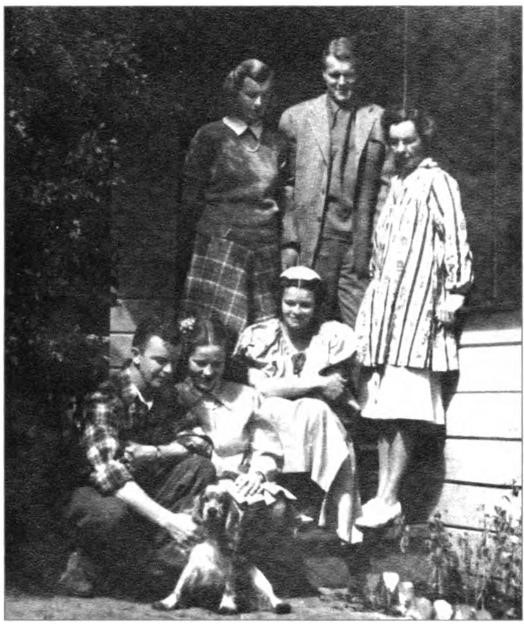
In October 1943 Roy and Hazle celebrated their thirtieth wedding anniversary, with a big party at the Bohemian Club for some 100 friends. Gene recalls that at that time their relationship seemed quite good and strong.
During the war, Hazle’s big effort was to serve as a Red Cross volunteer at the hospital in nearby Martinez. Roy considered that part of his “war effort” was to care for and assist his war widows and their children. He helped do chores their husbands would have performed, including garden and yard work. Each summer, after his fruits were harvested and preserved, Roy gave a generous supply to each of his children, which allowed them to enjoy the delicious fruits of his labors until the next harvest. His canning activities increased during World War II, when home food production became a patriotic duty. In 1942, for example, he single-handedly put up 30 quarts of cherries. Roy also became very active in the sale of War Bonds. For years he served as Chairman of the Northern California War Bond Organization. During the war years Blyth grew steadily.
By late 1945 the war was over and all the men came home safely. In September 1945 Lawton and Bobbie moved from Massachusetts, where Lawton had been a lieutenant and a teacher in the Naval Supply Corps, back to live at The Ranch in the small cottage only a short walk from Roy and Hazle.
 Shurtleff & Lawton Families Genealogy & History - Second Edition (2005)