** All Text on these chapter pages has been copied verbatim – with permission – from this book: “Shurtleff Family Genealogy & History – Second Edition 2005” by William Roy Shurtleff & his dad, Lawton Lothrop Shurtleff ** Text in pdf convert to word doc – any spelling errors from the book may or may not have been fixed. **
On 4 January 1936, the family (except for Gene who stayed in California to continue his studies at Cal) got on a train in Oakland bound for New York. Roy was age 49 and Hazle age 46. They arrived on the eighth and moved into the luxurious apartment they had previously arranged to rent in the River House Apartments, on the bank of and overlooking the East River on East 52nd Street, eight blocks from the present United Nations building. They would later occasionally throw champagne glasses from their balcony into the river, and Roy sometimes commuted to Wall Street by boat down the East River.
One of Hazle’s first projects in New York was to redo the apartment. She met a lady who was a top interior decorator and who introduced Hazle to antique furniture. Hazle binged, and started what would become a lifelong pleasure: redecorating new houses with antiques.
Roy spent most of his time trying to master his new job. Although the family had few personal friends, Roy soon developed numerous business associates, which inevitably put Hazle under considerable social pressure. As an example, Lawton recalls one evening when he, with his father and mother, were having dinner together. The phone rang and a voice inquired if Roy had forgotten the dinner being given that night to honor him and Mrs. Shurtleff. Roy adroitly replied that they had been unavoidably detained but they were on their way (an hour by train). So they departed, having already finished a full-course dinner. These were difficult happenings for Hazle to cope with. Moreover, Hazle was now uprooted from her brothers and sisters, family, and many old friends in the Bay Area. Her physical health was not good (in part from colitis), and accompanying her acute loneliness in the city apartment, she began to have depressions. Lawton and Gene were away at their schools. Nance, who came home from school and was with Hazle almost every weekend, recalls that this was more strongly felt loneliness than sickness. Nance’s detailed daily journal records only one day between late 1933 and 1937 when Hazle was sick in bed. She was usually extremely active and took Nance shopping a lot. A Sealyham terrier that she had with her in her apartment would sit right up in a chair at the dining table; it was her best friend but eased her loneliness only a little. The Filipino house boy, Horatio, was remembered by Lawton and Willard as being a good pool player; the pool table from Crocker Avenue in Piedmont had been shipped east for use at the apartment.
Lil Haven, who was very close friends with Don and Billie Lawton, remembers talking with Billie after Billie visited Roy and Hazle in New York “They were living high, wide, and handsome; high on the hog. Hazle had to live with the great and near great and it was harder than ever on her, who had been brought up in a warm, intimate family. More than ever, that role was out of harmony with her temperament. Billie felt sorry for Hazle in all that wealth and prestige, and I think things began to go downhill for her and her relationship with Roy after that.”
In early 1936 the New York office was expanded and moved to the 20th floor of 14 Wall Street. Blyth remained essentially a “bond house.” Between 1932 and 1937 Blyth managed the group of underwriters supplying construction funds for the Golden Gate Bridge, which opened in May 1937. A. P. Giannini of the Bank of America played a major role in this funding.
Nance was very unhappy on the East Coast, being away from her close circle of friends and from Willard. Roy and Hazle were trying to do anything they could to make her happy. Hazle was dying for a break from New York. So over Easter vacation, March 1936, Hazle chaperoned Nance and Don Lamont (whose mother was a close friend of Hazle’s) on a boat trip to Bermuda. Willard wasn’t wild about the idea. Fortunately for him, Nance was not the least bit interested in Don. It was an uneventful trip.
Nancy had been sent for two years to Miss Porter’s School (also called Farmington), a precollege boarding and finishing school in Hartford, Connecticut. As she remembers with spirit: “I hated it, just like I hated Castilleja, so I ran away. I was so naughty in those days! A nice security guard named G. Miller helped me escape from the dorm. Unfortunately the school authorities caught me soon afterwards in a local gas station and took me right back. They never punished me and kept things quiet. But they told my parents. I had simply planned to go back home to New York about two hours away.”

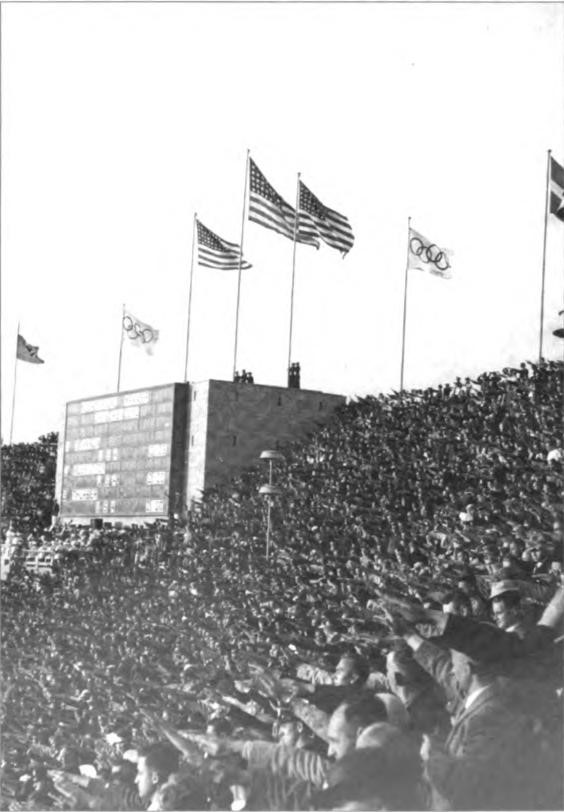
In June 1936 Lawton graduated from Cal. That summer he and Gene became the first in the family to visit Europe, where they toured mostly by bicycle. There is the famous story of them riding a tandem bike. Lawton discovered at the end of each day, when he was exhausted and Gene was fresh, that Gene had been sitting on the back seat enjoying the ride, without much pedaling. They went to Paris, kayaked on the Rhine, and had many adventures, ending with a visit to the 1936 Olympics in Berlin. Seated, as Lawton recalls, “right next to Hitler, Goehring, and Goebels,” they watched Jesse Owens win four gold medals and set a world record in the long jump, while pro-Aryan Hitler and his buddies turned their backs in a visible public gesture against the black champion.
At the start of the summer of 1936, Nance and Hazle had gone back to California, where they spent most of the summer at Lake Tahoe, visiting with and entertaining their respective friends. Roy came to spend a month at Tahoe and attend the Bohemian Grove play. He flew back to New York in August to meet Lawton and Gene as they returned from a summer in Europe. Then the three men in the family returned together to California for a brief reunion at Tahoe.
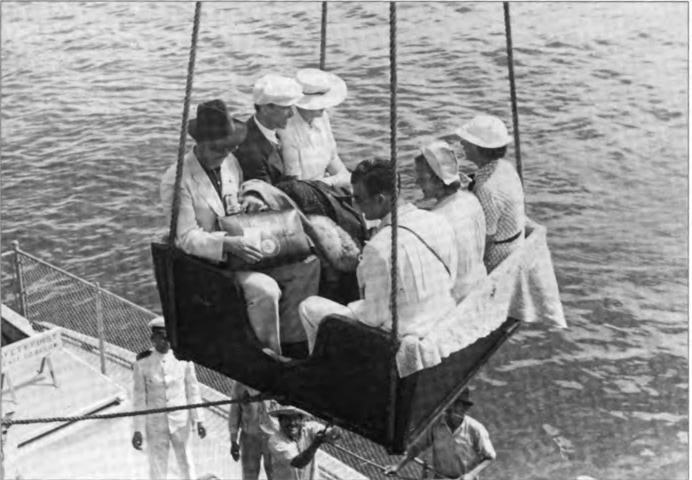
On 27 August, 1936 (after a brief stay with the William Cavalier family in Piedmont), Hazle, Lawton, and Nancy boarded the steamer San Elena in San Francisco heading back once again to the East Coast. Nance’s friends came to the dock to see her off; she cried and cried. Along the west coast of Mexico, in order to get ashore, they were dropped-10 to 12 people at a time—in huge cargo baskets into small boats waiting by the anchored steamer; the small boats then carried them ashore. After stopping in the city of Mazatlan (western Mexico), they disembarked in Guatemala and drove inland to the city of Antigua. Back to the boat, they stopped in San Jose (Costa Rica), then Balboa (on the Pacific side of the Panama Canal), then went through the Canal, into the Caribbean, and down to Cartagena on the coast of Colombia. Then they headed north to Cuba, where they saw Morro Castle (Los Tres Reyes del Morro Castle), the ancient fortress near Havana, and a cock fight. Finally they arrived in New York, 14 days after they started.
In the fall of 1936 Lawton entered Harvard Business School at Cambridge, Massachusetts, for a two-year course in business administration.
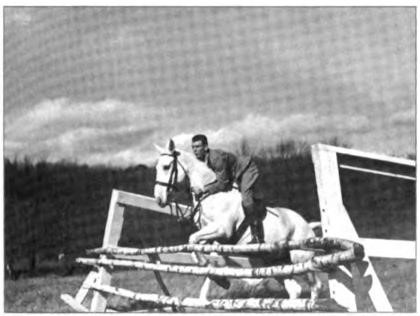
Several years later he recounted that “I resisted business in every way, toying with writing, teaching, forestry, even medicine before giving in to the necessities of making a living. At Harvard scholastic discipline began!” On weekends for the next two years he visited the family and did some horseback riding, including jumping, and learned to play squash racquets. For two years he played on the Harvard Business School squash team.
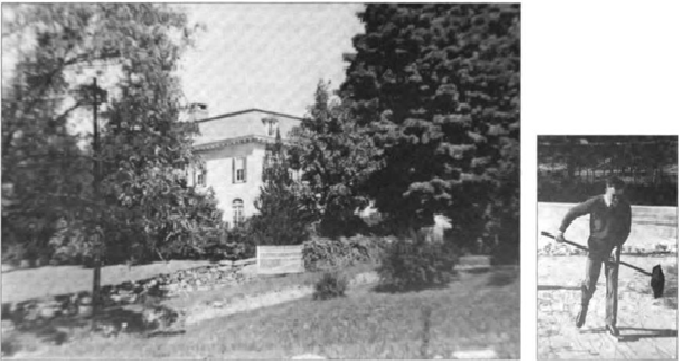
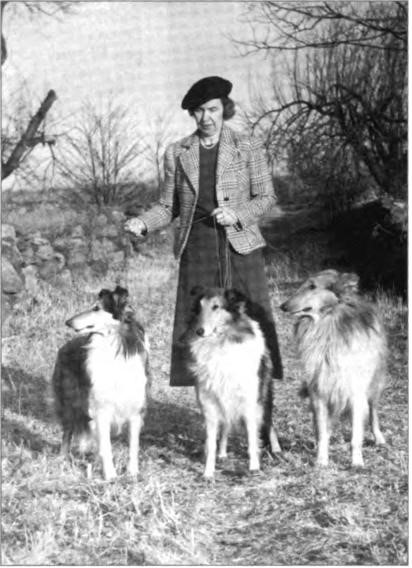
After a year at River House Apartments, in 1937 Roy and Hazle rented and moved to an elegant, completely furnished estate on three to four acres of land at Edgewood Drive in Greenwich, Connecticut. Here Hazle started to raise scotties (Scottish terriers, mostly as household or family dogs) and to breed collies professionally for showing, with a very close lady friend of hers.
Six months later, in mid-1937, they leased (with an option to buy) and moved to an even nicer country estate on Cherry Hill Road, outside Greenwich. The main house was a big three-story farmhouse, surrounded by three acres of land and wilderness, plus ducks, chickens, and a stream that flowed into a small lake across the road. The pond froze in the winter, and Roy and the children and many friends skated on it. The whole place was elegant. The return of Karmi and Sam to the U.S. to help out the family made it even nicer.
On 28 June 1937, immediately after signing the lease for what Hazle called “the new farm” on Cherry Hill Road and after Hazle had helped give birth to seven scottie puppies (she now had 10 dogs at home), Roy and Hazle, with Gene and Nancy, took a train to New York and boarded the steamer S.S. Bremen for England. Hazle and Roy’s long-dreamed-of first trip to Europe had begun. Arriving in London on July 5, they spent three weeks in England and Scotland with a car and driver; they saw all the sights, visited antique shops, raved over Cambridge College (“the jewel of the trip”), and missed American coffee. Hazle kept a detailed journal and wrote often to friends and relatives such as Billie and Don Lawton, and her son Lawton.
On Sunday July 25 Hazle wrote: “All enthused today to see Tenterden, the little village Roy’s grandmother came from.” (See p. 31) Apparently Roy already had an interest in the history of his family. With the top down on a beautiful day, they drove out to county Kent, about 50 miles as the crow flies southeast of London, England. Tenterden was the birthplace of Maria Louisa Avann, Roy’s maternal grandmother. They visited the lovely old parish church just across from the inn and stood in the doorway listening to the closing hymn. In the churchyard, under a spreading tree, they saw the old headstone, quite well preserved, marking the graves of Suzanna Avann (who died in 1801) and her husband John Avann (died 1829). Roy paid five shillings to look through the old records but couldn’t find any trace of Maria Louisa Avann, his grandmother. They took snapshots in Tenterden (including one of the gravestone) and sent these back to relatives in Berkeley.
During three days in the Netherlands, Roy declared he would move the family to the Hague when Roosevelt had ruined the U.S. In Amsterdam they bought Nancy her first diamond ring for her 18th birthday. Arriving in Paris on 29 July, they met Nancy’s boyfriend, Willard Miller. In Versailles Hazle wrote: “The peace and quiet here on this sublime day has given me a new lease on life.” They toured the chateau country with a driver, then departed for America on August 11 after what Hazle called “one of the happiest and most interesting trips one could have.” They arrived home on August 17. Hazle wrote: “How grateful we all were that we weren’t going to River House instead of Greenwich. We were welcomed home by sweet old Sam and Karmi, the place a gorgeous sight with the garden in full bloom, and, of course, the house cool and spotless.” Hazle and Nancy immediately dashed off to Stamford to see their collie puppies and other dogs. Gene left for California. Hazle’s 45-page typed journal of the European trip reveals a sensitive, expressive, and deeply feeling person, and a fine writer. Hazle concluded the journal noting: “We have so many happy memories and above all a great sense of gratitude because life has been so good to us.” The trip had been good for Hazle’s physical and mental health.
Despite that, after returning from Europe, Hazle had a difficult time. She made a valiant effort to conquer her depressions. She and Roy made many social friends in Greenwich, joining the Round Hill Club for horseback riding. They enjoyed the rural setting, with kennels for raising and breeding dogs (scotties, then collies), and a chicken house and vegetable garden for Roy. Still, in the summer of 1938 Hazle’s doctors suggested a one-month stay in a sanitarium outside Boston. It must have been a very traumatic experience for her to be confined like this. Neither her dogs, nor practicing needlepoint, nor other such things were sufficient to relieve Hazle of her ongoing depressions.

Recall that Gene had entered Cal in the fall of 1935. That year he lived in the DU house, and his freshman grades were so bad (“I was doing a lot of playing around”) that he almost flunked out. So Roy and Hazle arranged for him to live with relatives, Dr. Charles Meek (Roy’s half brother) and his son Elwood, who lived at 850 Regal Road in Berkeley. Elwood was 10 to 15 years older than Gene. Gene’s grades got better, so he continued to board there throughout his sophomore year and until the middle of his junior year. As a sophomore Gene was elected to Kappa Beta Phi (Phi Beta Kappa worded backward), a Cal drinking society. Notes Gene, “They got together once a year and got drunk.” In the middle of his junior year, with Hazle ill, Roy suggested that Gene come back to the East Coast. This also fit nicely into Gene’s plans, which included Columbia University. At Greenwich, Roy and Gene lived at the family home, taking horse-jumping lessons in the evening and on weekends going drag hunting, following the scent of a dragged fox skin. Lawton frequently visited the nearby family on weekends from Harvard and participated in the activities.
In the fall of 1937 Nancy entered the fashionable Miss Finch’s Finishing School, a junior college in New York City where she boarded. She graduated after two years, having spent the summer and vacations with Hazle and Roy at Greenwich. Also in the fall of 1937 Willard had entered Dartmouth College in Hampshire as a freshman. Geographically, the two were now not that far apart; in spirit, they were closer than ever. Nancy recounts how her escapades continued:
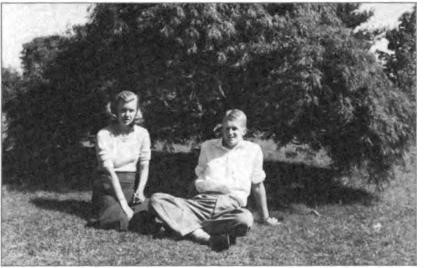
One night I didn’t get home until 4:00 in the morning from a date with Willard in Greenwich. Lawton caught me, hit the ceiling, and told Hazle. He told me that if I kept going in the direction I was headed I would never end up with any kind of a life at all.
When I was a sophomore at Finch’s, I ran up to Dartmouth to elope with Willard. We had definitely decided to go through with it. All the bridesmaids and other such people had come from their various colleges to stand up with us. I had my suitcase all packed. Then, just as we were about to go, I got scared and chickened out. I realized that I could never do such a thing to my mother. I just didn’t want to hurt her that badly. Willard was understanding, so we waited for a year and had a regular wedding back in California.
In spite of Hazle’s poor health, she became very active and interested in showing and breeding her collies. Nance, Gene, and women friends often went with her to shows. It was good companionship and good therapy. One of her favorite collies, Rudy, won high honors in New England, New Jersey, and New York City, earning his “Championship” rating. His offspring were also shown.
Lawton graduated with an M. B. A. from Harvard Business School in June of 1938. That fall he went to work for Blyth & Co. in their New York office, just as Roy had finished his two-year stint there. Lawton felt like a “duck out of water.” He had a two-hour meeting with Charlie Mitchell, head of the New York office and chairman of Blyth’s board. Mitchell sympathized with Lawton’s frustration and explained that to be a good investment banker one should start at the bottom of the manufacturing ladder (as he had in a steel mill) and that Lawton should consider doing the same. That fit Lawton’s plan exactly. After eight months he asked to be transferred to the San Francisco office to be in California, nearer to his new love, Bobbie Reinhardt, whom he had met the previous summer at Lake Tahoe. In 1939, when Blyth celebrated its 25th anniversary, Lawton was shown in a photograph with top management as being groomed for a leadership role. But it didn’t pan out. Even in San Francisco he didn’t really enjoy the investment banking business. He wanted to work for himself. Roy helped Lawton find a job with Hawley Pulp and Paper Company in Portland, Oregon, but inwardly he was disappointed that Lawton had left Blyth, since he had hoped to see a family succession in the business. Later, however, Gene fulfilled Roy’s hopes in this regard.
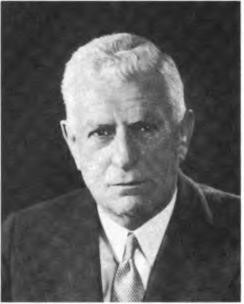

In 1938 the opportunity arose to purchase the Greenwich estate where the family was living.
Roy called a family meeting to discuss whether or not they all wanted to put down roots on the East Coast.
Hazle wanted very much to return to California, where her friends and activities were.
Gene changed his Columbia plans and decided to return to Cal.
Nance was delighted to return to her friends, who were also now at Cal.
The pull of the Golden State was simply irresistible.
 Shurtleff & Lawton Families Genealogy & History - Second Edition (2005)