** All Text on these chapter pages has been copied verbatim – with permission – from this book: “Shurtleff Family Genealogy & History – Second Edition 2005” by William Roy Shurtleff & his dad, Lawton Lothrop Shurtleff ** Text in pdf convert to word doc – any spelling errors from the book may or may not have been fixed. **
January 1917 saw the three Shurtleffs moving again, this time to 48 Chester Way in San Mateo, California. Lawton was a little over two years old. The move was made largely because of Lawton’s poor health after pneumonia (from which he had nearly died), and only incidentally because this area on the Peninsula, where Charlie Blyth and George Leib lived, was the center of social activity and wealth in those days.
Roy’s first real hobby after leaving college was gardening. Starting at the house on Chester Way, he created a garden at every house in which he lived. He deeply enjoyed gardening throughout his entire life. In San Mateo he raised flowers, vegetables, and rabbits. At each house occupied as the kids were growing up, he also built a swing. Another early hobby was home brewing. Lawton remembers bottles of Roy’s home brew and root beer exploding in the basement of their next home on Hurlingham.
On 27 February 1917 Roy and Hazle’s second son, Eugene Avery, was born at a hospital in San Mateo. Eugene was named after Eugene Hallett and Roy’s mother Charlotte Avery. By this time Roy, Jr.’s name had been changed to Lawton Lothrop Shurtleff.
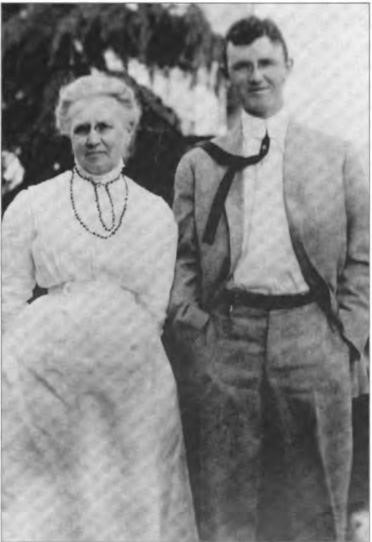
Not long atter Gene was born, when Lawton was about three years old, his left hand was crushed in a washing machine wringer located in the basement of the family’s home. He was rushed to the hospital, and a doctor said that the hand would have to be amputated at the wrist. As he was in the operating room, with the anaesthetic mask on, Mable Johnson, a Christian Scientist and friend of the family, entered the room and urged them to stop. She said that the hand could be saved by prayer and positive thought. Hazle told the surgeon to stop. Mable Johnson visited Lawton frequently at the Shurtleff home thereafter. She prayed and read from Mary Baker Eddy’s book Science and Health. Lawton’s hand was miraculously saved.
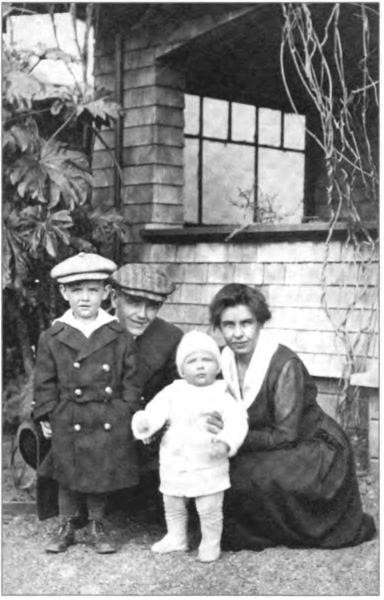
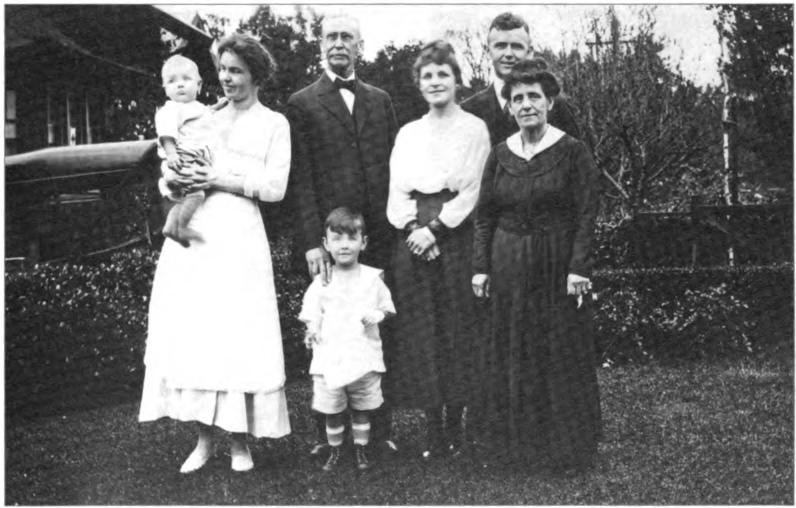
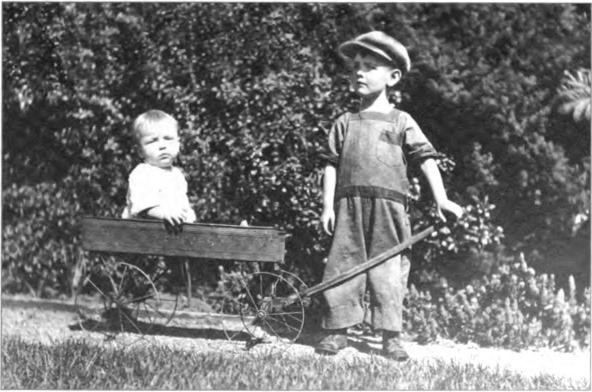
On Christmas, 1917, a number of excellent family portraits were taken of 13 Shurtleffs, Lawtons, and Meeks. Hazle is shown holding her newborn, Gene, and little Lawton is standing out in front with his bandaged hand, glad that it was still attached to his wrist.
On 7 August 1919, Roy and Hazle’s third child and first daughter, Suzanne Shurtleff, was born in their home at 48 Chester Way, according to her birth certificate. She was renamed Nancy Lee Shurtleff when she was about four months old—and that is the name on her birth certificate.
Interestingly, three of the five members of the family (Roy, Lawton, and Nancy) had had their names changed. In 1941 Roy wrote: “As I look back on the period from 1904 to date, no war or invention equaled in importance the births of Lawton, Gene, and Nancy.”
Shortly after Nancy was born, the family moved to a larger house on Hurlingham. Today this street is in San Mateo very near the border of Burlingame. But in those days the family (and the Berkeley newspapers when announcing the births of both Gene and Nancy) always spoke of the Shurtleffs living in Burlingame. Perhaps the boundary was changed or they just referred to Burlingame for its prestige value.

As Roy and Hazle watched Lawton’s hand healing (he eventually regained full use of it), they became converts to Christian Science. They regularly read Science and Health and recited the verses. For a few years, starting in San Mateo/Burlingame, and continuing after they moved to Oakland and Piedmont, the family went to a Christian Science church. But none of the children was ever baptized or christened. Then Mable Johnson’s husband, Tom, died. Gradually Roy and Hazle’s faith weakened and they stopped going to church. Winifred Seymour and her sister, Helen, continued their faith in Christian Science, each becoming a Practitioner who helped others with their problems using the Power of Mind over Matter. Many years later, a number of tragic deaths in the Lawton family further shook Roy and Hazle’s faith. In April 1938 Winnie Seymour’s son, Bob Seymour, died in Berkeley at age 18 of a brain tumor. A month later Helen Lawton died after a lengthy affliction with cancer. Roy and Hazle always felt that Bob and Helen’s lives might have been saved by conventional medical treatment. Yet throughout his life, Roy read the Bible regularly.
Blyth did well from the outset. Originally the company sold only bonds. In 1915 the business was capitalized for $100,000. All the stock was owned by the employees; Blyth and Witter had 35 percent each, while Shurtleff and the other two salesmen had 10 percent each. Thereafter, except for 1930-33, all of Blyth’s stock was owned by its employees. When a person left the firm, he had to sell his stock back to remaining employees. In effect, they had an elaborate and creative “buy-sell” or pooling agreement.
In 1916 Blyth opened its first branch office, in Los Angeles. In 1918 Roy Shurtleff was promoted to a vice president and director of the company, a position he held until 1955; his primary responsibility was sales. Also in 1918 Blyth began its very important relationship with the Zellerbach Paper Co. with a $1 million underwriting. Blyth long remained the investment bankers for Crown Zellerbach. In 1919 Blyth purchased $5 million of preferred stock of the Pacific Gas and Electric Co, marking the beginning of a long and fruitful relationship. This was the first large transaction that Blyth undertook without outside partners and without knowing how it would discharge the obligation, save through the arduous method of going out and selling the stock. Also in 1919 offices were established in New York City, Seattle, Oakland, and Pasadena. The company had just barely survived the rigors of World War I. In those days they worked long hours, and almost always on Saturdays. (There was no 40 hour week law.) They were paid in gold coins ($10 or $50 pieces) until about 1918, when paper money began to appear.
 Shurtleff & Lawton Families Genealogy & History - Second Edition (2005)