** All Text on these chapter pages has been copied verbatim – with permission – from this book: “Shurtleff Family Genealogy & History – Second Edition 2005” by William Roy Shurtleff & his dad, Lawton Lothrop Shurtleff ** Text in pdf convert to word doc – any spelling errors from the book may or may not have been fixed. **
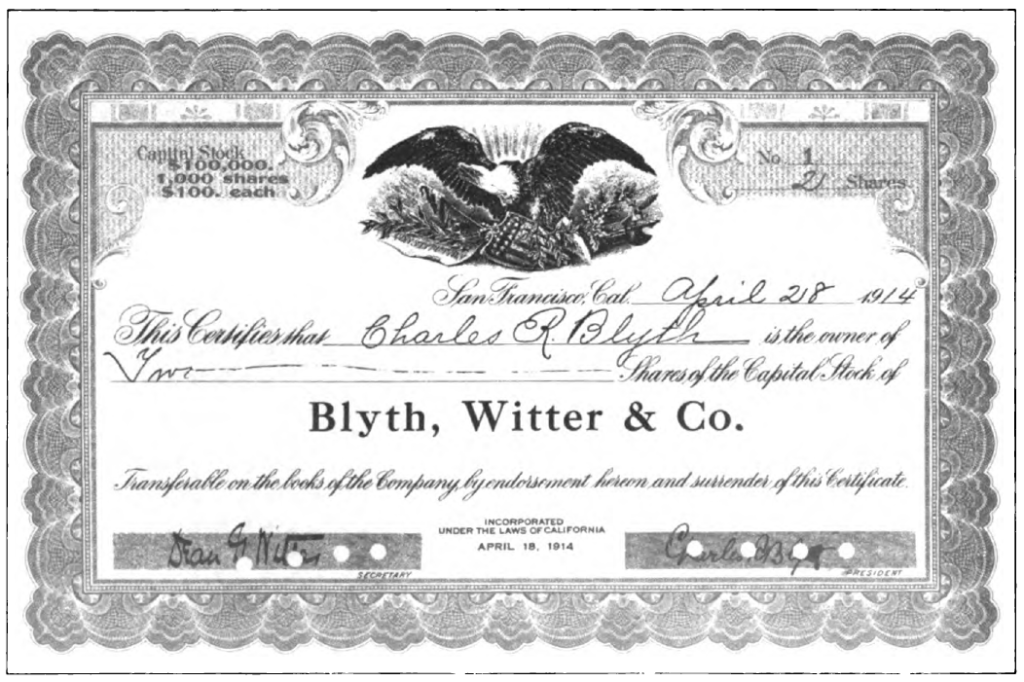
Passage of the Federal Reserve Act in December 1913, an attempt at major reform of U.S. banking and finance, put heavy pressures on Louis Sloss & Co. and on 1 April 1914 the firm declared bankruptcy. Roy, along with his co-workers Blyth, Witter, Leib, and Hartigan, all younger than 31, found themselves out of work during a period of threatened depression. They had virtually no financial resources, but they did have abundant energy, talents, intelligence, and fortitude. Blyth and Witter decided to start a new business and invited Leib, Shurtleff, and Hartigan to join them. On 7 April 1914, less than three weeks after the closing of Louis Sloss & Co., they announced the formation of the partnership Blyth, Witter & Co. That same day an article titled “New Bond House Will Open Soon” appeared in the San Francisco Chronicle. The firm was officially founded on 18 April 1914, with offices in the Merchants Exchange Building in San Francisco.
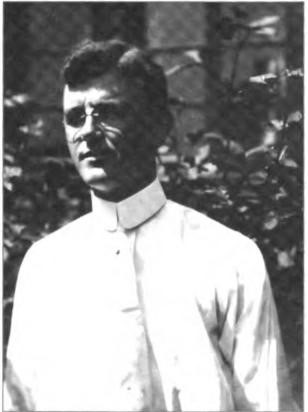
To help them get started Louis, Sloss & Co. turned over all of its files and office equipment. Frank B. Anderson, president of the Bank of California, loaned them $50,000. Dean Witter’s mother loaned him $10,000 and Charles Blyth sold his car; that was it for financial resources. Located 3,000 miles from the financial capital of the United States, severely undercapitalized, and run by men in their 20s and early 30s, the firm started with three strikes against it. Yet it went on to become the nationally famous investment banking company called Blyth & Co., Inc.
The earliest history of Blyth & Co., Inc. (Ryder 1954, p. 9) states that the company was founded by “four energetic young San Franciscans,” Blyth, Witter, Leib, and Shurtleff. John D. Hartigan (salesman) and Frank Weeden (office boy and file clerk) were original employees but were not considered founders. Eugene Hallett’s untimely death in the fall of 1912 precluded his joining the new company. In 1976 Roy Shurtleff stated that the company was founded by Blyth and Witter, perhaps because he and Leib had not invested money in the company originally. The company’s fifty-year history (Soher 1964) mentioned five founders, the fifth being John Hartigan. By now these men, who had grown to know and respect one another deeply, had a fortunate balance of talents.
Blyth (born in 1883) was the oldest of the group. The quality of inspiring people was one of his greatest attributes—he was indeed a natural leader. Blyth and Witter (both of whom were fairly wealthy and lived on the Peninsula) were fine executives; Shurtleff, Leib, and Hartigan were excellent salesmen.
Soher (1964) notes that:
At the outset, the five founders agreed to live on meager rations. Blyth and Witter would receive no salary; George Leib and lack Hartigan, who were single, would be paid S75 a month and Roy Shurtleff, who was married and had a son, would be given a salary of $125 a month. The three initial stockholders of record were Blyth, Witter and Shurtleff, each of whom owned two shares of $100 par value. Shurtleff, to this day, cannot recall making this investment of $200 although it certainly proved to be most profitable for him.
Roy’s primary interest was in sales but, even in the beginning, he showed abilities and performed functions in the organization much beyond that of a sales manager. He had a sense of orderliness as to what constitutes good business. He had a mind and ability to speak forcefully when disagreement seemed in order. From the very beginning he was destined to influence his company and the direction of its activities.
In 1914 in California there was a small number of securities firms carrying on “broker-dealer” activities. Their business was to make purchases and execute sales of stocks and bonds on behalf of their investor customers. Their transactions were made on the various exchanges where they held memberships, and their compensation was in the form of agency commissions paid by the customers. It was a relatively straightforward and risk-free business. The demands for new capital from growing businesses and corporations in the eastern United States had for many years prompted many of the stock and bond firms to offer expanded service in the form of raising new capital. They formed what they called “investment banking organizations,” which were willing to make commitments of capital for various purposes at their own risk. The capital was then raised through the sale of securities in the form of stocks and bonds. These were sold to customers at a price that provided profits, sometimes substantial, for this underwriting service.
Foreseeing similar needs for capital by the developing but still youthful electric power industry on the West Coast, the founders of Blyth, Witter & Co. commenced to apply the principles of eastern underwriters to help finance the growth of California public utilities (such as Pacific Gas and Electric Co.), thus becoming the earliest investment banking organization in the western United States.
World War I broke out less than four months after Blyth was started and it engulfed the world. It almost caused the company to go under. Blyth, Witter & Co. received its first substantial piece of business in 1914 from the Mt. Whitney Power and Electric Co., a public utility company in California’s San Joaquin Valley. In the years that followed Blyth, Witter & Co. focused its efforts on underwriting public utility securities, especially the youthful electric power and light industry of the West Coast, and specializing in its peculiar problems.
After Roy left home, his mother, Charlotte Avery Shurtleff, began to do charitable work with the San Francisco Presbyterian Orphanage, later called Sunny Hills. Founded in 1895 in San Anselmo, it was a big place out in the country north of San Rafael. It served as a home for orphans of all ages. Charlotte first became associated with Sunny Hills in about 1913 as a donor and “manager” (which meant she cared for the children, often doing volunteer, hands-on work such as changing diapers in the nursery). In 1919 or 1920 she was elected to the Board of Directors.
During the years from 1912 to 1917 Roy and Hanle took many automobile trips together. In those days of poor, unpaved roads, frequent blowouts, and gas stations that were few and far between, each must have been an adventure. In 1912 and 1913 they visited Roy’s birthplace, Nevada City, then went on to Tahoe and to Monte Rio. In 1916 Roy gave Hazle a Ford Model T sedan for Christmas. With it was a piece of Roy’s poetry, ending “A Ford sedan ain’t no tin can.”
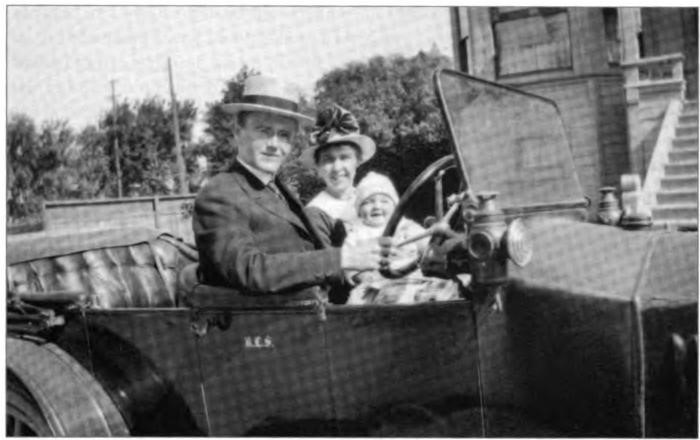
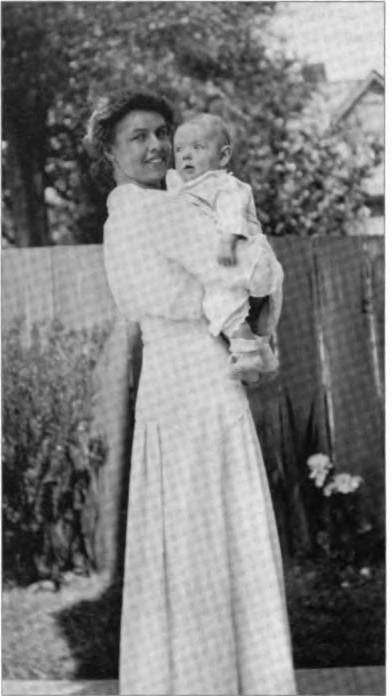
In 6 November 1914 Roy and Hazle’s first child was born in Berkeley at Alta Bates Sanatorium. The original birth certificate shows that he was named “Roy Lathrop Shurtliff”, after his father. But the name “Roy” didn’t stick and was soon changed to “Lawton Lothrop Shurtleff”, in part to perpetuate the Lawton family name. “Lathrop” of course had been misspelled. The family lived at 2307 Stuart Street. Roy was age 27 and Hazle age 24. Roy later wrote to his son, Lawton, on his 50th birthday:
1 remember well your advent into the world; the rush to Alta Bates Sanatorium, [now Alta Bates Hospital] at 3 A.M. on November 6, 1914; the long delay after the first indication, during which 1 went home and put up several dozen jars of jelly. We had the berries and didn’t want them to spoil. Anyway as a prospective father 1 was jumpy and had to do something. Then came your actual arrival in late afternoon—great joy—a healthy man child!
You were an autumn child and 1 sent great yellow chrysanthemums to your mother in the hospital. The sight of these flowers at this time of years always brings memories…
Another note by Roy in 1941 says:
You were born in Berkeley where we lived in a little bungalow on Steward St. [actually it was 2307 Stuart St., which runs parallel to Ashby and four blocks north of it] in Berkeley below Telegraph Avenue (about 11/2 miles from the University of California campus). I was a struggling young bond salesman and shortly before you were born the firm for which I worked closed up. The outlook must have been pretty grim, but 1 don’t recall that we were at all discouraged.
Although the outlook may have been grim, adventurous excursions in the family motorcar could create the impression of a life of leisure, as two clippings from Berkeley newspapers during this period seem to show.
July 1915, Mr. and Mrs. Roy L. Shurtleff, accompanied by Mr. and Mrs. William Gay, left this week on a motor trip to Lake Tahoe. They will visit the different summer resorts in the Tahoe country and will return to town in about a month. In 1917, Mr. and Mrs. Roy Shurtleff left a few days ago on a motor trip through Sonoma county. They expect to be away about three weeks and will stay a few days at the country home of Mrs. Shurtleff’s parents at Monte Rio.
Indeed Roy and Hazle often took their new child up to the Russian River at Monte Rio. Their next move was to a modest house at 1129 Shattuck Avenue way out in north Berkeley. This was probably the first house they actually owned, since they rented the Stuart Street house.
In November 1916 Roy joined the prestigious and exclusive Bohemian Club and remained an active lifelong member. At the Bohemian Grove, he joined the Piedmont Camp to be with his close personal friends from Piedmont—the Witters, Dollars, etc.—instead of joining a business camp. He later often remarked how tough it was, after an evening of rehearsing for the Grove Play, combined with drinking and good fellowship, to make the long ferry trip home, only to have Hazle put him in charge of their crying baby. In the mid-1970s he decided to discontinue his annual trips to the grove, because he said it now took him longer than 10 minutes after he woke up there to figure out where he was! In 1984 Roy was the senior member of the Club’s “Old Guard,” his membership predating that of any other living member.
Also in 1916 he joined the San Francisco Commercial Club, to which he belonged until 1925.
 Shurtleff & Lawton Families Genealogy & History - Second Edition (2005)