** All Text on these chapter pages has been copied verbatim – with permission – from this book: “Shurtleff Family Genealogy & History – Second Edition 2005” by William Roy Shurtleff & his dad, Lawton Lothrop Shurtleff ** Text in pdf convert to word doc – any spelling errors from the book may or may not have been fixed. **
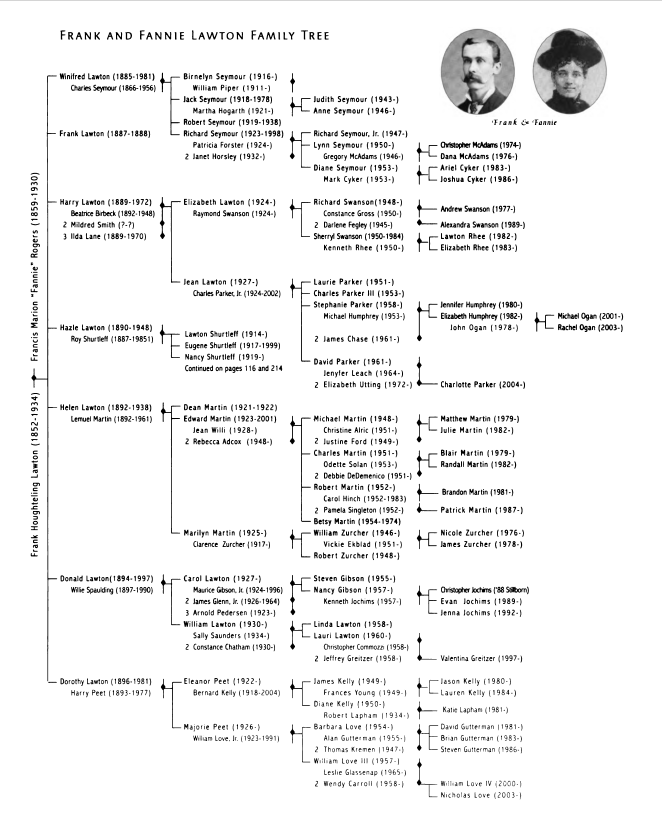
Early Years (1852-83). Frank and Fannie were Hazle Clifton Lawton’s parents. Frank was born on 28 December 1852 in Clyde, Wayne County, New York, the youngest of eight boys. Birnelyn Seymour Piper, his granddaughter, believes that all of his brothers were professional men. His father was Charles D. Lawton, born in Newport, Rhode Island, on 17 September 1802. His mother was Susan A. Houghteling, born in Susquehanna, Chenango County, New York on 30 March 1812.
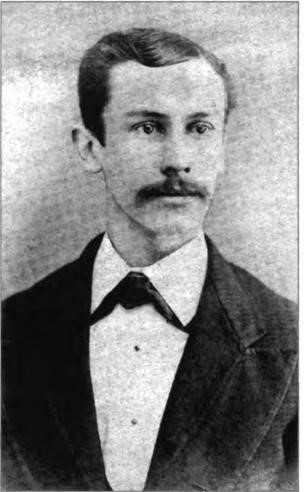
The 1870 U.S. Census shows Frank to be 17 years old and living with his parents in Clyde, New York. Photographs taken in 1872 show him to still be residing in Clyde. It was at about this time that Frank suffered a severe accident. He was driving a big, flatbed Studebaker wagon, pulled by a team of horses. Suddenly the horses began to run out of control. When he stood up to try to rein them in, he fell off and the heavy wagon wheel ran over one of his feet and crushed it. As his son Don recalls:
Pictured – Young Frank H. Lawton, soon to be patriarch of the Lawton family line, circa 1872.
The doctor said, “Now listen. I can take off this foot, since it is crushed beyond repair, and I’ll have you out of bed in 6 to 8 weeks.” Frank replied, “Well, so what i f I don’t?” The doctor warned, “You might be in bed for a year or two.” Frank said firmly, “That foot doesn’t come off” So he stayed in bed for a year rather than have it amputated. For the rest of his life, he walked with a slight limp and had to wear high black lace-up boots to support his weak foot.
Neither Frank nor his parents are shown as being in Clyde on the 1875 state census. Birnelyn Seymour Piper recalls hearing from her mother, Winnie, that Frank’s father, Charles, had signed as guarantor for a large loan or debt on behalf of a friend. The friend was never able to pay. Charles could have gotten out of his obligation, but he was a man of such high principles that he paid the debt. Because of this, there was no money left for his youngest son, Frank, to go to college. Instead, young Frank worked in a drugstore for a while and thought seriously about becoming a doctor. Then he decided that he would like to go out West, start a new life, and go into business. Although he never did go to college, he was a very well-educated man. He read and studied a great deal.
His elder brother, William D. Lawton, had gone to San Francisco, California, arriving in about 1874. After working as a salesman for Percy Beamish, an importer and manufacturer of shirts and other clothing, he started his own business, W. D. Lawton & Co., in about 1876 at 9 Post Street and 608 Market Street It manufactured fine men’s shirts and collars. He may have started with a partner, B. F. Commings. So, in the late 1870s Frank Lawton left Clyde, New York, and headed west.
Starting in about the mid-1800s, long before the telephone was invented, many larger cities had a book called a City Directory. Similar in conception to today’s phone book, it listed the name, home and business address, and usually the occupation for most heads of households in the city.
The San Francisco City Directory for 1879-80 (when he was about 27 years old) first lists him as a shirtmaker residing at 417 Mason Street. The next Directory shows him to be working as a bookkeeper for his brother at W. D. Lawton & Co. and living with his brother at 1718 Turk Street.
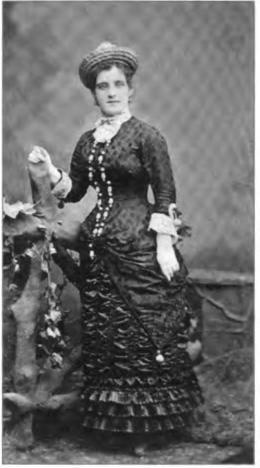
It is not clear when or how Frank Lawton met his bride to be, Francis Marion Rogers. She was living in San Francisco from 1877 on and working as a clothing saleslady and then as a milliner, so they may have met on business. They were married on 17 May 1884 in San Francisco by the Rev. Robert Patterson. The place of the marriage and their religious affiliations are not known. He was 31 years old, and she was 24. Frank was about 6 feet 4 inches tall, and lean and serious. Fannie was no bigger than a minute, and no taller than 4 feet 11 inches, but full of spirit and fun and love. Frank’s growing shirt business supported the young couple quite adequately.
Fannie Rogers and Her Ancestors. Fannie’s parents pose an intriguing mystery in our family history. Despite years of intensive genealogical research, there are still important gaps in our knowledge; yet we do know quite a bit about them. Her father was almost certainly William P. Rogers, who was born in about 1810 in Maryland, probably in Baltimore. We do not know the names of his parents. We are quite sure that William had a younger brother, Thomas Rogers, who was also born in Maryland, in about 1812-20.

Fannie’s mother was almost certainly Frances O’Donnell, who was born in about 1824-25 in Maryland, probably in Baltimore. We are almost certain of her maiden name, but we do not know the names of her parents or of any of her siblings—if she had any.
A marriage record shows that William Rogers and “Francis Odonnell” were married on 11 August 1840 at St. Mary’s Church (Roman Catholic), Chartres Street, New Orleans. The names of their parents are not given—and we have never been able to find them. The Rev. Constantine Maenhaut, Rector, officiated, in the presence of Charles Hefferman, Eva Jackson, and Thomas Rogers (probably William’s brother), witnesses.
Note that Frances (the bride) was about 15-16 years old at the time and William about 30, or 14-15 years older. Since Frances was so young, and since she was married by a Catholic priest, why were her parents not present to give permission and serve as witnesses? We are almost sure that William was a sea captain and that his bride’s first name was spelled “Frances.” Unfortunately, we do not know the name of his ship. He probably sailed from Maryland to Louisiana. Yet it is not clear why he and Frances chose to live in Louisiana.
In about June 1846, William Henry Rogers was born in New Orleans, Louisiana, the first known child of William and Frances Rogers. We have been unable to find this birth certificate; this information comes from William Henry’s death certificate (in 1864, at age 17).
In 1848 in New Orleans Mrs. Frances Rogers purchased a slave from Walter Lewis Campbell, according to the Notorial Records of Edward Barnett (vol. 46, p. 60).
On 25 January 1850 William Rogers purchased a “negress slave Acerlane,” aged 21-22 from Claire Panche, “fully guaranteed against the vices and maladies prescribed by the law except the vice of running away.” On the deed of sale are the signatures of Wm. Rogers, Selim Wagner, Alphonse Charles Weysham, and perhaps an O’Donnell. Note that this took place more than a decade before the start of the Civil War.
The New Orleans City Directory for 1850 shows a Captain William Rogers (probably ours) residing at 13 Victoria Street (presently known as Decatur Street).
On 23 February 1850, Frances Rogers sold the female slave she had purchased only a month earlier. William appeared before notary Edward Barnett in New Orleans and “declared that he does and by these presents appoint and, in his place, and stead put his wife Mistress Frances O’Donnell to be his true and faithful attorney… to sell a Negro slave named Acerlane” notarized by Barnett on January 25. The same four signatures appear, including a clear signature of “William Rogers” (see vol. 52, p. 122). The sale of the slave was finalized on May 7—according to conveyance records.
The book San Francisco Passenger Lists, Vol. 1 1850-1875, by Rasmussen contains an entry (p. 14) that seems to fit well with the movements of our Rogers family: The ship California (Capt: Lt. T. A. Budd), a steamer from Panama, arrived in San Francisco on 25 March 1850. One of the many passengers was Mrs. F. O’Donnell. The trip from Panama took 23 days. Yet if this was our Frances, why did she give her surname as “O’Donnell” rather than “Rogers”? Very few women joined the Gold Rush to California—only about 10-15 percent of those who rushed in. Therefore, it seems highly unlikely that more than one woman with this name would be arriving in San Francisco at about this time.
Let us propose a theory to explain many of these unusual events. In late 1849 or early 1850 William Rogers received news from this brother, Thomas (who was in San Francisco), that he should come quickly to join the California Gold Rush. In about February 1850, William hastily sailed from New Orleans, around Cape Horn, to San Francisco, leaving his business-oriented wife to clear up the sale of the female slave, Acerlane, that he had purchased only a month before; California was a “free” state and slavery was against the law. After Francis settled the family’s affairs in New Orleans, she and her young son, William about age four, left immediately, crossed the Isthmus of Panama, then traveled by steamer to meet her husband in San Francisco.
Pioneers in San Francisco. Both William and Thomas Rogers were in San Francisco, California by September 1850. The “Society of California Pioneers Centennial Roster, Commemorative Edition,” edited by Walter C. Allen and published on 1 May 1948 shows that a Thomas Rogers (almost certainly ours) arrived in San Francisco on 8 November 1849, and was an early member of the society, which was founded in 1850.
These were heady days in San Francisco. Only a few years previously (on 30 January 1847) the city had changed its name from Yerba Buena to San Francisco, to tie it with the bay, named San Francisco Bay since an earlier date. The discovery of gold at Sutter’s mill on 24 January 1848 had led to the Gold Rush of 1849, flooding the city with new inhabitants. On 9 September 1850 California became the 31st state to enter the union.
Kimball’s San Francisco City Directory for 1850 listed William Rogers as a harbor pilot, working out of the Harbor Master’s Office. He was one of only four harbor pilots listed in San Francisco at the time. Thomas Rogers was listed as a laborer, living on Ohio Street, between Broadway and Pacific.
It is not clear where William was living in 1850. It seems most likely from the City Directory listing that he was either living at the Harbor Master’s office or with his brother, Thomas. Neither of these places was near Nob Hill.
By 8 November 1853 William and Thomas had begun to buy land in Alameda County, across the San Francisco Bay. The Alameda County Deed Book B (p. 272) shows that they jointly purchased Block 25 on Kellersberger’s Survey, part of Rancho Todos Santos, for $1,200. A map of the Oakland-Berkeley area surveyed by Julius Kellersberger in 1857, titled “Map of the Ranchos of Vincente and Domingo Peralta,” shows most of Alameda County divided into blocks averaging about 640 acres, and each block divided into various lots. Though no reference to the term “Ranchos Todos Santos” or “Rancho of Todos Santos” in Alameda County can be found, it appears repeatedly in subsequent land deeds related to this piece of land. On the Peralta map of 1857, Block 25 is located just to the northeast of the northeast tip of what is now called Lake Merritt.
This piece of land changed hands within the family numerous times. In February 1855 William Rogers (“of Alameda County”) sold his portion of the land to Thomas Rogers (“of San Francisco”) for $4,000. It seems strange that he would have made such a huge profit after only two years. Then a year later Thomas sold Frances all or part of his share of Block 25 for only $1. No explanation for these unusual transactions is given in the deeds of sale. In the Alameda County deed books, some 33 land transactions are recorded from 1853 to 1873 in which either William, Frances, or Thomas was a buyer or seller. The land, which was in what are today the cities of Oakland, Alameda, San Leandro, and probably Berkeley, was usually paid for in United States gold coin. A number of fairly large loans were negotiated to buy some of this land. The source of these loans is not given on the deeds.
The 1854 San Francisco City Directory reveals three interesting changes: First, Thomas’s occupation has changed from laborer to pilot. Second, William’s occupation has changed from harbor pilot to sea captain. And third, Thomas was now living in the same house as William and his family at the northwest corner of Kearny and Union streets. This was two blocks southwest of Telegraph Hill and far to the northwest of Nob Hill. This raises the questions as to when “He built one of the first wooden houses on Nob Hill and built it something like the shape of a ship.” Assuming that Winifred Lawton’s statement (see Robert E. Lee, below) is correct, he may have built that house before 1850, when the first San Francisco City Directory appeared.
In about 1855 William and Frances Rogers had twins, Caroline E. and Catherine Rogers, the first Rogers children to be born in California, almost certainly in San Francisco. Then in about 1857 J.J.H. Rogers was born; he may have been called “Henry.”
On 7 March 1859 William and Frances had a daughter in San Francisco. They named her Francis Marion Rogers and called her “Fannie.” The San Francisco City Directory for 1860-61 shows that Thomas and William are still living in the same house, at 254 Kearny Street. The 1860 U.S. census shows Thomas to be head of this household in Precinct One. Note that their surnames were misspelled as “Rodgers,” a common occurrence since census takers received their information verbally, were in a hurry, and were often not well educated. The household looked like this (BP = Birthplace; ME = Maine):
Concerning the structure of the families in this household, we can observe the following:
(1) Of the 12 people living in this house, the first 8 are kin and the next 3 are probably boarders, since they have no property and seem unrelated. In a note in the margin of the census sheet, we are told that Caroline and Cath. are twins. (2) Wm. P. Rogers is probably the older brother of Thos. since they both have the last name, were born in Maryland and are only 2 years apart in age—but they could be cousins. (3) William P. and Frances Rogers are probably the parents of the 5 children and Thomas is probably a bachelor. Yet Thomas is age 48; he could be a widower, with or without children.
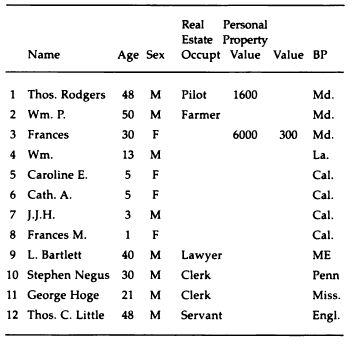
However, questions arise: (1) Fannie Roger’s only living child (in 1987), Don Lawton, is sure that he never heard his mother tell of having any older brothers or sisters, nor of there being twins in her family. (2) At the time Fannie’s parents died or disappeared when she was age 13, there is no indication that anyone in the family (only J. J. H. / Henry? was living) came to her rescue or support. (3) Thomas Rogers, who is younger than William, and apparently less affluent, is listed as the head of the household. This would make more sense if he were the father of some of the children.
Aside from family structures, at least three other things are curious or puzzling: (1) Frances Rogers owns a large amount of real estate while her husband, William, has none. Since she was married at such a young age, it seems highly unlikely that she had been previously widowed and is now holding the property in trust for one of her children by the previous marriage. (2) William P. Rogers, who we know was a sea captain or pilot, lists his occupation a “Farmer.” Yet in the 1860 City Directory he was listed as a “pilot.” (3) There is an 8-year gap between William (age 13) and the next younger children (twins, age 5). Yet children born during this time could have died in infancy.
Finally, the families appear to be fairly affluent, since one or both of them own a large house and have a servant.
On 5 October 1861 William P. Rogers and his wife, Frances, “of the city of Oakland” sold their portion of Block 25 on Kellerberger’s survey to Thomas for $1,000 (Deed Book L. p. 257). Moreover, William does not appear in the San Francisco Directory and Business Guide for 1862, or any year thereafter.
In early 1862 William Rogers, Frances’s husband, died in San Francisco. His obituary in the Alta California (Thursday, February 20) read: “Died. In this city, February 19th. Capt. Phoenix Rodgers [sic], a native of Baltimore, Md., aged 52 years. Friends and acquaintances are respectfully invited to attend the funeral at 2 p.m. to-morrow, (Friday) from No. 1112 Kearney Street” [the home of his brother, Thomas Rogers]. He was buried in Calvary Cemetery, a Catholic cemetery in San Francisco. Fannie Rogers was age three at the time of her father’s death; she barely knew him.
Note that William died less than two years after the 1860 census. If at the time of the census he were seriously ill and uncertain of how long he might live, this might help to answer several questions concerning that census record: William might have (1) asked his brother, Thomas, to take over as head of the household, (2) transferred all his assets to his wife, Frances, and (3) retired from active duty as a sea captain, listing his occupation instead as “Farmer”—perhaps on his land in Alameda County where the climate seemed better and the pace of life more relaxed.
Frances and Thomas are Married. After the death of her husband, William, Frances was apparently in a difficult position, with a number of young children to raise and no apparent means of support—although she may have been joint owner of land in Oakland and Alameda County, and she had $6,000 in her own name according to the 1860 census. Thomas, her former husband’s brother, whom she had known for many years, was single. So they apparently did the obvious, sensible thing: they married, sometime between 1862 and 1868, probably in either San Francisco or Oakland. We have been unable to find a record of this marriage. Almost all San Francisco marriage records, and other vital statistics were destroyed by the great San Francisco earthquake and fire of April 1906. Although there are apparently complete, indexed marriage records in Alameda County for the years from 1854 on, this marriage is not recorded.
Sometime between 1862 and 1867, Charles T. Rogers was born—probably in San Francisco. The 1866 date comes from the 1870 U.S. census. The 1861 date is from Mountain View Cemetery records at the time of his death. His mother was Frances Rogers. Thomas was probably his father.
The 1862-63 San Francisco City Directory shows that Thomas Rogers, a pilot, has moved to 1112 Kearny and has his office at 13 Vallejo. The next year his office is listed as the Old Line Pilot Office, at 811 Front Street. Then in 1864 he apparently retired, for his occupation is shown as “ex-pilot” still residing at 1112 Kearny. This listing continued until 1867.
In early 1864 tragedy struck Frances Rogers again; her eldest son died. A short obituary in the San Francisco Evening Bulletin of February 1 states: “Died. In this city February 1st, William Henry Rogers, son of the late Captain William and Frances Rogers, aged 17 years and 8 months.”
Move from San Francisco to Oakland. In mid-October 1867 Thomas, Frances, and their children moved from San Francisco to the city of Oakland, which in those days included what is now called “Berkeley.” Land deeds show that by April 1868 Thomas and Frances were married.
On 8 May 1870, Catherine A. Rogers, one of Frances’ twin daughters, died in Oakland—in her youth and unmarried. In her brief obituary The Bulletin (San Francisco) gave her name as “Katherine Rogers, twin daughter of the late Capt. William P. Rogers, aged 18 years.” We believe that Catherine died at the age of about 15 years and 6-7 months (based on the information given in 1875 at the death of her twin sister). We have been unable to find a record of her burial. Thus, Frances had to endure the death of her husband and two of her children.
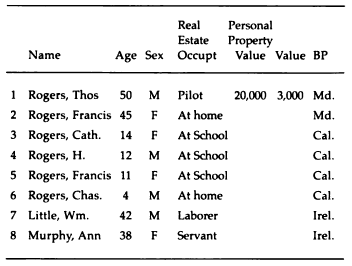
The 1870 U.S. census for Oakland, California, gives us a clear picture of the Rogers family. On 20 July 1870 it looked like this (BP = Birth place; lrel = Ireland):
Note the following:
- According to this 1870 census, Thomas was only 5 years older than Frances (50 vs. 45) whereas in the 1860 census he was 18 years older (48 vs. 30). These are major age discrepancies.
- Catherine Rogers is shown as age 14, attending school. Yet Catherine died 2 months before the census was taken. Could it have been Caroline E. Rogers who was age 14 and in school? She was probably age 15.
- All of Frances’s property has been shifted to her husband, Thomas. Could she have done this because she was ill or had a life-threatening disease?
- H. Rogers is age 12 and in school. This must be our J.J.H. Rogers, whose full name we do not know. He may have been called “Henry.”
Sometime before mid-1872 the Rogers family apparently left Oakland and returned to live in San Francisco.
Then suddenly on 13 June 1872 Frances died in San Francisco, probably of a disease, since she was still quite young. Her obituary, published on June 14 and 15 in the Alta California, the San Francisco Evening Bulletin, and the San Francisco Morning Call read:
In this city, June 13, at 6 o’clock P. M. Frances, wife of Capt. Thomas Rogers, a native of Baltimore, Md., aged 48 years. [Oakland, New Orleans and Baltimore papers, please copy]. Friends and acquaintances of the family are respectfully invited to attend the funeral on Saturday, June 15th, at 101/2 o’clock A. M. from St. Mary’s Cathedral, corner of California and Dupont Streets (San Francisco], without further notice.
The references to Oakland, New Orleans, and Baltimore imply that she was thought to have relatives or friends living in those cities. The Calvary Cemetery record gives her age at death as 48 years and 4 months. She was buried in the Rogers plot (6 – 7 – 2 – 476).
On 3 February 1873 Thomas Rogers made his last land transaction in Alameda County, selling land he owned at 15th and West streets in Oakland. This was apparently the last land he owned in the East Bay. In this transaction, it was noted that he now lived in San Francisco.
In 1875, only three years after Frances’ death, her second twin daughter, Caroline E. Rogers, died in San Francisco—in her youth and unmarried. The Alta California and San Francisco Morning Call published the same obituary ‘Died. In this city June 11th, Miss Caroline Rogers, daughter of the late Capt. Wm. P. Rogers, aged 20 years and 8 months.
She heard the song triumphant
That fills all space Elysian
And all her pure heart prayed for
Has met her raptured vision.
“Friends and family are invited to attend the funeral this day (Sunday) at nine o’clock a.m. from St. Mary’s Cathedral.” She was buried in the Rogers family plot at Calvary Cemetery.
Thomas was now alone with a family to raise. What happened next is not clear. According to one oral family tradition, he died shortly after his wife, Frances, probably in San Francisco. The last listing for a Thomas Rogers (probably ours) in the San Francisco City Directory of this period appeared in the 1876/1877 edition. It read: “Rogers, Thomas, master mariner, dwelling: corner Sierra and Louisiana.” In 1876 Fannie would have been about 17 and Charles about 10 years old.
Nome Peet recalls hearing that after his wife died, Thomas left his daughter, Fannie, with Judge Burnett in Santa Rosa, then went back to sea, and was not heard of again.
Fannie Rogers’s Relationship to Robert E. Lee. There is a long and impressive tradition within Fannie Rogers’s descendants indicating that she was related (at least indirectly) to the famous Civil War General Robert E. Lee (1804-70) of Virginia. Yet we are not yet sure which of Fannie’s parents or other close relatives was related to the Lees. We have done our best for 20 years to find this connection and have hired several professional genealogists to help us. We have made considerable progress—but have not yet been able to prove that a relationship exists. Genealogists interested in a detailed discussion of what we know and don’t know about four possible links to Robert E. Lee, please see Appendix E.
One of our best sources of information about this relationship is Winifred Lawton Seymour, who was Frances O’Donnell’s granddaughter, and Fannie Rogers’s eldest daughter. Though Winifred never met her grandmother, Frances, she must have heard many stories about her from Fannie. In 1967, when Winifred was 82 years old and had an excellent memory, she wrote several letters about her parents to her niece, Marilyn Zurcher. In one of these, dated 9 January 1967 she had this to say about the early lives of her maternal grandparents:
Grandmother’s maiden name was Fannie Rogers. Her people came from the South. Her father was a sea captain and owned his own ship, which he sailed from the South into San Francisco. He built one of the first wooden houses on Nob Hill and built it something like the shape of a ship. Fannie was related to Robert E. Lee. She told me she had seen letters from him to members of her family.
In a letter to Marilyn from about 1975 titled “Lawton History,” Winnie added a few details:
My mother, Fannie Rogers, was horn in San Francisco. Her family came from Virginia. General Robert E. Lee was a relative of theirs. My mother told me of hearing a letter he wrote to her family.
Marilyn Zurcher recalls (1987) hearing Winifred and Helen Lawton say “that Fannie’s father came from Georgia and her mother came from Virginia, and she was either from the Shirley Plantation [in Virginia] or closely linked with it. She gave me a brochure of the Shirley Plantation. Fannie’s father was a clipper ship captain.” This plantation was long the home of the Carter family that intermarried extensively with the Lees. Exhaustive searches of three Lee and two Carter genealogies have failed to uncover any woman with the given name “Frances” born in Maryland in about 1825.
Fannie’s youngest son, Don Lawton, had always thought that “Fannie was a Scotch lass, of Scotch descent, but her father was English.”
In January 1987 Ed Martin (Fannie’s grandson) recalled:
Fannie was a descendant of Robert E. Lee in the direct line. That’s where I got my first name, Edward, which was his middle name. Fannie had three letters from Robert E. Lee and was very proud of them. She used to talk about them a lot. She did it so much that Frank Lawton [her husband] finally got fed up with it and tore up all her letters. Fannie was very sad for she prized them highly.
Ed recalls hearing this from his mother, Helen Lawton Martin, who died when Ed was age 15.
The name “Lee” appears several times in the names of Fannie Rogers’s descendants. Her granddaughter (Hazel Lawton’s daughter) was named Nancy Lee Shurtleff, and Nancy’s daughter was named Sandra Lee Miller.
Remember, these are only recollections and have not yet been proven (See Appendix E).
Fannie’s Early Years (1859-83). As noted above, Francis Marion (“Fannie”) Rogers was born on 7 March 1859 in San Francisco, California, the daughter of captain William P. Rogers and Frances O’Donnell. She grew up in San Francisco, living in a fairly affluent family. Apparently, she had only one sibling who survived and with whom she kept in touch, a brother named Charles T. Rogers, who was a year or two younger than she was—although the 1870 census shows him as seven years younger. As for J. J. H. (Henry?) Rogers, apparently her elder brother (about two years older), we have been unable to find where he lived, what he did, and when or where he died.
In 1967, Fannie’s eldest daughter, Winifred Lawton Seymour, wrote:
When my mother [Fannie Rogers] was very young, she lost both her father and her mother. They had plenty of money, but the man who was appointed her guardian used up their money. He got in touch with a very nice family in Santa Rosa who were willing to let my mother board in their home. It was the Hood Family, well known in Santa Rosa. My mother attended a school there known as Christian College. She loved Santa Rosa and all the lovely friends she had there.
Don Lawton recalls slightly differently that the guardian absconded with the funds. Nothing was ever seen or heard of him again.
Note that Dora Hood, who graduated from Christian College (in May 1877), became one of Fannie’s dearest friends. She married a Burnett. This explains why Fannie’s youngest daughter, Dorothy Burnett Lawton (Peet), recollected that Judge Burnett’s family in Santa Rosa raised Fannie after her parents died, and she boarded at their home during college.
We know little about what happened to Charles T. Rogers after he was orphaned at about age 19. He may well have found a job in the Bay Area and been able to support himself.
While it is clear that Fannie lived in Santa Rosa after her mother, Frances Rogers, died in June 1872, several important questions remain: (1) When did she move to Santa Rosa? Probably between 1872 and 1876. (2) Did she move there while her stepfather, Thomas, was still alive, or after he died or disappeared, and she was orphaned at about age 17? (3) Who chose the family in Santa Rosa to be her guardians and why? (4) Which family in Santa Rosa did she board with—the Burnett family or the Hood family or both?
One theory seems plausible—the Burnetts may have been relatives of the Rogers! Two Burnett brothers are a part of our story, largely because they married two sisters—both with the surname Rogers. All four were born in Tennessee—in adjoining counties.
The two sisters were the only daughters of Peter Rogers (born in about 1788 in Tennessee; died in 1858 in Clay County, Missouri; parents unknown) and Sarah “Sally” Purtle (daughter of George Purtle, Sr.). Peter and Sarah were married on 9 August 1806 in Davidson County, Tennessee.
The first brother (and the younger of the two) was Glenn (also spelled “Glen”) Owen Burnett. Born on 16 November 1809 in Davidson County, Tennessee, he married Sarah M. Rogers on 6 January 1830 in Hardeman County, Tennessee. She was born in about 1815 in Wilson County, Tennessee, and died in 1889 in Santa Rosa, California. As part of the Restoration Movement (to restore Christianity to its original foundations), they arrived by wagon train in the Oregon Territory in October 1846. There he became very well known as a preacher within the Church of Christ, as described in the book Christians on the Oregon Trail 1842-1882, by Jerry Rushford (1997). In 1857 Glenn and his family moved to California, where they settled in Santa Rosa and he continued his church work (see History of the Disciples of Christ in California, by E. B. Ware, 1916). He was one of the founders of Christian College, which opened there on 23 September 1872 and graduated its first class in 1873; he was also a member of the board of trustees. Glenn Owen Burnett and his wife, Sarah Rogers had eight children, born between about 1832 and 1850. If Fannie Rogers had lived with this family in Santa Rosa, their youngest child (James) would have been at least nine years older than Fannie. Interestingly, one of their sons was named Francis I. Burnett. Glenn Owen Burnett and Sarah Rogers are buried in Santa Rosa.
The second (and most famous and elder) brother was Peter Hardeman Burnett. Born on 15 Nov. 1807 in Nashville, Davidson County, Tennessee, he married Harriet Walton Rogers on 28 August 1828 in Hardeman County, Tennessee.
She was born in about 1811 in Wilson County, Tennessee, and died on 19 September 1879 in San Francisco. Peter and Harriet had six children, born between 1829 and 1841 in Tennessee and Missouri. In 1839 he was admitted to the bar in Missouri and began practicing law. In 1839-40 he was appointed district attorney. The family moved to the Oregon Territory in 1843, then on to California in late 1848 after learning of the discovery of gold. Settling in San Jose (California’s first state capital, 1849-51), Peter Hardeman Burnett was the first civilian (not military) governor of California, serving from 1849-51. While he was governor, the gold rush began (1849) and California was admitted to the Union (9 September 1850 as the 31st state). In 1857 Burnett was appointed justice of the Supreme Court of California. In 1863 he founded the Pacific Bank of California and was president of it until 1880. Also, in 1880 his fascinating autobiography, Recollections and Opinions of an Old Pioneer, was published. He died on 17 May 1895 in San Francisco of old age and was buried near his wife and some children in Santa Clara Mission Cemetery—after a long and very distinguished career.
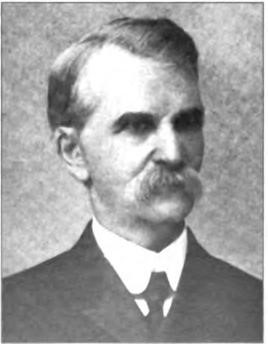
However this “Judge Burnett” never lived in Santa Rosa, so Fannie could not have lived with him or his family there.
Why do we give genealogical and historical details about these two Burnett families? First, because these two Rogers wives may explain why Fannie Rogers was sent to live with a Burnett family in Santa Rosa. Second, because these Rogers wives may be part of our family’s connection to Robert E. Lee. And one other reason—read on!
The other family that Fannie is said to have stayed with in Santa Rosa was the family of Dora Hood. Dora was about Fannie’s age and probably her best friend. Dora’s parents were Mr. and Mrs. Thomas B. Hood of Santa Rosa—both founders and supporters of the Santa Rosa Christian Church (Disciples of Christ) in Santa Rosa. Interestingly, in 1875 (roughly a year before Fannie moved to Santa Rosa) Dora married Albert Glenn Burnett, the youngest child of Glenn Owen Burnett and Sarah M. Rogers.
Born 9 April 1856 in Bethel, Polk County, Oregon, Albert grew up in California. In 1873 he settled in Santa Rosa with his parents. Albert attended Christian College and graduated in 1875—the same year he married Dora Hood. He was then ordained to the ministry of the Disciples of Christ and preached at Healdsburg, Santa Rosa, Modesto, and San Francisco. After that Albert became a teacher and taught school for 10 years. In 1887 he was admitted to the California state bar and began to practice law. A year later he was elected district attorney of Sonoma County, and re-elected in 1890. In 1896 he was elected superior Court judge of Sonoma County. In 1906 he was elected justice of the District Court of Appeals for the northern judicial district of California. According to Ware (1916, p. 318-19), “Judge Burnett is one of the most polished political orators of the State and for years the most popular man in public life in Sonoma county.”
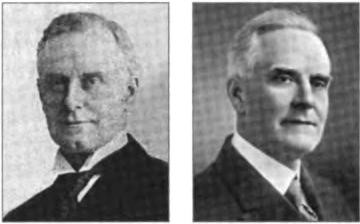
How interesting! There was another “Judge Burnett” and he did live in Santa Rosa. Therefore, the recollections that Fannie boarded with “the Hood family, well known in Santa Rosa” (Winnie Lawton, 1967) and with “Judge Burnett” (Dorothy and Nonie Peet), may both mean the same thing! And Nonie’s mother, Dorothy Burnett Lawton (Peet) could have gotten her middle name from any of three Bumetts: Albert (most likely), Peter, or Glen—or perhaps from all three!
If Fannie’s parents chose this family for her to live with, why might they have done so? (1) Albert’s mother, Sarah M. Rogers, may have been a relative, although we have been unable to prove this. (2) Since Fannie’s parents were both Catholics, they may have wanted a family with strong Christian values and even perhaps a place where she could attend a Christian college.
When Fannie was a girl, she started to keep a scrapbook, which still survives. She kept it in a large (81/2 by 13-inch) leather bound ledger book containing 400 pages. On the spine is printed “CASH-BOOK” and across the top of many of the lined pages toward the front of the book is written, in an adult hand, “Order Book for 1875.”
Many of these pages are filled with handwritten orders, and some of these curiously contain handwritten Chinese characters. This suggests that she started to keep it no earlier than 1876, which is supported by the fact that the earliest dated documents in the book and Fannie’s earliest handwritten dates both are from 1876, when she would have been 17 years old. Nevertheless, toward the back of the book (p. 352) Helen Lawton, Fannie’s daughter, wrote in 1902, “Mama started this book when she was 8 years old [i.e. in about 1867] and has some of the old writings and sayings in it.” Fannie apparently kept adding poems and letters to the volume until about 1882. Helen Lawton later used the last half of the book for a detailed diary during her college years.
In the first half of this scrapbook Fannie pasted hundreds of small poems, clipped from magazines and newspapers. These poems are all sentimental, romantic, spiritual, sweet, and pastoral. A sampling of titles includes “Save the Sweetest Kisses for Me,” “Trust in God and Do the Right,” “I Would I Were a Child Again,” “Cupid’s Foibles, Follies, and Fancies,” “Life is Death Where Love’s Denied,” “Repentance,” and “Life.” On the side of one verse of many of these poems is penciled in “my self,” indicating that they struck a special responsive chord in young Fannie. Virtually none of the clipped poems were by famous authors. Toward the middle and back of the book we begin to find more of Fannie’s own writing. She transcribed quite a few poems by famous poets (especially Lord Byron) and composed little romantic letters or poems to her friends.
There is good reason to believe that Fannie started to keep this scrapbook during her college years. She went to college at Christian College in Santa Rosa, about 45 miles north of San Francisco. A picture of the college’s large main building is found in the scrapbook, as well as lengthy published speeches, strongly religious and inspirational, given from the college’s fourth and fifth commencements in May 1876 and 1877.
A long article (from an unknown newspaper) in Fannie’s scrapbook titled “Christian College Commencement” begins: “The Fifth Annual Commencement of Christian College was held on Thursday, May 10th [1877]. “Miss Dora Hood” was one of the six students—four unmarried women and two men—in the graduating class. From the platform she read her thesis titled “Leave the Past,” which was praised in the article as “a real gem.” Note that if the Fifth Annual Commencement was in 1877, then the first was probably in 1873. Yet this article raises a question: If Albert G. Burnett married Dora Hood in 1875, why is she listed as “Miss Dora Hood” in this article of May 1877?
The most romantic handwritten letters, notes and poems are reserved for Melville Owen, who was apparently Fannie’s sweetheart. Clearly, she wrote these while daydreaming, trying out then crossing out numerous floridly inscribed salutations and closings for each one: “Yours in loving affection”, “Ever yours”, “Forever”, “Your friend”, “Yours as ever.” Two handwritten headings begin: (1) “Darling. San Francisco, June 7th, 1876. My Dearest Melville”; (2) “Oakland Dec. 28th 1878. ‘Tis night. Melville Rolland Owen, Bakersfield P. Kern Co., California.” She always signs her own name “Fannie Rogers.” It is not clear whether Fannie composed the poems or borrowed them: Here are four short examples, written to Melville:
Though hill and dale divide us
And my face you cannot see
Remember there is one dear
That ofttimes thinks of thee
Words alone cannot unfold
The love I feel for thee
For thou art more precious far
Than costly gems to me
When dearest friends around thee twine
And all is mirth and glee
I ask thee but to pause a while
And give one thought on me
I will think of thee often when thou art far
I will liken thy smile with the night’s fairest star
As the ocean still breathes of its home in the sea
So in absence my spirit shall murmur of thee
Fannie also, apparently, asked friends to write in her book, as the following:
Dear Fannie –
As deep as the dark blue ocean,
As clear as the pearly sea,
Such is my soul’s devotion.
Such is my love for thee.
Your dear friend, Vina
Oakland, Cal. Aug. 24,1881.
There is a word in every tongue
That speaks of friendship dear.
In English ’tis “Forget-me-not”
In French, ’tis “Souvenir.”
“Forget-me-not” this simple boon
I only ask of thee
Oh, let it be an easy task
Sometimes to think of me.
May [Diggs]
We are quite sure that Fannie attended Christian College, but we do not know whether or not she graduated. The fifth and last class apparently graduated in May 1877.
In about 1877, at age 18, Fannie returned to San Francisco and worked there until about 1882. The 1877 San Francisco City Directory shows her residing at 934 Howard Street and working for Palmer Brothers, a clothing, furnishing goods, and auction store at 726-34 Market Street. In 187980 she was a saleslady there, and in 1880-81 she was working as a milliner (one who designs, makes, or sells women’s hats) for Mrs. M. A. Soper.
A full-page handwritten entry in her journal raises questions about where Fannie lived in 1878. On the top line is written: “Oakland, Dec. 28th ’78” [1878]. Below that: “Tis night. Melville Rolland (??), Bakersfield, Kern Co., California. / Miss Maytie Phillips, with Palmer Bros., San Francisco. / 1878), F.? R. Proctor – Darling [Santa Rosa], Mrs. A.G. [Albert Glen] Burnett (Santa Rosa.”
The Proctors and the Bumetts were close friends, who played an important part in Fannie’s later life. Names of other woman friends found fondly written by Fannie in this book include Sallie De Angelis (1876), Miss Dora Hood (Santa Rosa), Miss May Diggs, and Miss Eva Diggs (Half Moon Bay).
Photographs were taken of her in San Francisco in 1881 and 1882, and a newspaper article notes that she was residing in San Francisco when she attended a New Year’s Eve dance on the last day of 1881. Fannie seems to have left San Francisco in 1882, but it is not clear where she went.
Charles T. Rogers never married but lived in the Oakland-Berkeley area for most of the rest of his life.
Frank and Fannie Start a Family (1884-1900). Recall that Frank Lawton and Fannie Rogers were married on 17 May 1884 in San Francisco. They wasted no time in starting a family. Their first child, Winifred Marion Lawton, was born on 19 March 1885, in San Francisco, just 10 months after her parents’ marriage. Winnie’s middle name was the same as that of her mother. In the coming years, Frank and Fannie had seven children, six of whom married and themselves had children. All (except Dorothy, who willed her body to science) were buried in the Lawton plot at Mountain View Cemetery, Oakland, California:
- Winifred Martin Lawton, born 19 March 1885 in San Francisco, California. Married Charles Birney Seymour on 19 June 1915 in Berkeley, California (later divorced). Died 30 Nov. 1981 in Sebastapol, California.
- Frank R. Lawton, born 39 Sept. 1887 in Berkeley, California. Died 16 March 1888, Berkeley.
- Harry Rogers Lawton, born 19 May 1889, Berkeley, California. Married (1) Beatrice Joyce Birbeck on 14 June 18923 in Piedmont, California. She died on 16 Oct. 1948 in Seattle, Washington. Married (2) Mildred (Griffiths) Smith on 5 Nov. 1948. Divorced. Married (3) Ilda Lane on 15 June 1956 in Los Angeles, California. She died on 17 Feb. 1970. Harry died 3 Oct. 1972 in Walnut Creek, California.
- Hazle Clifton Lawton, born 25 Sept. 1890 in Berkeley. Married 13 Oct. 1913 to Roy Lothrop Shurtleff in Berkeley. Died 19 May 1948 in Orinda, California.
- Helen Gladys Lawton, born 25 Sept. 1892 in Berkeley. Married 27 Aug. 1919 to Lemuel Edward “Ed” Martin. Died 17 May 1938 in Berkeley.
- Donald Carroll Lawton, born 2 Aug. 1894 in Berkeley. Married 6 July 1922 to Willie May Spaulding in Oakland, California. Died 2 June 1997 in Berkeley.
- Dorothy Burnett Lawton, born 3 Aug. 1896 in Berkeley. Married 14 Aug. 1920 to Harry Eldridge Peet in Berkeley. Died 8 March 1981 in Walnut Creek, California.
Sometime between 1877 and 1884 (see 1880 census), following her husband’s death in Clyde, New York, Susan A. Lawton, Frank’s mother, moved to San Francisco to be near or live with Frank. On 4 August 1884, just 3 months after he was married, she presented the new couple with a large and beautiful Bible, which she inscribed and dated. Measuring 11 by 13 inches, and almost 4 inches thick, it weighed 12 pounds, and contained pages for recording births, marriages, and deaths in the family. These are a treasure trove of genealogical information.
In about 1885 W. D. Lawton, Frank’s brother and co-worker or boss at the shirt business, left San Francisco, probably to return to the East Coast for unknown reasons. Frank took over the shirt business. His high-quality and fancy custom-made men’s shirts (with special turn-back cuffs and buttons) for the upper classes brought him a good income.
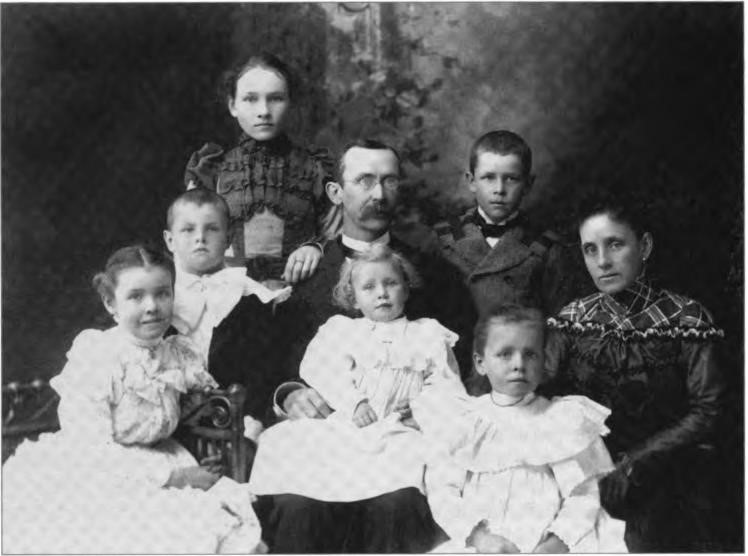
In 1885 Frank and Fannie moved from San Francisco across the Bay to Berkeley. This small rural town had first attracted attention when the University of California was established there in 1868; Berkeley was established as a town (separated from Oakland) and incorporated in April 1878. On Channing Way near Shattuck in Berkeley, Frank had built a fairly small but nice new house (Winnie called it a “cottage”). The Lawton family lived prestigiously near the “steam train,” which Frank would board each morning, and disembark at the Oakland Mole—a very long pier or wharf stretching from southwest Oakland far out into the Bay, with train tracks running out to the end, where the ferry boats docked. From there, Frank caught the ferry to San Francisco.
On 24 July 1886 Frank’s mother, Susan A. Lawton, died of heart disease at her son’s home. A newspaper in Clyde, New York, listed her as dying “at her son’s home in San Francisco,” but she probably died at his home in Berkeley. Frank buried her the next day at Mountain View Cemetery in Oakland in a small plot (plot 19, lot 159), which he probably purchased at that time for Susan’s burial. Established in 1863, this cemetery was (and still is) the largest and oldest cemetery in Alameda County.
On 29 September 1887 Frank and Fannie’s second child and first boy, Frank R. Lawton was born. Then tragedy struck. On 16 March 1888, when the infant was only 5 months and 28 days old, he died of meningitis. The next day Frank, his father, went again to Mountain View Cemetery and purchased plot 26, lot 44. There he buried his tiny son. It is not clear why he purchased this plot when he apparently already owned the one in which he buried his mother, unless the former one was too small and / or was in a less favorable location. On 26 October 1896 he decided to consolidate his two plots. So, he returned plot 19, lot 159 to the Mountain View Cemetery, for credit, and at the same time had Susan A. Lawton disinterred and reburied in plot 26, lot 44, near his small son. Today plot 26 remains the final earthly/physical gathering place for many members of the Shurtleff and Lawton families and holds a precious store of both memories and genealogical information—as Frank Lawton may well have envisioned over a century ago.
The family’s third child, Harry Rogers Lawton, was born 19 May 1889, at home on Charming Way in Berkeley. It was time for a move to larger quarters.
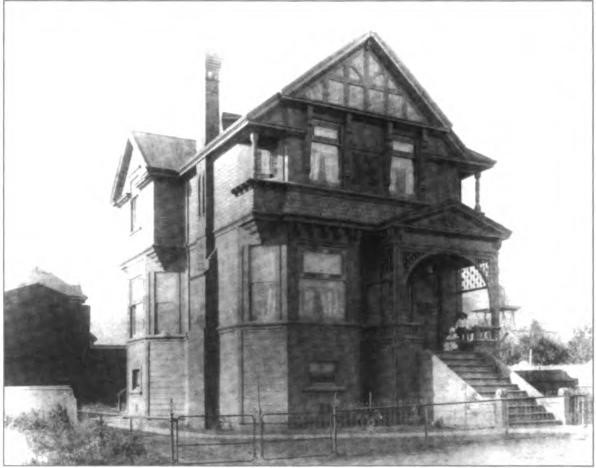
So, in about 1890 Frank and Fannie had a new and much larger home built in Berkeley, at 2211 Durant Avenue, just above Fulton, in Berkeley. The house was on the left-hand side of Durant as you stood looking uphill (east), not far from what is today the southwest corner of Cal’s Edwards Track Stadium. The Lawtons lived in this home for the next 44 years. Containing 10 rooms, it was basically a four-story house, with an elevated first floor (about seven feet above ground level), a large, raised basement, a second floor containing the bedrooms, and a spacious attic with a clear view of San Francisco. When the big brick chimney was built, two colorful glazed tiles, each about one foot square, were mortared into the outside back. They bore the silhouettes of a boy and a girl and were in full view as one came up the driveway. A great house in which to raise a large family, it became in the coming years a favorite gathering place for the many neighborhood kids. For Lawton Shurtleff, who played there in the mid-1920s, “It was simply a fantastic home for us young kids. Laundry chutes, dumbwaiters, an attic full of all types of mementos and souvenirs to play hide and seek in made it the most fascinating place in the world. It really should have been preserved as an historic monument.” New attractions were added as time went on. A photo of the house taken in the early 1890s shows Harry and Hazle seated on the front steps. At the back of the large backyard, a huge barn was built. In it were kept one or more horses, a surrey, and a phaeton. It is clear that by this time Frank’s shirt business must have been prospering.
Four more children were born at exactly two-year intervals in the new home in Berkeley: Hazle Clifton Lawton (25 September 1890), Helen Gladys Lawton (25 September 1892), Donald Carroll Lawton (2 August 1894), and the last child, Dorothy Burnett Lawton (3 August 1896). Each of the children was weaned in a handsome, solid walnut wooden highchair (now in the possession of her great-grandson, Bill Shurtleff), patented in 1876. The front tray flipped up and over the back, out of the way, when the child was to be removed. And all were rocked in Fannie’s little rocking chair (now with her great-granddaughter, Barby Love Gutterman) in the sewing room.
In about 1891 Frank decided to rename his thriving shirt business from W. D. Lawton & Co. to F. H. Lawton & Co., and to move it to 305 Kearny Street In 1894 he moved it again, to 229 Kearny.
Raising a Family (1900-20). The six surviving Lawton children turned into a wonderful, tightknit family. And their early lives were full of fun and adventures. Most of them attended Dwight Way School (later renamed McKinley Grammar School) and Berkeley High School.
Starting in about 1900 Frank and Fannie started a lasting tradition of taking the family on a two-month vacation each summer, in part to get away from the fog and cold of Berkeley to a warmer place. The kids loved it. As Don Lawton recalls the first trip:
When we went to Los Gatos for the summer, we called Berkeley’s only baggage smasher, whose name was John Shekumpshun Sherman Boyd, to help with our belongings. He was so big and reckless, he’d smash everything he put on his horse-drawn wagon. Now father had this large trunk, and he wrapped it in a long rope that he took along to make us a swing. Well, you could hardly see the trunk it was wrapped in so much rope. Boyd’s wagon took us down to the train depot. The manager there was a neighbor friend of ours, but he said. “Mr. Lawton, this trunk cannot go. It’s way overweight.” Father said, “Well, it has to go. We have our train reservations and we’re all here ready to go. I want you to put it on the train.” The manager explained that it would just be taken off again later down the line, but he put it on anyway. Apparently he telegraphed ahead, because when we arrived at The Mole the conductor walked up immediately and said to mother, “I’m sorry lady, but you have a trunk on the train here which we’ll have to remove because its overweight.” She said, “How do you know? You haven’t weighed it.” But he replied, “Well, we happen to know.” So she said, “All right.” We unroped and unroped and unroped that trunk, as the train waited. Then Fannie asked each one of us to take an armful. 1 took the underwear. Harry took the shoes. Helen took the hats, and so forth. We all got on board the train and sat there loaded down all the way to Los Gatos. The trunk went along half empty. Fannie said as we left, “Well, I guess that’ll satisfy him.”
On the way I remember I stuck my head out the window as we went thru a tunnel and my nice new white sailor hat blew off. My whole life I’ve wanted to go back and see if I could find that hat.
In Los Gatos we stayed in a house, way up on a hill, with a creek nearby. Father took that long rope off the trunk and tied it to the branch of a big tree near the creek. As we rode that swing way out over the creek, it seemed like swinging out over Niagara Falls. It was just the greatest thrill in the world.
The next year Fannie had a creative idea. She had made many close friends with families in Santa Rosa during her years at Christian College. Perhaps they might like to exchange houses with her family for the summer, especially since the Lawtons had such a spacious and attractive home. The idea worked, and for the summer of 1901 and 1902 the Lawton family stayed in beautiful big houses in Santa Rosa. One summer they stayed at the McKinley’s home and the other at Judge Bumett’s home. Dora, Judge Albert G. Burnett’s wife, was a close friend of Fannie’s from her college years.
In 1902 Frank Lawton began to diversify his business interests. He started a company named Lawton & Albee, located at 2139 Center Street in Berkeley. His partner was Marshall P. W. Albee, and they sold real estate and fire insurance, collected rents, paid taxes, negotiated loans, and served as a notary public. By 1903 Frank had telephones at his business and at home. In 1904 or 1905 Lawton and Albee separated, but continued to do exactly the same type of work. Frank’s new company, called F. H. Lawton & Co., was located a few doors down and across the street at 2147 Center Street Albee & Coryell occupied the former site. Frank’s 1906 advertisement read, “Reliable Expert Information… Carriages always in waiting.” In 1907 Frank moved next door to his former partner, to 2141 Center, and consolidated his services to real estate and insurance. By 1908 he was focusing solely on real estate.
For the summer of 1903 the Lawtons swapped houses with a family in Ukiah, located at the headwaters of the Russian River about 60 miles north of Santa Rosa. And the next summer they stayed with the Guerne family on the Guerre Ranch in Guerneville, just upstream from Monte Rio on the Russian River. The kids stayed in a big boarding house on the large Guerne Ranch and enjoyed the horses, cows, and fruit trees. Before that summer was over, Fannie took the family to see a little town she had heard about down the river called Monte Rio. They made the trip in a special railway car, sort of an open-top gondola with rows of seats in it. They found that the river was unusually wide in Monte Rio and the town was quaint and rustic. The exterior finish of all the homes was redwood tanbark rather than paint. A sign proclaimed the town the “Little Switzerland of America.” Father asked, “Do you all like this place well enough to have a summer home here?” Everyone replied, “Yes, we love it.” So Frank bought a lot and found a contractor named Mr. Proctor, who had a wooden leg. He began to build a large summer home for the Lawton family in Monte Rio on a hill overlooking the river. At the end of that summer (1904) Harry Lawton and a friend walked all the way back to Berkeley on the railway tracks.
For the summer of 1905, while the house was still being built, the Lawton family rented the highest house on the hill in Monte Rio, up behind the railway station and the Air Castle (which had two steeples and was painted red and white). To get to Monte Rio from Berkeley in those days before cars were widely used was no easy task. First the big family and baggage was loaded on a nearby train that took them to the Oakland Mole. There they loaded everything onto a ferry bound for the Ferry Building in San Francisco, where they caught another ferry going north to Sausalito or, if Sausalito was fogged in, to Tiburon. And finally, they caught a wood-burning steam train to Monte Rio. It was an all-day operation.
On the morning of Wednesday, 18 April 1906, the great San Francisco earthquake struck. It destroyed the brick building in which Frank had his shirt factory and dealt a serious blow to the business as well. Frank decided to sell that business and focus on his real estate and insurance business in Berkeley. His timing (and probably his basic perception of the market) could not have been better, for the earthquake transformed Berkeley almost overnight into a boom town, as thousands fled San Francisco. Moreover, by now Frank was probably tired of having to commute from Berkeley to San Francisco every day on the ferry anyway.
The earthquake also damaged many Berkeley schools (including Berkeley High and Cal), so school was let out early for the year. Frank’s son Harry went over to San Francisco and was conscripted into the labor force there. Don and Guy Witter jumped on a streetcar each morning, went down to the Oakland Tribune offices, and got an armful of newspapers for 5 cents each, then rode all the way back to Berkeley and sold them for ten cents each. “Read all about it, all about it,” they’d call out. There were very few telephones and no radios in those days. Each night for several days the family would stand on the front porch and watch the city of San Francisco burn.
The Lawton family took off shortly for Monte Rio, traveling by trains and ferries. For the first time they started to live in their new summer home, even though it was not yet completed. They took their blankets and slept out on the porches, here and there among the lumber, the four girls on the big open upstairs porch and the two boys on the open platform below. The view out over the river was gorgeous. In the years to come this home and haven was the place to go, not only for the Lawtons and their many friends, but for the Shurtleffs as well. Frank commuted to Monte Rio each weekend.
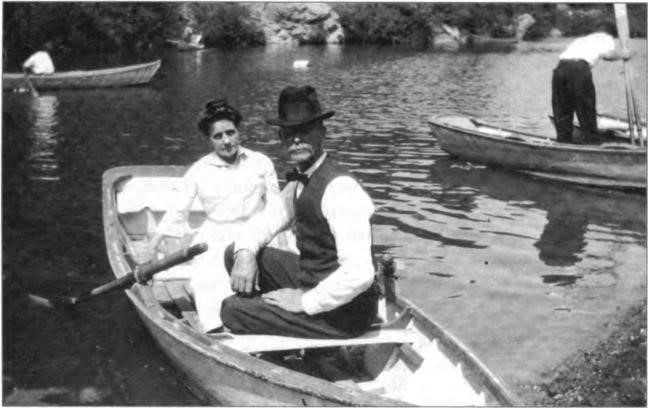
In 1906 or 1907 the family bought (for $47.50) a beautiful rowboat named the Lawton, which was built by Monte Rio’s pioneer boat builder C. W. Meadows. At least once a summer Don and friends his age (Guy Witter and Ed and Heber Steen) and Harry with his friends (separately) would row the boat down to the mouth of the Russian River at Jenner. They would leave in the morning, then sail back with the afternoon wind. One summer a young married couple on their honeymoon drowned in the river. Don had to search for them until he caught them with grappling hooks. They were still holding hands, and all that night he saw her lips, indigo blue in death. A sort of canoe, named the Smoka Pipa Hoppa, made out of barrel staves and canvas by Lowell High School boys was also kept at the Lawton house and widely used. On the river there were also motor-driven boats run by Meadows or Farnell on which the family could take a daily excursion, down to Jenner or up to the Bohemian Pool.
Swimming was a favorite sport and pastime of the Lawton children at Monte Rio, and they all became excellent swimmers, especially Harry, Helen, and Dorothy. During the first year or two they swam at nearby Monte Rio beach, but then they discovered and opened up a new area called Sandy Beach. The water was deeper there and the sand went way up on the bank. They liked to dive off a 12-foot-high platform that had been built in a wide, deep stretch of the river. Beautiful Margaret Witter, Dean Witter’s sister, was a frequent companion. The Lawton house had a big lower deck, which became the main depot or warehouse for all the kids from the Bay Area to park their sleeping bags, boats, and the like. On many occasions, as when there were Berkeley High School reunions or it started to rain, the rallying cry was “Everybody head for the Lawton cottage.” They would all stay overnight on the lower deck under the shelter of the big porch, and the next morning Fannie would cook huge breakfasts for the whole gang, featuring hot biscuits with applesauce or strawberries. The Lawton family continued to go to Monte Rio each summer until all of the kids were grown. To this day, they are still a legend around Monte Rio.
Back home in Berkeley, the kids all went to public schools. For grammar school it was Dwight Way School (on that street just below Telegraph), which was renamed McKinley Grammar School in 1907-10. Then on to Berkeley High for High School and the nearby University of California for college. All of the Lawton children except Dorothy went to Cal. In those days it was much less common for women to go to college than it is today. Frank, who had had to forego a college education himself for lack of money, must have been extremely supportive and proud of his sons and daughters.
Young people entertained themselves much differently in the early 1900s than they do today. Transportation was mostly by foot, or by horse and buggy up until about 1910. There was much more self-entertainment. Favorite past times away from home in 1909-11 (when Helen Lawton kept a detailed journal) included buggy rides, rides on “the electric” (the new Key Route trains that replaced steam trains) and “Tug rides on the Bay.” A high school would charter a big tug and leave the Jackson Street Wharf in San Francisco heading slowly for California City by Tiburon. The get-together, for couples and chaperones, featured a band and dancing on board. The Orpheum Theater on 12th Street in Oakland was the place to go for vaudeville (even clowns on unicycles) and movies. The first day of high school it was tradition for everyone to cut classes and take off to the Orpheum.
The Lawton home in Berkeley was the favorite hangout of many neighborhood kids, whose ages ranged widely. Don remembers:
We had just crowds in and out of the house. It was a center of fun and activity. The Witters had six kids just like we did: Dean, Margaret, Elizabeth, Guy, Charles, and Jack (“Babe”). Mr. Witter was a great big overweight lawyer who drove a large Thomas Flyer automobile. They lived only one block away, also on the corner of Durant Ave. Our two families were so close that our doors were always open night and day, and so were theirs. Everybody was just good friends, and we were all about the same age. We loved to play One Foot Off the Gutter on Durant Avenue. On summer evenings the Solinsky kids, who lived next door, would stand out in front of our house and call out “Winnic Winnie Wah Walr Day Day Dawton” to get us Lawtons out to play.
In those days we had a funny little thing we used to say back and forth as kids. It was in the family for years and it went like this: “Have you seen my friend Al? Al who? Alcohol. Kerosene him last night. Ain’t benzene since. Gasoline’d against the fence and took a nap-there.”
One major attraction was the big backyard playground, where Don, a budding carpenter and mechanic, had constructed, out of scrap lumber, a gigantic Ferris wheel. He also built a “Trip the Trolley” sky-diving rig that allowed a kid to leap from the hay loft of the barn and sail 100 feet in the air, supported by a pulley that raced along a taut rope (both ingenious contraptions are described in detail at the story of Don’s life).
One very popular backyard activity, in addition to baseball, was boxing. Fannie bought the kids boxing gloves. As Don recalls:
Harry and I would lace up our boxing gloves and spar. He was an excellent boxer and gave me many good tips. Later we’d start to invite some of the fellows from Berkeley High up to our house and we’d box nearly every afternoon. I remember one fellow in particular who was very small, named Waldo Colby, a tough little scrappy guy who had a peculiar way of hitting. He’d jump up in the air, pound you on top of the head, and knock you down on your knees. I’ve never forgotten it and I could never lick him.
Don went on to become the heavyweight boxing champion of the University of California.
In addition to horses, chickens and a goat were kept in the Lawtons’ backyard. On the corner by the Lawton house was Wickson’s vacant lot where Frank Lawton would graze his horses. Wickson owned a big house nearby and a barn that had a steep roof with all four sides going up to a flagpole in the middle. The Lawton kids would run up that roof trying to grab hold of the flag pole, then slide down and tear the shingles off. Wickson would raise hell with the little rascals.
In about 1908 Harry Lawton, then 19 years old, was spending a lot of time with his high school friends hanging out at Al’s Pool Hall on Shattuck Avenue, near Center Street, not far from his father Frank’s real estate business. One day Frank, growing a bit concerned, said to Harry, “Look, how would you like to have your own pool hall in our basement at home so you could invite your friends to come there?” Frank asked Don to clean out all the firewood in that part of the basement. Then he had a pool hall with a pool table built on one side of the basement and a real one-lane bowling alley built on the other. Don’s workbench was in one corner. Saturday night was bowling night for the neighborhood. Kids would come from far and wide. The family would light coal oil lamps and line them up on stands along the sides of the bowling alley and around the walls of the basement. Someone (often Don) would set the pins by hand, both full-sized 10 pins and smaller duckpins. Fannie fixed a big cut glass bowl of punch and everyone had a great time.

Dinner time, especially on weekends, found the ten-foot-long heavy oak table at the center of the Lawton dining room table packed with visitors, usually friends of the kids. Roy Shurtleff, who lived only eight blocks away, was a frequent visitor, from October 1910 on. Each weekday evening, when it was time to study, the Lawton kids would gather around the table, lighted by a large coal oil lamp that was suspended from the high ceiling and covered with an umbrella-shaped stained glass shade. In the winter, the wood-burning, pot-bellied stove gave off convivial warmth. Don Lawton recalls how
Dean Witter, who was captain of the crew at Cal, would visit the family study hall time and time again when he was in college. Harry used to go out with his sister, Margaret Witter. Dean sat right down with us and said, “Maybe I can help you with some of this mathematics.” So he pitched right in and, oh, we had a big time.
If anyone asked Hazle what she was doing on her math, she’d look up quickly and say, “Ought’s ought are oughty ought and two to carry” In other words “Nothing.”
Don remembers how on winter mornings the pot-bellied stove warmed the home.
We kids would go out in the morning before school and gather up scraps of wood from four nearby homes on Channing way that father was building. We’d load up my big coaster, bring it back and store it in the basement. Every morning, from the time we were little kids, father would get up in the morning early, get a fire started in the pot bellied stove, then come up stairs and call “Everyone up, everybody get down stairs.” We’d all jump out of warm beds just packed with comforters, run down there in our bare feet and pajamas and he’d lead us for 10 to 15 minutes of regular army calisthenics: one two one two. We’d all jump up and down, swing our arms (he’d just swing his arms because of his weak foot) and get really warm, then go up and put our clothes on and come down and have breakfast. At night I was the lamplighter. Father taught me how to turn the gas light wick on and down, without turning it off
The Lawton family had a big piano in the living room. Miss Hudson came once or twice a week to give lessons to Helen, Don, and Dorothy. Helen and Dorothy became quite good. Fannie didn’t play piano at all.
We noted earlier that Fannie had a younger brother named Charles T. Rogers, who never married. He visited the Lawtons’ home frequently and the children all called him “Uncle Charlie.” A fun-loving young fellow, Charlie was a racetrack gambler by trade, and he made fairly good money at it. He rented an upstairs apartment at about 40th and Edeline in Emeryville down near the Bay and the Temescal Race Track, and resided there with “Aunt Sophie,” his live-in, whom he never married. Charlie liked to hang out in Emeryville at Landregan & White, a saloon at Adeline and Stanford, down by the race track.
Don Lawton remembers Uncle Charlie as…
a very jovial, clean-cut and friendly, sort of free-lance, happy-go-lucky fellow. Just a good all around guy. We kids all enjoyed him and he had a lot of friends in his own world. He was always welcomed by our family because he made everyone so happy. It was a big day when he would come out on the streetcar to visit us. When we were kids we didn’t understand that some adults regarded his relationship with “Aunt Sophie” as fairly scandalous. Once I rushed up and kissed her. My elder sister Helen said, “You shouldn’t do that. She’s not your real aunt.” But everyone liked her and they were together for many years.
In about 1903 Charlie bought an old Victor Talking Machine in Oakland and took it to the Lawtons on the Horse Car. This beautiful big phonograph had a round cylinder on it, and every Saturday night for a while Frank would open the house window toward the vacant lot on Fulton Street and turn it on full blast. All the neighbors would come out and listen, as the family played “Turkey in the Straw” over and over again. No one in Berkeley in those days had anything like it, and it added music to the many other attractions of the Lawton home.
Helen Lawton’s diary (1909-11) mentions that Uncle Charlie visited the Lawton family repeatedly: He did chin-ups and played baseball with the kids in their backyard, brought them gifts of candy or money, took them to the “moving pictures shows” or to Lenhardt’s for ice cream, and sometimes stayed for dinner or all night. The family also visited him.
Charlie had a word game he liked to play with the Lawton children when they were young.
He’d say slowly and very seriously with a Polish accent: “Did you know that Izidore de Rosenberg, iz brother he is dead?” The kids would respond, “Is he?” Then Charlie, putting on a face of great distress, would answer back, “Oh no, no, no, no. Not Izzie! Izzie de Rosenberg, iz brother he is dead.” “Oh is he?” the children would reply, starting to crack up. “No, no, no, no….” Don remembers: “Well, he’d go on and on, and we’d laugh for about half an hour into tears at that damn thing!” Many of the Lawton children later entertained their children with this same story, and they in turned passed it on.
Charles T. Rogers (Uncle Charlie) passed away on 14 October 1913 at age 52 of heart disease (“chronic fatty degeneration of the heart”). He was buried in the Lawton family plot at Mountain View Cemetery in Oakland. The cemetery records show his place of death as Antioch, California, but no death record can be found in the state’s comprehensive index, nor is Charlie shown in California in the 1910 census.
Though Fannie was a “pro” at all aspects of home making, raising a family of six active children was not easy. Winnie, her eldest child, helped her a lot, and she also brought in some outside help. Starting in about 1907 Kitty Kayler, who lived in an apartment nearby, started to come in to work primarily as a laundry maid, but also to help with the house keeping. She came for many years afterwards. Then once a year a seamstress named Mrs. See from northern California would come to live with the family. She made each of the children two new sets of dressy clothes: one for summer and one for winter. The design for each child was different. The Lawton kids were always well dressed.
Each of the Lawton children was a unique person, with a great sense of humor and unusual inner strength. Winnie, the eldest by four years, looked strikingly like her mother. Strong, generous, and deeply loved and respected, she was like a mother to those younger than she was. Yet she was always ready with a limerick or a joke or a pun. Harry was full of fun and mischief, a fine athlete and a young man with a multitude of friends. Hazle was a good solid warm person and quite popular. Helen, a beautiful young lady, was a magnificent swimmer, plus an extremely popular and fun-loving leader among her classmates. She and Hazle are remembered for their wonderful laughs. Don was a whiz mechanic, a carpenter, and a track star. Dorothy was the witty, spoiled little beautiful sister to all. When everyone else had to line up in the winter to take blackstrap molasses, she was excused. Fun loving and warm, she was down to earth and ready for anything.
The last listing in the Berkeley City Directory for the real estate firm F. R. Lawton & Co. appeared in 1908. During 1910-11 Frank was working with F. R. Peake & Co. Then from 1912 to 1916 his listing was simply “F. H. Lawton, real estate, 2035 Shattuck Ave.” Don Lawton recalls that during this period he was working with Scott Martin in a real estate sales and construction company (also handling some insurance and notary business) that became very successful and lasted for many years: together with Mason-McDuffie, it played a major role in developing Berkeley. It was especially active in the Claremont territory (Although there is a Lawton Street in the Rockridge area of Oakland, it was not named after Frank, but after General Alexander R. Lawton [1818-96], a Confederate soldier and distant relative.) In the early days Frank’s company had two horses and two carriages in which to take clients around to view houses. In about 1912 the company bought its first car. A prestigious replacement for the horse-drawn vehicles, it was a large and beautiful new four-cylinder, high-wheeled Oldsmobile, which was advertised in the Chronicle: “This Oldsmobile climbed Twin Peaks in San Francisco.” A chauffeur (rather than Frank) drove the car. Frank later learned to drive in his backyard, in a 1917 Dodge touring car, a gift from his son, Don. Years later Frank bought a large Buick, which eventually ended up in the Roy Shurtleff family. Frank is remembered to have been one of the five original founders of the Berkeley Realty Board. He continued to be self-employed in the real estate business until his retirement in 1919.
Fannie Lawton as a Person. Fannie is remembered by everyone who knew her as a wonderful, remarkable lady. A tiny woman, she had great inner strength, a tremendous devotion to her family, deep religious faith, and a great sense of humor—a rare combination. Her son Don recalls:
Mother was lots and lots of fun and laughs, with her vivid Scottish expressions and little quips like “Just give ’em a lick and a promise.” Hale, hearty, and well met, she was sharp as a tack. She loved big groups and lots of kids and their friends around. She liked singing, raising Cain; she was a kick, a great sport. Fannie had lots and lots of friends, including those from her high school days in Santa Rosa. She was so friendly; just loved big teas with all her friends. She was a knockout, just a beautiful, sterling person. A sweetheart of sweethearts. Oh, God how I loved her. Everybody loved her. I only wish that everyone could have a life like we Lawton kids had, both as little kids and as grownups—with a mother and a father like we had.
Fannie is remembered by many who knew her well as a very devout Christian Scientist. Her interest began in about 1908-09. We have already seen how, as a young girl, she had a deep interest in God and things of the spirit. Birnelyn Seymour Piper recalls hearing from her mother, Winnie (who was also a Christian Scientist and referred to the incident once in writing), that prior to this time, Frank Lawton had a chronic illness, which was never discussed with his children. While living in Berkeley, he had gone to all the best San Francisco doctors, but to no avail. One day a neighbor lady stopped Fannie on Durant Avenue and said, “My husband had the same problem that yours does and he was healed by Christian Science.” Fannie, who was not aware of Christian Science at the time, started to go to church. First she went to the meetings in Wilkens Hall, a dance hall next to the old McKinley School on Dwight Way, a block or two up from the Lawton home. There and at 2300 Durant, Dr. Francis J. Philo, lecturer and teacher from the First Church of Christ Scientist in Oakland, would conduct weekly meetings. Especially impressive were the Wednesday night testimonials, when people would tell of the healings they had received. In 1910 a beautiful new church building was opened on Dwight Way, designed by the world-famous architect, Bernard Maybeck, who also designed the University of California Faculty Club. From the outset, it was packed with people for both the testimonials and the Sunday morning services. At first Frank showed little interest in all this. Then at some point while Winnie was in college (probably in about 1905 or 1906), Birnelyn recalls hearing, and Winnie noted in a list of her Testimonials, that Frank Lawton was completely healed of his ailment. But Don Lawton, who was there at the time and about 16 years old, was not aware of Frank’s former protracted illness or of any healing.
Helen Lawton’s journal shows that during 1909-11 Fannie, and quite often Frank and Winnie or Don, went to Christian Science church together. Soon they were reading The Sentinel and Mary Baker Eddy’s writings, learning of the Divine Mind and the power of God to heal. Eventually Winnie became the most active and devout Christian Scientist, though Fannie and Helen also showed deep faith.
Part of Christian Science teachings was not to discuss one’s health problems with others, and especially with those outside the family. Equally important was not to dwell on the negative aspects of life.
Fannie kept a little book in which she wrote her favorite prayers and religious sayings. Their source is not known. Here are three that Winnie copied down in the about 1980:
The power of love the world can sway
Good shall prevail.
If nought but love reign in my heart today
Nothing I do can fail.
God is my help in every need.
God doth my every hunger feed.
God walks beside me, guides my way
Through every moment of his day.
I now am strong, I now am true
Faithful, kind, and loving, too.
All things I am, can do and be
Through Christ the Truth that is in me.
I now am well, I can’t be sick.
God is my help, unfailing quick
God is my all, I know no fear
Since God and Truth and Love are here.
My Prayer
To be ever conscious of my unity with God. To listen for his voice and hear no other call.
To separate all error from my thoughts of man. To see him only as my father’s image. To show him reverence and share with him my holiest treasures.
To keep my mental home a sacred place, golden with gratitude, redolent with love, white with purity, cleansed of self will.
To send no thought into the world that will not bless or cheer or heal.
1 have no aim but to make earth a fairer, holier place and to rise each day into a higher sense of Life and Love.
Fannie was truly a Good Samaritan. Her lifelong sterling example of charity in helping others who were in need rubbed off on each and every one of her children, even down to her grandchildren and great-grandchildren. For example, when she would pack her baskets of food and clothing that she would deliver for needy families, she was known to whisk the clothes right off her own children’s backs.
Fannie was very firm in her belief that the family came first. Birnelyn Seymour recollects, how “She trained the family to support each other and to always be loyal to one another. She was the mainstay and strength and fulcrum of the family. And she used to joke and quip a lot.” Jean Lawton Parker adds, “Fannie insisted that when any brother was invited to a dance, he had to be sure that his sisters found a way to go too—or he had to take one of them as his date!” Hazle, for example, often told of being Harry’s date for dances, and how she loved their dates! This credo of mutual aid was adopted by each of her children and they helped one another throughout their lives, often in the most selfless and inspirational ways.
Closely related to Fannie’s caring for others were her many worthwhile civic activities. She is said to have been one of the founders of the 20th Century Club in Berkeley, not far away from her home. Though popular, very energetic, well liked, active in her community, and in the upper socioeconomic level in Berkeley, Fannie was not a socialite. She had no interest in purely social things or social status, and neither did her children.
Braveness and strength were two more of Fannie’s many virtues. She was a mighty little mite. Her son, Don Lawton, recalls a story that illustrates this abundantly, though it hardly shows a Christian Science attitude:
In about 1912 Fannie had a little sore patch on her nose. When she went to the doctor in San Francisco, he diagnosed it as cancer. He told her, “If you’ll come back in a few days, I’ll remove it.” Mother said, “What are you doing now? Are you busy?” The doctor answered, “Well, don’t you want to wait a day or two to think this over. Also, I haven’t the right kind of anaesthetic for you.” But she said in her direct, no-nonsense manner, “No! If it’s cancer, you cut it out. We might as well do it right now. Never mind the anaesthetic. If there’s gonna be pain, I can take it.” So father held her arms behind her on this big chair and
he doctor cut that cancer out without a damned bit of anaesthetic. She had guts! By golly, I get big tears in my eyes when I even think of it. After that she had a big x-shaped scar right across the bridge of her nose.
The cancer never returned.
Though extremely generous with others, Fannie was also the epitome of thrift. Here’s another story from Don:
Mother never wasted a penny. One day she gave me 10 cents and said, “Now, this afternoon you can take the streetcar down to Idora Park (it cost 5 cents each way) and have yourself some fun.” Which I did. When I got home she said, “Well how was it?” I said. “Fine. I walked down there, climbed over the fence when the cop wasn’t looking, spent my 10 cents to ride the Scenic Railway (roller coaster) and the Coal Mine, then walked back.” She said, “Now that is foolish economy. You wore out more than 10 cents worth of shoe leather.” God I thought that was funny. It just shows what a fine and thrifty Scotch lass she was.
Fannie enjoyed making things with her hands, and she was a fine craftswoman. Lawton Shurtleff recalls from his boyhood days: “There was a beautiful big sewing room on the sunny side of the Lawton family home. I can remember whenever I was there, Fannie would be there with two or three other lady friends sewing. She was always the center of gaiety, the outgoing happy center of the family life.”
Nonie Peet Kelly remembers Fannie as “a small, cheery, busy lady, always hurrying around doing something. Busy and happy and cheerful. I don’t remember her sitting down except at the dinner table and in the sewing room, where her trunk of pillow-making equipment was kept. It was full of down and feathers, and we had to be careful not to scatter them. She also had such wonderful things as pieces of silk and brocade to make the pillows, yards of silk cord and tassels, and boxes of beads and Chinese coins to make them more ornate. A fun lady to be around.”
Mardy Peet Love remembers that “Fannie did a lot of painting on white porcelain containers—flower vases, pitchers, cups, and saucers, which were then baked. It was a popular thing to do in those days. She also made beautiful silk flowers to go on hats and in corsages. And she loved jewelry, of which she had many wonderful, interesting things from the late 1800s.”
One day, during the years when Harry Lawton was in college and a member of the Fiji (Phi Gamma Delta) fraternity, Fannie was attending a Mothers’ Club luncheon at the Fiji house. The ladies were talking about drinking, and one of them said to Fannie, “Are you Harry Lawton’s mother?” She answered, “Well yes.” They said, “We understand that he is called Bottoms Up Lawton.” Without blinking an eye, Fannie responded, “Well yes. That’s because whenever anybody has a drink, he just turns his glass upside down.” The joke was that Fannie really did believe that Harry didn’t drink! And so she was proud of the fact that he was called “Bottoms Up.”
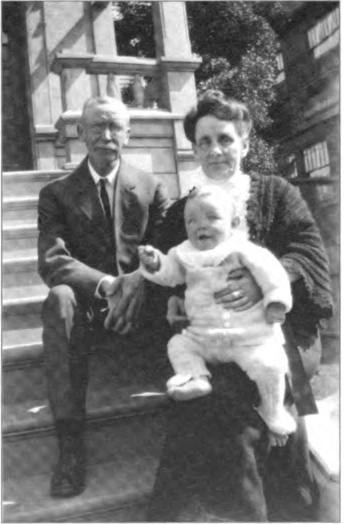

Frank Lawton as a Person. If Fannie was small and gay, Frank was tall and serious. It was his posture and bearing that his grandchildren still remember most vividly. Nancy Shurtleff Miller: “Grandfather Lawton was very tall, erect, and dignified; straight and straight forward. Strict and stiff, almost a severe kind of person. His mannerisms and looks were very much those of his son, Don, but without Don’s sense of humor. He rarely laughed. I always picture him with high black lace-up boots to protect his ankles and his weak foot.” Birnelyn Seymour Piper: “When grandfather Lawton walked down the high steps from the front of his house, he held himself absolutely straight, as erect as a ramrod. I never saw him slouch or walk round shouldered. He always sat up straight, with shoulders back—always elegant and regal looking. He didn’t talk a lot and was not demonstrative. Though very strict, he was also very good and kind. He was not rigid and showed lots of character.” Mardy Peet Love: “Frank had a very regal mien. He usually walked on the streets of Berkeley with a cane and with each step he would touch it to the ground, then briskly raise its tip above his head, like an inspector of the troops. Always perfectly groomed and mannered, he wore a hat, which he would lift in greeting others. He cut a distinctive figure.”
As noted above, Frank was a strict man, but he was fair, and his children liked and respected him. The girls called him “Papa.” As Don Lawton recalls:
Yes, father was a strict disciplinarian but he was absolutely fair. He took no monkey business. I like strictness and discipline when they are correct. I admired him because you knew exactly where you stood. When he laid the law down, it was very clear cut, not vague at all. One day when I was a little kid I borrowed a monkey wrench from our workshop in the basement on Durant Avenue and forgot to put it back. Frank wanted to know where it was and told me to find it. When I finally told him I couldn’t find it, he just grabbed me and gave me a paddling on the rear end. It was the only one he ever gave me. But just as an indication that I should know where I put things. Then he said, “Don’t you ever borrow those tools out of the basement unless you put them back exactly where they were, as soon as you’re done with them. Do not leave anything hanging around in the yard.” To this day, when I pick up something at my workbench to put it back, I think of him. . . fondly.
To his grandchildren, though, Frank’s strictness was a bit more difficult to understand. A number of them have vivid memories of him saying at the dinner table, “Children are to be seen, not heard.” Lawton Shurtleff: “Grandfather Lawton was a completely dictatorial man, and he seemed to be a very distant man with his children. I still remember how furious he became the time Gene and I shot BBs and punctured the window of his Buick sedan.” Mardy Peet Love: “In my memory he was very cold and rigid. But I was very little. When I went to grandfather Lawton’s house, I would sit very quietly. There was a great big beautiful Oriental Empress Chair made of rosewood (given to him by the Chinese ambassador in about 1900) with dragon’s heads on the arms. Grandfather would say to me seriously, ‘If you can’t sit still, I’ll just have to put your hand in his mouth.’ Of course, I believed him, and feared that something horrible would happen. At other times he would frighten me by saying, ‘You’ll have to watch out or I’m going to put your head between your ears!’ It terrified me. He was half joking, but with a very straight face.”
One of Frank’s great concerns was punctuality. Nonie Peet Kelly recalls: “Grandfather Lawton had a hobby of collecting clocks, and the house was full of them. He made quite a ritual of winding them every night. And on the hour, when they struck, rang, and chimed, it was a marvelous cacophony. In his three-piece charcoal or lighter-gray suits, he carried a pocket watch on a gold chain, and he referred to it often. Dinner was served each evening promptly at six, and each person in the family was expected to be there on time.” In college, Don Lawton had wanted to go out for crew, but he found that the crew sometimes practiced until 8 p. m.; Frank told him to find another sport. Being present at dinner on time came first.
Like Fannie, Frank was thrifty. Don Lawton described him as “very hardworking and frugal. He pinched pennies and never made a show of his money, but he never hesitated to spend money for a worthwhile thing or to make the family happy.”
Frank was an influential and widely respected realtor and businessman in Berkeley, as Don Lawton relates in the following story:
In about 1920 Ed Martin’s mother and father arrived in Berkeley, having driven from Wyoming. They parked the wrong way on the street in front of our house at 2211 Durant. Putsker, one of the Berkeley policemen, wrote them a ticket. Frank went out, explained that these family guests were strangers in Berkeley and did not know local regulations, and asked the policeman to tear up the ticket. When he refused, Frank phoned the police station and talked with August Vollmer, the Chief of Police, who was an outstanding individual. Vollmer asked that Frank come with the policeman down to the station. Mr. Martin and I went too. When we got there, Vollmer said to the policeman, “You go in the waiting room, I’ll deal with you later.” Then he said, “Mr. Lawton, I want to apologize for what has taken place here. This is so unusual.” After many apologies, we left. I never saw that policeman in the streets of Berkeley again.
Frank was an ardent Mason for a while, as were many men in those days. A man named Young was also a Mason. Young was caught lying. Frank resigned. Choose him or me. Frank stood on principle.
The Lawtons as a Family. While each of the Lawtons was a fine, strong person, they were at their best as a family. Nonie Peet Kelly has vivid memories of this wonderful bunch, of whom we have heard more than one person say, “I have never seen a family as close as the Lawtons.” Nonie:
I remember clearly all the brothers and sisters of that generation. They were a close-knit tight little group—absolutely devoted to each other with no friction between them—at least as adults. They loved and admired and respected each other absolutely. They enjoyed each others’ company and were hilarious to be around. Everything was fun. It was an absolute violation of the code to be anything but upbeat and cheerful. They totally approved of each other and never knocked one another (except in a good humored jest) and would not tolerate even the hint of criticism from anyone else about one of their own. It was unforgivable to find anyone of them at fault or to offend one. Their loyalty did not allow it.
It was, however, not a family in which social position or money were important. Reputation was and your reputation meant that you were honest, dependable, respectable, hardworking, and could be trusted never to hurt anyone in any way. I would say they were “problem solvers” not “problem staters.” If they saw a problem—they fixed it or offered to help before anyone had to ask. They looked for ways to help.
Probably because of their Christian Science training they did not discuss disease, illness, or problems of any and every kind—with anyone not directly involved. Problems within the family stayed there and were not discussed outside the family, period. They could absolutely depend on one another’s discretion.
They really enjoyed each others’ company. No wonder, because they were always cheerful, happy and noncompetitive. It was a family full of laughter—without any trace of jealousy—no power struggles. I never heard one criticize, put down or condemn another or allow it from any one else. They were a superb unit and appreciated having each other. In fact, they just loved each other and thought each one was a perfect example of the human race. I loved them all.
In each of the six lives there were, at one time or another, major problems with children, wives, or husbands that they could not have handled without the immediate response of their brothers and sisters. No one was spared tragedy, illness, or abuse, yet in each case the family rushed in to help him or her to survive it. Whatever the problem, they assumed each others’ burdens and helped to carry them through it.
Later Years (1913-34). In 1913 Hazle became the first of the Lawton children to marry. Winnie married next in 1915, followed by Helen (1919) and Dorothy (1920). The two boys, Harry and Don, married last, in the early 1920s.
Frank and Fannie’s first grandchild, Lawton Lothrop Shurtleff, was born to Hazle and Roy Shurtleff on 6 November 1914. By 1930 Frank and Fannie had 16 grandchildren.
As each of the Lawton children got married, five of them and their spouses ended up living very near their parents. Four of these lived for many years in the Claremont district of Berkeley, within about four blocks of one another. They saw each other almost daily. Winnie and Birney Seymour lived at 2844 Woolsey Street; Helen and Ed Martin were at 3023 Benevenue Avenue; Don
and Billie Lawton were at 3315 Claremont; and Dorothy and Harry Peet were at 6446 Regent Street Hazle and Roy Shurtleff lived only a few miles away at 209 Crocker Avenue in Piedmont. The only couple to leave the Bay Area was Harry and Joyce Lawton, who moved to Seattle.
Not only did the Lawton children reside close to one another, they kept close to one another and in touch in many ways. As Nonie has noted above, and as we will detail later in discussing their individual lives, when hardship or tragedy struck one of the Lawtons, all of the others rushed to their help. Harry, who was farthest away, was one of the closest at heart.
Because of all this proximity and family ties, Frank and Fannie’s grandchildren grew to know one another extremely well, and many remained close lifelong friends. Jack and Bob Seymour, Nonie Peet, Ed Martin and Dick Seymour, Marilyn Martin and Carol Lawton, Mardy Peet and soon after Bill Lawton all went to John Muir Grammar School, Willard Junior High, and Berkeley High. Many of them learned from the same teachers who had taught their parents. And many of their classmates’ parents had played at the Lawton house and knew their parents. Lots of fun.
Of Fannie’s six children who survived past childhood, Helen Lawton Martin died at the youngest age (45 years, 7 months). Don Lawton lived the longest (102 years, 10 months), followed by Winnie Lawton Seymour (96 years, 8 months). Both Don and Winnie remained clear of mind and full of good humor until almost the end. Good genes!
Fannie’s 16 grandchildren came to be known as “the cousins.” Of these, eight were women as pictured on the following page. All shared Fannie’s humor, camaraderie, and integrity. Born between 1916 and 1927, they kept in close touch over the years and are all still alive today! More good genes! In May 1999 they held a reunion at the St. Francis Yacht Club in San Francisco. In May 2004 they all met again at Trader Vic’s restaurant in Oakland.
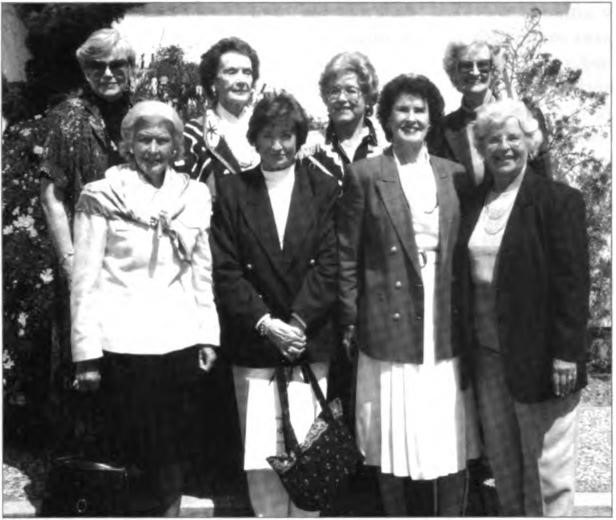
Of the six Lawton children, four had unusually close relationships with their spouses: Don and Billie Lawton, Dorothy and Harry Peet, Helen and Ed Martin, and Harry and Joyce Lawton. Hazle’s relationship with Roy Shurtleff was a very warm one until the late 1930s. They separated in November 1945. Winnie’s relationship with Bimey Seymour, who was 19 years older than she, was difficult from the outset. It ended in a painful separation in about 1933, and later a divorce. Harry was also divorced once—in a marriage entered into hastily after his beloved Joyce died.
In 1919 Frank retired, and in the mid-1920s, with all their kids “out of the nest,” he sold the Lawton home at Monte Rio. Frank and Fannie liked to visit their children and grandchildren. And Winnie would hold big parties once or twice a year where everyone came.
Then in 1928 Fannie was again diagnosed as having cancer. She gradually became frail, and her whirlwind pace slowed down. Mardy Peet Love recalls that she went to a Christian Science rest home for quite a while in San Francisco. Then she stayed with the Peets on Regent Street briefly. For a while Frank went through hell seeing her pain. She was in such terrible pain that Frank couldn’t take care of her alone. Don Lawton recalls that at one point it was decided to put her in a rest home near Hayward. Don took her there. As he got ready to leave, she looked at him with big sad eyes and said, “Oh, I wish you wouldn’t leave me here.” Apparently she raised such a ruckus that the next morning the owner called and explained that they couldn’t keep her.
At that point Hazle and Roy Shurtleff took her into their home at 209 Crocker Avenue in Piedmont. After six to nine months of great pain and anguish, she died there on 7 November 1930, at age 71, of cancer of the stomach. Miss Ruth Reeder, a trained nurse, was present. Toxemia for her last three months was listed as a contributory cause on her death certificate by Dr. Harold A. Morse of Oakland, an old friend of the Lawton family. A 12-line obituary appeared in the Berkeley Daily Gazette (Saturday evening, 8 November 1930, p.14). A private family funeral service was held on Sunday, November 9, at 2 p.m., in the afternoon, at the Little Chapel of the Flowers (Hull and Durgin mortuary) on Adeline Street at the Ashby Station in Berkeley. After cremation by Hull and Durgin, her ashes were interred at the Lawton family plot at Mountain View Cemetery in Oakland.
After Fannie’s death, Frank was very lonely in the big house at 2211 Durant Avenue in Berkeley. She had been such a strong person that he found great difficulty in going on alone without her. Mrs. Alberta Patterson his housekeeper, came in each day and fixed his meals, and his children visited him whenever possible. On weekends they would take him for rides and on outings to visit his children. Mardy Peet Love recalls that after they would take him home and prepare to leave, he would tip his hat and, in his formal was; say “Much obliged.”
But Frank was just too lonely without his dear Fannie. Moreover, his feet, weak from youth, finally gave out, so he could no longer take the daily walks he once enjoyed so much. He had nothing to do. So on 23 July 1934, in the midst of summer, he wrote his children two notes. According to his obituary, one explained that he could not “stand the strain any longer and I know that we will both be better off when I am at rest.” Don Lawton recalls that it also asked for his children’s forgiveness. The second note asked that no one but himself be blamed for the act. The economic depression of the times had nothing to do with it.
Frank then sat in a chair in his bedroom and, using an ingenious device made of a stick to steady his aim and keep the pistol a certain distance from him, he committed suicide with a bullet through his head. He was 83 years old. He was found by his housekeeper, Mrs. Patterson. Only about six months previously his dear friend, August Vollmer, the retired Berkeley chief of police, had done exactly the same thing.
Frank’s obituary appeared on the front page of the Berkeley Daily Gazette on Tuesday evening, July 24. He was described as “a wealthy retired real estate operator” who had lived in Berkeley for the last 48 years. Private funeral services were held the next day, conducted by the Rev. Laurence L. Cross, pastor of the Northbrae Community Church.
It is interesting to note that neither Frank nor Fannie had funeral services, which Christian Scientists generally do not, since according to their belief, human beings are essentially spiritual, not material. Yet Frank and Fannie did want to have their material remains placed in the family plot. Like that of his wife, Frank’s body was cremated at Hull and Durgin mortuary in Berkeley, and his ashes were interred at Mountain View Cemetery in Oakland, in the site (plot 26, lot 44) that he had established.
Frank and Fannie’s six children in turn had 16 children, and these 16 themselves had 35 children—born between 1941 and 1960. Four of Frank and Fannie’s six children were women and two were men. Of the children of these two men, all were women except one: Don Lawton’s son, Bill Lawton. Thus, of Frank and Fannie’s grandchildren, only Bill Lawton carried the Lawton surname. Bill Lawton had two children, both girls. Thus, sadly, there are no descendants to carry on the Lawton surname.
The story of the lives of each of Frank and Fannie’s children, and of their children, is given in Part VI of this book. Now let us turn to the story of Hazle Lawton and her husband, Roy Shurtleff.
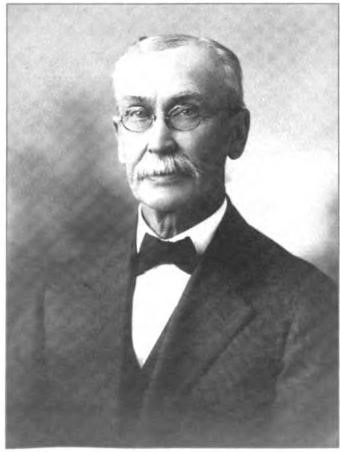
 Shurtleff & Lawton Families Genealogy & History - Second Edition (2005)