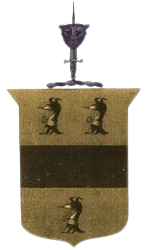
** All Text on these chapter pages has been copied verbatim – with permission – from this book: “Shurtleff Family Genealogy & History – Second Edition 2005” by William Roy Shurtleff & his dad, Lawton Lothrop Shurtleff ** Text in pdf convert to word doc – any spelling errors from the book may or may not have been fixed. **
Charles D. Lawton was born on 7 September 1802 at Newport, Newport County Rhode Island. His parents were George Lawton and Abigail Hall.
Some time between 1802 and 1804, while still an infant, Charles moved with his parents to Hamilton, Madison County New York, where he later attended Hamilton Academy. After graduation, he decided to become a lawyer, so he studied law with Hiram K. Jerome in Palmyra, New York. He was admitted to the bar in 1831 or 1832 and began to practice in Clyde, Wayne County New York, in 1833. Located in Upstate New York on the shores of Lake Ontario, Wayne County had been created in 1823, with its capital at Lyons. The parent county or territory from which it was organized was Ontario County (created in 1789) and Seneca County (created in 1804). Clyde was a village in the small town of Galen, located about 12 miles south of Lake Ontario. Clyde, Lyons, and Wayne County were centers of activity for members of the Lawton, Houghteling, and de Zeng families for several generations.
In 1837 Charles D. Lawton received the great honor of being admitted at Utica to practice in the state Supreme Court.
That same year, Charles married Susan Amelia Houghteling on 5 June 1837 at Galen, Wayne County, New York. Susan was born on 30 March 1812. According to the 1855 and 1865 Galen censuses, she was born at Susquehanna, Chenango County, New York. But other sources (L. B. Thomas 1896; Mrs. Alta B. Ash 1967) indicate that she may have been born at Kingston, Ulster County, New York. Her parents were James (or Jacobus) Houghteling and Ernestine Jeanette Frederica de Zeng.
The surname of this family is spelled in two different ways: “Houghteling” and “Houghtaling.” The following support the spelling with an e: (1) Two advertisements (printed and signed) for James’ firm Hudson & Houghteling (1818-19); (2) The tombstone inscription for James Houghteling (1840); (3) The middle name given our direct ancestor, Frank H. Lawton in 1849 was definitely spelled “Houghteling”; (4) Maple Grove Cemetery records for James and Ernest Houghteling (1860); (5) A Clyde Times article on the death of Abram Houghteling (1872); (6) The three-page genealogy of the Houghteling family published by Lawrence B. Thomas (1896) in The Thomas Book.
The following support the spelling with an a: (1) Galen Vital Statistics on the death of James Houghtaling in 1849; (2) the 1850 Galen census; (3) Edward F. de Lancey’s five-page “Biography of Baron de Zeng” (1871) in which he states that Ernestine de Zeng married James Houghtaling, M. D. of Kingston; (4) Philip Mark de Zeng’s detailed article titled “The Descendants of Frederick Augustus, Baron de Zeng” (1874) in which he criticizes de Lancey’s research but repeats his spelling “Houghtaling”; (5) George S. Conover’s History of Ontario County (1893); (6) Several family group records for Houghtaling compiled by Mrs. Alta B. Ash in the 1960s; (6) All of the six Houghtaling families in the 1987 Wayne County phone book spell their name as such; there are no “Houghtelings”.
First, we must note that during the 1800s, less attention was given to proper, consistent spelling than it is today. Census takers were notorious for spelling names as they sounded. We feel that, all things considered, there is stronger and earlier evidence from more primary source documents to support the spelling “Houghteling” than the alternate “Houghtaling.” The incorrect spelling seems to have been introduced by Edward F. de Lances’ in 1871, then repeated by Philip Mark de Zeng (1874), George S. Conover (1893), and Mrs. Ash (1%7-68).
Susan A. Houghteling was descended from an illustrious family that traces its roots back to Germany and Baron de Zeng.
Susan A. Houghteling’s Maternal Grandparents: Frederick Augustus Baron de Zeng and Mary Lawrence. Frederick Augustus, Baron de Zeng and his wife, Mary Lawrence, were Susan A. Houghteling’s maternal grandparents. They were the parents of her mother, Ernestine de Zeng.
There are several good early published sources of information on Baron de Zeng, who was a famous German nobleman: (1) Edward F. De Lancey. 1871. “Biography of Baron de Zeng.” The New York Genealogical and Biographical Record 2(2):49-53. This is the key work on his life. (2) Philip Mark de Zeng. 1874. “The Descendants of Frederick Augustus, Baron de Zeng.” The New York Genealogical and Biographical Record 5(1):8-12. Jan. Information extracted largely from these sources is also found in George S. Conover’s History of Ontario County (1893, Part II, p. 286-88) and Grip’s Historical Souvenir of Clyde (1905).
Frederick Augustus, Baron de Zeng, the ancestor of the only family of this name in America, was a Saxon (German) nobleman, born in 1756 in Dresden, the capital of Saxony. He was the second son of Baron de Zeng, of Rueckerswalde-Wolkenstein near Marienberg in Saxony, Lord Chamberlain to the Duchess of Saxe-Weissenfels, and High Forest-Officer to the King of Saxony. His mother was Lady Johanna Phillipina von Ponickau, of Altenberg.
Frederick received a military education, and at the age of 18 (on 11 February 1774) he was commissioned as “Lieutenant of the Guard” in the service of the Landgrave of Hesse-Cassel.
At that time, Germany consisted of a federation of fairly sovereign states, each ruled by a prince. The largest state was Prussia, which united the others in the late 1870s. There were many noblemen in Germany and each was loyal to one sovereign prince. Only noblemen at that time were allowed to hold commissions in the army of a sovereign prince, but with the consent of their sovereign prince, they could enter any army, domestic or foreign, that they desired. Because of this system, Baron de Zeng, though a Saxon, held a commission in the army of Hesse-Cassel, and saw his first service in the Legion of Baron de Winkop, in a campaign in Moravia and Bohemia. After that war he continued in the same service and on 19 May 1776 received the court appointment of “Hof-Juncker” or “Gentleman of the Chamber” to his Serene Highness, Frederick of Hesse-Cassel.
During the next few years Frederick de Zeng became a close and intimate friend of the celebrated Baron de Steuben, a Prussian nobleman, who was much the elder of the two. This friendship lasted until the death of the latter, after both had become American citizens. Baron de Steuben had held at one time the command of the “Regiment Von Salmuth,” afterward styled “Hesse-Cassel.” At this point, however, de Steuben was in the service of the Prince of Hohenzollern-Hechingen.
Frederick de Zeng was a captain in the regiment of the “Hereditary Prince.” This was one of the regiments ordered to America by the Landgrave of Hesse-Cassel, under the convention that the British government had entered into with him, and with the Duke of Brunswick, and two or three other minor German princes. It called for them to send German troops to aid in suppressing the American Revolution.
Frederick, however, did not come to America until quite late in the war, at the close of 1780 or early 1781. He exchanged from the regiment of the “Hereditary Prince” into that of the “Regiment du Corps,” and his commission in the latter bears the date 30 January 1781. Stationed in the city of New York and its environs, he was fortunate in never having been engaged in conflict with the Americans. In fact, after his arrival in America, active hostilities were comparatively limited north of the Chesapeake Bay.
Baron de Zeng was exceedingly pleased with America and Americans, perhaps in part because he had fallen in love with a charming young Quaker lady, named Mary Lawrence, from Long Island, New York. At the close of the war, he decided to make America his home.
He found some difficulty in getting his resignation accepted, but finally succeeded, and on 8 November 1783 received, at his own request, an honorable discharge from German military service.
That same month, on 27 November 1783, he married Miss Mary Lawrence in Trinity Church, New York. Born on 11 April 1765 at Flushing, Long Island, New York, she was the daughter of Caleb Lawrence and Sarah Burling of Flushing. De Lancey (1871) notes that Mary was “a lady of extraordinary beauty and grace, united with a commanding presence, and was gifted with great good sense and decision of character.”
According to the Historical Genealogy of the Lawrence Family (1858, p. 30), Mary was descended from a distinguished English family. Her paternal great-great-grandfather was the first William Lawrence, of Great St. Albans, Hertfordshire, England, who came to America in 1635. The eldest son of William Lawrence’s second marriage to Elizabeth Smith (daughter of Richard Smith of Smithtown, Long Island) was named Joseph Lawrence. When William Lawrence died, Elizabeth married Sir Philip Carteret, Governor of New Jersey, who founded and named after his wife Elizabethtown in that state. Joseph Lawrence was Mary Lawrence’s paternal great-grandfather (her father’s father’s father). Joseph’s wife was Mary Townley, daughter of Sir Richard Townley (who was the son of Charles Townley, who fell at Marston Moor). Mary Townley’s sister, Dorothy Townley, became the wife of the seventh Baron Howard, of Effingham, who was afterward created Earl of Effingham. The name of Mary Lawrence’s paternal grandfather is not known.
After their marriage, Baron de Zeng and Mary Lawrence lived at Red Hook, Dutchess County, New York, where the baron purchased an estate. Frederick (Baron de Zeng) became a joint owner, with his neighbor and friend, Chancellor Livingston, of a very large tract of land in Ulster County, just to the east of Dutchess County.
On 3 November 1789 Frederick was naturalized as an American citizen in New York. He dropped the use of his hereditary title (though others often used it in addressing him) and simply signed himself Frederick A. de Zeng.
On 13 January 1792 he was commissioned by New York’s Governor George Clinton, Major Commandant of a Battalion of Militia, in the County of Ulster, residing westerly of the towns of Woodstock, Hurly, Marbletown, and Rochester, as the Commission curiously expressed it. From this appointment he derived the title of Major de Zeng, by which he was known during the rest of his life.
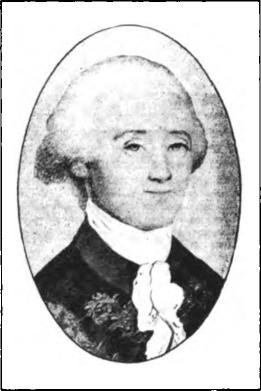
He and Governor Clinton were intimate friends, socially and politically. During this period he was deeply interested in the opening of the interior water communications of New York, and he made personal examinations and surveys in the years 1790, 1791, and 1792 of the entire country from Albany to the Genesee River. An interesting account of one of these journeys in 1792, written at the time by Mr. Vanderkemp, one of his companions, was published in the 1860s.
During these expeditions, Major de Zeng spent a good deal of time with Indians. He took great interest in them and had their confidence. This led to his appointment several times as a Commissioner to negotiate with them—notably in 1794, when Governor Clinton sent him to talk with the Oneidas, Onondagas, and Cayugas concerning their reserved lands. On one of these trips he was accompanied by Peter Otsegat, a full-blooded Oneida Indian, who had been educated in France for many years. Major de Zeng later wrote a memoir on Otsegat, who later returned to live with his tribe.
Of an active, enterprising spirit, Major de Zeng was one of the earliest promoters of internal improvements in the state of New York. He was associated with General Schuyler in establishing and carrying on the “Western Inland Lock Navigation Company,” subscribing largely for the stock and taking a personal interest in the construction of the works. The heaviest part of the work was to be done at Little Falls, and he superintended this section of the construction himself, moving his family to that place temporarily.
While working there, his old friend, Baron de Steuben, paid one of his annual visits. During this visit, on 16 March 1793, Mary Lawrence de Zeng gave birth to a child, who was named William Steuben de Zeng, in honor of the baron. Steuben, a bachelor, was pleased with this unexpected event and remembered it by leaving to his namesake his portrait and 1,000 acres of land in the Mohawk Valley.
In about 1796, in conjunction with Jeremiah Van Rensselaer and Abraham Ten Eyck, Major de Zeng established at Hamilton, near Albany, a very large window-glass factory. All of the workmen and tools, and some of the materials, were brought from Germany. Thought to be the first glass works in the state of New York, it was very successful, financially and otherwise, until it finally closed in 1815.
The de Zeng family resided for many years at Kingston, Ulster County, New York, and subsequently at Bainbridge, Chenango County, where he built and owned the bridge over the Susquehanna River.
Between 1784 and 1802 (according to the de Zeng family Bible), Frederick and Mary de Zeng had nine children, of whom Ernestine, the first, was our direct ancestor.
- Ernestine Jeanette Frederica Augusta de Zeng. Born 26 June 1784 at New York City, New York. Married James Houghteling, M.D., on 26 Feb. 1807 at Kingston, Ulster County, New York. He was born in Feb. 1779 at Kingston, Ulster County. They had 11 children. He died on 22 Dec. 1849 at Clyde, Wayne County, New York. She died on 8 April 1859 at Clyde, New York.
- George Scriba de Zeng. Born 1 Aug. 1786 in New York City. Married Eliza Smith of Waterloo, New York, in 1809. They had 3 children (Frederick, James H., Mary) and 3 grandchildren. He died in 1829 at Grand Gulf, Mississippi. Eliza remarried to Dr. Cole of Sandusky, Ohio.
- Richard Lawrence de Zeng. Born 3 Oct. 1788 at Shandaken, Ulster County New York. Married Sarah Lawrence, his first cousin, on 12 Sept. 1815. The daughter of Richard Lawrence of New York, she was born on 22 April 1793. They had 2 children (Emeline, Rev. Edward) and 8 grandchildren. He died 17 June 1848 at Oswego, New York. She died on 24 Nov. 1872 at the same place.
- Philip Mark de Zeng. Born 16 Nov. 1790 at Kingston, Ulster County, New York. Married Lucretia Sayre, of Bainbridge, New York, on 4 Oct. 1810. She was born on 31 Nov. 1793 at Durham, Connecticut. They had 6 children (Charles Sayre, Amelia, Lawrence W., Eliza, Philip Mark, and John Clark) and 21 grandchildren. He died 15 March 1862 at Clyde, Wayne County, New York. She died on 3 May 1866 at Girard, Pennsylvania.
- William Steuben de Zeng. Born 16 March 1793 at Little Falls, New York. His middle name came from his father’s friend, Baron de Steuben. Married Caroline Cutbush Rees on 16 Jan. 1817. She was the daughter of Major James Rees of Geneva, New York, who was born 1 Oct. 1796 in Philadelphia, Pennsylvania. William and Caroline had 10 children (Matilda Rees, James Rees, Evelina Throop, Josephine Matilda, William, Caroline, Henry Lawrence, Edward Cutbush, Mary Anne, Evelina Throop) and 11 grandchildren. Though his home was in Geneva, William was a pioneer in Clyde, New York, one of the first owners of land on the site of what became the village, and the man responsible for laying out the park and many streets. In 1828 he and James R. Rees constructed a large glass factory in Clyde. Laying of the cornerstone was presided over by Major de Zeng. He also obtained the charter from Hobart College, and was one of its main stays and chairman of the board. He died 15 Aug. 1882 at age 90.
- Arthur Noble de Zeng. Born 23 Feb. 1795 at Little Falls, New York. He married a woman (name unknown) from Ohio but left no issue. He died in 1829.
- Sarah Matilda de Zeng. Born 16 April 1797 at Hamilton, Albany County, New York. Married Richard L. Lawrence of New York, her first cousin, on 15 Feb. 1818. He was born on 4 March 1788 in New York. They had 6 children (Mary, Henry C., Emma, Ernestine, George de Zeng, Eliza) and 11 grandchildren. He died on 12 April 1855 at La Fayette, Indiana. In 1874 she was living at Clyde, New York. Her date of death is not known.
- Maria Augusta de Zeng. Born 6 April 1799 or 1800 at Hamilton, Albany Co., New York. Married William Sears Stow, of Clyde, New York, on 12 Sept. 1825. He was born on 6 October 1797 at Wilmington, Vermont. William T. de Zeng had persuaded William Stow to move to Clyde, where he arrived in Nov. 1825, and was subsequently active in promoting the welfare of the village. Maria and William had three children (John Barber, Marie Antoinette, De Lancey) and 6 grandchildren. She died 25 Dec. 1873. He died on 20 Aug. 1880 and was buried in Maple Grove Cemetery.
- Amelia Clarissa de Zeng. Born 21 May 1802 at Kingston, New York. Married Addison C. Griswold of Syracuse on 20 December 1820 at Bainbridge, New York. He was born on 25 Dec. 1799 at Cairo, New York. They had 6 children (Augusta M., Edmond B., George de Zeng, Addison C., De Zeng, Clarence) and 2 grandchildren. He died 25 Dec. 1872 at Syracuse, New York. She died 30 Sept. 1881.
In 1812 Major de Zeng suggested the enterprise that resulted in the formation of the Seneca Lock Navigation Company, for the enlargement of the locks and improving of the navigation of the Seneca River in Upstate New York. In 1814 and 1815 he led this enterprise, which later resulted in uniting the waters of Seneca Lake with those of the Susquehanna by the construction of the Chemung Canal. He personally made the first explorations of the highlands dividing the watersheds of the St. Lawrence and Susquehanna Valleys, at the head of Lake Seneca, for this purpose.
Major de Zeng played an important role in the early development of Clyde, New York, where our Houghteling and Lawton families also later lived. He first visited the area in 1790 while inquiring into the proposed opening of interior water communications. White settlers had first located in the area in about 1801. According to Grip’s Historical Souvenir of Clyde (1905), the major realized that the Clyde River (then known as Canandaigua outlet, renamed in 1818) was one of the main waterways leading into the interior west of the Oswego River, and a course he was about to recommend for a canal. He also liked the scenic beauty. So in 1815 he had his surveyors make a map of the area and survey of the south side of the river into village lots and streets. The north side of the Clyde River was uninhabited at the time, and “Blockhouse” on the south side was only a small frontier hamlet with not more than 12 families. Major de Zeng bought land on both sides of the river, then had his surveyors run two streets north and south from the river. In 1818 he constructed a dam across the Clyde River (authorized by an act of the state legislature), with a lock to admit the passage of boats and a race to provide water power for his mills. He built a grist mill on the south side of the river and a sawmill on the north side. One street was called Mill Street because of these two mills. According to Grip’s Historical Souvenir:
Frederick Augustus, Baron de Zeng, should be designated as the “father of Clyde,” since it was he who having purchased a large tract of ground.. . furnished the money and ambition to open the village to commerce and industry, erecting mills here and laying out the village south of the river. All of the business section of Clyde and most of the residential section, if indeed not the whole of it, stands on the land which the Baron purchased when it was entirely unopened to settlement.
A few years later his son, William Steuben de Zeng, bought all of is father’s property there and continued laying out the village of Clyde. One street was named De Zeng Street, after his pioneering father. The village on both sides of the river was incorporated in 1835. In 1871 Edward F. de Lancey described Frederick de Zeng as follows:
The fine natural abilities of Baron de Zeng were highly cultivated. He had, in his youth, all the advantages that rank and wealth could give, and profited well by them. He was noted for the elegance and manly beauty of his person, and his graceful manner and mien. The politeness and suavity of his address was remarked by all with whom he came in contact. In society, of which he was fond, he was noted for his agreeableness and his grace in dancing, and he was a great favorite with both sexes.
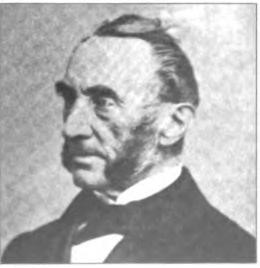
On 8 October 1835 Frederick’s wife, Mary, died at Oswego, New York, and was buried there.
Fredericks long and active career closed at Clyde, Wayne County, in Upstate New York, on the shores of Lake Ontario, where two of his married children lived. He died on 26 April 1838, at age 82, and was buried in Clyde.
By 1871 the de Zeng family was extinct in Germany.
Frederick and Mary’s eldest daughter, our ancestor Ernestine, had long since married James Houghteling and given birth to a daughter, Susan Amelia Houghteling.
Ernestine must have inherited from her father a silver teapot, which is about 10 inches high and has a beautiful wooden handle. On the bottom is inscribed “Maj. F.A. de Zeng, 1778.” It is not clear what this date signifies, since it refers to a date about two years before Frederick de Zeng first came to America. Yet he did not become a major until 1792. Ernestine apparently bequeathed this to her third child, Susan Amelia Houghteling, who gave it to her youngest child, Frank H. Lawton, who passed it on to his eldest child, Winifred M. Lawton, who loaned it to her sister Hazle Lawton, who had it for some years in her dining room at The Ranch near Martinez. Winifred finally bequeathed it to her eldest child, Bimelyn Marion Seymour. Bimelyn, in turn, gave it to her cousin, Jean Parker, to be certain it would stay in the Lawton family.
Susan A. Houghteling’s Parents: James Houghteling and Ernestine de Zeng. According to L. B. Thomas (1896), the Houghteling (often spelled “Houghtaling”) family’s immigrant ancestor was Jan Willemsen Hooghteyling, who came from The Netherlands and settled at Esopus (later called Kingston), New York, in 1661. Five generations in unbroken descent lived and died there before Jacobus or James Houghteling.
James was probably born in February 1779 at Kingston, Ulster County, New York. (Strangely, his tombstone inscription lists his birth year as 1786 and his death date as 22 December 1840. He probably died nine years later, on 22 December 1849, as will be explained later. Dates on tombstones are sometimes difficult to read.) He was christened at Kingston on about the fourth of that month. We know nothing about his parents (Susan A. Houghteling’s paternal grandparents), Abraham Houghteling and Catherine Hasbrouck, except their names.
At some point before marrying, James received his M. D. degree and became a physician. At the time of his marriage, he was living in Kingston, Ulster County, New York.
James married Ernestine de Zeng on 26 February 1807 at Bainbridge, Chenango County, New York. Note that after the marriage James and Ernestine moved there. Both James and Emestine’s parents lived in New York at that time.
Dr. and Mrs. Houghteling had 11 children, all born in New York between 1808 and 1828. We have relied primarily on two sources for information about these children: (1) Philip Mark de Zeng’s 1874 article “The Descendants of Frederick Augustus, Baron de Zeng” (New York Genealogical and Biographical Record 5(1):8-12. Jan.) and (2) L.B. Thomas’ chapter on “Houghteling” in The Thomas Book. Thomas used as his sources records of the Old Dutch Church at Kingston, New York and family papers obtained through living Houghteling descendants. Mrs. Alta B. Ash compiled an LDS Archive Record on the Houghtaling family in about 1967. She consulted both of the earlier sources, plus two other minor sources. She generally followed Thomas, except that she spelled the family name “Houghtaling” and added some new information. There are a number of differences between our two main sources, including different spellings of the family name. Where we have been unable to resolve these discrepancies by checking primary source documents, we will take the Thomas and Ash versions as our basis, noting where de Zeng differs in square brackets []. According to Thomas and Ash, the first three children were born at Kingston, Ulster County; the fourth through sixth at Bainbridge, Chenango County; and the last five at Geneva, Ontario County. The third of these, Susan A. Houghteling, was our direct ancestor.
- Mary Matilda Houghteling. Born 11 November 1808 [1809] at Kingston. Died 12 May 1824 [1854] at Geneva [Romulus], New York.
- Catherine Arietta [Catharine Arrietta] Houghteling. Born 19 July 1810 [1811] at Kingston [Bainbridge]. Resided in Clyde, New York, in 1874.
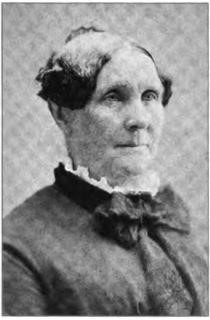
3. Susan Amelia Houghteling. She was born on 30 March 1812. This birth date is confirmed by L. B. Thomas (1896), her son Frank H. Lawton (1900), William D. Lawton (1919), and Mrs. Alta B. Ash (1967). Her birthplace is not clear. The 1855 Galen census states that Susan was age 42, born at Susquehanna, Chenango County, New York. The 1865 Galen Census says she was age 43, born at “Chenango.” Philip Mark de Zeng (1874) has her born on 13 March 1813 [this date is not correct] at Bainbridge, Chenango County, New York. Thomas and Ash give the place as Kingston, Ulster County.
Susan married Charles D. Lawton on 5 June 1837 at Geneva, New York, and became the mother of 8 children, of whom Frank Houghteling Lawton, our direct ancestor, was the youngest. Susan died on 24 July 1886 in Berkeley, California, at age 73 of heart disease. She was buried the next day at Mountain View Cemetery in Oakland. Thomas notes that hers was “the first death from natural causes in her generation of the family for 62 years.”
4. Laura Louisa Houghteling. Born 16 Dec. 1813 [1814] at Bainbridge, New York. Married Hiram Reynolds 27 March 1833 and had three children: 1. Ernestine married Augustine Lawrence McCrea on 18 Dec. 1866 at Chicago, Illinois. 2. Agnes. 3. Louise married George K. Schoenberger on 31 July 1873 at Chicago. Laura died 27 July 1892 at Kenosha, Wisconsin.
5. James Lawrence Houghteling. Born 27 Aug. 1815 at Bainbridge, New York. Married Zilmana Rosalie Adair [Zilmena Adelle] in July 1837 at Natchitoches, Louisiana. He was accidentally killed on 30 May [27 Aug.] 1852 at Natchitoches. No issue.
6. Carolina [Caroline] de Zeng Houghteling. Born 8 July 1817 at Bainbridge, New York. Married Charles Sayre de Zeng on 18 Dec. 1838 at Clyde, New York. Her cousin and eldest son of Philip Mark de Zeng, he died 26 May 1859. They had 8 children: Rees, Laura, Robert, Charles, Virginia, Josephine, Lawrence, William. The first 6 were born at Clyde, New York from 1840 to 1851. The seventh at Brooklyn and the eighth at Oswego, New York. In 1874 Caroline resided at Quincy, Illinois.
7. William de Zeng Houghteling. Born 23 [25] Aug. 1819 at Geneva, New York. In 1855 he moved to Chicago, Illinois, and became one of the leading merchants of that city. On 16 Nov. 1863 [1853] he married Marcia Elizabeth Stockbridge at Allegan, Michigan. She was the daughter of Dr. John Stockbridge of Bath, Maine (whose ancestor settled at Scituate, Massachusetts in 1635), and Eliza Russell (daughter of John Russell, publisher of the Columbian Centinel of Boston). They had 6 children: Eliza Russell, James Lawrence, Joseph, Josephine, Laura, and William. In 1874 and in 1895 William resided at Chicago. Thomas (1896) wrote: “He has taken an active interest in field sports and n his 76th year still rides to hounds.”
8. Augusta Anna [Anne] Houghteling. Born 27 July 1821 at Geneva, New York. Married John A. Rhodes of Oswego, New York, on 4 [19] Oct. 1842. He was born 8 July 1817 at Bridgewater, Oneida County, New York. They had 5 children between 1844 and 1856: James Houghtaling, Mary Wright, Catherine Houghtaling, Louisa Augusta, and William Schuyler Malcolm. The first 4 were born at Pulaski, the last at Oswego, New York. John died on 12 July 1868 at Philadelphia and Augusta Anna died on 8 April 1892.
9. Jane Rose Houghteling. Born 8 Sep. 1823 at Geneva [Varick], New York. Married Cyrus Grosvenor Perkins of La Fayette, Indiana on 28 June 1852. They had two children: Janet Russell and Ernest. She died on 4 March 1892 at San Francisco, California. He died in Indiana on an unknown date.
10. Abram Houghteling. Born 27 Sept. 1825 at Geneva or Varick [Varick], New York. He married Eliza (or Leila) Stout McGinnis or M’Ginnis [Leila S. M’Ginnis] of Battle Creek, Michigan on 5 Oct. 1853 at Joliet, Will County, Illinois. They had 3 children: Amelia M’Ginnis, Caroline de Zeng [Ernestine], and Margaret Morris. He died on 22 Jan. 1872 at Arcola, Douglas County, Illinois, where he was shot dead by his nephew, apparently J. Rees de Zeng, who had begun to show signs of derangement.
11. Sarah Matilda Lawrence Houghteling. Born 27 March 1828 at Geneva [Varick], New York. She married Edmond [Edmund] B. Hendrick of Clyde, New York, on 2 May 1854. A photograph of her still exists. They had one child, Mary Ernestine, who married Clarence P. Bartlett of Los Angeles in 1903. It is not known when they died.
We have noted that James Houghteling was a physician at the time of his marriage. More precisely, he was apparently an apothecary, similar to today’s pharmacist. He was also a partner with Daniel Hudson in the firm Hudson and Houghteling, Druggist and Apothecary. The firm advertised in the Geneva Gazette (27 May 1818, p. 3) and James both spelled and signed his name as shown above. A 1919 ad shows that, in addition to the drugstore business, the firm was also “forwarding merchandise and produce between Geneva and Schenectady.”
According to Galen County vital statistics, James Houghteling died on 22 December 1849, at age 69, of apoplexy, in Clyde, Wayne County, New York. He was buried there at the “old Clyde cemetery.” His occupation at the time of his death was given as “farmer.” It is interesting that the old inscription on his tombstone is interpreted as “James Houghteling. 1786 to Dec. 22, 1840.” It may have been difficult to distinguish 1840 from 1849.
Ernestine was now head of the family. The 1850 Galen census shows her to be age 66, a farmer, with real estate valued at $4,800. Living at home were Catharine (age 40, her second child), Abram (age 26, her tenth child), Jane (age 24, her ninth child), Sarah (age 22, her eleventh child). Note: The ages of Abram and Jane seem to have been reversed in the census. The census also shows two people in this family who we cannot identify: Mary Rhoads (age 4) and John Snyder (age 49, a farmer). All were born in New York. This family does not appear on the 1855 census of Galen.
Ernestine died on 9 April 1859 in Clyde, of old age. She was buried next to her husband, first in the “old Clyde cemetery.” We have been unable to locate a will or probate records for either James or Ernestine in Wayne County.
During the 1850s and 1860s there was a trend in New England to make larger graveyards with more rural, pastoral settings. Trees, for example, were usually left standing. In 1860 a new and larger cemetery, the Maple Grove Cemetery, was inaugurated in Clyde. On November 22 of that year, the remains of both James and Ernestine were removed from a vault where they had been temporarily stored (after being transferred from the old cemetery) and interred in the new cemetery. Also removed from the vault the same day were James H. Lawton (died 15 February 1840), Robert Lawton (died 28 December 1850), and Richard Lawton (died 1 April 1844); they were the children of Charles and Susan.
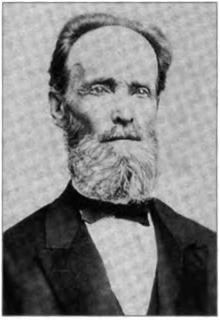
The Seventh Generation of Lawtons—Charles D. Lawton and Susan Houghteling. Having discussed Susan A. Houghteling’s ancestors, let us now return to her life with Charles D. Lawton. Recall that he was a prominent lawyer and they were living in Clyde, New York. In 1838, Charles and Susan started to raise a family.
During the next 15 years they had eight children, all boys, of which Frank, the youngest, was our direct ancestor. Three of the children died before the age of three years. The first four and the last two were born at Clyde, New York.
1. Charles A. Lawton was born 5 April 1838 in Clyde, Wayne County New York. He married Fanny Bingham 26 April 1863 at Indianapolis, Indiana. She died 5 June 1866 in Indianapolis, Indiana. Charles A. Lawton married a second time to Elizabeth Daily at New Orleans, Louisiana, on 19 May 1868. She was born 18 March 1847 in Madison, Indiana, and died 26 Dec. 1910. Charles and Elizabeth (Daily) Lawton had 4 children:
- Susan A. Lawton. Born 23 May 1869 in St. Louis, Missouri.
- William D. Lawton. Born 17 Dec. 1871 in St. Louis, Missouri. He married Ella Eoff at St. Louis, Missouri, on 2 July 1901. He became interested in the history and genealogy of the Lawton family and did extensive research. In 1919, while in New York, he published a six-page type written manuscript, on which virtually all of our information on the first six generations of Lawtons in the United States and their origins in England is based. William D. Lawton and Ella Eoff had 3 children: William D. Lawton. Born 2 Aug. 1903 in Topeka, Kansas. Chapline Eoff Lawton. Born 6 Nov. 1906 in Ridgewood, New Jersey. Elizabeth McC. Lawton. Born 12 April 1909 in Ridgewood, New Jersey.
- Fannie B. Lawton. Born 5 June 1874 in Memphis, Tennessee.
- Charles A. Lawton. Born 19 Nov. 1869 in Kirkwood, Missouri.
2. James H. Lawton was born on 15 Feb. 1840 in Clyde, Wayne County, New York. He died on 5 April 1842 in Clyde at age 2 years, 1 month, and 20 days. He was buried first in the “old Clyde cemetery” then in 1860 transferred to the newer Maple Grove Cemetery in Clyde.
3. George C. Lawton was born on 22 Oct. 1842 in Clyde, Wayne County, New York. He later became a physician, and married Mary Lyons on 28 Nov. 1872. He died at McPherson [Kansas?], on 22 March 1882.
4. Richard Lawrence Lawton was born on 1 April 1844 in Lyons [Ash says Clyde], Wayne County, New York. He died there on 23 Sept. 1844 at age 5-6 months of whooping cough, and was buried first in the “old Clyde cemetery,” then in 1860 transferred to the newer Maple Grove Cemetery.
5. William D. Lawton was born on 10 March 1846 in Lyons, Wayne County New York. In about 1874 he moved to San Francisco, California, and by 1876 owned a shirt manu facturing company named W. D. Lawton & Co. and located first at 9 Post St., then with a second location at 608 Market St. By about 1879 William was employing his younger brother, Frank, in the shirt-making business. The last listing for William D. Lawton in the San Francisco city directory is for 1884, at which time he would have been age 46. Don Lawton recalls that in 1917 “Uncle Will” was living in New Jersey. He would have been age 71.
6. Henry Watson Lawton was born on 20 or 21 June 1848 in New York City, New York. He apparently moved to St. Louis, Missouri, for an undated photograph taken in that city and titled “Watson Lawton” shows him in his 30s. He died in about 1890 in California.
7. Robert Lawton was born on 28 Dec. 1850 in Clyde, New York. He died there on 10 Sept. 1851, at the age of 8 months, and was buried first in the “old Clyde cemetery,” then in 1860 transferred to the newer Maple Grove Cemetery, in Clyde.
8. Frank Houghteling Lawton, the youngest of the Lawton children, was born on 29 Dec. 1852 at Clyde, Wayne County, New York. He later became the father of the Lawton family that is at the center of our story.
In 1844 the Charles D. Lawton family moved from Clyde to Lyons, New York, since Charles had been elected District Attorney there. They resided in Lyons from 1844 to 1848.
From Lyons, the family moved to New York City, where Charles continued his law practice. His brother, Cyrus Lawton, was already established there. But within a year, probably in 1850, Susan and her son Frank returned to Clyde, where they would spend the rest of their lives. Nice photographs of each of them were taken in Clyde in 1872.
Charles D. Lawton died on 31 August 1877 in Clyde, at age 75, after more than 40 years residence in that town. A formal service was held in Clyde, and for it an 8-page brochure was published. On the cover was written:
86 CHARLES D. LAWTON AND SUSAN A. HOUGHTELING: THE SEVENTH GENERATION OF LAWTONS
“Jesus Christ, who hath abolished death and brought life and immortality to light.”
The Burial Service
of
The Protestant Episcopal Church,
(catholic, reformed and free)
at the funeral of
Charles D. Lawton,
Born September 7th, 1802, in Newport, R.I.
Died August 31st, 1877, in Clyde, N.Y.
A communicant of St. John’s Church, Clyde.
“These confessed that they were strangers and
pilgrims in the earth.”
Inside was printed each of the hymns, prayers, and responsive readings, plus the minister’s speech (which made no mention of Charles) and various quotes from the Bible.
On 3 September Charles was “received in the vault” at the Maple Grove Cemetery in Clyde, where three of his children already lay at rest. A nice obituary, which appeared in the Clyde Times of 6 September 1877, has been a major source of our information on his life.
It was apparently following Charles’s death, that his wife Susan, now 64 years old, went to California. She stayed there with her youngest son, Frank, first in San Francisco, then briefly in Berkeley. A nice photograph of her, taken on 27 May 1880 in San Francisco, still exists.
On 4 August 1884, Susan presented a large (11 pound, 101/2 by 121/2 by 31/2 inch thick) family Bible to her youngest son and his wife. On the front page she wrote in a large, elegant script: “Presented to Fannie and Frank by their mother with her best wishes, Susan A. Lawton, 1884.”
Susan died on Saturday, 24 July 1886, of heart disease, probably at her son’s residence in Berkeley. She had lived in California for nine years. Her obituary published on July 28, some 3,000 miles away in New York by the Wayne Press Democrat read:
Mrs. Lawton, relict (widow] of Mr. Charles D. Lawton, a farmer well-known of this village (Clyde] died at the residence of her son in San Francisco, Cal., last Saturday. The remains will he brought here for burial for interment by the side of her husband.
The obituary was inaccurate on two counts. First, since Frank’s residence was now Berkeley rather than San Francisco, Susan probably died in Berkeley. Second, Susan was buried the next day (25 July 1886) by her son at Mountain View Cemetery in Oakland, California, in a small plot (Plot 19, Lot 159), and never returned to New York.
Ten years later, on 26 October 1896 Frank had her remains moved to Plot 26, Lot 44, in the same cemetery. That plot now is the final resting place of many members of the Lawton and Shurtleff families.
Susan’s name is presently inscribed on the family tombstone, second from the top after her son, Frank. It reads: “Susan A. Lawton 1813-1886.” Note that her year of birth is written incorrectly. It should be 1812, since numerous sources show that she was born on 30 March 1812. The Mountain View Cemetery Records do not list her birth date, but they do list her age at death as 73 years, 3 months, 27 days. Since she died on 24 July 1886, that would theoretically make her birth date 29 March 1813. Not one of the many sources that list her birth date give that as the date.
In 1948 when Hazle Shurtleff died, her children, Lawton, Gene, and Nancy, and their spouses talked with Harry Lawton, the oldest living direct descendant of Frank Lawton, about replacing the old stone.
The old stone was designed to lie flat on the ground, so it was not easy to read and was not large enough to accept more names. Harry agreed that they might proceed to have a much larger upright stone installed. It was designed and installed on 21 October 1948 by Amador Monument Co. (which is located on Piedmont Ave., just outside the cemetery’s gates.)
The first seven names, starting with Hazle’s father, Frank Lawton, and ending with her sister, Helen, were copied to the new stone from the old one; Hazle’s name was inscribed below Helen’s.
Then in 1981 when Dorothy’s husband, Harry Peet, died, the one polished side was nearly filled with names, so Harry’s daughter, Eleanor, and Lawton Shurtleff arranged for the second side to be slabbed (recessed) and polished, and the stone was re-installed with the edge, newly inscribed with the Lawton name, facing the street. (see p. 229)
 Shurtleff & Lawton Families Genealogy & History - Second Edition (2005)