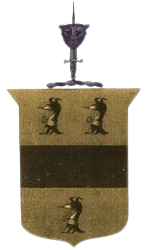
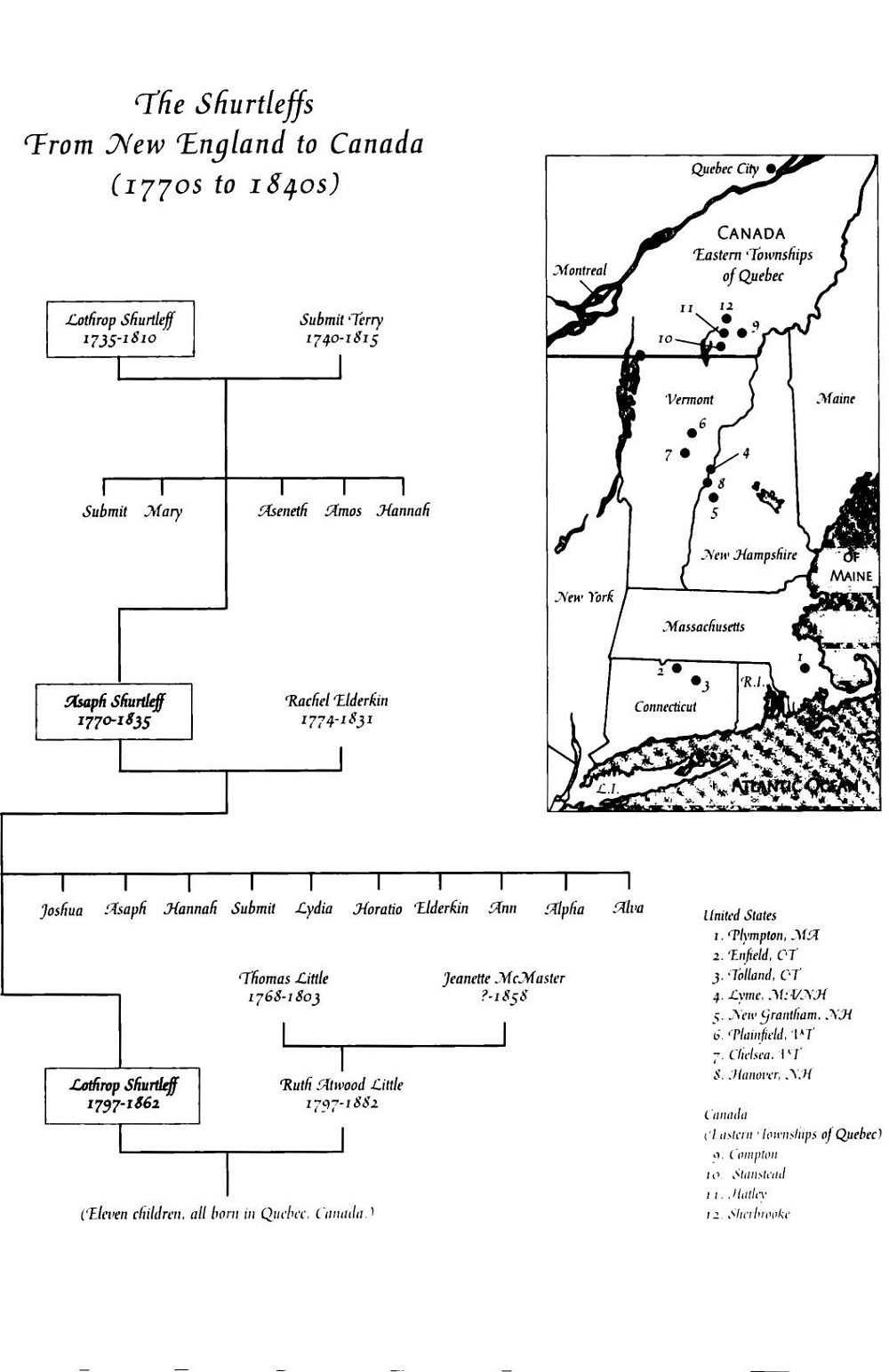
LOTHROP SHURTLEFF (1735-1810) AND SUBMIT TERRY (1740-1815),
ASAPH SHURTLEFF (1770-1835) AND RACHEL ELDERKIN (1774-1831),
LOTHROP SHURTLEFF (1797-1862) AND RUTH ATVVOOD LITTLE (1797-1882)
** All Text on these chapter pages has been copied verbatim – with permission – from this book: “Shurtleff Family Genealogy & History – Second Edition 2005” by William Roy Shurtleff & his dad, Lawton Lothrop Shurtleff ** Text in pdf convert to word doc – any spelling errors from the book may or may not have been fixed. **
The preceding chapter listed the first four generations of our direct ancestors in America.
This chapter tells the story of three more consecutive generations: Lothrop Shurtleff and Submit Terry (fourth generation); Asaph Shurtleff and Rachel Elderkin (fifth generation); Lothrop Shurtleff and Ruth Atwood Little (sixth generation). Since their lives were deeply intertwined, we have decided to combine their stories in one chapter.
After William Shurtleff’s arrival in America in the mid-1600s, the Shurtleff family resided in the northeastern states. For the first 130 years they lived in Massachusetts, and for the next 33 years in Connecticut, just south of Massachusetts.
Lothrop and Submit Shurtleff (Fourth Generation) Move Their Family to New Hampshire. The Shurtleffs began to move north in the late 1700s—along with thousands of other American families. Lothrop Shurtleff was born in Plympton, Massachusetts; his wife, Submit Terry, was born in Enfield, Massachusetts, probably in Hartford County. Some British colonies in North America had borders that were unclear or disputed. Enfield, located on the border of Massachusetts and Connecticut, was settled in about 1680 as part of Massachusetts, but in 1749 it was annexed to Connecticut. So when Lothrop and Submit were married on 15 November 1764 at her home town of Enfield, they were married in Connecticut. Their six children were all born in Tolland, Windham Co., Connecticut—except for their second, Mary (“Polly”), who was born on 4 May 1768 in Lyme, located near the Connecticut River about 150 miles north of Tolland in what would soon become New Hampshire. But in 1768 Lyme was in Massachusetts. In 1769 the Royal British Province of New Hampshire was created—carved off the top of Massachusetts and divided into five counties; Lyme was now in Grafton County New Hampshire. The last of Lothrop and Submit’s children was born in Tolland in May 1778.
Extensive genealogical information on Submit Terry’s ancestors may be found in Notes of Terry Families in the United States of America, by Stephen Terry (1887).
The Revolutionary War between Britain’s thirteen colonies and the mother country began on 19 April 1775 with the Battle of Lexington and Concord in Massachusetts. Records show that Lothrop was a soldier in Captain Charles Ellsworth’s company, which marched that very same day, on the alarm of 19 April 1775, from East Windsor, Connecticut. This was the day after Paul Revere went on his famous ride (“the 18th of April in ’75”) warning those in the area that the British army was coming—so Lothrop Shurtleff was active on the first day of the war, and may have ridden with Paul Revere. Interestingly, he was actually paid money for those five days of military service!
The turning point of the war, in favor of the Americans, came in October 1777 at Saratoga, in upstate New York, when the colonists won their first big battle, forcing the surrender of many British troops, and leading to France’s entry into the war on the side of the colonists. The war ended in 1781 at Yorktown, Virginia, when General George Washington and France’s Compte de Rochambeau forced the surrender of British troops under General Cornwallis after a long siege. In 1783 the war officially ended with the Peace of Versailles and British recognition of American independence.
We do not know exactly when or why Lothrop decided to leave Connecticut and move his family far to the north, to New Grantham, New Hampshire. If they left during the Revolutionary War, it was probably to get out of the war zone. We also do not known why they chose the town of New Grantham—located about 20 miles south of Lyme, New Hampshire. The trip must have been a long and difficult one since there were few good roads at the time in New Hampshire; they may well have traveled up the Connecticut River—which would have made the journey easier.
The 1790 U.S. census for New Grantham, Cheshire County, New Hampshire lists one “Lathrop Shartliff” as head of a family of six—three males and three females. This Lathrop was almost certainly our Lothrop Shurtleff. Of the “free white males,” three were age 16 or older [Lothrop, Asaph, Amos]. Of the “free white females,” three were age 16 or older [Submit Terry, Asenath, and Hannah]. There were no “other free people” or “slaves” in the household. Note: The names in square brackets are inferred from the two Shurtleff genealogies by Benjamin Shurtleff (1912) and Roy Shurtleff (1976). In 1790 Asaph, our direct ancestor (fifth generation) was about age 21 and unmarried.
The book History of Cheshire and Sullivan Counties, New Hampshire, by D. Hamilton Hurd (1886) includes a detailed early history of Grantham from 1761. In 1788 the name of the town was changed from Grantham to New Grantham, “which name it retained until 1818, when its original name was restored… About midway through the town, running northerly and southerly, was Croydon Mountain, making a natural division of the town into east and west parts, and upon the top of the mountain was the centre of the town.” It was a poor place to farm, since the land was generally steep and rocky. The population grew from 333 in 1790 to 712 in 1800 to a peak of 1,036 in 1840. Although the names of hundreds of early settlers are given, no “Shurtleff” or “Shartleff” is among them. Why? This book was written more than 80 years after our Shurtleffs lived for at least 12 years in one small town of the two counties it discusses. Apparently they kept to themselves, held no public offices, left no descendants in these two counties, and did nothing important enough to warrant mention in the book.
Asaph Shurtleff (Fifth Generation) Marries Rachel Elderkin in Vermont. Asaph, a resident of New Grantham, married Rachel Elderkin on 31 August 1797 in Plainfield, Vermont—which was probably where she and her parents lived at the time. Born on 19 July 1774 in Tolland, Connecticut, she was the daughter of Joshua Booth Elderkin and Lydia Dennison. Since both Asaph and Rachel were born in Tolland, Connecticut, they may well have met there. After their wedding, the couple decided to stay in Vermont. Their first child, Lothrop Shurtleff (our direct ancestor, sixth generation), was born on 8 December 1797 in Chelsea, Orange Co., central Vermont.
Vermont was still a wild and revolutionary place. There were few roads. Until 1777 Vermont had been part of New York. But that year Vermont split off from New York and proclaimed itself an independent republic—independent of New York, the United States, and Britain. Also in 1777 Vermont wrote and ratified its state constitution, which was the first to ban slavery. On 4 March 1791 Vermont became the first state added to the union, after the original thirteen. Soon Asaph and Rachel moved again, this time about 45 miles to the southeast, to New Grantham, New Hampshire, where Asaph’s parents, Lothrop and Submit, were still living. There their second and third children were born in August 1799 and June 1801.
The 1800 U.S. census for New Hampshire shows that our “Lathrop Shartliff” was still in New Grantham, but now he as was head of a much larger family. The size and composition of the family (six males and four females) seem to indicate that at least two families (Lothrop’s and Asaph’s) were living together. Of the “free white males,” two were under the age of ten years [Asaph’s Lothrop and Joshua B.], one was age 1016 [unknown], one was 16-26 [Amos], one was 26-45 [Asaph], and one was age 45 or older [Lothrop, Sr.]. Of the “free white females,” one was age 10-16 [unknown], two were 16-26 [Rachel Elderkin and Hannah], and one was 45 or older [Submit Terry]. There were no “other free people” in the household. Again, the names in square brackets are inferred from our two Shurtleff genealogies.
The 1801 tax records for New Grantham show that Asaph owed (and probably paid) the following: Town tax $0.76. State tax $7.62. County tax $30.63. School tax $2.59.
Two Shurtleff Families Decide to Move to Quebec, Canada. Then in about 1802 these adventurous families decided to make the biggest move of their lives: they left the United States and moved north into the wilderness of Lower Canada—an area known today as the Eastern Townships of Quebec (Cantons de l’Est in French). During the 1800s, most residents of the Eastern Townships came from either the United States or England, and spoke English rather than French.
They were not the first Americans to move to Canada. John Adams, our second president, said that during the American Revolution, the colonial population divided up into one third that took to arms, one-third that was either openly or secretly loyal to the British, and one-third that didn’t give a damn. Lothrop Shurtleff took up arms.
Those in the second group were branded “Loyalists” or “United Empire Loyalists” and most were treated harshly during and especially after America won the war. Quakers from Pennsylvania, most of whom had refused (on principle) to fight, were generally treated with compassion. But many of the rest lost their houses and businesses, and some had to pay double or triple taxes. In 1782 and 1783 they were forced into exile in great numbers—to Canada, the West Indies, or back to England. Since the British government controlled Canada, it offered Loyalists free land there, not far from home. The offer was eagerly accepted and from 25,000 to 30,000 Americans left their homes and settled in the British townships of what is today southern Ontario, just north of the New York border. At the same time a few hundred families settled in the townships of what is today southern Quebec, south of the St. Lawrence River, east of the River Richelieu / Montreal, and just north of Vermont and New Hampshire. This area was known as the “Eastern Townships.” Our Shurtleffs, who were not Loyalists, did not immigrate to the Eastern Townships until 20 years later.
Brief Chronology of Early Quebec. For centuries the French and British had struggled for control of Canada and Quebec. Yet when our Shurtleffs went there in about 1802, there was actually no country named “Canada,” and no province named “Quebec,” so a brief chronology might be useful:
1534. Jacques Cartier of France reached the Gulf of St. Lawrence and claimed Quebec for France. This was long before any British claim in North America.
1608. Samuel de Champlain of France established Quebec City, the first permanent European settlement in today’s Canada. The previous year (1607) the British established Jamestown, the first English settlement in America.
1663. King Louis XIV made the Quebec region a royal province called “New France.”
1759. The British captured Quebec City during the French and Indian War.
1763. Britain acquired Quebec by the Treaty of Paris. France had now been driven from North America.
1774. The British Parliament approved the Quebec Act, extending the Province of Quebec’s borders far to the south into the Ohio Valley, Illinois, down the Mississippi River, along the entire western frontier of the 13 colonies, and as far south as northern Florida. Those in the 13 colonies were outraged, and this grievance became another cause of the American Revolution. At the same time the British established French Canadian political and religious rights.
1790. George III, King of England, issued a proclamation establishing the first parliament in Canada.
1791. After losing the war with its 13 American colonies, Britain approved the Constitutional Act, which divided a much smaller Quebec into the provinces of Upper Canada (to the west, roughly today’s southern Ontario) and Lower Canada (to the east, roughly today’s southern Quebec). The Province of Lower Canada was divided into the districts of Montreal, Three Rivers, and Gaspe. The Eastern Townships were located in these three districts.
1803. Slavery was abolished in Lower Canada (Quebec) by the courts of Montreal.
1837. The Rebellion of 1837-39 begins in Quebec. The Quebec government, run by a small group of Englishmen, puts down the rebellion and exiles or jails the rebels. But the goals of political and electoral reform were eventually partly realized.
1841. The Act of Union joined Upper and Lower Canada under one government named “Canada.”
1842 Aug. 9. The Webster-Ashburton Treaty was signed, establishing the U.S. Canadian border from Maine to Minnesota, including New Hampshire, Vermont, and New York.
1867. The British North America Act created the Dominion of Canada and formed the province of Quebec. French and English were recognized as Quebec’s two official languages. The Act gave Quebec province direct control over education and civil law. Still, many French Canadians resented British rule.
Why and How Did Our Two Shurtleff Families Leave the United States for Quebec? In about 1802, Lothrop and Submit Shurtleff, with their sons, Asaph and Amos, and daughter Hannah, migrated north into the Eastern Townships of Upper Canada. The area was still wild and undeveloped. It was also cold. We may never know exactly why, how, or even when they went, but extensive research has enabled us to make some educated guesses —which also shed light on life in America around the year 1800.
Why did they go? Probably in search of better land. We have seen that the land in New Grantham, New Hampshire, was generally hilly and rocky. By contrast, the land in the Eastern Townships was said to be flat, fertile, and largely free of stones, but heavily forested. Moreover, the government of Lower Canada (Quebec) was encouraging immigration by offering large parcels of free land and a life free from taxation and government regulations—with plenty of elbow room and opportunities for a pioneering and adventurous way of life.
When did they go? Sometime between June 1801 when Asaph and Rachel’s third child, Asaph, Jr., was born in New Grantham, New Hampshire, and June 1803 when their fourth child, Hannah, was born in Compton Township, Quebec. Yet the family probably didn’t travel when Asaph, Jr., was a nursing infant, nor when Rachel was pregnant with Hannah, so this narrows the time to roughly the 12 months of 1802.
Leaving in the winter had the advantage of smooth sledding, even over smaller frozen rivers, but the disadvantage of winter cold and a shortage of fish and game in the wilderness with no real shelter. Leaving in the early spring had the disadvantage of muddy and slushy dirt roads as the snow melted, and the inability to plant spring crops. In the late spring, swollen rivers were hard to cross and often washed out dirt roads, making travel slow and difficult. Leaving in the summer had the advantage of good roads and good weather upon arrival to build a cabin and clear the land for fields, but the disadvantage of being unable to harvest the crops planted in the spring. Leaving in the fall, immediately after the harvest but before the first snows, had the advantages of leaving with a year’s supply of food (hopefully), good roads, and enough time to begin clearing land and to build a simple cabin before the snows started. So fall seems to be a good choice.
They may have all gone together in one trip or, as was fairly common at the time, the men may have gone ahead in the fall of the first year to stake a claim, build a rough cabin, and clear some land, then returned during early winter for a second trip with the women and children the next fall.
What means of transportation did they use? They probably traveled overland, using an oxcart to carry their food, possessions, and the women and little children. The men, boys, and older girls probably rode horses. Or Asaph may have sent his wife, children, and parents as far ahead as possible by stage, then met them in his oxcart with the family possessions. If they traveled in the winter, they might have used one or two sleighs. They almost certainly did not go the whole way by river, since the Connecticut River becomes too shallow, narrow, and rapid to navigate in northern Vermont and New Hampshire, and the narrowness and surrounding wilderness would make travel too dangerous.
What route did they take? They probably stayed on the New Hampshire (east) side of the Connecticut River following the route of today’s Highway 89, making their way northwest to Hanover, then used one of the three ferries near Dartmouth College (founded 1769) to cross the river. Although turnpikes (public toll roads) were being developed in New Hampshire and Vermont by 1800, it is clear that by 1802 there were not any good public roads, that would have been carrying stagecoach traffic, in the northern part of these states. Turnpikes were generally passable except during the spring thaw.
After crossing the river into Vermont, they probably picked up the well-traveled Bayley-Hazen Military Road, which followed the river north to Newbury, then headed north to Ryegate, up through the center of the state, meeting the ill-defined Vermont-Canadian border not too far from Compton Township (Twp.). General Jacob Bayley and Colonel Moses Hazen had constructed this road, starting in June 1776 from the mouth of Wells River in the south, during the Revolutionary War at the command of General George Washington to facilitate a possible invasion of Canada! The northern terminus was Hazen’s Notch in Westfield. After the war, this “road offered the only means of transportation to northern Vermont, and so it became an avenue of great importance” (see The Turnpikes of New England, by Frederic J. Wood, 1919 (p. 263-65); and On the Road North of Boston: New Hampshire Taverns and Turnpikes, by D. B. Garvin and J. L. Garvin, 1988). Our Shurtleffs may have stopped for a visit with Rachel’s parents in Plainfield, Vermont, where Asaph and Rachel had been married only about 5 years earlier.
How long did they journey take? The distance from New Grantham to Compton Twp., Quebec, is about 130-140 miles. At 25 miles per day they might have covered 100 miles in the first four to six days. But their rate would have slowed as they got farther north, through Derby Center, Derby Line, and Rock Island, then slowed further as they entered the Canadian wilderness and had to cut a trail through. For many families, the trip took five to six weeks.
Life in Quebec, Canada. On 7 February 1792, the Eastern Townships were first opened to settlement by Europeans by a proclamation issued by Sir Alured Clark, the British lieutenant governor of Lower Canada (Quebec). The first step was to survey the wilderness into townships (10 miles square = 64,000 acres), then to subdivide each township with Range (east-west) and Lot (north-south) lines to form parcels of land of about 200 acres. Each parcel is described by its Range and Lot number.
A good description of the general area where our Shurtleffs arrived in 1802 is given in The History of Stanstead County, Province of Quebec, by B.F. Hubbard (1874). It was a wilderness with no roads, no cities, no mail, no churches, no schools, and no newspapers. This land was dirt cheap (or free) and heavily forested with hardwoods of every description. Fish, sable, raccoon, mink, otter, beaver, moose, and deer provided food for the taking. So numerous were the wolves and bear that domestic livestock was difficult to raise. Instead the early settlers turned to growing corn, wheat, rye, oats, barley, buckwheat, and potatoes. For many years, potatoes were the principal crop, and the production of whiskey the major community effort.
From all reports it was a raw land and a tough and lonely life. In the earlier days, six or seven families shared a single shanty. To grind corn, one carried heavy bags on foot through dense woods, then traveled another 20 miles by canoe to the nearest mill. The closest neighbor was often 10 or more miles away. The first mail route between the Eastern Townships and the United States did not open until 1812.
In 1802, when our 10 Shurtleffs arrived in Quebec, their ages (rounded off to the nearest year) were: Lothrop 67 and Submit 63. Their three grown children: Asaph 33, Amos 28, and Hannah 24. Asaph’s wife, Rachel Elderkin, was 28, and their three young children were Lothrop 5, Joshua 3, and Asaph, Jr., 1. The age of Amos’s wife, Nancy Brown, is unknown. It must have taken considerable courage for Lothrop and Submit to have launched into a new life in the Canadian wilderness at their ages.
The first Shurtleff to be born in Quebec was Asaph’s fourth child, Hannah, on 10 June 1803, in Compton Twp.
Amos and Nancy Shurtleff apparently moved to nearby Stanstead shortly after the 10 Shurtleffs arrived in Canada, for on 19 September 1804 their first child, also named Lothrop (not our direct ancestor), was born in Stanstead. Their other two children were also born in Stanstead: Jonathan Brown Shurtleff on 6 August 1807 and Nancy Shurtleff on 20 September 1818.
In Quebec, in 1802, our Shurtleffs first settled in Compton Township, which is about 22 miles (as the crow flies) northeast of the New Hampshire border at Derbyline. There was much excellent farmland in this township, and many families came here from New Hampshire. Asaph Shurtleff, with his parents and a growing number of children, lived in this township from about 1802 to 1835. Eight of his children were born there between June 1803 (Hannah) and the twins Alpha and Alva (Feb. 1817).
Lothrop Shurtleff (Asaph’s father) lived with or near his son in Compton Twp., Quebec, Canada, until he died there on 1 April 1810 at the age of 74 years and 3 months. Six of his grandchildren had been born while he was alive.
Submit Terry (Asaph’s mother) lived in Compton Twp. for five more years. She died there on 18 December 1815 at the age of 75 years and 11 months. She had been alive for the birth of nine grandchildren. She and Asaph were probably buried side by side in Compton Twp., but we have no record of this.
Of Asaph and Rachel’s 11 children, six died in Canada (four in Quebec and two in Ontario) and five died in the United States (in Ohio, New Hampshire, Massachusetts, Nebraska, and New York).
Asaph and Rachel (fifth generation) eventually had 11 children, the first three born in Vermont and New Hampshire, and the last eight born in Compton Twp., Quebec, Canada:
- Lothrop Shurtleff, born 8 Dec. 1797 in Chelsea, Vermont. Married Ruth Atwood Little on 30 Dec. 1819 in Hatley, Quebec, Canada. Died 16 March 1862 in Hatley, Stanstead Co., Quebec. Buried at the Massawippi Cemetery there on March 19.
- Joshua Booth Shurtleff, born 2 Aug. 1799 in New Grantham, New Hampshire. Married Minerva Brown on 12 June 1828 in Queensbury, Warren Co., New York. Born on 22 Dec. 1794 in Queensbury, Warren Co., New York, she died on 7 Jan. 1872 in Alliance, Stark Co., Ohio. Joshua died 7 June 1864 in Cleveland, Ohio.
- Asaph Shurtleff, born 13 June 1801 in New Grantham, New Hampshire. Married Laura Bill on 24 Oct. 1822 in Hatley, Stanstead Co., Quebec, Canada. Died 1874 in Caledonia Spring, Prescott County, Ontario, Canada.
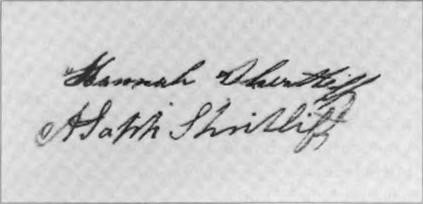
- Hannah Asaph Shurtleff, born 10 June 1803 in Compton Twp., Quebec, Canada. Married George Ferguson Pennoyer on 20 Sept. 1824 in Hatley, Stanstead Co., Quebec. Born 7 April 1802 in Compton Twp., Quebec, he was the son of Jesse and Martha (Ferguson) Pennoyer. He died in 1848 in Buckingham, Quebec. Hannah died 15 July 1842 in Caledonia Spring, Prescott County, Ontario, Canada. Note: She was the first Shurtleff born in Canada. The signatures of “Hannah Shurtleff” and her father, Asaph, appear on the marriage record (see below).
- Submit Shurtleff, born 4 June 1805 in Compton Twp., Quebec. Married Samuel Porter Carpenter on 9 March 1828 in Charleston [near Hatley], Stanstead Co., Quebec. Born 31 March 1803 in Berlin, Hartford Co., Connecticut, he died 12 Jan. 1870 in Colebrook, Coos Co., New Hampshire. Submit died 28 Feb. 1885 in Colebrook, New Hampshire.
- Lydia Asa Shurtleff, born 22 May 1808 in Compton Twp., Quebec. Married Harvey McLeod on 28 Dec. 1828 in Ascot Corner, Sherbrooke Co., Quebec. Born in Compton Twp., Quebec, Harvey died in 1836 in Boston, Massachusetts. Lydia died 11 March 1834 in Boston, Massachusetts.
- Horatio Nelson Shurtleff, born 20 June 1810 in Compton Twp., Quebec. Married Amy Brown on 6 April 1831 in Queensbury, Warren Co., New York. Born 21 Oct. 1806 in Queensbury, Warren Co., New York, Amy died 8 Sept. 1872 in Branch Co., Michigan. Horatio died 31 Aug. 1887 in Madison, Madison Co., Nebraska.
- Elderkin Shurtleff, born 4 Dec. 1812 in Compton Twp., Quebec, died unmarried 23 Feb. 1887 in Greenwich, Washington Co., New York.
- Ann Jane Shurtleff, born 25 May 1815 in Compton Twp., Quebec, died unmarried after 31 Aug. 1888 in Hatley, Quebec, Canada.
- Alpha R. Shurtleff, a twin, born 15 Feb. 1817 in Compton Twp., Quebec, died unmarried 1831 in Compton, Quebec.
- Alva T. Shurtleff, a twin, born 15 Feb. 1817 in Compton Twp., Quebec, died unmarried 18 March 1817 in Compton, Quebec.
During the life of Asaph Shurtleff of the fifth generation (1770-1835): The war of 1812 between Britain and the U.S. began; The U.S. won in 1814. Spain ceded Florida to the U.S. (1819). The Monroe Doctrine was enunciated, opposing European intervention in the Americas (1823). The Mormon Church was organized by Joseph Smith in New York (1830).
Lothrop Shurtleff (sixth generation) Marries Ruth Atwood Little in Hatley, Quebec. Asaph Shurtleff’s eldest child, Lothrop, named after his grandfather, was born on 8 December 1797 in Chelsea, Vermont. At age five, he traveled with his parents and grandparents to Quebec, where he grew up in the wilderness. On 30 December 1819 he married Ruth Atwood Little in Hatley, Quebec. Hatley Twp. is adjacent to Compton Twp., located just to the west.
They must have been married in the Old North Church, which was built in 1818—the first church built in that area and the only one existing in 1819. It was Episcopalian, which must have been the Shurtleffs’ denomination, since only Episcopalians could be married there.
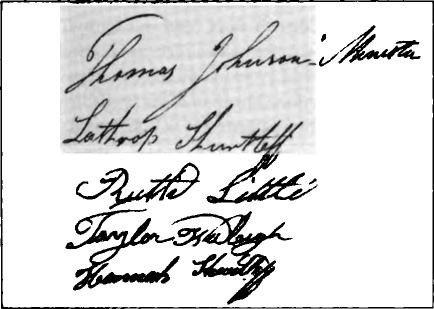
Ruth was born on 24 September 1797 in Fishersfield (now Newbury), New Hampshire, the second child and second daughter of Thomas Little and Jeannette McMaster, who were married on 26 March 1795. Ruth’s father, Thomas, was born on 16 September 1768, the son of Bond Little and Ruth Atwood, who were married on 16 March 1762. Thomas died in Newbury, New Hampshire, on 11 August 1803. We do not know when his wife died. The record of this 1819 marriage appears in a very small book—like one carried in a minister’s pocket. It reads: “On this thirtieth day of December, one thousand eight hundred & nineteen Lathrop Shurtleff of Compton, Farmer & Ruth Atwood Little of Hatley, Spinster, both of major age—were married by Banns in the presence of his Brother & the other subscribing witnesses by.” Five names are signed: Thomas Johnson—Minister, Lathrop Shurtleff, Ruth Little, Taylor Wadleigh, and Hannah Shurtleff. Note that both Lathrop and Hannah spelled their surname “Shurtleff.” Taylor Wadleigh was the first cousin of Ruth Atwod Little.
We don’t know how or when Lothrop met Ruth Atwood Little, or exactly when she went to Quebec. But we do know that in 1798 Bond Little and his wife, Ruth Atwood, both natives of New Hampshire, settled in Hatley, Quebec, on No. 15, 1st Range (Hubbard 1874, p. 252). Since Ruth Atwood Little was born in 1797 in New Hampshire, she had moved to Quebec as an infant—just as her husband-to-be Lothrop Shurtleff had.
The Shurtleff and Little families intermarried and became very close to one another after they immigrated to the Eastern Townships from New England at about the same time. Bond and Ruth Atwood Little, natives of New Hampshire, arrived in Hatley Twp., Quebec, in 1798 with their sons Taylor Little and Abhijah Little (Ruth Atwood’s uncles); they settled on No. 15, 1st Range of Hatley. This was three years before the Shurtleffs arrived in 1802. Did the Littles know the Shurtleffs in New Hampshire? Could they have influenced the Shurtleffs’ decision to move to the neighboring Compton Township in Quebec?
Abhija’s daughter, Mary Abijah Little, was born on 18 August 1803 in Hatley; she married Joel Shurtleff, Jr., on 25 January 1823 in Hatley. Mariette Little, the daughter of Bond Little and Mary Bean (of New Hampshire), married Thomas Shurtleff (brother of Samuel Matthew Shurtleff) on 28 January 1852, also in Hatley. Ludo Burrill Little, the son of Joseph Little and Mary Cobleigh (of Lyman, New Hampshire), married Mary Elizabeth Shurtleff (sister of Samuel Matthew Shurtleff) on 2 January 1865 in Bourbon County, Kentucky. Their only child, Hazen Jesse Little, had an unusual first name. Bond Little, who married Ruth Atwood in 1762, had served under Capt. John Hazen in the expedition against Crown Point (a French stronghold in northeast New York during the French and Indian War) in 1758, and not long after settled in Weare, New Hampshire. In the early 1800s Bond Little moved with several of his children (including Taylor and Abijah) to Hatley, Quebec. Is it a coincidence that “Hazen” is also in the name of the Bayley-Hazen Military Road, which our Shurtleffs followed in 1802 when they immigrated to Quebec!
The Descendants of George Little…, by George Thomas Little (1882) contains an excellent genealogy of this family, plus much accurate information about our Shurtleff ancestors. Records for 44 Littles appear in our genealogical database.
The 1825 census of Compton Township showed three Shurtleff families living there. The family of “Asaph Shurtliff” had 10 members, that of “Asaph Shirtleff, Jr.” had four members, and that of “Joel Shirtliff” had five members. Joel and his wife, Eunice Scott, had arrived in Compton Twp. from Vermont by July 1804, when their second child, Lyman Shurtleff, was born there. Lyman was the second Shurtleff child to be born in Canada.
Asaph’s wife, Rachel Elderkin Shurtleff, died in Jan. 1831 in Compton Twp., Quebec, Canada. She had been alive during the birth of five of her grandchildren. Her husband, Asaph Shurtleff, died four years later on 8 September 1835 at the same place. He had been alive for the birth of nine grandchildren. Rachel and Asaph were probably buried in Compton, but we have no proof; many of Compton’s early graveyards and their burial records no longer exist. Of the six Shurtleffs known to have been buried in the Compton Cemetery, the first was Joel Shurtleff (our relative), who died 16 April 1828 at age 61. His wife, Eunice, was the next to be buried there, on 8 May 1846.
History of Compton County, by L. S. Channell (1896), gives a history and geography of the county, of each of its townships, and many villages, plus biographical sketches of many of the pioneers and a county map. Compton Township (p. 166) was created on 31 Aug. 1802 and granted to Jesse Pennoyer, Nathaniel Coffin, Joseph Kilbome, and their many associates. The Shurtleff and Pennoyer families later intermarried. The village of Compton was not created until 12 June 1893. “There are no mountainous elevations in Compton. It is a rich agricultural township, and has advanced ahead of other townships in the County in its material interests… Dairying is the common industry, and cheese and butter are extensively made. It is specially noted throughout America for its high class of blooded stock, in both cattle and horses.” Compton Township was formed in 1802 (in the Three Rivers District of Lower Canada), Compton County in 1853, and Compton Village in 1893. Our Shurtleffs are not mentioned in this book, which is surprising since Asaph and his family were among the early arrivals in the township and county, and they lived there for more than 30 years. However they apparently held no public office and did not otherwise distinguish themselves. Perhaps most important, the few Shurtleffs left in the Compton County in 1896 were unaware of the family’s early history there.
Lothrop and Ruth (sixth generation) eventually also had 11 children, all born in Quebec, Canada. The first two were born in Sherbrooke, and the last nine in Hatley.
- Helen Rosaline Shurtleff, born 6 April 1822 in Sherbrooke, Sherbrooke Co., Quebec. Baptized 26 Oct. 1832 in Charleston, Hatley Twp., Quebec. Married Aaron DeWitt Forman on 11 March 1846 in Cato, Cayuga Co., New York. Born 4 April 1823 in Freehold, Albany Co., New York, he was the son of unknown parents. He died 26 April 1883 in North Wolcott, Wayne Co., New York. Place of burial: Unknown. Helen died 17 Feb. 1896 in Nevada City, Nevada Co., California.
- Solon Shurtleff, born 24 May 1824 in Sherbrooke, Quebec. Baptized 26 Oct. 1832 in Charleston, Hatley Twp., Quebec. Married Rebecca Johnson on 29 Sept. 1848 in Hatley, Stanstead Co., Quebec. Born 20 Jan. 1825 in Hatley, Stanstead Co., Quebec, she was the daughter of Zacheas and Laura (Hovey) Johnson. She died on 16 Sept. 1886 in Somerville, Middlesex Co., Massachusetts. Solon died 19 Feb. 1871 near Nevada City, Nevada Co., California. Buried in Nevada City.
- Lucia Sultana Shurtleff, born 18 April 1826 in Hatley, Stanstead Co., Quebec. Baptized 26 Oct. 1832 in Charleston, Hatley Twp., Quebec. Married Tyler Harry Moore Hyndman on 4 March 1846 in Lennoxville, Sherbrooke Co., Quebec. Born 15 March 1822 in Sherbrooke, Sherbrooke Co., Canada, he was the son of unknown parents. He died 20 Sept. 1902 in North Wolcott, Wayne Co., New York. Lucia died 2 Sept. 1882 in Wolcott, Wayne Co., New York.
- Mary Jane Shurtleff, born 26 Sept. 1829 in Hatley, Stanstead Co., Quebec. Baptized 21 June 1832 in the Anglican church, Charleston, Hatley Twp., Quebec. Died unmarried 21 June 1832 in Hatley, Quebec. Buried in the Anglican Cemetery, Charleston, Hatley Twp., Quebec. Note that Mary Jane was baptized on the day she died. This probably prompted Lothrop and Ruth to have their other children baptized on 26 Oct. 1832.
- Thomas Shurtleff, born 24 June 1830 in Hatley, Stanstead Co., Quebec. Baptized 26 Oct. 1832 in Charleston, Hatley Twp., Quebec. Married (1) Mariette Little on 28 Jan. 1852 in Compton Twp., Quebec. Born 18 May 1830 in Hatley, Stanstead Co., Quebec, she was the daughter of Bond and Mary (Bean) Little. She died 9 Oct. 1867 in Hatley, Stanstead Co., Quebec, and was buried on Oct. 11 at the Adventist Cemetery in Stanstead. (2) Lodema Caroline Percival on 16 Sept. 1868 in San Francisco, California. Born 11 June 1843 in Hatley, Stanstead Co., Quebec, she was the daughter of Charles Lewis and Emily (Kezar) Percival. She died 12 Feb. 1896 in Nevada City, California. Place of burial: Unknown. Thomas died 25 May 1912 in Cloverdale, Sonoma Co., California. Place of burial: Unknown.
- Asaph William Shurtleff, born 22 April 1832 in Hatley, Stanstead Co., Quebec. Baptized 26 Oct. 1832 in Charleston, Hatley Twp., Quebec. Married (1) Kate Crockett on 13 Aug. 1856 in Sterling, Cayuga Co., New York. Born 16 Dec. 1835 in Baltimore, Baltimore Co., Maryland, she was the child of unknown parents. She died on 26 Aug. 1859 in Paris, Bourbon Co., Kentucky. Place of burial: Unknown. (2) Louise Bevier DeWitt on 23 April 1862 in Liberty, Sullivan Co., New York. Born 12 Aug. 1830 in Aurelius, Cayuga Co., New York, she was the daughter of unknown parents. She died on 9 May 1907 in Weedsport, Cayuga Co., New York, and was buried at the Weedsport Rural Cemetery. Asaph died 6 Sept. 1907 (only four months later) in Weedsport, Cayuga Co., New York. He, too, was buried in Weedsport Rural Cemetery.
- John Alpha Shurtleff, born 13 May 1835 in Hatley, Stanstead Co., Quebec. Baptized 10 Dec. 1839 in Hatley Twp., Stanstead Co., Quebec. Died unmarried 18 Jan. 1854 in Hatley, Quebec. Buried in Universalist Cemetery, Canton Ascot, Quebec.
- Amos Shurtleff, born 29 April 1837 in Hatley, Stanstead Co., Quebec. Baptized 10 Dec. 1839 in Hatley Twp., Stanstead Co., Quebec. Married Mary Bringham on 11 Dec. 1873 in Rusk, Cherokee Co., Texas. Born 29 May 1849 in Clayton, Barber Co., Alabama, she was the daughter of unknown parents. She died on 22 Nov 1938 in Houston, Harris Co., Texas. Place of burial: Unknown. Amos died 15 March 1883 in Wichita Falls, Wichita County, Texas. Place of burial: Unknown.
- Samuel Matthew Shurtleff born 12 Aug. 1839 in Hatley Twp., Stanstead Co., Quebec. Baptized 10 Dec. 1839 in Hatley Twp., Quebec. Married (1) Varilla Marston in Aug. 1863, Bourbon Co., Kentucky. Born 28 May 1841 in Ruddels Mills, Bourbon Co., Kentucky, she was the eldest child of Ebenezer Marston and Mary B. Moore. Varilla died 5 Jan. 1883 in Nevada City, California. Buried there 8 Jan. 1883 in Pine Grove Cemetery. (2) Charlotte Avery Meek (widow of John Meek) on 6 Dec. 1885 in Grass Valley, California. She was born 13 Dec. 1849 in Brecksville, Cuyahoga Co., Ohio, the daughter of George J. Avery, Jr. and Maria Louisa Avann. She died 16 Sept. 1926 in Berkeley, California. Buried 18 Sept. 1926 at Chapel of Memories, Oakland, California. Samuel died 24 Aug. 1889 in Nevada City, Nevada Co., California. Buried there 26 Aug. 1889 in Pine Grove Cemetery. Roy Shurtleff (1887-1985) was the only child of Samuel Matthew and Charlotte.
- Alice Jane Shurtleff, born 5 July 1841 in Hatley, Stanstead Co., Quebec. Baptized 10 Sept. 1841 in Hatley Twp., Stanstead Co., Quebec. Married Robert Humphrey Forman on 18 May 1864 in Wolcott, Wayne Co., New York. He was born 12 Oct. 1841 in Freehold, Greene Co., New York, the son of unknown parents. He died 12 Aug. 1911 in Loomis, Placer Co., California. Place of burial: Unknown. Alice died 10 July 1908 in Loomis, Placer Co., California. Place of burial: Unknown.
- Mary Elizabeth Shurtleff, born 26 Dec. 1843 in Hatley, Stanstead Co., Quebec. Baptized 4 Nov. 1844 in Hatley Twp., Stanstead Co., Quebec. Married Ludo Burrill Little on 2 Jam 1865 in Bourbon Co., Kentucky. Born 24 Oct. 1838 in Lyman, New Hampshire, he was the son of Joseph and Mary (Cobleigh) Little. He died 2 March 1890 in Nevada City, California. Buried there at Masonic Cemetery. Mary died 8 Aug. 1899 in Nevada City Nevada Co., California. Buried 11 Aug. 1899 at Masonic Cemetery, Nevada City California.
On 10 Dec. 1839, John Alpha, Amos, and “Matthew Samuel,… children of Lathrope Shirtliff Surgeon of Hatley & Ruth his wife were privately baptized in presence of the subscribing witnesses by me, C. Jackson Minister of Charleston, Hatley.” Lothrop and Ruth Shurtleff signed their names in the minister’s small baptismal book. Note that both surnames are spelled “Shurtleff.” Lothrop’s occupation is given as chirurgien (surgeon).
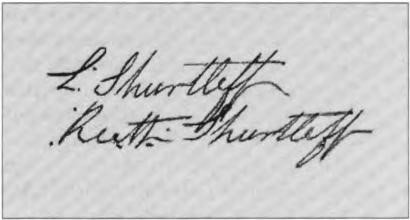
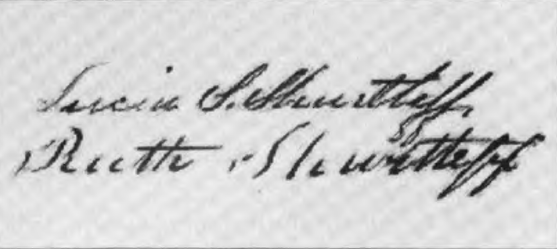
On 4 November 1844, “Mary Elizabeth, daughter of Lathrope Shirtliffe Surgeon of Hatley & Ruth his wife” were baptized by C. Jackson Minister of Charleston, Hatley, “in presence of her Mother and sister.” Lucia S. Shurtleff (her elder sister) and Ruth Shurtleff (her mother) signed their names in the baptismal record. Note that both surnames are spelled “Shurtleff.”
Starting with Lothrop and Ruth Atwood (Little) Shurtleff, many of our Shurtleffs lived in Hatley Township, just to the west of Compton Township. According to the book The Story of Hatley (1949), the main street was laid out in 1810 1813. The first post office opened in 1817. The Reverend Charles Stewart, “a man of great influence, much loved and respected by the people of Hatley,” was there by 1818. Within Hatley Twp., the villages of Charleston (named after Rev. Charles Stewart), East Hatley, North Hatley, and West Hatley, were not far apart.
In most books and articles published during the 1800s in which our Shurtleffs are mentioned, their surname is spelled “Shurtliff,” but also “Shirtleff” and “Shirtliff.”
Samuel’s father, Lothrop Shurtleff, died on 16 March 1862, at age 64, in Hatley, Quebec. His wife, Ruth Little Shurtleff, died about 20 years later, on 16 December 1882, at age 85, in North Wolcott, Wayne County, New York.
During the life of Lothrop Shurtleff of the sixth generation (1797-1862): After the battle at the Alamo, Texas declared independence (1836). The first immigrant wagon train reached California (1841). The first message was sent over a telegraph line (1844). The Gold Rush began in California (1849). California became a state (1850). Commodore Perry opened Japan (1853). Abraham Lincoln was elected president (1860). The Pony Express began operation (1860). The Civil War began (1861).
The family of Lothrop and Ruth Shurtleff is one of the most remarkable described in this book. Both parents and all 11 children were raised in the Canadian wilderness. Yet Lothrop, the father, became a physician, who practiced his profession in Quebec—mainly in Hatley and Stanstead. Solon, the eldest son, also became a physician; he graduated from Geneva Medical College in New York, but began his practice in 1853 near Hatley, Quebec. Thomas traveled to Kentucky in 1853 and taught school until 1861, then he moved California in 1861; he owned land and was on the Board of Town Trustees in Nevada City. Asaph William became a lawyer and school teacher in Kentucky and New York. Amos also became a lawyer in Kentucky. Samuel Matthew was a farmer and school teacher; he traveled to California in 1878. Mary Elizabeth graduated in 1873 with an M.D. degree from the University of Michigan, where women were first admitted to the Medical School in 1870; thus, she was an early American woman physician with a university degree. In 1865 she traveled to California with her husband, Ludo Little, who was an attorney.
For nearly 50 years the Shurtleffs called the Eastern Townships in Quebec their home, probably living off the land—hunting, fishing, and farming.
By the mid-1800s, more than eleven of the elder Lothrop’s grandchildren (including Samuel’s father, Lothrop) and twenty-three of his great-grandchildren, including Samuel, had been born in the immediate area. Quebec had become the new home for three generations of our direct Shurtleff ancestors.
Quebec had also become home for many other Shurtleffs less directly related. As of May 2002, we have solid records of 99 Shurtleffs (relatives with the surname Shurtleff) who were born in Quebec, and 41 Shurtleffs who died in Quebec. Moreover, at least 236 close relatives with various surnames (such as the children of Shurtleff women) were born, christened, died, or buried in Quebec.
Our direct Shurtleff ancestors lived in only three townships in the Eastern Townships: Compton, Hatley, and Sherbrooke. However, their descendants lived in the nearby towns of Ascot Corner, Barnston, Clifton, Coaticook, Fitch Bay, Lennoxville, Melbourne, Shipton, Stanstead, Waterville, and Winslow.
Some Shurtleff families immigrated to Quebec from the United States, then became very close to our direct ancestors whom they first met in Canada! Joel Shurtleff (mentioned earlier), for example, was born in 1767 in Barre, Massachusetts. He and his wife, Eunice Scott, and six young children moved to Compton Township in about 1802/1803. Their first child to be born there,
Lyman Shurtleff, was born in July 1804. The two parents died Compton—just like Lothrop and Submit Shurtleff—and may have been buried in the same cemetery. Many of Joel’s children moved to Hatley—just like the children of Asaph and Rachel.
Caleb Shurtleff, eldest son of Joel, was born in 1790 in Barre, Vermont. In 1814 he married Sarah Place in Hatley. Their first two children were born in Compton (where our Shurtleffs lived) in 1814 and 1816. Then they moved to Hatley, where from 1817 to 1824, they had five more children. In December 1819, Lothrop Shurtleff and Ruth Little were married in Hatley, and from 1826 to 1843 had nine children in Hatley. Since Hatley was a tiny town in a huge wilderness, these two Shurtleff families must have known one another.
Quebec was a wild and lonely land, where bonds were forged that would bind this family for decades to come. Thus began the odyssey, which over the next hundred years would take members of this Shurtleff family from New England to Canada, south to New York, and on to Kentucky, Illinois, and, finally, to the goldfields of northern California.
After the death of his first wife, Varilla, Samuel Matthew Shurtleff (Roy Shurtleff’s father) married Charlotte Louise Avery Meek (the widow of John David Meek). We will now look at Charlotte’s ancestors, the Avery and Avann families, and at her first marriage to John David Meek. Then, in Chapter 5, we will continue the story of the Shurtleffs and of Samuel Matthew Shurtleff.
 Shurtleff & Lawton Families Genealogy & History - Second Edition (2005)