In July 1623…
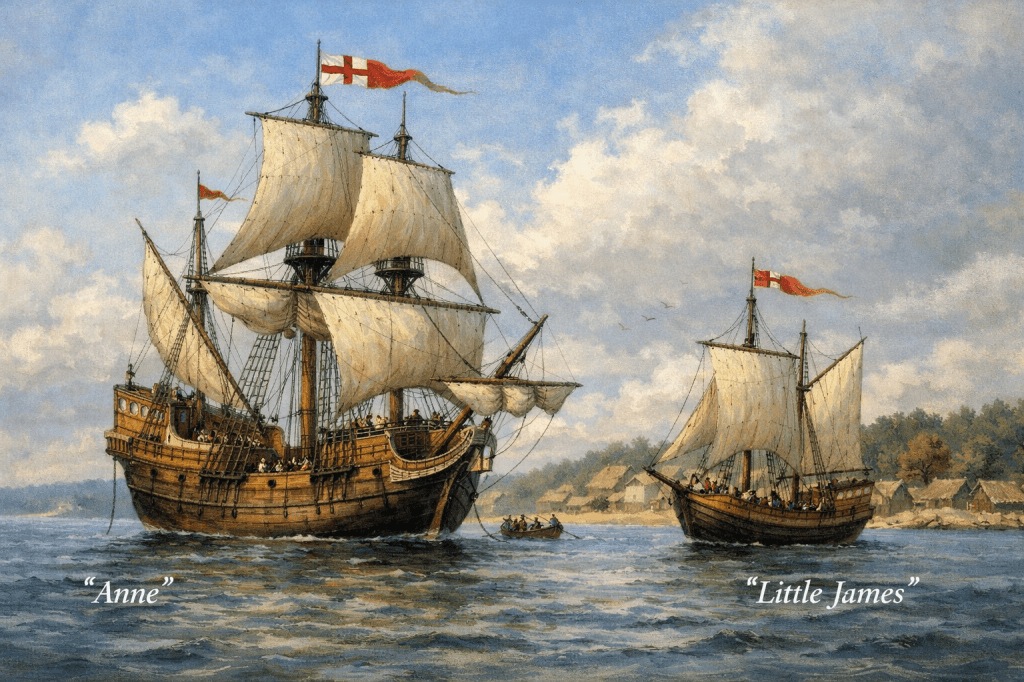
… a modest 140-ton ship named Anne dropped anchor in Plymouth Harbor, carrying hope, reinforcements, and badly needed supplies to a struggling English colony. Accompanied by the smaller pinnace Little James, the Anne delivered roughly sixty settlers—men, women, and children—who would later be known as the “Old Comers,” a term used to distinguish early Plymouth settlers from later waves of New England immigrants.
This arrival marked one of the most critical turning points in Plymouth Colony’s early survival story.
The Voyage of the Anne and Little James
The Anne was a supply and passenger vessel of about 140 tons, while the Little James was a much smaller 44-ton pinnace intended to remain in the colony for fishing, transport, and defense. Both ships departed England together but were separated by storms, with the Anne arriving first in early July 1623 and the Little James about a week to ten days later.
Governor William Bradford later recorded that the Anne brought “about 60 persons” for the colony—some joining family members who had arrived on the Mayflower in 1620, and others seeking land and opportunity on their own.
These arrivals came during a period of hardship. A recent drought and food shortages had left Plymouth residents struggling, and the newcomers were shocked by the colony’s austere conditions.
Who Were the “Old Comers”?
There are no surviving original passenger manifests from the voyage, but historians reconstruct the passenger list from land records, wills, and colonial documents—especially the 1623 Division of Land, which assigned acreage to settlers.
Among the passengers commonly identified as arriving on the Anne and Little James were:
Family Members Reuniting with Mayflower Pilgrims
- Patience Brewster and Fear Brewster (daughters of Elder William Brewster)
- Hester Cooke and her children (wife of Mayflower passenger Francis Cooke)
- Bridget Fuller (wife of Samuel Fuller)
- Elizabeth Warren and her daughters (wife of Richard Warren)
- Margaret Hicks and her children
Independent Settlers and Families
- Anthony Annable and family
- Edward Bangs
- Robert Bartlett
- Christopher Conant
- Thomas Clark (to whom William was apprenticed to)
- George Morton and family
- Godbert Godbertson and family
- Timothy Hatherly
- John Faunce
- Nicholas Snow
- Francis Sprague
- Stephen Tracy and family
- Ralph Wallen
- Abraham Pierce
- Alice Southworth
- Manasseh Kempton
- Experience Mitchell
- Ellen Newton
- John Oldham and family
(and many others identified through land grants and genealogical research)
Together, these settlers formed a second foundational generation of Plymouth residents—reinforcing population, skills, and family life in the fragile colony.
Why the Anne Arrival Mattered
The arrival of the Anne and Little James was crucial for several reasons:
1. Population Stability
Many Mayflower settlers had died during the first brutal winter of 1620–1621. The 1623 arrivals replenished the colony’s population and allowed family reunification, strengthening social cohesion.
2. Economic Survival
The ships brought tools, supplies, and new settlers with useful skills, helping Plymouth expand agriculture, fishing, and trade.
3. Political and Social Development
The “Old Comers” later received land and became established property holders, forming the backbone of Plymouth’s early governance and society.
Historical Legacy
Today, descendants of the Anne passengers are counted among the earliest English families in New England. Genealogical organizations and historians consider these settlers nearly as significant as the Mayflower passengers themselves, since they arrived during the colony’s most precarious phase and helped ensure its survival.
The Anne’s voyage thus stands as a quieter but essential chapter in the story of America’s early colonization—one defined not by dramatic landfall, but by perseverance, family reunion, and the slow building of a community.
Sources & Further Reading
- Pilgrim Hall Museum:
- The Anne
- The Little James
- WeRelate Genealogy: “Anne & Little James Passenger Lists”
- Historical summaries and genealogical research compiled in works by Charles Edward Banks, Eugene Aubrey Stratton, and others (cited via historical archives and Wikipedia summaries).
Post written via Chat GPT


 Shurtleff & Lawton Families Genealogy & History - Second Edition (2005)
Leave a comment